The main CDL General Knowledge test is the first big hurdle, and it consists of 50 questions. To pass, you'll need to get at least 40 of them right, which comes out to a solid 80%.
But that's just the beginning. The total number of questions you'll face really depends on the specific endorsements you're aiming for, like Air Brakes or HazMat, since each has its own separate exam.
How Many Questions Are on the CDL Test?
One of the first things people want to know when they start this journey is, "Exactly how many questions am I up against?" It's a great question because knowing the numbers helps you map out a smart study plan.
The 50-question General Knowledge exam is your starting point, no matter what you plan to drive. Think of it as the foundation—you can't add any specializations until you've proven you have the core safety knowledge down cold.
This standardized format ensures every new commercial driver, regardless of their state, meets the same fundamental safety and operational standards. It creates a reliable baseline for the entire industry.
The goal isn't just to pass a test; it's to make sure every driver on the road has a non-negotiable grasp of essential safety principles before they get behind the wheel of a large commercial vehicle.
A Quick Look at the Numbers
To give you a clearer picture, let's break down the question counts for the most common CDL tests. This way, you'll know exactly what to prepare for as you move through each part of your licensing.
Just remember, before you can even take these tests, you have to meet all the other state and federal CDL requirements.
CDL Knowledge Test At a Glance
This table sums up the question counts and passing scores for the core CDL written exams you're likely to encounter.
| Test Section | Number of Questions | Passing Score (%) | Correct Answers Needed |
|---|---|---|---|
| General Knowledge | 50 | 80% | 40 |
| Air Brakes | 25 | 80% | 20 |
| Combination Vehicles | 20 | 80% | 16 |
As you can see, the 80% passing score is the standard across the board. The key is to prepare for each section individually, making sure you don't just memorize answers but truly understand the concepts behind them.
Mastering the General Knowledge Test

Think of the 50-question General Knowledge test as the main event for any aspiring trucker. It’s the foundational exam you absolutely must pass, no matter if you're going for a Class A, B, or C license. Simply put, you can't move on to any specialized endorsements without acing this first.
This isn't just a test of random facts. It’s designed to instill the core mindset of a safe, professional driver, preparing you for the immense responsibility of handling a vehicle that can weigh tens of thousands of pounds.
What the Test Covers
The General Knowledge test casts a wide net, covering the universal principles that keep commercial drivers safe on the road. The goal isn't just to see if you can memorize the handbook; it's to confirm you can apply those safety rules in real time. For a closer look at the topics, you can learn more about the General Knowledge test and what to expect on exam day.
You can expect questions to zero in on these key areas:
- Vehicle Inspection: Knowing your rig inside and out through pre-trip, en-route, and post-trip inspections is non-negotiable.
- Basic Vehicle Control: This is all about the fundamentals—accelerating smoothly, steering correctly, shifting gears, and braking safely.
- Hazard Recognition: The test will challenge you to prove you can see potential trouble, think ahead, and react defensively.
- Emergency Procedures: You'll need to know exactly what to do when things go wrong, from brake failures and tire blowouts to accidents.
This test is less about a perfect score and more about proving you have the sound judgment to keep yourself and everyone else safe on the road.
Why This Foundation Matters
Passing this test is your ticket to the next level. For example, you can't even sit for the Combination Vehicles or Air Brakes endorsement exams until the General Knowledge portion is complete. It’s the official stamp from the Federal Motor Carrier Safety Administration (FMCSA) saying you have the baseline skills to be a professional driver.
Every question is rooted in a situation you could face tomorrow. A question on stopping distance isn't a physics problem—it's about preventing a horrific accident. One on vehicle inspections is about spotting a small mechanical issue before it becomes a disaster. Passing this test proves you’re ready for that responsibility.
Getting to Know CDL Endorsements and Their Tests
Passing the General Knowledge test is a huge first step, but it’s really just the beginning of your journey. Think of that initial CDL as your foundational qualification. The endorsements are what truly shape your career, acting as specializations that let you drive specific types of vehicles or haul certain kinds of cargo.
Each endorsement you want to add to your license means you'll need to pass another, separate knowledge test. The number of questions on these tests isn't random; they vary because each one covers a completely different set of skills and safety rules. The expertise needed to safely transport a bus full of children, for instance, is world's apart from what you need to know to haul hazardous materials.
This infographic breaks down the kind of questions you can expect on these specialized exams.
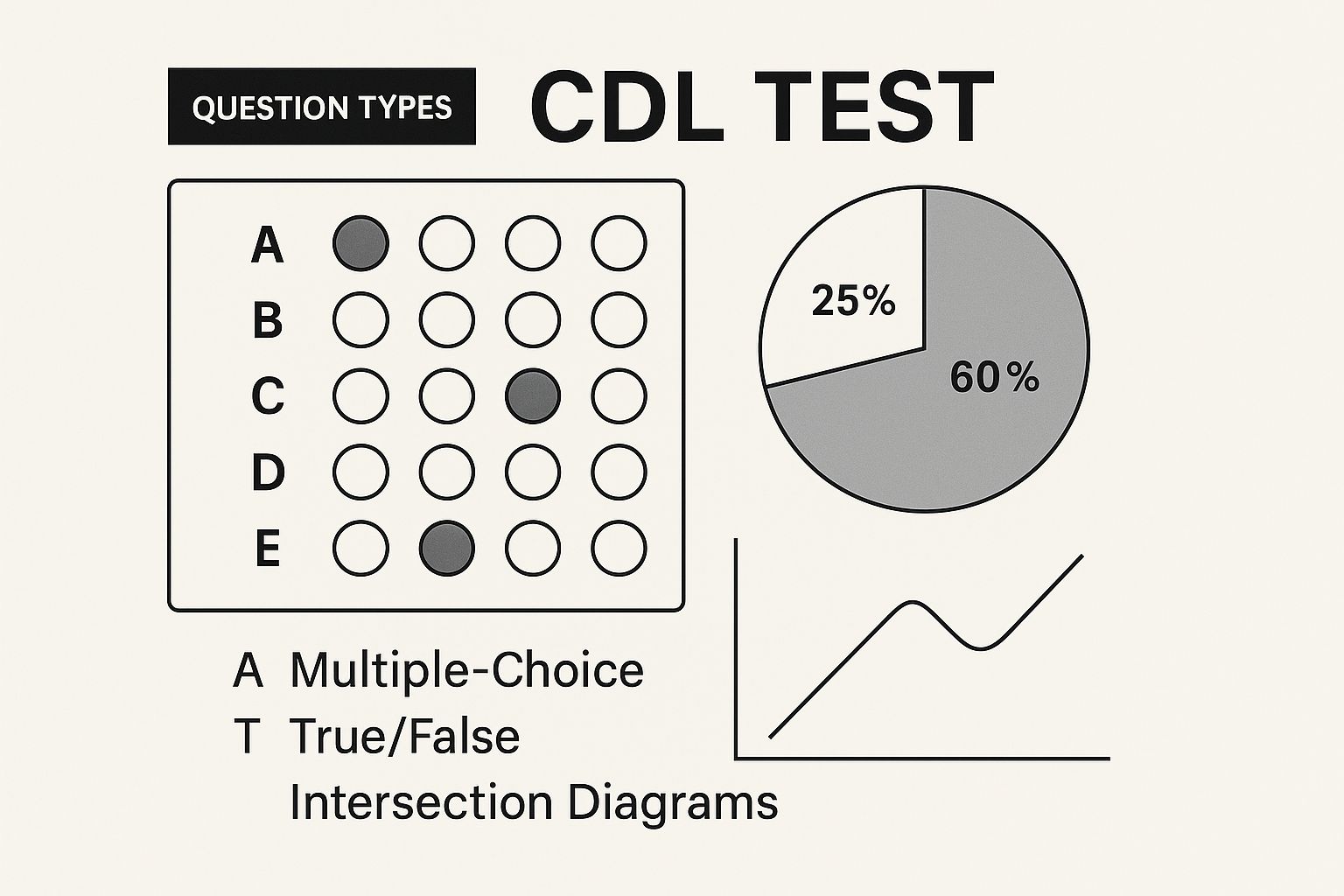
As you can see, each test is laser-focused on the operational and safety procedures that matter most for that particular specialization.
Key Endorsements and Their Question Counts
Knowing how many questions to expect for each endorsement test is key to preparing the right way. Take the Air Brakes endorsement—it's absolutely essential for anyone getting behind the wheel of a Class A or B truck with an air brake system. This test dives deep into the system's components, proper inspection techniques, and how to use them correctly. You can get a feel for it by taking a good Air Brakes practice test.
Another big one is the Combination Vehicles test, which is a must-have for Class A drivers pulling tractor-trailers. It has fewer questions but really hones in on the critical skills of coupling, uncoupling, and safely maneuvering those big rigs.
Each endorsement test is a focused assessment. The goal isn’t just to check a box; it’s to prove you have the specific, in-depth knowledge needed for the job, whether that means transporting passengers or hazardous liquids.
To give you a clearer picture, I've put together a table breaking down the most common CDL endorsement tests. It shows the typical number of questions and the score you'll need to pass.
CDL Endorsement Test Question Breakdown
This table details the structure of common endorsement exams, giving you a quick reference for your study plan.
| Endorsement | Typical Number of Questions | Required Passing Score |
|---|---|---|
| (T) Double/Triple Trailers | 20 Questions | 80% (16 Correct) |
| (N) Tank Vehicles | 20 Questions | 80% (16 Correct) |
| (H) Hazardous Materials (HazMat) | 30 Questions | 80% (24 Correct) |
| (S) School Bus | 25 Questions | 80% (20 Correct) |
| (P) Passenger Transport | 20 Questions | 80% (16 Correct) |
Keep in mind that while the number of questions changes, the standard for passing is almost always a firm 80%. This consistency means you need to aim for a high level of mastery no matter which endorsement you're pursuing.
Why Standardized Question Counts Exist

The number of questions on your CDL test isn't just some random number pulled out of a hat. It’s a direct result of a nationwide effort to make our highways safer for everyone.
Believe it or not, before the Commercial Motor Vehicle Safety Act of 1986, the world of commercial driving was a bit like the Wild West. Standards varied wildly from one state to the next, which created some serious safety loopholes on our roads.
Just picture it: a driver could get a license in several different states, making it easy to hide a bad driving record. With no single, unified system, there was no way to confirm that every driver on the road had mastered the same fundamental skills and knowledge. This patchwork of regulations made it nearly impossible to hold all drivers to the same high professional standard.
Creating a National Safety Standard
Seeing the problem, the federal government stepped in to establish a uniform benchmark for all commercial drivers. This started with legislation like the Motor Carrier Act of 1980, which began the push for more serious, thorough testing to improve safety.
Back then, the written tests were all over the place. Some states might have only asked 20-30 questions. To get everyone on the same page and align with Federal Motor Carrier Safety Administration (FMCSA) guidelines, states eventually settled on the 50-question format for the General Knowledge exam.
This standardization was a game-changer. It meant that a driver who earned their CDL in California had the exact same baseline knowledge as a driver from Florida. By setting a consistent bar for what the test covers and how many questions are on it, these federal rules helped professionalize the entire industry.
The standardized CDL test isn't just a hurdle to clear; it’s a critical public safety measure. It guarantees that every commercial driver has proven their understanding of essential safety protocols before getting behind the wheel of an 80,000-pound vehicle.
Understanding this history helps you see the test for what it really is—not just an obstacle, but a system designed from the ground up to protect you, your fellow drivers, and everyone else on the road.
How Your State Might Change the Test
Think of the federal government as setting the foundation for the CDL test—they create the main blueprint that everyone has to follow. But it's your state's DMV that acts as the general contractor, deciding on the final details of how the test is actually administered.
This means the core requirements, like the 50 questions on the General Knowledge exam and the need to score at least 80% to pass, are pretty much set in stone nationwide. Where things get different is in the nitty-gritty details of the testing process itself.
Where State Differences Appear
You'll find that most state-to-state variations don't change what you need to know, but how you go about taking the test. These seemingly small differences can have a real impact on your preparation and test day experience. For a deep dive into one state's specific process, check out our guide to getting a CDL in California.
Here are the most common areas where states put their own spin on things:
- Time Limits: Some states are generous, giving you a full two hours to work through the questions. Others have no time limit at all, letting you take as long as you need.
- Retake Policies: Didn't pass on your first attempt? Some states will let you come back the very next day. Others might make you wait a week or more before you can try again.
- Associated Fees: The cost for the knowledge test, your permit, and the final license can vary quite a bit from one state line to the next.
The single most important rule for any CDL applicant is this: your local DMV's official CDL manual is your ultimate guide. It has the final say on every rule, fee, and procedure for your specific state.
Got Questions About the CDL Written Test? We've Got Answers.
Alright, let's wrap up by tackling some of the most common questions we hear from drivers-in-training. Getting straight answers can make all the difference, helping you walk into that testing center feeling prepared and confident, not nervous.
Is the CDL Test All Multiple-Choice?
Yes, it is. Every single written CDL test—from the big General Knowledge exam to all the specific endorsement tests—is 100% multiple-choice.
This isn't to make it easy; it's to make it consistent. The format is a straightforward way to test your grasp on everything from federal regulations and safety checks to the nuts and bolts of operating a commercial vehicle. You can relax knowing you won't be writing any essays or trying to fill in blanks.
What Happens If I Don't Pass the First Time?
First off, don't panic. It happens, and it's definitely not the end of the road. Think of it as a spotlight showing you exactly what you need to study a bit more before you go back.
You can absolutely retake the test. The catch is that each state has its own rules. Some might let you come back the very next day, while others require a waiting period of a few days or even a week. The best move is to check your local DMV or state licensing agency's policy so you know the game plan.
Failing a test is just part of the learning curve for many great drivers. It's a chance to go back, hit the books, and come back even stronger for the next attempt.
Is the CDL Test Timed?
This is another one that depends entirely on your state. Many states give you plenty of time, usually one or two hours, which is more than enough to read each question carefully without feeling rushed.
Believe it or not, some states don't have a time limit at all. The goal here is to test what you know, not how fast you can answer questions under pressure. If you're curious about the whole process, you can get a great breakdown on preparing for your commercial learner's permit.