

A Pennsylvania CDL can be disqualified after one major offense, an accumulation of serious traffic violations, or certain railroad-crossing and out-of-service-order convictions. Some violations in a personal vehicle can also affect commercial driving privileges. Understanding the categories before a citation becomes a conviction is essential for every CLP holder, CDL student, and professional driver.
This guide explains the principal Pennsylvania CDL disqualification rules and penalty timelines in plain English. It is educational information, not legal advice. Official sources were reviewed on August 3, 2026; drivers facing a citation, criminal charge, or PennDOT notice should obtain advice about their specific record immediately.
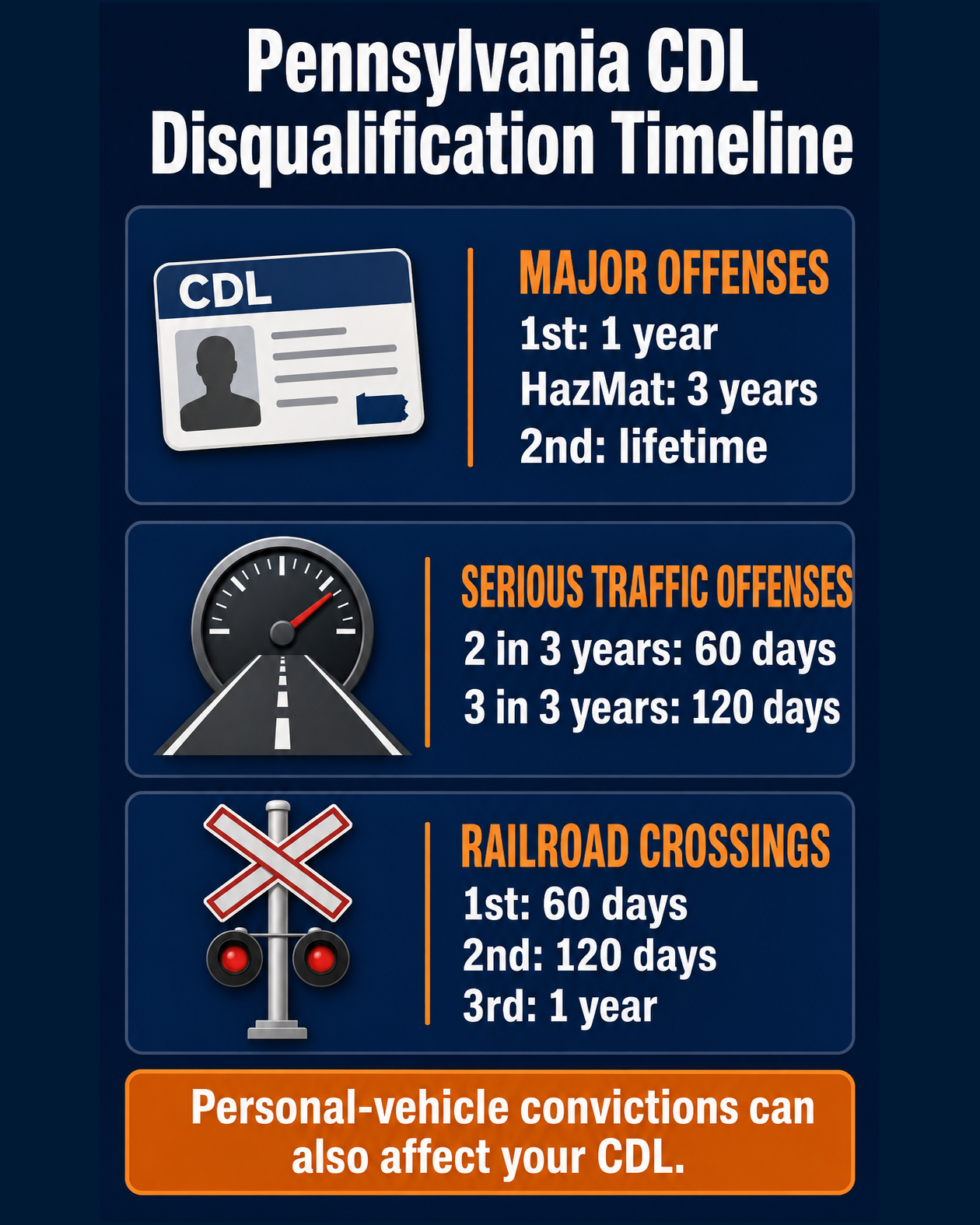
Pennsylvania CDL Disqualification at a Glance
PennDOT defines a disqualification as the temporary or permanent withdrawal of a person's privilege to operate a commercial motor vehicle. It is possible to lose commercial driving privileges even when a person remains eligible to drive a non-commercial vehicle. The exact result depends on the offense, vehicle type, prior record, timing, and any separate suspension or criminal penalty.
| Violation category | Trigger | Typical Pennsylvania CDL consequence |
|---|---|---|
| Major offense | One qualifying conviction | Usually 1 year; 3 years when the offense occurs while transporting placarded hazardous materials |
| Second major offense | Two qualifying major offenses | Lifetime disqualification in the standard federal/state framework |
| Serious traffic offenses | Two convictions within 3 years | 60 days |
| Serious traffic offenses | Three or more convictions within 3 years | 120 days |
| Railroad-highway grade crossing | First qualifying CMV conviction | 60 days |
| Out-of-service order | First qualifying Pennsylvania conviction | 1 year for ordinary freight; 2 years for placarded HazMat or a 16-plus-passenger vehicle |
These periods are not a substitute for reading the actual PennDOT notice. A driver can face a longer or additional sanction because of another law, a prior conviction, a license suspension, a criminal sentence, or a federal safety order. Start with the broader CDL requirements and driver responsibilities before treating any single table as a complete licensing analysis.
Major Offenses: One Conviction Can Disqualify a CDL
A major offense is the highest-risk category because one conviction can remove commercial driving privileges. PennDOT's current lists the offenses and Pennsylvania code references used in the state process.
| Major-offense example | Vehicle scope | First-offense CDL result shown by PennDOT |
|---|---|---|
| Driving under the influence of alcohol or a controlled substance | CMV or personal vehicle | 1 year; 3 years with placarded HazMat |
| Refusing required chemical testing | CMV or personal vehicle | 1 year; 3 years with placarded HazMat |
| Leaving the scene of an accident | CMV or personal vehicle | 1 year; 3 years with placarded HazMat |
| Using a vehicle to commit a felony | CMV or personal vehicle | 1 year; 3 years with placarded HazMat |
| Driving a CMV while CDL privileges are revoked, suspended, cancelled, or disqualified | CMV only | 1 year; 3 years with placarded HazMat |
| Causing a fatality through negligent CMV operation | CMV only | 1 year; 3 years with placarded HazMat |
Lifetime disqualification offenses
Two major offenses generally result in lifetime CDL disqualification. Federal and Pennsylvania rules also identify offenses that can produce a lifetime result on the first conviction. These include using a vehicle in a felony involving manufacturing, distributing, or dispensing a controlled substance. Using a CMV in a qualifying severe human-trafficking felony is also listed as a lifetime-disqualifying offense.
Federal rules allow limited reinstatement consideration after at least ten years for some lifetime-disqualified drivers who complete a state-approved rehabilitation program, but that possibility does not apply to every lifetime offense. FMCSA states that a controlled-substance felony involving manufacturing, distributing, or dispensing results in lifetime disqualification without the possibility of reinstatement. Never assume eligibility based on the passage of time alone.
A criminal case and a CDL case are connected—but not identical
A court disposition may create criminal penalties, a regular-license suspension, and a separate commercial disqualification. The end date of one consequence does not automatically end the others. Pennsylvania also treats participation in Accelerated Rehabilitative Disposition (ARD) as a conviction for CDL sanctioning purposes. Drivers should give counsel the complete facts about the CDL or CLP, the vehicle, the cargo, and all prior violations.
Serious Traffic Violations: The Three-Year Accumulation Rule
One serious traffic offense generally does not trigger the federal 60-day accumulation penalty by itself. Two qualifying convictions within a three-year period produce a 60-day disqualification; three or more within that period produce a 120-day disqualification. When multiple disqualification periods apply, federal guidance says serious-violation periods are served consecutively.
Common serious traffic offenses
- speeding 15 mph or more above the posted maximum;
- reckless driving as defined by state or local law;
- improper or erratic lane changes;
- following another vehicle too closely;
- a traffic-control violation connected with a fatal accident;
- driving a CMV without obtaining a CDL;
- driving a CMV without the CDL in the driver's possession;
- driving without the proper CDL class or required endorsement;
- texting while driving a CMV; and
- using a hand-held mobile telephone while driving a CMV.
Pennsylvania also identifies certain state-specific serious traffic offenses, including duties in construction or maintenance areas and highway safety corridors, as well as hazardous-grade violations. The precise statute and vehicle type matter; the description written on a citation may not be enough to predict the licensing result.
| Record pattern | Commercial disqualification | Practical meaning |
|---|---|---|
| One qualifying serious offense | No 60-day accumulation penalty yet | The conviction remains important and can combine with another within 3 years |
| Two qualifying serious offenses within 3 years | 60 days | No CMV operation during the disqualification |
| Three or more within 3 years | 120 days | A third conviction can add a new consecutive penalty |
Why students should understand the rules before earning a CDL
A commercial learner's permit is treated as a CDL for federal disqualification and recordkeeping purposes. A student cannot dismiss a citation as something that matters only after graduation. Safe speed selection, lane discipline, following distance, phone storage, and railroad procedures should be practiced from the first supervised drive.
When a Personal-Vehicle Conviction Can Affect Your CDL
A common misconception is that a CDL is affected only by conduct in a truck. Major offenses such as DUI, chemical-test refusal, leaving the scene, and using a vehicle to commit a felony can count when committed in a personal vehicle. PennDOT also identifies Pennsylvania-specific personal-vehicle situations for certain serious traffic offenses.
Under the federal baseline, a serious traffic violation committed in a non-CMV counts toward the CDL accumulation rule when the conviction results in revocation, cancellation, or suspension of the person's non-CMV driving privileges. Pennsylvania's current table further identifies reckless driving as applying to CMV or personal-vehicle conduct, and speeding 15 mph or more in a personal vehicle when it occurs in a work zone or school area.
Practical rule: Protect the CDL every time you drive. A personal-car citation, an out-of-state disposition, or an ARD agreement can carry consequences beyond the immediate fine.
Out-of-state violations still follow the driver home
PennDOT says out-of-state violations are treated as though they occurred in Pennsylvania for purposes of the driver's Pennsylvania privilege. CDL holders also have short reporting duties for certain convictions and license actions. Do not wait for a carrier or PennDOT to discover a record that the driver was required to report.
Railroad-Highway Grade Crossing Offenses
Railroad-crossing violations form a separate CDL disqualification category when committed while operating a CMV. The first conviction produces a 60-day disqualification, the second within three years produces 120 days, and a third or subsequent conviction within three years produces at least one year.
| Qualifying railroad-crossing conduct | Why it is dangerous |
|---|---|
| Failing to slow down and verify the tracks are clear when a stop is not always required | A train may be approaching even when gates or lights are absent |
| Failing to stop when the tracks are not clear | The CMV can enter the train's path |
| Failing to stop when the vehicle is always required to stop | Certain CMVs and cargo require a full stop by law |
| Entering without enough space to clear the crossing | The truck or trailer can become trapped on the tracks |
| Disobeying a traffic-control device or enforcement direction | The driver overrides the crossing's active safety controls |
| Attempting a crossing without enough undercarriage clearance | A low trailer can become high-centered on the rails |
A safe crossing decision starts before the tracks
Scan early, reduce speed, identify whether the vehicle must stop, check traffic behind you, avoid shifting on the tracks, and do not enter until the entire combination can clear. Route planning is equally important for low-clearance trailers. If a crossing geometry is unsafe, stop in a safe location and use an approved alternate route rather than testing the trailer's clearance.
Violating an Out-of-Service Order
An out-of-service order means the driver, vehicle, or operation may not continue until the stated condition is satisfied. Driving around the order, moving before the authorized time, or treating it as a recommendation can create both civil penalties and a CDL disqualification.
| Operation when the OOS order is violated | First Pennsylvania conviction | Second or subsequent conviction within 10 years |
|---|---|---|
| Non-hazardous-material operation | 1 year | 3 years |
| Placarded hazardous materials or vehicle designed for 16+ occupants including driver | 2 years | 5 years |
The also notes civil penalties for drivers convicted of violating an out-of-service order. Penalty amounts can change, and a state or federal case may include consequences beyond the disqualification period. The lawful response is to understand the order, notify the carrier, document the correction, and move only after the applicable authority permits it.
What to Do After a Citation or PennDOT Disqualification Notice
A roadside citation is not the same thing as a final licensing determination, but deadlines can begin immediately. A driver who ignores the case may lose the chance to contest facts, preserve evidence, or file an appeal. Use this order of operations:
- Stop any prohibited CMV operation. Never drive during a disqualification, suspension, or out-of-service period.
- Preserve the documents. Keep the citation, inspection report, crash report, PennDOT notice, court paperwork, dispatch messages, dash-camera data, and electronic logs.
- Record the deadlines. Court appearances, administrative appeals, PennDOT responses, and employer reports can have different due dates.
- Identify the vehicle and cargo. Whether the event occurred in a CMV, personal vehicle, placarded HazMat operation, or passenger vehicle can change the sanction.
- Check the full driving record. A prior offense inside the relevant three- or ten-year window may change the consequence.
- Get qualified advice. A traffic disposition that seems minor can have a mandatory CDL result. Counsel should understand commercial-driver sanctions.
- Notify the employer when required. Federal and employer reporting rules apply even when the conviction is out of state.
- Follow the restoration instructions exactly. Serving time alone does not automatically restore the credential.
Can a disqualified driver use a personal vehicle?
PennDOT says a CDL or CLP holder who is disqualified only from CMV operation may apply for a non-commercial license to drive a personal vehicle during the commercial disqualification. That does not apply when a separate suspension or revocation also removes non-commercial privileges. The PennDOT notice should include the relevant application instructions.
How CDL restoration works
PennDOT states that the driver must serve the required disqualification period and pay the applicable restoration fee before the CDL is returned. Other conditions may also apply, such as resolving a separate suspension, satisfying court requirements, completing the FMCSA return-to-duty process, updating medical status, or requalifying for a lapsed credential.
A drug-and-alcohol Clearinghouse prohibition is a separate compliance track from the conviction categories in this article. Review the FMCSA Clearinghouse guide for new CDL drivers to understand prohibited status, state downgrade, and return-to-duty steps.
CDL Record-Protection Checklist
- □ I check my CDL class, endorsements, restrictions, medical status, and expiration dates
- □ I do not operate a CMV during any suspension, disqualification, or out-of-service order
- □ My phone is stored before the vehicle moves; I do not text or hold it while driving
- □ I manage speed early, especially in work zones, school zones, curves, and grades
- □ I maintain enough following distance for the vehicle, load, speed, traffic, and weather
- □ I make deliberate lane changes with visible observation and adequate space
- □ I know when my vehicle must stop at a railroad crossing
- □ I never enter a crossing until the entire combination can clear
- □ I report convictions and license actions within the required deadlines
- □ I protect my commercial record when driving a personal vehicle
- □ I keep copies of inspection reports, citations, notices, and corrective documents
- □ I obtain professional advice before accepting a disposition that may affect my CDL
Frequently Asked Questions
Can one DUI disqualify a Pennsylvania CDL?
Yes. A first qualifying DUI is a major offense and generally produces a one-year commercial disqualification, or three years when the offense occurs while transporting hazardous materials required to be placarded. A separate non-commercial suspension or criminal consequence may also apply.
Does a speeding ticket in my personal car count against my CDL?
It can. Under the federal rule, a serious non-CMV violation counts when it causes suspension, revocation, or cancellation of non-CMV driving privileges. Pennsylvania also identifies speeding 15 mph or more in a personal vehicle in a work zone or school area as a serious traffic offense for CDL purposes. The exact charge and disposition matter.
How long is a Pennsylvania CDL disqualification for two serious violations?
Two qualifying serious traffic offense convictions within three years result in a 60-day CMV disqualification. Three or more qualifying convictions within that period result in 120 days.
Is my CDL automatically restored when the disqualification period ends?
No. PennDOT says the required period must be served and the restoration fee paid before the CDL is returned. The driver must also resolve any other suspension, federal prohibition, medical issue, court requirement, or credential-expiration problem that applies.
Educational information only; not legal advice. CDL sanctions depend on the exact statute, vehicle, cargo, disposition, prior record, and date. Verify current requirements with PennDOT, FMCSA, the court, and qualified counsel. Official sources reviewed August 3, 2026.