

A Pennsylvania CDL restriction can limit the transmission, braking system, or tractor-trailer configuration you may legally operate. The letters are small, but their effect on job eligibility can be significant. The most common equipment-based restrictions are E, L, Z, and O, and each is tied directly to the vehicle or system used during CDL testing.
This guide explains what each code means, how to avoid an unintended restriction, and how an existing CDL holder can prepare to remove one. Rules and forms were checked against current PennDOT, FMCSA, and federal regulatory sources on August 2, 2026. Confirm the exact permit, fee, waiting-period, and test requirements for your individual record before scheduling.
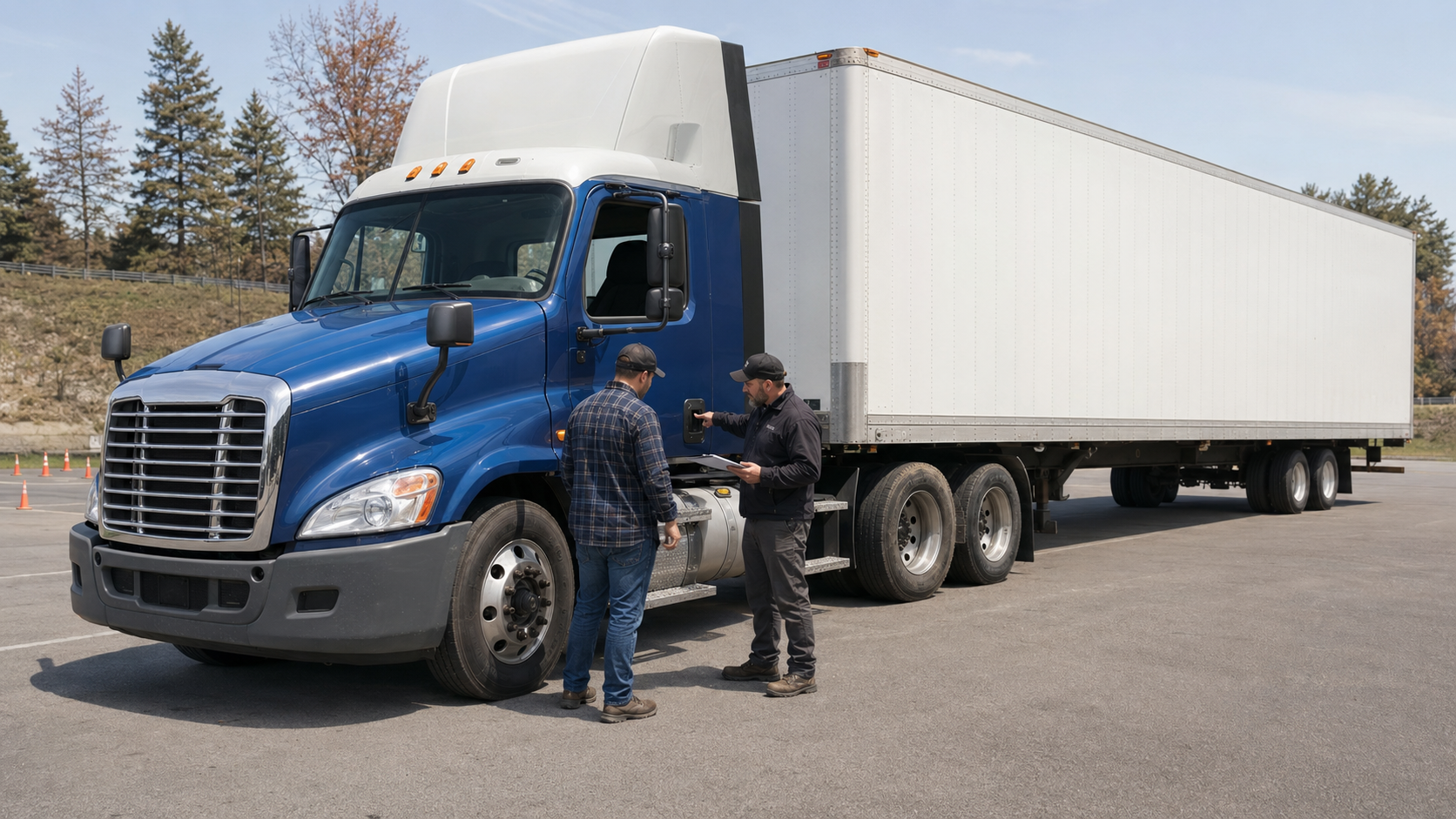
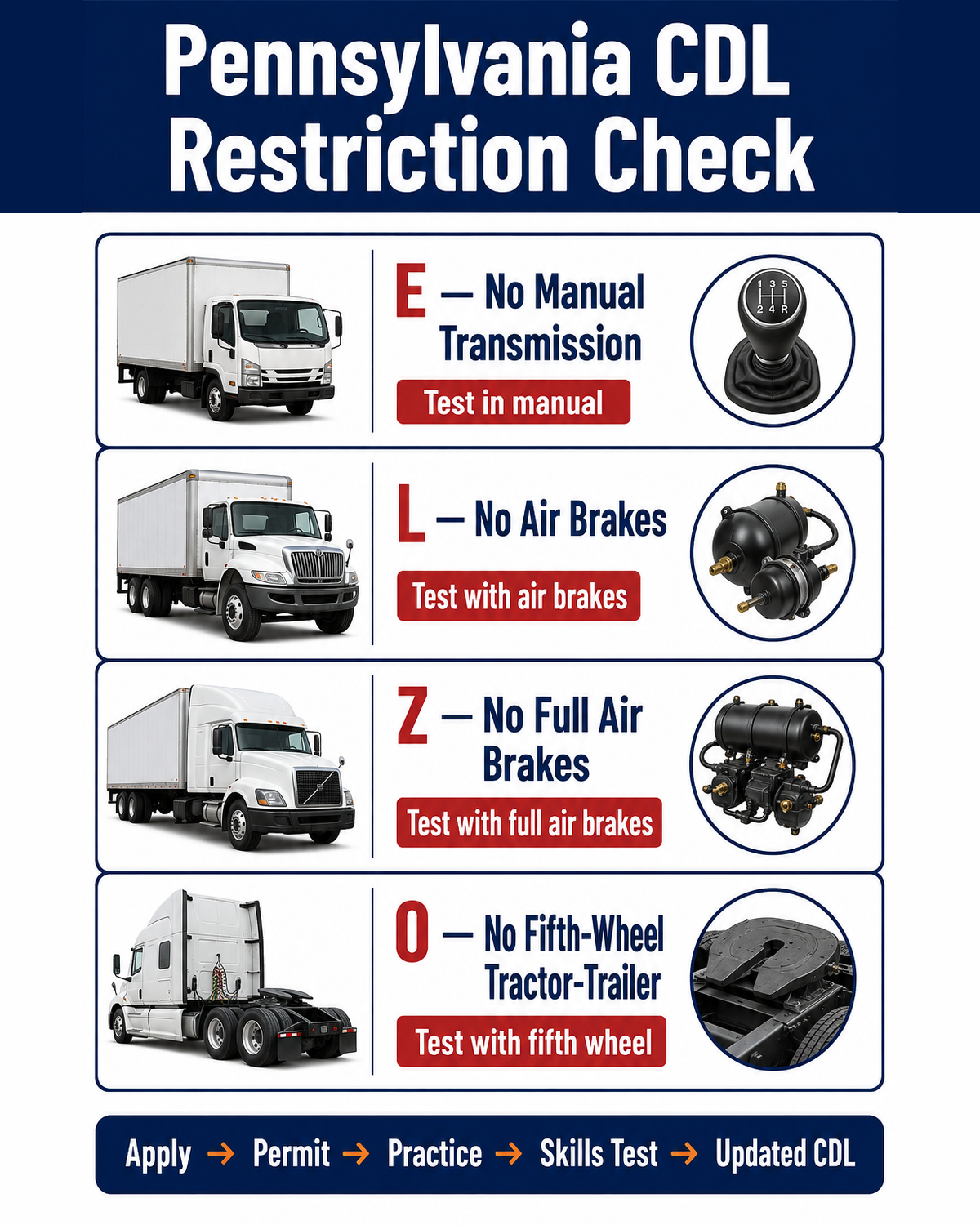
Pennsylvania CDL Restriction Codes at a Glance
The restriction is not a comment on the driver's general ability. It identifies equipment or a vehicle configuration that was not demonstrated during the qualifying skills test. Federal rules require states to record these limitations when the test vehicle does not prove the broader operating privilege.
| Code | What it means | Typical reason it appears | Vehicle needed to demonstrate the broader privilege |
|---|---|---|---|
| E | No manual-transmission CMV | Skills test completed in an automatic transmission | Representative manual-transmission CMV |
| L | No CMV with any air-brake system | Air-brake knowledge or inspection requirement not passed, or skills test completed without air brakes | Representative air-brake-equipped CMV plus required air-brake testing |
| Z | No CMV with full air brakes | Skills test completed with an air-over-hydraulic system | Representative CMV with a full air-brake system |
| O | No Class A fifth-wheel tractor-trailer | Class A test completed with a pintle-hook or other non-fifth-wheel connection | Representative Class A combination with a fifth-wheel connection |
Why Your CDL Skills-Test Vehicle Matters
A CDL skills test proves safe operation only in the class and configuration represented by the test vehicle. Under , a state must apply equipment restrictions when the applicant tests without the relevant transmission, brake system, or fifth-wheel configuration.
PennDOT reinforces this point in the current : restrictions are placed on the license based on the vehicle used for testing. Before paying for training or reserving a test vehicle, compare its specifications with the jobs you expect to pursue.
| Ask before training | Why the answer matters | Evidence to verify |
|---|---|---|
| Is the transmission manual or automatic? | An automatic test vehicle can create an E restriction | Cab inspection and instructor confirmation |
| Does the vehicle have full air brakes? | Hydraulic or air-over-hydraulic systems can create L or Z limits | Brake-system components and vehicle documentation |
| How are the power unit and trailer connected? | A non-fifth-wheel Class A combination can create an O restriction | Visible fifth-wheel coupling assembly |
| Is the vehicle representative of my CDL class? | The class and vehicle group must match the privilege sought | GVWR/GCWR labels, registration, and test-provider acceptance |
E Restriction: No Manual-Transmission Commercial Vehicle
The E restriction means the driver may not operate a commercial motor vehicle equipped with a manual transmission. FMCSA requires it when the skills test is completed in a vehicle with an automatic transmission. Federal rules define an automatic transmission broadly for this purpose: any transmission that does not meet the regulatory definition of a manual transmission can trigger the restriction.
What a manual-transmission removal test requires
Removing E is not simply a paperwork change. The driver must demonstrate control of a representative manual CMV through the state testing process. Preparation normally needs to address:
- clutch engagement and controlled starts without rolling or stalling;
- upshifting and downshifting at appropriate engine and road speeds;
- gear selection before turns, curves, grades, and stops;
- keeping both hands available for safe steering and control;
- inspection, basic control, and on-road performance in the manual vehicle used for testing.
A licensed driver who needs focused practice can review Patriot CDL's E-restriction removal training. Training time should be based on demonstrated clutch and shifting consistency, not only on a fixed number of lessons.
L and Z Restrictions: Two Different Air-Brake Limits
L and Z are often confused, but they do not authorize the same vehicles. The difference is whether the driver is barred from all air-brake-equipped CMVs or only from vehicles with a full air-brake system.
L: no air brakes
An L restriction bars operation of a CMV equipped with any type of air brakes. Under the federal rule, it can result when an applicant fails the air-brake knowledge component or tests in a vehicle that does not use air brakes. FMCSA also identifies an incomplete air-brake inspection or systems check as a reason the restriction may apply.
Removal preparation is therefore broader than driving. It can include the Pennsylvania air-brake knowledge test, correct identification of system components, a complete in-cab brake check, vehicle inspection, and skills testing in an accepted air-brake-equipped CMV. See Patriot CDL's L-restriction removal guide for a focused preparation overview.
Z: no full air brakes
A Z restriction applies when the skills test is completed in a vehicle with air-over-hydraulic brakes. That system uses air and hydraulic principles together, but it is not a full-air-brake system. The restriction prevents the driver from operating a CMV whose braking system works fully on the air-brake principle.
| License status | Hydraulic brakes | Air-over-hydraulic | Full air brakes |
|---|---|---|---|
| No L or Z restriction | Generally permitted if otherwise qualified | Generally permitted if otherwise qualified | Generally permitted if otherwise qualified |
| L restriction | Permitted if otherwise qualified | Not permitted | Not permitted |
| Z restriction | Permitted if otherwise qualified | Permitted if otherwise qualified | Not permitted |
“Otherwise qualified” matters: the CDL class, endorsements, other restrictions, medical status, and vehicle use must still be valid for the operation.
O Restriction: No Fifth-Wheel Tractor-Trailer
The O restriction applies to a Group A or Class A driver who completed the skills test in a combination vehicle connected by a pintle hook or another non-fifth-wheel system. It prevents operation of the fifth-wheel tractor-trailer configuration that is common in freight transportation.
To prepare for O removal, the driver needs a representative Class A tractor-trailer with a fifth-wheel connection and should be able to demonstrate the complete coupling system inspection, safe coupling and uncoupling procedures, trailer control, backing, turns, and on-road operation. Patriot CDL's O-restriction removal guide explains the equipment and practical skill focus in more detail.
Why the coupling inspection matters
The fifth wheel is not just a licensing symbol. A driver should be able to identify the mounting hardware, platform, release arm, locking jaws, kingpin, apron, clearance, air and electrical lines, and landing gear condition. The inspection should confirm that the jaws are locked around the kingpin and that the trailer is seated correctly without a dangerous gap.
How to Remove a CDL Restriction in Pennsylvania
PennDOT uses the DL-31CD application for initial CDL privileges, upgrades, endorsements, and restriction-removal requests. Its current CDL learner's permit FAQ says PennDOT issues a Knowledge Test Authorization for each requested class, endorsement, and restriction removal. Required knowledge testing comes before skills practice and skills testing.
- Read the current CDL. Confirm the exact restriction letter and check for any additional class, medical, passenger, or intrastate limits.
- Define the target privilege. Choose the vehicle and job type you want to qualify for; do not request a change that does not match a real operating goal.
- Submit the required Pennsylvania forms and fees. PennDOT's current process starts with DL-31CD and self-certification. Medical documentation may also apply to non-excepted operation.
- Complete the assigned knowledge testing. Air-brake removal can require the air-brake knowledge component. Follow the KTA issued for your transaction.
- Receive the proper practice authorization. A KTA is not permission to practice in a CMV. Wait until PennDOT issues the applicable learner's permit or driving document.
- Practice with qualified supervision. Use a compliant representative vehicle with the equipment needed to remove the code.
- Pass the required skills test. Confirm which inspection, basic-control, and road components are required for the exact restriction-removal transaction.
- Inspect the updated CDL. Do not assume the restriction is removed until the new credential and PennDOT record show the correct privileges.
Important timing note: PennDOT requires at least 15 days between permit issuance and a scheduled Class A, B, or C skills test and says the learner's-permit process applies across commercial classes, endorsements, and restrictions. Ask PennDOT or the authorized testing provider to confirm the waiting period and components assigned to your specific restriction-removal transaction.
Does restriction removal require ELDT?
The expressly says drivers removing E, L, or Z restrictions are not subject to ELDT solely for that removal. That does not eliminate state application, permit, knowledge, practice, or skills-test requirements. Because the cited FMCSA answer specifically names E, L, and Z, a driver seeking another change should confirm ELDT applicability for the complete transaction—especially if it also includes a license-class upgrade or first-time covered endorsement.
Restriction-Removal Training and Test-Vehicle Checklist
- □ I verified every restriction printed on my current CDL
- □ I selected the correct restriction-removal request on DL-31CD
- □ My self-certification and medical status match my intended work
- □ I passed every knowledge test shown on my KTA
- □ I received the correct permit before practicing
- □ My supervising driver holds the required class and unrestricted privilege
- □ The test vehicle is representative of my CDL class
- □ For E removal, the vehicle has a qualifying manual transmission
- □ For L or Z removal, the vehicle has the required full air-brake system
- □ For O removal, the Class A combination uses a fifth-wheel connection
- □ Registration, insurance, inspection, and test-provider documents are ready
- □ I confirmed the waiting period, appointment, and retest policy
Frequently Asked Questions
Can I drive a manual commercial vehicle with an E restriction?
No. An E restriction means you are not authorized to operate a commercial motor vehicle equipped with a manual transmission. You must complete the state restriction-removal process before driving that equipment as a CDL holder.
What is the difference between L and Z on a CDL?
L prevents operation of a CMV with any type of air brakes. Z prevents operation of a CMV with full air brakes but generally allows air-over-hydraulic equipment when the driver is otherwise qualified.
Do I need to repeat the full CDL course to remove E, L, or Z?
FMCSA says restriction removal for E, L, and Z is not subject to ELDT solely because of the removal. Pennsylvania can still require the applicable application, permit, knowledge, practice, inspection, and skills-test steps. Focused professional preparation may be more appropriate than repeating an entire entry-level program.
Can I use any Class A combination to remove an O restriction?
No. The purpose of O removal is to demonstrate operation of a qualifying Class A tractor-trailer with a fifth-wheel connection. Confirm the vehicle's class, weight ratings, coupling system, brake system, and acceptance with the testing provider before the appointment.
Educational information only; not legal advice. License records and transaction requirements vary. Confirm your exact application, fees, documents, permit, waiting period, test components, and vehicle acceptance with PennDOT or your authorized CDL testing provider. Official sources reviewed August 2, 2026.