

Getting a Pennsylvania commercial learner’s permit (CLP) is easier when you separate the process into three stages: prepare the right documents, pass the required knowledge tests, and use the issued permit for safe, supervised practice.
This checklist follows current PennDOT and FMCSA guidance reviewed July 27, 2026. It also explains the commonly confused Knowledge Test Authorization (KTA), Pennsylvania’s 15-day waiting period, and when Entry-Level Driver Training (ELDT) becomes mandatory.

Pennsylvania CLP Requirements: Quick Answer
Most Pennsylvania applicants need a current Pennsylvania noncommercial driver’s license, the Commercial Learner’s Permit Application (DL-31CD), the Commercial Driver’s License Self-Certification Form (DL-11CD), applicable fees, and any identity or residency documents PennDOT requests. Applicants who certify in a non-excepted category must also have a valid medical certification recorded.
| Requirement | What to prepare | Why it matters |
|---|---|---|
| Base driver’s license | Current Pennsylvania noncommercial license | A CLP adds commercial learning privileges to an existing driving credential |
| CLP application | Completed DL-31CD | Identifies the CDL class and endorsements requested |
| Self-certification | Completed DL-11CD | Declares the type of commercial operation you expect to perform |
| Medical status | Valid result on record when required | Non-excepted applicants must meet federal medical qualification rules |
| Knowledge testing | Study plan for general knowledge and applicable add-on tests | You cannot receive the CLP until the required tests are passed |
| Fees and documents | Correct payment plus requested identity/residency proof | Incomplete submissions delay processing |
Before completing the forms, review the broader CDL eligibility and licensing requirements so your permit plan matches the work you want to do.
Four Decisions to Make Before You Apply
1. Choose Class A or Class B
Class A generally covers combination vehicles with a gross combination weight rating of 26,001 pounds or more when the towed vehicle is rated above 10,000 pounds. Class B generally covers a single vehicle rated at 26,001 pounds or more, including such a vehicle towing 10,000 pounds or less. Confirm the manufacturer ratings and the actual vehicle class—not just a job title.
2. Identify the endorsements you really need
Passenger, school bus, tanker, double/triple trailer, and hazardous-material operations can require additional knowledge tests, training, background checks, or skills testing. Requesting an endorsement without a clear career reason can add cost and complexity. Start with the vehicle and work you intend to pursue.
3. Choose the correct self-certification category
The DL-11CD asks whether your expected commercial operation is interstate or intrastate and whether it is excepted or non-excepted. This choice affects medical-certification requirements. Read PennDOT’s explanations carefully and do not select a category solely to avoid a physical. If you are unsure how your planned job operates, verify it with the prospective employer and PennDOT.
4. Check your medical record
Since June 23, 2025, certified medical examiners listed on the National Registry electronically transmit examination results and restrictions to FMCSA, which sends them to PennDOT. PennDOT says it no longer accepts a Medical Examiner’s Certificate delivered in person or by email. Confirm that the examiner has your correct driver-license information and allow the electronic process to update.
Use PennDOT’s for the current transmission rules.
Pennsylvania CLP Documents and Forms Checklist
| Item | Who needs it | Preparation tip |
|---|---|---|
| Current Pennsylvania driver’s license | All applicants | Make sure the name and address are current before applying |
| DL-31CD application | All applicants | Select the correct class, endorsements, and restriction-removal requests |
| DL-11CD self-certification | All applicants | Choose the category that matches the commercial work you expect to perform |
| Medical qualification on record | Non-excepted applicants | Use a certified examiner and verify that the result was transmitted electronically |
| Proof of identity or lawful status | As required for the transaction | Bring original acceptable documents, not phone photos |
| Proof of Pennsylvania residency | As required by PennDOT | Use documents showing your current Pennsylvania address |
| Social Security documentation | When requested | Ensure all records use the same legal name |
| Applicable fee | All applicants | Check the current fee and accepted payment method before submission |
PennDOT’s lists acceptable identity, residency, and lawful-status evidence. Requirements vary by transaction and applicant status, so use the official list instead of relying on an old photocopied checklist.
Knowledge Test Authorization vs. Commercial Learner’s Permit
Pennsylvania applicants often receive a KTA before receiving a CLP. They are not interchangeable.
| Document | What it allows | What it does not allow |
|---|---|---|
| Knowledge Test Authorization (KTA) | Allows you to take the listed CDL knowledge tests | Does not authorize commercial driving practice |
| Commercial Learner’s Permit (CLP) | Allows supervised practice in a commercial vehicle consistent with its class, endorsements, and restrictions | Does not allow unsupervised operation or bypass other operating rules |
PennDOT says a KTA may be used the day it is issued. It is generally valid for one year and provides three attempts for the particular knowledge tests authorized. You must pass the required knowledge tests before PennDOT issues the CLP. If the authorization expires, a new application, fees, and retesting may be required.
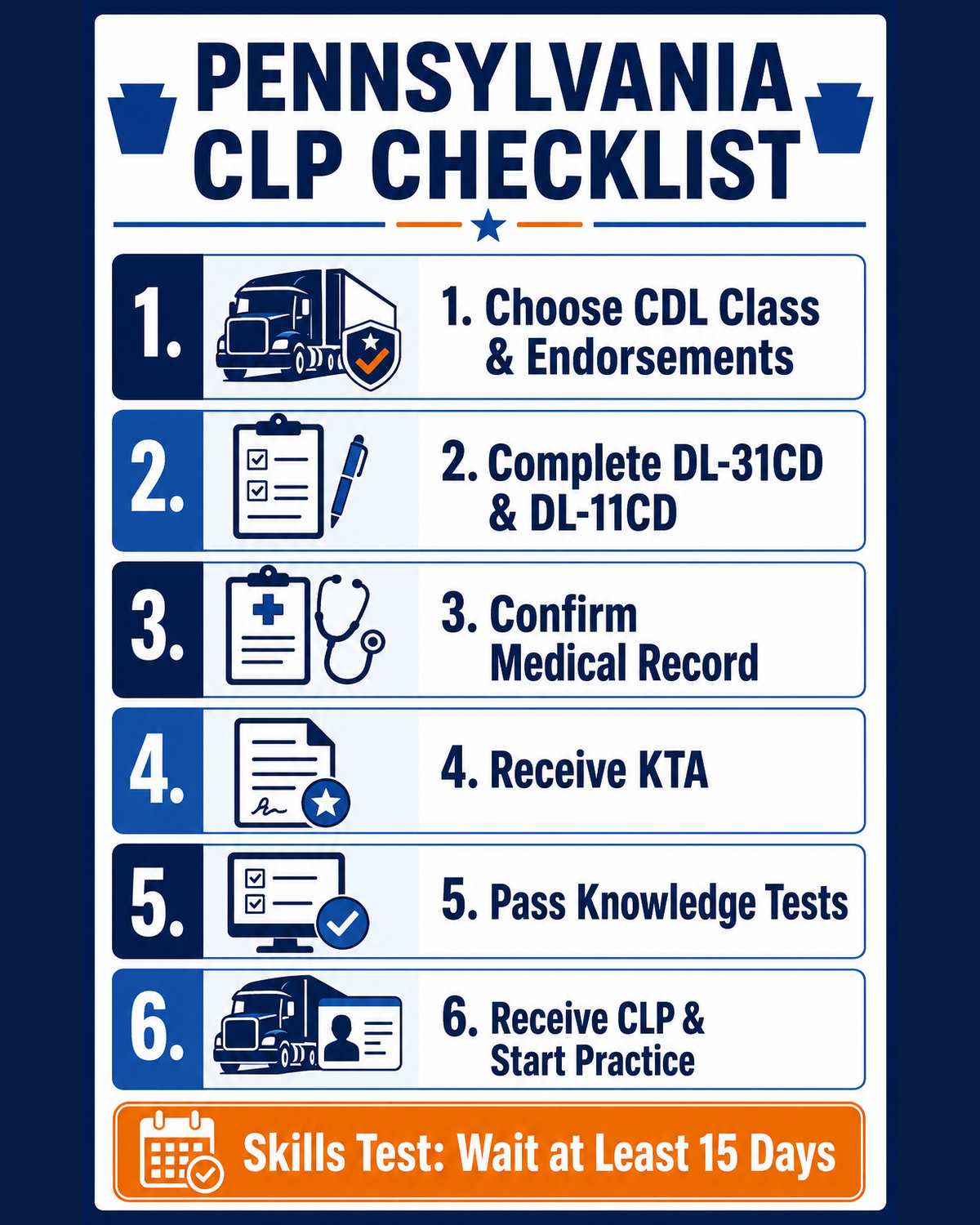
How to Get a Pennsylvania Commercial Learner’s Permit
- Select your CDL class and endorsements. Match the application to the commercial vehicle and job you intend to pursue.
- Review your driving credential and personal records. Correct name or address conflicts before submitting CDL forms.
- Complete DL-31CD and DL-11CD. Answer every item and keep a copy for your records.
- Complete a DOT physical if your self-certification requires it. Use a medical examiner on the FMCSA National Registry and confirm that your information is accurate.
- Submit the application, supporting documents, and fee. PennDOT processes the request and issues a KTA for the selected tests.
- Take every required knowledge test. Passing general knowledge alone may not be enough for the class, brakes, or endorsements you selected.
- Receive and check the CLP. Verify the class, endorsements, restrictions, legal name, and expiration information before practicing.
- Begin qualified supervised practice. Train only in vehicles allowed by the permit and under the supervision required by federal and Pennsylvania rules.
A structured CDL permit preparation course can help you turn the Pennsylvania manual into a repeatable study plan without replacing the official manual or PennDOT testing rules.
Which Knowledge Tests Should You Expect?
| CDL goal | Core test identified by PennDOT | Possible additional tests |
|---|---|---|
| Class A | 70-question Class A knowledge test | Air brakes, combination vehicles, and requested endorsements as applicable |
| Class B | 50-question Class B knowledge test | Air brakes, passenger, school bus, tanker, or other applicable tests |
| Passenger or school bus | Base class test plus endorsement tests | Applicable ELDT and skills testing are also required for first-time endorsements |
| Hazardous materials | HazMat knowledge test | FMCSA ELDT and TSA security threat assessment requirements apply |
The tests on your KTA are driven by your application. Use the current Pennsylvania Commercial Driver’s Manual and practice every tested topic, including air-brake systems if you want to avoid an air-brake restriction.
After You Receive the CLP: Practice, ELDT, and the 15-Day Rule
PennDOT requires applicants to wait at least 15 days after the CLP is issued before taking the Class A, B, or C skills test. This is a minimum waiting period, not a complete training plan. Use it to build consistent inspection, backing, basic-control, and on-road habits.
Federal ELDT theory training does not have to be completed before you obtain the CLP. When ELDT applies, however, the required theory and behind-the-wheel training must be completed through a provider listed in the FMCSA Training Provider Registry before the relevant skills test. FMCSA also explains that theory and behind-the-wheel training do not have to occur in a prescribed order.
Review the , then compare Patriot CDL’s Class A and Class B training programs for an integrated permit-to-skills-test plan.
| Permit-stage priority | Practical action | Ready when |
|---|---|---|
| Permit accuracy | Check class, endorsements, restrictions, name, and dates | Every field matches your intended vehicle and identity |
| Qualified supervision | Confirm the supervising driver and vehicle meet all rules | Practice is legal before the vehicle moves |
| ELDT record | Complete required training with a registered provider | Completion is submitted and visible to the licensing agency |
| Skills-test timing | Count at least 15 full days from CLP issuance | The scheduled test date meets PennDOT’s waiting period |
| Vehicle match | Train and test in the class, brake, and transmission configuration you need | The test vehicle will not create an avoidable restriction |
Seven Mistakes That Delay Pennsylvania CLP Applicants
- Confusing the KTA with a driving permit. A KTA authorizes testing only.
- Applying for the wrong CDL class. Vehicle ratings determine the class, not the name of the job.
- Choosing the wrong self-certification category. This can create a medical-status conflict.
- Trying to hand-deliver a paper medical certificate. PennDOT now receives medical results electronically through the federal system.
- Studying only general knowledge. Brake systems, combination vehicles, and endorsements can add tests.
- Scheduling the skills test too early. Pennsylvania requires at least 15 days after CLP issuance.
- Ignoring test-vehicle restrictions. The vehicle used for skills testing can limit the CDL you receive.
Pennsylvania CLP Final Checklist
- □ I hold a current Pennsylvania noncommercial driver’s license
- □ I chose the correct CDL class for my target vehicle
- □ I requested only the endorsements I need
- □ I completed DL-31CD without blank required fields
- □ I selected the correct category on DL-11CD
- □ My medical result is electronically recorded when required
- □ My identity, residency, and legal-name documents agree
- □ I confirmed the current fee and accepted payment method
- □ I know that the KTA is not a driving permit
- □ I prepared for every knowledge test listed on the KTA
- □ I checked the issued CLP for errors and restrictions
- □ I arranged legal, qualified supervision for practice
- □ I planned applicable ELDT before the skills test
- □ My skills-test date is at least 15 days after CLP issuance
Frequently Asked Questions
How long is a Pennsylvania Knowledge Test Authorization valid?
PennDOT says the KTA is generally valid for one year and provides three attempts for each authorized knowledge test. If it expires, you may need a new application, fees, and retesting.
Can I drive a commercial vehicle with a Pennsylvania KTA?
No. The KTA only authorizes you to take the listed knowledge tests. You must pass the required tests and receive the CLP before beginning legal, supervised commercial-vehicle practice.
Do I need to finish ELDT before getting a CLP?
No. FMCSA says ELDT theory does not have to be completed before CLP issuance. When ELDT applies, the required training must be completed and reported before the relevant CDL skills test.
How soon can I take the Pennsylvania CDL skills test?
PennDOT requires at least 15 days between CLP issuance and the scheduled Class A, B, or C skills test. Adding certain endorsements or removing certain restrictions can trigger another waiting period.
Educational content only. Forms, fees, medical procedures, document requirements, testing availability, and federal or Pennsylvania rules can change. Confirm your individual requirements with PennDOT, FMCSA, and your testing provider. Official information reviewed July 27, 2026.