


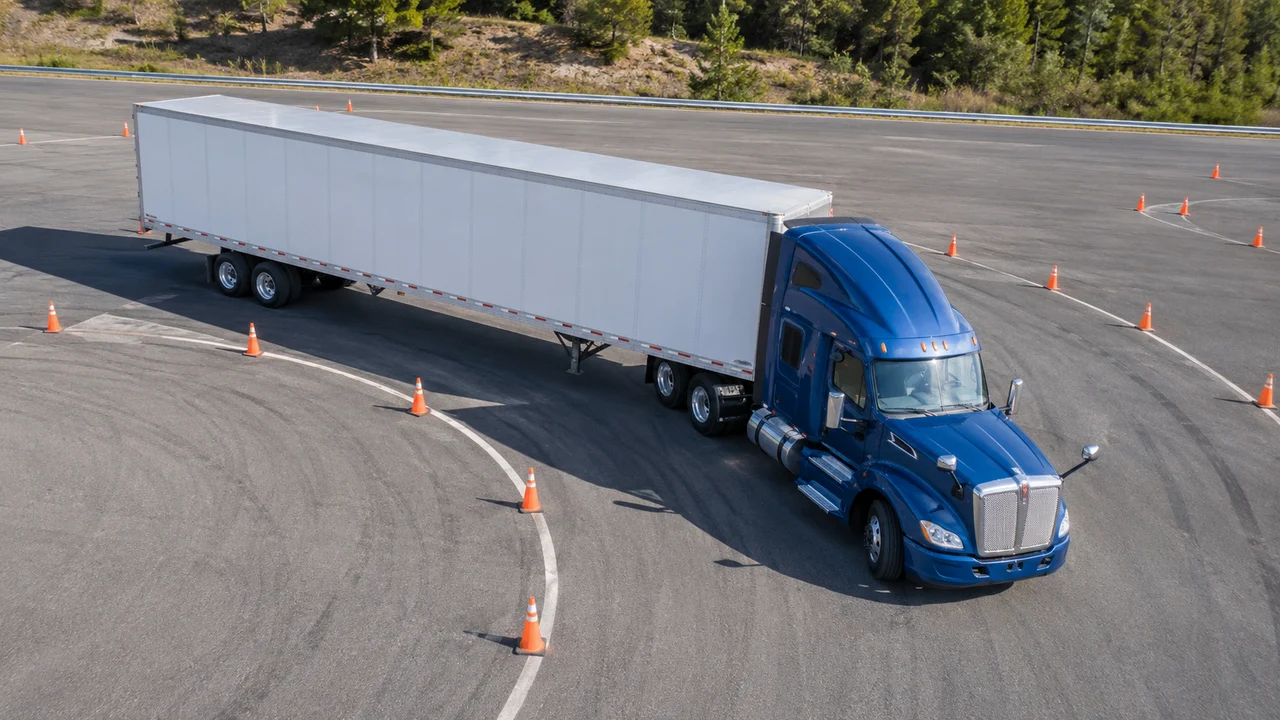
A tractor can clear the corner while the trailer wheels approach the curb behind it. That difference between the path of the front of the combination and the path followed by its rear wheels is central to understanding offtracking. It explains why a turn cannot be judged from the windshield alone and why a successful turn in a passenger car provides little guidance for a long commercial vehicle.
For a student, the challenge is to connect vehicle geometry with observation and planning. You must understand the space the whole vehicle needs, recognize conflicts early, and use the method taught for the actual equipment. This guide explains the questions to discuss before supervised practice. It does not provide a universal steering point, authorize encroaching on other lanes, or replace instruction for a particular intersection.
Understand which parts of the truck follow different paths
Picture the rear-wheel path
Recognize that rear wheels can travel inside the path made by the front of the vehicle during a turn. A cab that clears a fixed object does not establish clearance for the trailer. Compare the predicted wheel paths with an instructor’s demonstration on an approved range.
On a range, a controlled demonstration can make separate wheel paths visible in a way that a diagram cannot. Watch from the location designated by the instructor. Never stand close to a moving combination to obtain a better view of the tires or coupling area.
Distinguish offtracking from tail swing
Ask how the inside rear-wheel path differs from outward movement of a rear overhang. Watching only the inside curb may leave an outside conflict unnoticed. Identify both the wheel path and the outer body envelope before the exercise.
A rear overhang describes bodywork beyond an axle; its movement can create a different conflict from the wheels cutting inward. Ask the instructor to identify the relevant parts on the actual truck. The full vehicle envelope matters even when every tire remains on pavement.
Read the intersection before committing to the turn
Locate the intended receiving lane
Know where the combination is supposed to finish before beginning the turn. A late discovery that the receiving lane is blocked can leave the vehicle occupying the intersection. Discuss the full approach, turn, and exit with your instructor.
The receiving lane is part of the plan before entry. Look for stopped vehicles, narrowing pavement, and other conditions that could prevent the whole vehicle from finishing the turn. A clear corner followed by a blocked exit is not a complete available path.
Read traffic controls
Observe lane-use arrows, signs, signals, and restrictions early enough to plan a lawful approach. A lane that appears convenient for a wide turn may not be available to your vehicle. Connect the posted controls with the route and approved lane position.
Read the controls that apply to the intersection rather than assuming the widest-looking lane is appropriate. A large vehicle still has to follow the lawful approach. Resolve route suitability before arrival whenever possible so a restriction does not force a rushed decision.
Balance forward observation with mirror information
Identify vulnerable road users
Look for pedestrians and cyclists near the corner and along both sides of the vehicle. A person can enter a turning conflict after the initial glance at the crosswalk. Explain which areas require another observation before and during movement.
Pedestrians and cyclists can be difficult to track around a large vehicle. Their position while you wait may differ from their position when movement begins. Keep the observation active and follow the instructor’s direction rather than relying on a single earlier glance.
Approach at a controlled speed
Complete necessary preparation before entering the conflict area so observation does not become a rushed reaction. Excess speed reduces time to notice a clearance problem and respond smoothly. Ask the instructor how speed and gear selection fit the actual vehicle.
Controlled entry gives the driver time to update observations and respond to a developing conflict. It does not remove the need for a suitable path. A very slow attempt through an unsuitable corner can still place the trailer or another road user in danger.
A practical comparison to keep in your notes
| Checkpoint | What to confirm | Why it matters |
|---|---|---|
| Picture the rear-wheel path | Recognize that rear wheels can travel inside the path made by the front of the vehicle during a turn. | A cab that clears a fixed object does not establish clearance for the trailer. |
| Locate the intended receiving lane | Know where the combination is supposed to finish before beginning the turn. | A late discovery that the receiving lane is blocked can leave the vehicle occupying the intersection. |
| Identify vulnerable road users | Look for pedestrians and cyclists near the corner and along both sides of the vehicle. | A person can enter a turning conflict after the initial glance at the crosswalk. |
| Use mirrors as part of a scan | Update the trailer’s position without abandoning the road and hazards ahead. | Fixating on one mirror can solve a wheel-path question while creating a forward collision risk. |
| Read the road surface and edges | Consider curbs, shoulders, uneven pavement, and fixed objects that reduce usable clearance. | An apparent paved edge may not be a safe place for a heavy wheel load. |
| Stop before forcing an uncertain path | Treat an unconfirmed clearance as a reason to reassess safely, not as a challenge to squeeze through. | Continuing after the safe path disappears can leave no controlled recovery. |
Recognize equipment and roadway differences
Use mirrors as part of a scan
Update the trailer’s position without abandoning the road and hazards ahead. Fixating on one mirror can solve a wheel-path question while creating a forward collision risk. Practice identifying the relevant cue and returning attention to the wider situation.
Mirror use should answer a question, such as where the trailer lies relative to the inside boundary. Once that information is updated, the driver must continue observing the rest of the traffic picture. Staring at a mirror is not the same as maintaining awareness.
Account for changing geometry
Recognize that wheelbase, trailer length, axle position, and overhang affect the space required. A remembered steering reference from another combination may not produce the same path. Tell the instructor which equipment difference you noticed and ask how it changes planning.
Equipment dimensions affect where the rear wheels and body travel. Record which tractor and trailer were used when discussing a lesson. Otherwise, a student may compare two attempts as if the roadway were the only variable even though the vehicle geometry changed.
A worked example: a tight corner with a pedestrian
Read the road surface and edges
Consider curbs, shoulders, uneven pavement, and fixed objects that reduce usable clearance. An apparent paved edge may not be a safe place for a heavy wheel load. Identify the actual usable space rather than assuming every visible surface is available.
An unpaved shoulder or pavement edge may not provide the usable support or space it appears to offer from the cab. Do not plan to use an uncertain surface as an escape. Ask the instructor to explain how road edges change the available path.
Protect the turning space
Avoid an improvised wide swing that invites another road user into a dangerous gap. A motorist may misread an unexplained move and attempt to pass on the turning side. Study the manual and instructor’s approach to controlling space lawfully.
Turning space must be managed through the taught lawful technique, not by surprising nearby traffic with an improvised swing. Other drivers may interpret an unexplained move as an opportunity to pass. Understand the reason behind positioning instead of copying an outward movement without context.
Debrief turns with a complete vehicle-path review
Stop before forcing an uncertain path
Treat an unconfirmed clearance as a reason to reassess safely, not as a challenge to squeeze through. Continuing after the safe path disappears can leave no controlled recovery. Discuss how to request assistance and manage the situation without unsafe reversing.
Stopping to reassess is useful before clearance is lost. Waiting until contact seems imminent can leave few safe options. If a turn cannot be completed, follow qualified direction for assistance and recovery; do not treat reversing into live traffic as an automatic solution.
Review the entire maneuver
Evaluate the approach and exit as well as the point closest to the curb. A turn can miss every object yet still include poor scanning or an unsafe setup. Name one early decision that improved or reduced the available clearance.
A turn debrief should consider signs, speed, lane position, scanning, wheel path, body clearance, and exit. Missing every object is not the only measure of sound technique. Identify the earliest decision that made the remaining maneuver easier or more difficult.
Checklist for your next step
- Identify approach lane and receiving lane
- Check signs, signals, pedestrians, and cyclists
- Predict inside wheel path and outside body movement
- Use the actual equipment’s taught method
- Update mirrors and forward view throughout
- Reassess safely before forcing uncertain clearance
Choose the checklist item that remains least certain and turn it into a concrete question. For this topic, a useful starting point is “Identify approach lane and receiving lane: what have I actually confirmed?” Work through that answer before moving to the next item. Keep a note of the source or instructor feedback that supports your decision, especially where a requirement, equipment difference, or employer process could change what happens next.
Frequently asked questions
Does offtracking happen only with tractor-trailers?
No. Large straight vehicles also have different front and rear wheel paths during turns. Vehicle dimensions and configuration affect how much room is needed. Class A and Class B students should learn the behavior of the particular equipment used in training.
Can I use one steering point for every corner?
No. Road geometry, vehicle configuration, axle position, and available space differ. A reference used during one range exercise must be understood in context. Ask your instructor how to recognize the conditions that support a method rather than memorizing a universal distance.
Should I watch only the inside mirror during a turn?
No. The inside path matters, but so do the road ahead, other traffic, pedestrians, and outside clearance. Learn a balanced observation method with your instructor. A long fixation on one mirror can hide a developing hazard elsewhere around the vehicle.
What if I cannot confirm clearance?
Do not force the combination through an uncertain space. Follow your instructor’s directions and the applicable safe response for the situation. Avoid an improvised swing or reverse movement that creates another conflict. Good planning aims to identify the problem before commitment.
Official references and next steps
Use the for state study material and to confirm the federal training framework. These sources answer different questions; neither should be confused with a school advertisement or an employer’s individual hiring terms.
Originally dated 2026-09-14; expanded and reviewed October 19, 2026. Examples are illustrative and do not describe a promised test or employment outcome. Follow current official requirements and qualified instruction for the actual vehicle and setting.