

Before paying a CDL school or online ELDT provider, verify more than the business name. The FMCSA Training Provider Registry lists the locations authorized to submit federally required Entry-Level Driver Training records—but you must confirm the correct location and the exact training type you need.
This guide shows how to search the official registry, interpret a provider result, check removal notices, and conduct a separate quality review. The process takes only a few minutes and can prevent a costly enrollment mistake.

How to Verify a CDL School: Quick Answer
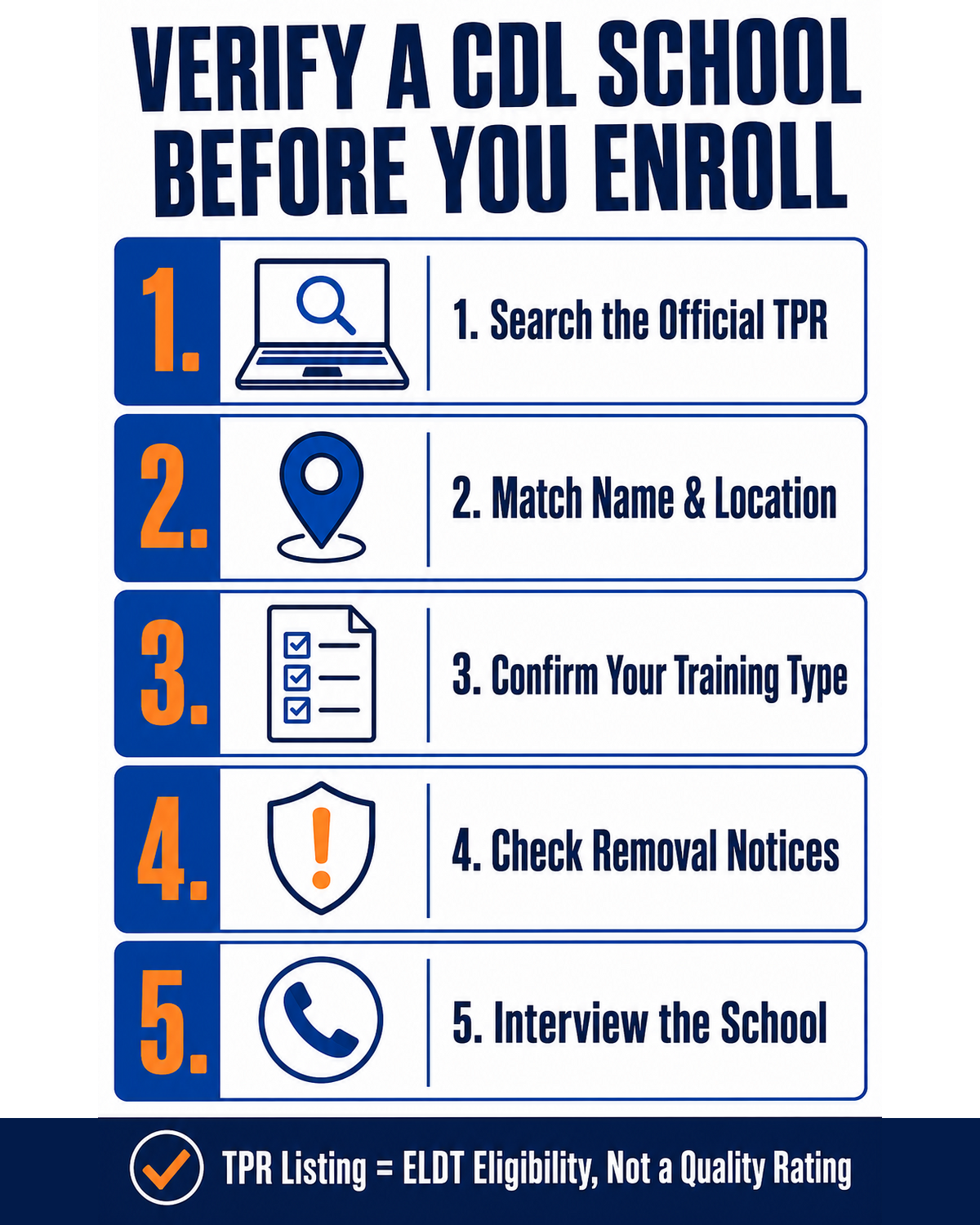
- Open FMCSA’s official .
- Select the exact training type you need: Class A, Class B, passenger, school bus, or HazMat, plus theory or behind-the-wheel where applicable.
- Search by the school’s legal or advertised name and location.
- Match the listed address, delivery format, enrollment availability, and training type to what the school offered you.
- Check FMCSA’s proposed-removal and removed-provider pages before paying.
- Interview the school about schedule, vehicles, instructor access, fees, completion reporting, and state authorization.
Start with the complete CDL requirements and licensing path so you know whether ELDT applies and which credential you are pursuing. Searching for “CDL training” without identifying the correct class or endorsement can lead you to a provider that is legitimate but not listed for your required curriculum.
Why TPR Verification Matters in 2026
For applicants subject to ELDT, only a provider listed in the Training Provider Registry for the applicable training can submit the completion certification the state needs before the relevant test. A receipt, school certificate, social-media advertisement, or verbal assurance cannot replace that electronic record.
Verification has become especially important during heightened federal enforcement. On July 16, 2026, FMCSA reported that approximately 75 schools were being investigated for suspected fraudulent activity and that 9,500 unqualified training schools had been removed from the registry during the broader enforcement effort. The live TPR dashboard showed 9,821 removed locations and 427 locations under review when this guide was reviewed on July 30, 2026. Those dashboard totals are dynamic and may change.
Use those numbers as a reason to check current status—not as a reason to distrust every school. A careful applicant verifies the exact location, exact curriculum, and current notice status immediately before enrollment.
Before Searching, Know Which Training You Need
The TPR search filters training by credential and component. Selecting the wrong option can hide a suitable provider or make an incomplete program look sufficient.
| Credential goal | Theory listing to confirm | BTW listing to confirm |
|---|---|---|
| First Class A CDL | Class A theory | Class A behind-the-wheel |
| Class B-to-A upgrade | Class A theory or applicable upgrade curriculum | Class A behind-the-wheel |
| First Class B CDL | Class B theory | Class B behind-the-wheel |
| First passenger endorsement | Passenger theory | Passenger behind-the-wheel |
| First school bus endorsement | School bus theory | School bus behind-the-wheel |
| First HazMat endorsement | Hazardous materials theory | No federal ELDT BTW component |
If the distinction is unclear, review the comparison of ELDT theory and behind-the-wheel training. Theory may be delivered online or in a classroom by a listed provider. Required BTW training must be completed in person in a representative vehicle.
One provider or two?
FMCSA allows theory and BTW training to come from separate registered providers. However, the agency warns that some BTW schools require students to enroll in a complete theory-and-BTW package. Before purchasing a standalone online theory course, ask the intended BTW school whether it accepts outside theory completion and whether it has space for BTW-only students.
How to Search the FMCSA TPR Step by Step
Step 1: Use the official government site
Go directly to a URL ending in tpr.fmcsa.dot.gov. Search-engine advertisements and private directories may help you discover schools, but they are not the official registry. Do not enter sensitive information into a look-alike website.
Step 2: Choose the correct training type
Select the credential and component needed. For example, a first-time Class A applicant should not stop after finding “Class A Theory” if the applicant also expects the same school to provide practical range and road training. Confirm “Class A Behind-the-Wheel” separately.
Step 3: Search by provider name
Enter the name the school gave you. If no result appears:
- Remove punctuation, abbreviations, or words such as “school” and “academy.”
- Ask the school for the legal provider name used in the TPR.
- Search by city, state, or ZIP code instead.
- Confirm whether the advertised brand and the registered provider are different entities.
Step 4: Match the training location
Providers with multiple locations must register their locations separately. Compare the listed street address and city with the location where training will actually occur. A matching company name in another state does not automatically verify the local yard or classroom.
For online theory, confirm that the result is presented as an online provider for the curriculum being sold. For a traveling provider, confirm the delivery model and ask where the vehicle, range, instructor, and state authorization come from.
Step 5: Confirm enrollment availability
The search can distinguish public enrollment from private enrollment. A provider may be listed but train only employees, members, or students referred through a specific organization. A private-enrollment listing is not necessarily open to the general public.
Step 6: Open the result and save the details
Review the full entry instead of relying on the search-card headline. Save a screenshot or PDF showing the provider name, location, curriculum, and date checked. Then compare it with the written enrollment agreement before paying.
| Registry field | What to compare | Potential mismatch |
|---|---|---|
| Provider name | Legal name, trade name, and contract name | The seller cannot explain the relationship between two names |
| Location | Classroom, range, or traveling-provider information | The advertised yard is not the listed location |
| Training type | Credential and theory/BTW component | Only theory is listed, but a complete program is being sold |
| Delivery format | In-person, online, or traveling | An online listing is presented as proof of a physical training yard |
| Enrollment type | Public or private availability | A private provider accepts payment without confirming eligibility |
| Notice status | Any proposed-removal warning | The school did not disclose an active notice |
What a Current TPR Listing Means
A current listing means the provider registered with FMCSA, registered the location, and self-certified that it meets applicable federal and state requirements for the training shown. Those requirements include the applicable curriculum, qualified instructors, compliant facilities and vehicles, state authorization for in-person training, recordkeeping, and electronic submission of driver completion records.
It also means the location is eligible to submit the relevant training certification. States must verify the completion record before allowing the covered CDL skills test or HazMat knowledge test.
What the listing does not mean
The TPR is not a star-rating service or a guarantee that every listed school will fit your needs. FMCSA tells applicants to interview multiple providers about requirements, fees, enrollment policies, and availability. A registry entry does not by itself tell you:
- How much individual driving time you will receive
- How many students share a truck or instructor
- Whether the schedule matches your availability
- Whether a provider has the transmission and vehicle class you expect
- What tuition, testing, retest, vehicle-use, or administrative fees apply
- Whether the program offers meaningful feedback and additional practice
- Whether the school’s job-placement claims are realistic
A strong choice requires two checks: regulatory eligibility in the TPR and a separate review of program quality, written terms, equipment, instruction, and student support.
How to Check Proposed-Removal and Removed-Provider Lists
FMCSA may begin removing a provider that does not maintain TPR qualifications or comply with applicable federal and state requirements. Check both lists on the same day you verify the ordinary search result:
If the provider has a proposed-removal notice
FMCSA requires a provider with a notice of proposed removal to inform current students and students scheduled for future training. The provider may generally continue training while responding or completing corrective action, but an applicant should not ignore the warning.
Ask for the notice date, stated issue, corrective-action timeline, refund or transfer policy, and written plan if the provider is removed before your training is reported. Independently contact the TPR Team when the answer is unclear.
If the provider has been removed
FMCSA states that training conducted after the removal date is invalid. Do not enroll or continue training based only on a promise that the listing will soon return. Verify current status directly with FMCSA and protect copies of your contract, payment records, attendance, and communications.
Important distinction: A proposed-removal notice is not the same as final removal, but it is a material fact the provider must disclose. A removed provider cannot provide valid ELDT after the effective removal date.
CDL School Interview Checklist
After the registry check, interview the provider. Patriot CDL’s Class A and Class B program overview shows the kind of theory, inspection, range, and road components students should compare when reviewing a complete training plan.
| Question | Why it matters | What to get in writing |
|---|---|---|
| What provider name and location should I find in the TPR? | Connects the sales conversation to the official listing | Legal name and training address |
| Which ELDT components do you report? | Theory and BTW records are separate | Exact class, endorsement, and component |
| Is this program public or private enrollment? | Confirms that you can enroll | Eligibility conditions |
| How is instruction divided? | Observation, group time, and individual driving are not identical | Classroom, range, road, and driving-access schedule |
| Which vehicle will I train and test in? | Vehicle configuration can affect license restrictions | Class, transmission, brake system, and vehicle-use terms |
| What is the complete price? | Low advertised tuition may exclude required services | Tuition, materials, exam, retest, vehicle, and administrative fees |
| When do you report completion? | A missing record can delay testing | Reporting process and contact person |
| What happens if I need more practice? | Proficiency may require additional instruction | Availability, price, and rescheduling policy |
| Are you authorized by the state for this in-person location? | TPR eligibility includes applicable state compliance | Current state license or authorization when required |
| What is the cancellation and refund policy? | Protects you if plans or provider status change | Signed enrollment agreement |
Red flags that deserve more investigation
- □ The school refuses to provide its TPR-listed name or location
- □ The listed address does not match the advertised training site
- □ The provider is listed only for theory but promises complete BTW certification
- □ The school claims to be “FMCSA certified” instead of explaining its listing
- □ A proposed-removal notice was not disclosed
- □ The provider promises completion without required instruction or proficiency
- □ Tuition and additional fees are not provided in writing
- □ The school guarantees a license, test result, salary, or job
- □ You are pressured to pay immediately by cash, gift card, or an untraceable method
- □ The provider will not explain how or when your completion is submitted
Verify Your Record After Training
A provider must submit the training certification by midnight of the second business day after completion. If the provider misses that deadline, FMCSA says the driver is not penalized, but the driver cannot take the applicable test until the state can access the certification.
- Wait until the provider’s reporting window has passed.
- Use FMCSA’s .
- Verify your name, CDL or CLP information, credential, theory/BTW type, and completion date.
- Contact the reporting provider immediately if a record is missing or incorrect.
- Do not schedule a tight test-day connection until the required record is visible to the state.
Frequently Asked Questions
Does a TPR listing mean a CDL school is FMCSA certified?
No. FMCSA says it does not approve or certify providers. It approves applications for providers to be listed after they self-certify that they meet applicable federal and state requirements.
Why can I find a school name but not the location I was offered?
Providers must register training locations separately. Ask for the exact legal name and location used in the registry, then confirm where the classroom, range, and road training will occur before paying.
Can theory and behind-the-wheel training come from different providers?
Yes, if each provider is listed for the component it delivers. Confirm that a BTW provider accepts outside theory completion before purchasing a theory-only course.
What should I do if my provider is on the proposed-removal list?
Ask for the notice details, corrective-action timeline, and written refund or transfer plan. Verify the status directly with FMCSA before enrolling or continuing, and remember that training completed after final removal is invalid.
Educational information only; not legal advice or an endorsement of any provider. Registry data and enforcement totals change. Recheck the live FMCSA Training Provider Registry before enrolling. Official sources reviewed July 30, 2026.