


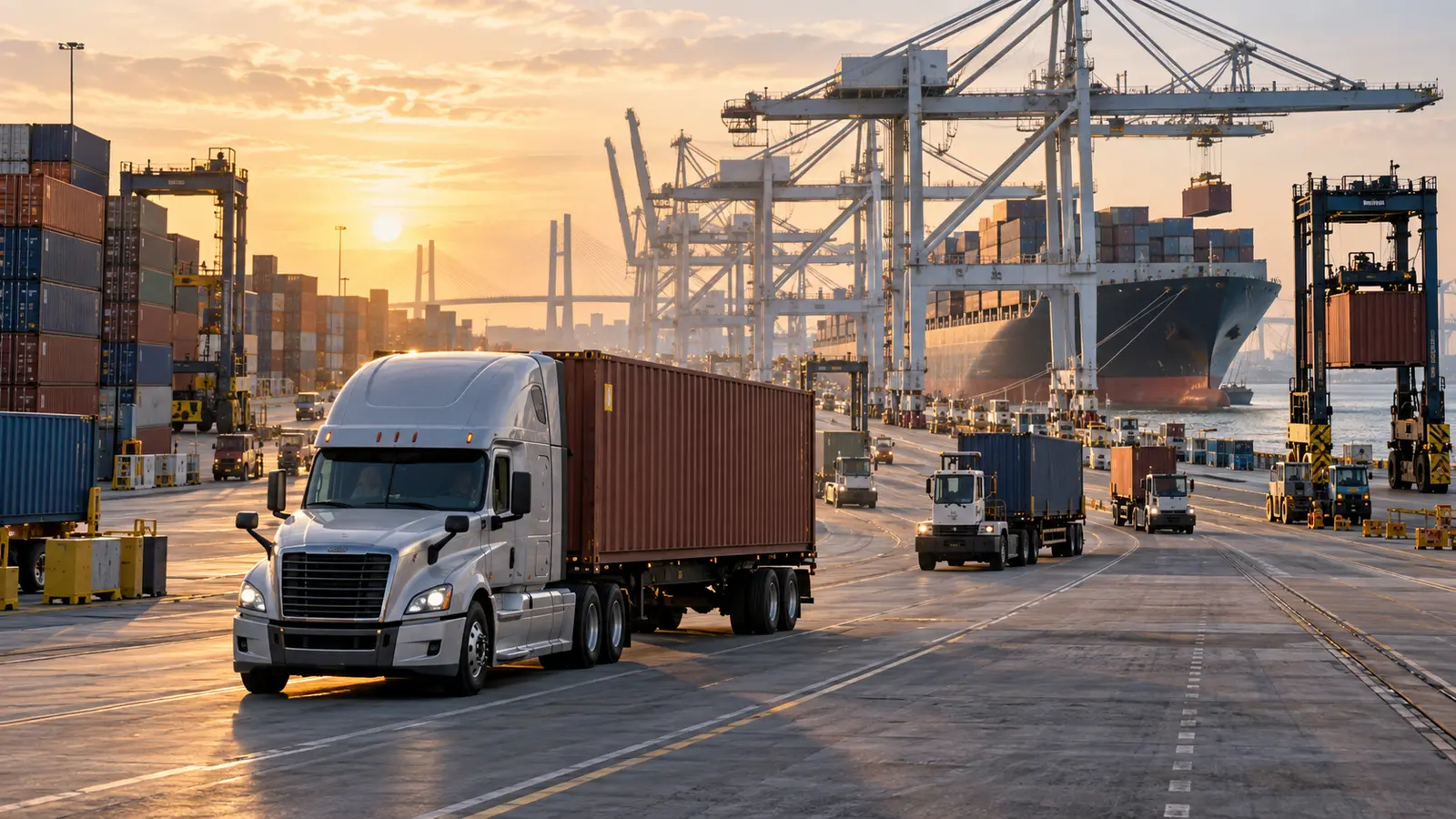
The Port of Savannah handled 529,523 twenty-foot equivalent container units in August while export loads increased 4.2% from a year earlier. TheTrucker.com reported the figures September 15. Loaded exports reached 117,242 TEUs, about 4,700 more than August 2025, while loaded imports rose 1.5% to 265,859 TEUs. Total monthly volume was less than 1% below the prior year.
For the first two months of the Georgia Ports Authority fiscal year, Savannah moved 1.03 million TEUs. That was 22,537 TEUs, or 2.2%, above the same period last year. The result suggests useful freight activity despite overseas weather disruptions and routing uncertainty around the Panama and Suez canals. It does not guarantee stronger pricing on every lane, but it gives drayage and regional carriers a current measure of container flow.
Terminal efficiency also improved. Dual transactions that combine an import pickup with an export drop averaged 43 minutes, 6.5 minutes faster than the preceding six-month average. Nearly 80% of truck visits involved a dual move, and weekday gates handled about 15,000 transactions between 4 a.m. and 6 p.m. Those figures matter because fewer empty movements and faster turns can raise productive capacity without adding tractors.
Inland and roll-on/roll-off activity provided additional signals. The Appalachian Regional Port recorded 10% August growth and a 25% increase across the first two fiscal months. Brunswick handled 60,572 autos and machinery units, down 5% overall, although heavy machinery volume rose sharply. Drayage carriers should compare appointment availability, chassis supply, customer cutoffs and actual turn times before adding capacity. The broad takeaway is steady container demand with better gate velocity, not a universal surge across every port-related freight segment.
Build Your CDL Career With Patriot CDL
Explore professional Class A, Class B and restriction-removal training in Levittown, Pennsylvania.
Talk With Admissions