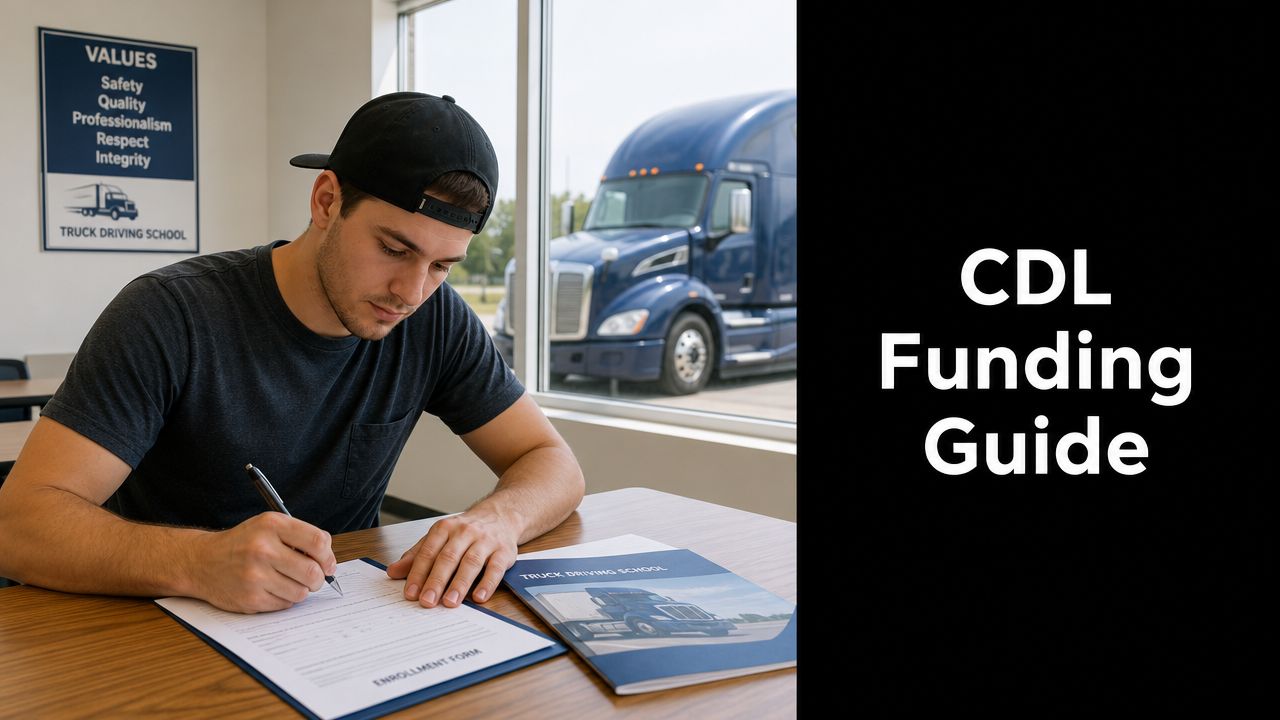
You're probably doing the math right now. You found a CDL program, saw the tuition, added permit and licensing costs, and realized truck driving school can feel expensive before you've earned your first mile.
That reaction is normal. Traditional CDL training in the United States can cost $3,000 to $10,000, and when licensing fees and living expenses are added, the total can reach $9,000 or more according to Roehl's breakdown of CDL school costs. The good news is that paying cash upfront is only one path, and for many students it's not the best one.
The smartest way to think about how to pay for truck driving school is simple. Start with money you don't repay. Then use earned benefits. Then look at company-paid options. Only after that should you consider payment plans or loans.
Navigating the Cost of Your CDL Journey
You find a school that can start you next week. The price looks steep, and the first instinct is to ask, “How do I borrow this?”
Slow down. The better question is, “What is the cheapest way to cover this without boxing myself into a bad decision later?”
That mindset saves students money.
The smartest funding order is simple: start with money you do not repay, move to benefits you have earned, then compare employer-sponsored training. Leave payment plans and loans for the gap that is still left. Students who reverse that order often end up with debt they did not need or a job commitment they did not fully understand.
Look at the full cost, not just tuition
Tuition is only part of the bill. Permit fees, licensing costs, DOT physicals, drug testing, transportation, and a few weeks of lost income can matter just as much, especially in accelerated programs where the schedule leaves little room for outside work.
Program type matters too. Private schools usually get students in faster, which helps if you need to start earning soon. Community college programs can cost less, but I have seen wait lists and slower start dates turn a lower sticker price into a more expensive choice overall if a student loses a month or two of wages while waiting.
Ask direct questions before you commit:
- What does tuition include?
- Are permit, testing, physical, and drug screen fees separate?
- How soon can I start?
- How many weeks before I can realistically be job-ready?
- Will the schedule let me keep working at all?
One cheap program that delays your first paycheck can cost more than a higher-priced program that gets you on the road sooner.
Rank your funding options by financial advantage
If a student were sitting in my office, I would put the options in this order:
- Grants and scholarships. Best option if you qualify, because they reduce or cover cost without repayment.
- Military education benefits. Strong path for veterans, service members, and sometimes eligible family members.
- Company-paid training or tuition reimbursement. Good for students who want a fast start and can accept a work commitment.
- School payment plans. Useful when the gap is small and the terms are clear.
- Private CDL loans. Last resort, because interest and repayment pressure can follow you into your first job.
That order gives you the most flexibility. It also protects your first-year income.
Match the funding path to your real situation
The right choice depends on three things: how fast you need to start, how much cash you have now, and how much control you want over your first driving job.
A student with no savings and no interest in debt should check grant options first, then look at carrier-sponsored training. A veteran may be better off using earned education benefits and keeping more freedom to choose an employer after school. A student who can cover part of the cost may use a short payment plan and avoid a larger loan entirely.
If you are comparing grant routes before you apply anywhere, this list of truck driving school grants is a good place to start.
Quick checklist for accelerated CDL programs
Fast programs can be a great value, but only if you plan for the short-term cash squeeze. Before you enroll, confirm these points:
- You know every upfront fee due before day one
- You have a plan for rent, food, gas, and child care during training
- You understand whether missing days can delay graduation
- You know when job placement starts and how soon income is likely
- You have already checked free money, benefits, and employer-sponsored options before considering a loan
Students who do this homework usually make better choices and feel less pressure once class starts.
Pursue Free Money with Grants and Scholarships
If you qualify for grant funding, that should be your first move. Free money beats debt every time, and it keeps your first job decision from being controlled by a loan payment or a carrier contract.

Start with WIOA
The biggest grant route for many CDL students is WIOA, the Workforce Innovation and Opportunity Act. For qualified applicants who are unemployed or underemployed, the WIOA grant can cover up to 100% of CDL tuition according to 160 Driving Academy's overview of CDL grants and financial aid.
That's the kind of funding you pursue before you even think about a loan application.
WIOA is built for job training in high-demand fields. Truck driving often fits because it leads directly to employment. If you're between jobs, working low hours, or earning less than you need, this is one of the strongest paths available.
For more grant ideas beyond WIOA, it also helps to review a focused list of truck driving school grants.
How to apply through your local American Job Center
This process is more paperwork-heavy than difficult. The people who get approved usually start early and stay organized.
- Find your local American Job Center. Ask specifically whether they fund CDL training under WIOA.
- Confirm your eligibility. Tell them whether you're unemployed, underemployed, receiving unemployment benefits, or changing careers.
- Bring your documents. Expect to provide identification, proof of residence, employment history, and income-related paperwork if they ask for it.
- Ask whether your chosen school is eligible. Many students hit delays because they pick a school first and only later learn the training provider has to meet program requirements.
- Complete every requested intake step. That may include orientation, counselor meetings, or career planning paperwork.
- Follow up until you get a clear answer. Silence isn't a denial. Workforce offices move at their own pace.
Go to the Job Center before you commit to paying tuition. Once you've signed a financing agreement, some grant paths become harder to use cleanly.
Don't stop at one funding source
WIOA gets most of the attention, but it's not the only place to look.
- State workforce support: Some states or local workforce boards offer job-training assistance tied to demand occupations.
- School-based awards: Some schools offer scholarships or short-term tuition relief.
- Community and nonprofit programs: Local organizations sometimes help with career-entry costs, especially for workers in transition.
- Private grants: Some students qualify for outside funding based on background, career goals, or location.
Commercial Driving Academy notes that qualifying grants can cover approximately 100% of tuition costs for some students, and it also points to employer sponsorship, government workforce funding, scholarships, and payment plans as real alternatives in its guide to paying for CDL school.
What to watch out for
Grant money is great, but it usually isn't instant.
A student in an accelerated program needs to ask two questions early: how long approval takes, and whether the class start date can be held while funding is processed. If you skip that step, you can lose your seat or end up delaying your training start.
Use Military Benefits to Fund Your CDL
Veterans, active service members, and in some cases dependents have one of the strongest funding paths available. If that's you, don't leave those benefits sitting on the table while you shop for loans.

The Post-9/11 GI Bill® explicitly provides expanded benefits for CDL training tuition and includes an apprenticeship program, allowing eligible individuals to use those benefits to pay tuition and receive additional assistance during training, as explained in this guide to CDL tuition options for veterans.
A practical place to start is a school-focused overview of GI Bill CDL training, then verify the specifics through official VA channels and the school you're considering.
How the Post-9/11 GI Bill® applies to CDL training
A lot of people assume GI Bill® benefits only apply to college. They don't.
CDL training is vocational education. That means approved non-college programs can fit. The apprenticeship side matters too, because some military-affiliated students want a path that continues beyond the classroom into paid training or structured employment.
Depending on your eligibility and the approved program, these benefits may help with tuition and related training support. That makes this route more complete than many students expect.
Verify before you enroll
Students' payment decisions either save them a headache or create one.
Use this checklist before you sign anything:
- Check your eligibility status: Confirm which benefit you have and whether you're approved for CDL training use.
- Review remaining entitlement: If you've used benefits before, make sure you know what remains.
- Confirm school approval: Not every truck driving school participates the same way.
- Ask about the training format: Accelerated programs, stand-alone CDL courses, and apprenticeship-linked pathways may be treated differently.
- Get the school's process in writing: You want to know who submits what and when.
Advisor's note: Military benefits are too valuable to use casually. Confirm approval on the exact program, not just the school name.
A quick explainer can help if you want a visual overview before making calls.
Where veterans usually go wrong
The most common problem isn't eligibility. It's timing.
Some students assume benefits will be sorted out after enrollment. Then the class date arrives, paperwork is incomplete, and they're scrambling. Others assume every vocational truck driving program is automatically approved. That's also risky.
A better approach is to handle military funding in this order:
| Step | What to do |
|---|---|
| First | Confirm your benefit type and remaining usage |
| Second | Verify that the specific CDL program is approved |
| Third | Ask what documents the school needs from you |
| Last | Lock in your class date once funding steps are underway |
If you're eligible, this route is often cleaner than borrowing and more flexible than signing a long carrier agreement. For the right student, it's one of the best answers to how to pay for truck driving school.
Let a Trucking Company Pay Your Way
You want to start soon, your savings are thin, and waiting another few months is not realistic. This is the point where many students look at carrier-paid training. It can be a smart move, but only if you treat it like a job decision first and a funding decision second.
Company-paid CDL training usually falls into two buckets. Direct sponsorship means the carrier covers training upfront. Tuition reimbursement means you pay for school first, then get part of that cost repaid after hire. Both can lower your out-of-pocket cost. Both usually come with a work commitment.

Direct sponsorship versus reimbursement
The difference matters because the cash-flow problem is different.
| Model | How it works | Best for | Main trade-off |
|---|---|---|---|
| Direct sponsorship | The carrier covers school upfront, often tied to employment | Students with little cash who want a direct path into work | Less freedom to choose your first employer |
| Tuition reimbursement | You pay first, then a carrier helps repay over time | Students who can start training but want repayment support later | You still need a way to cover school before reimbursement starts |
Some carrier programs also pay trainees during school and may include lodging or meals. As noted earlier, Roehl is one example of a paid training model. For students in accelerated programs, that can make a real difference because the issue is often not just tuition. It is also the income you lose while you are in class.
Real examples of sponsored routes
This path is common enough that students should compare it seriously, especially after checking grants, scholarships, and military benefits first.
A practical starting point is this guide to free Class CDL training, which shows the kinds of company-sponsored options students usually find in the market.
I tell students to ask four blunt questions before they get excited about a sponsored seat:
- Who pays the school directly?
- How long is the work commitment?
- What do I owe if I quit or get terminated early?
- Where will I train and where will I be dispatched after graduation?
Those answers tell you whether the offer is affordable or just deferred risk.
How reimbursement programs usually work
Reimbursement programs solve a different problem. They help after graduation, not before. A carrier may add monthly reimbursement or hiring incentives once you start working, but that does not help much if you still need cash to enroll next week.
That is where students get tripped up. They hear "company pays for school" and assume no upfront money is needed. In many reimbursement setups, you still need your own plan for tuition, permit fees, transportation, and time off work. If you need to borrow to bridge that gap, it helps to compare student loan options before signing anything.
What works and what can trap you
This route works best for students who care more about getting on the road quickly than keeping every first-job option open.
It works less well for students who want maximum flexibility right away, are unsure about staying with one carrier, or have not read the repayment terms carefully.
Here are the practical trouble spots I see over and over:
- Early-exit penalties: Some agreements require repayment if you leave before the service term ends.
- Weak training fit: A paid seat is not a bargain if the schedule, location, or training quality does not work for you.
- Bad assumptions about "free": Free upfront can still mean costly later if miles are inconsistent or the contract is restrictive.
- Rushed enrollment: Students in accelerated programs often sign before reviewing housing, meal costs, route assignments, and start-date timing.
Read the service agreement line by line. The real cost of company-paid training is usually in the contract, not the brochure.
If you are ranking funding options from best to worst financially, company-paid training usually sits behind grants, scholarships, and military benefits, but ahead of private borrowing for many students. It can be a solid choice. Just make sure you are buying speed and structure, not stepping into a commitment you do not fully understand.
Understand School Payment Plans and CDL Loans
A common scenario. A student has already checked grants, military benefits, and company sponsorship, but class starts in two weeks and there is still a gap to cover. That is when payment plans and loans move from backup ideas to real decisions.
These options can get you into school fast. They also carry the most risk, so I tell students to put them near the bottom of the list. Free money comes first. Borrowing comes last.
Clear up the FAFSA confusion
Many students assume CDL school works like a degree program and start with federal student aid forms. In many cases, that leads to wasted time. As noted earlier, CDL training usually does not fall under the same FAFSA-based aid path students expect, so funding often comes from private lenders, school payment plans, workforce support, or other nontraditional sources.
If you want a better handle on repayment before you borrow, it helps to compare student loan options so you can judge what a monthly payment will do to your budget after training.
What private CDL loans usually involve
Private CDL loans are straightforward on paper. You apply, the lender reviews your credit or cosigner situation, the school gets paid, and you repay the lender under the contract terms.
The catch is simple. Approval does not mean the loan is affordable.
I have seen students focus so hard on getting a seat in the next class that they forget to ask when payments start, what the interest adds over time, and how the payment fits if their first employer takes a few weeks to get them rolling. That is where people get squeezed.
Payment plans versus loans
A school payment plan and a private loan solve different problems.
A payment plan works best when you can cover part of tuition now and finish paying over a short period. Some schools require a deposit, then split the rest into scheduled payments during training or before graduation. That can be a good fit for students with savings, family help, or a small funding gap.
A private loan is usually the better fit when you need the full amount upfront and do not have another source ready in time. It creates more breathing room before class starts, but it also creates a longer financial obligation after school ends.
Before you choose either one, review the cost of Class A CDL training so you know whether you need help with just tuition or with permit fees, DOT physicals, testing, housing, and missed wages too.
How to choose the safer option
Use this quick filter:
- Choose a payment plan if you only need a smaller gap covered and can keep up with short-term installments.
- Choose a private loan if class timing matters, you need a larger amount, and the payment still looks manageable on entry-level income.
- Use a mix of cash and financing if you can lower the amount borrowed. Smaller balances give you more flexibility once you start working.
Questions to ask before you sign
Students in accelerated programs need clear answers, not guesses:
- What is the full amount I need, including testing and living costs?
- What is due before class starts?
- When does repayment begin?
- Is there a penalty for paying early or missing a payment?
- Can I realistically make this payment if onboarding to my first job takes longer than expected?
- Would waiting one start date let me use a cheaper option instead of borrowing now?
A loan can solve a timing problem. It should not create a bigger money problem three months later.
Borrowing has its place. Just treat it like the last tool on the table, not the first one you grab.
Create Your CDL Funding Action Plan
Most students don't need more options. They need a sequence.
The best funding plan for accelerated CDL training is built around speed, paperwork readiness, and backup choices. If your target program starts quickly, you can't afford to begin gathering documents after you've already chosen a class date.

Your accelerated-program checklist
Get these items together before you start making calls:
- Photo identification: Driver's license or other accepted ID.
- Proof of residence: Utility bill, lease, or other accepted document if needed.
- Employment history: Especially important for workforce offices and recruiters.
- Income or unemployment documentation: Useful for grant screening.
- Military benefit information: If applicable, have your benefit details ready.
- School and start-date preferences: You need to know how quickly you want to begin.
- Basic budget notes: Include tuition, testing, and short-term living costs.
- Questions for each funding source: Don't rely on memory during calls.
If you need help organizing your savings while waiting for class, a simple sinking fund explanation can help you set aside money for permits, fees, transportation, or missed workdays without mixing those costs into your everyday spending.
Pick your path by circumstance
Different students should start in different places.
| If this sounds like you | Start here |
|---|---|
| You're unemployed or underemployed | Contact your local American Job Center and ask about WIOA-funded CDL training |
| You're a veteran or military-affiliated student | Verify GI Bill® eligibility and confirm program approval |
| You want the fastest route into a job | Compare company sponsorship and reimbursement offers |
| You have some savings but not enough | Ask schools about payment plans first |
| You need a final fallback | Compare private CDL loan terms carefully |
For students focused on price and speed together, it's also worth reviewing options for an affordable truck driving school.
A no-nonsense decision framework
Use this order and you'll avoid most preventable mistakes:
- Check for grants first. Free funding changes everything.
- Use military benefits next if eligible. Don't borrow before confirming them.
- Compare company-paid routes. Read the contract before getting excited.
- Ask about payment plans. They may reduce how much you need to finance.
- Borrow only for the gap. Smaller financing is easier to manage.
The students who get through this process smoothly usually do one thing differently. They stay realistic. They don't chase the perfect option while deadlines pass. They choose the best available path that gets them trained, licensed, and employed without creating unnecessary debt.
If you're trying to figure out how to pay for truck driving school, the winning move is usually not one big solution. It's stacking the right options in the right order.
If you're ready to start training with a school built around fast, practical CDL preparation, Patriot CDL can help you take the next step. Reach out to discuss program options, scheduling, and what you'll need to get on the road quickly.