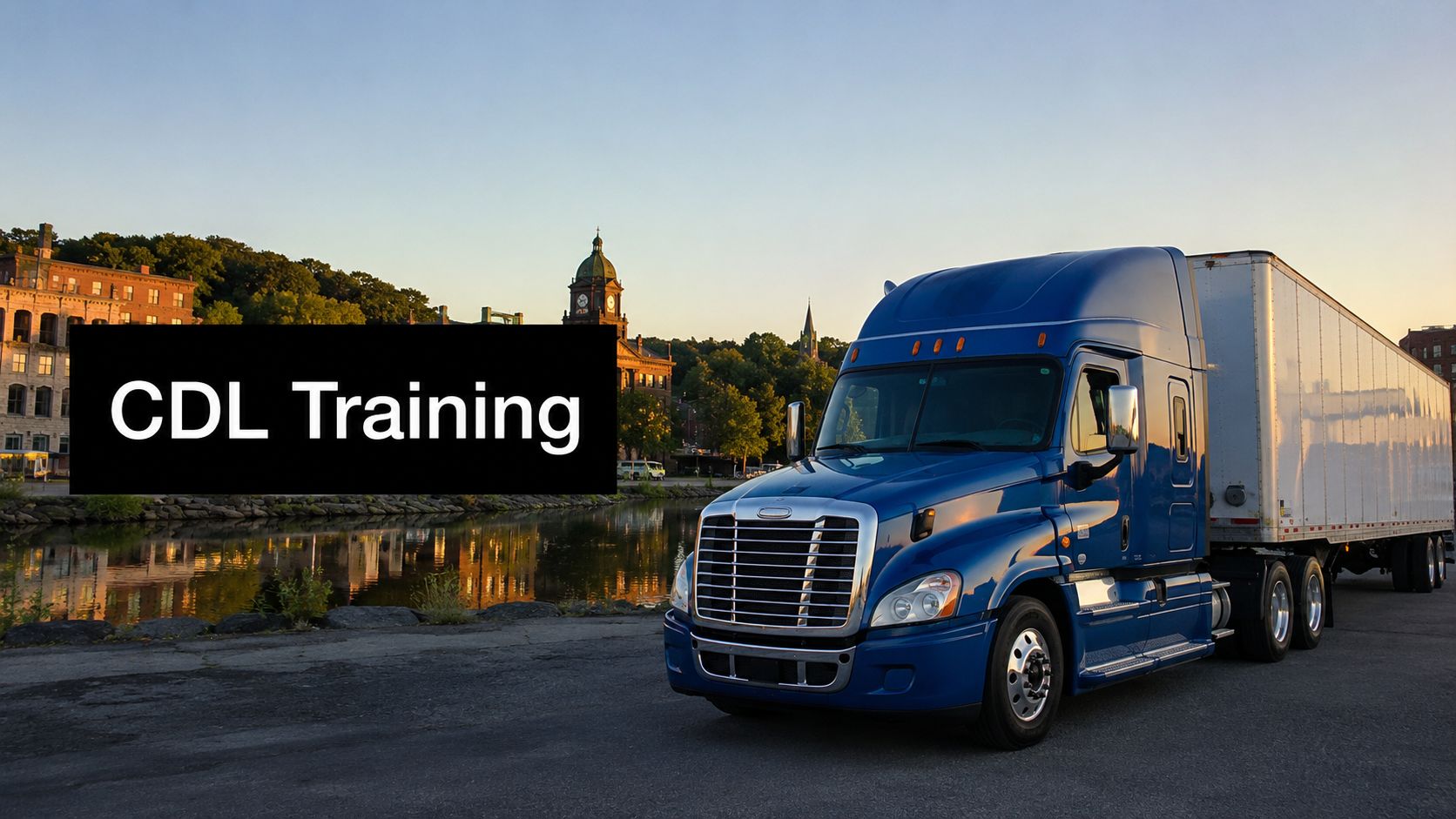
You're probably here because work feels capped out. Maybe you're grinding through retail, warehouse shifts, food service, landscaping, or a job that pays the bills but doesn't build a future. Then you keep seeing tractor-trailers on I-87 and Route 209, and the thought hits you: that driver has a skill, a license, and a job that travels.
That instinct isn't wrong. A CDL can change your income path fast, but only if you choose the right training. Plenty of people looking for commercial driver training in Kingston, NY get distracted by flashy ads, vague “5-week” promises, or schools that talk a big game without clearly stating how much real road time you'll get. That's where people waste time and money.
I'm going to give you the version I'd give a new student sitting across the desk from me. No sugarcoating. You need to know which license fits your goals, what New York requires, and which school questions matter. If you want a realistic look at where the industry is heading, this short read on the truck driver shortage adds useful context without the usual hype.
Your Road to a New Career Starts in Kingston
A lot of future drivers start the same way. They're tired of asking for raises that never come, tired of schedules changing every week, and tired of jobs where there's no clear next step. They don't need another motivational speech. They need a path with rules, training, and a license that employers recognize.
That's what a CDL is. It's not magic. It's a credential tied to real skill. You learn inspections, control, backing, shifting, turns, traffic awareness, and how to handle a large commercial vehicle without freezing up when things get tight. If you put in the work, the license opens doors.

What changes when you get serious
Kingston is a practical place to start this process. You're close enough to major freight corridors to see what the job really looks like, and you're not forced into guessing which training route makes sense. The key is treating CDL school like career training, not like a casual class you squeeze in without commitment.
Straight advice: If you want a trucking career, stop shopping like you're comparing gym memberships. Shop like you're choosing the people who will prepare you to control 80,000 pounds in traffic.
A good start means asking sharper questions than most applicants ask. You need to know what class of license you want, whether the school gives actual on-road practice, and how the state testing process works. If you get those three things right, you're already ahead of most beginners.
The mindset that helps people finish
The students who do best aren't always the ones with trucking family in the business. They're the ones who show up on time, take correction, and don't get defensive when an instructor tells them they missed a mirror check or drifted too wide on a turn.
CDL training rewards consistency. You don't need to be perfect on day one. You do need to be coachable.
Understanding Your CDL Options in New York
You enroll, pay tuition, and start training. Two weeks later, you realize you picked the wrong license class for the jobs you want. That mistake costs time, money, and momentum. Fix the target before you start.
If you are choosing between Class A and Class B, choose by job outcome, not by what sounds bigger. Class A fits combination vehicles such as tractor-trailers and usually gives you the widest range of freight jobs. Class B fits heavy straight trucks, many local delivery roles, buses, and some construction or municipal work. One gives you broader reach. The other can be the smarter fit if you want to stay local.
CDL Class A vs. Class B At a Glance
| Feature | Class A CDL | Class B CDL |
|---|---|---|
| Vehicle type | Combination vehicles with a trailer over 10,000 lbs. | Single vehicles, typically heavy straight trucks |
| Typical jobs | Tractor-trailer, tanker, regional freight, long-haul work | Dump truck, box truck, bus, local delivery |
| Flexibility | Broadest range of commercial driving options | More limited, but still useful for local careers |
| Training focus | Trailer management, coupling, backing, highway control | Straight vehicle control, local route handling |
| Best fit | Drivers who want the widest job market | Drivers who want local or specialized straight-truck work |
Here is the part too many schools gloss over. Your license class is only half the decision. The training format matters just as much.
A Class A program loaded with simulator hours and light on-road time can leave you underprepared. A slower school can also cost you more than the posted tuition if road test scheduling drags out for weeks and you cannot start earning. Ask blunt questions: How much seat time is on public roads? How fast do students get to the test? If a school gets vague, keep looking.
Endorsements change your earning options
Endorsements matter because they shape the jobs you can accept after graduation.
- Hazardous Materials H endorsement adds security screening and stricter rules, but it opens doors to freight that many entry-level drivers cannot touch.
- Tanker N endorsement applies to liquid loads, where surge changes how the vehicle handles.
- Doubles and Triples T endorsement allows you to pull those combinations where permitted.
Age matters too. Drivers under 21 face legal limits in New York. If you are 18 to 20, build your plan around intrastate work and the endorsements you can hold now. Do not waste energy planning for hazmat or interstate runs until you are old enough to qualify.
Pick the license that matches your first job and your next job. That is how you avoid paying twice for training.
Choose the license by the work you want to do
Some students chase Class A just to say they got the top license. That is ego, not planning. If you want broad freight access, Class A is usually the right call. If you want straight-truck work, local routes, transit, or municipal driving, Class B may be the better move. Read this breakdown of Class A vs. Class B CDL paths before you commit.
One more point. Commercial driving is a skilled trade with real legal exposure, so basic industry awareness matters. If a crash involves another negligent party besides the driver or carrier, understanding the basics of filing third-party truck accident lawsuits gives you a clearer picture of how liability can extend beyond the obvious parties.
The Official NY State CDL Licensing Process
You pass the permit test, sign up with a school, and expect to be on the road to a paycheck soon. Then the delays start. Paperwork is incomplete. ELDT reporting is sloppy. The school burns hours on simulators instead of real driving. The road test gets pushed out, and every extra week costs you income. That is how applicants waste time in New York.
The state process is straightforward if you handle it in the right order and choose training that gets you real truck time early.

Get your permit and medical requirements handled
Your first step is the Commercial Learner's Permit, or CLP. You earn it by passing the written knowledge tests for the license class you want and any endorsements you plan to add. Treat that seriously. Students who coast through the written material usually struggle with pre-trip inspections, safety rules, and decision-making once they get in the truck.
Get your DOT medical exam done early too. Do not wait until training is underway to chase forms and signatures. That kind of delay is avoidable, and it can hold up everything behind it.
Use this order:
- Pass the written knowledge tests for your permit.
- Complete the DOT medical requirements so your file is clean.
- Enroll in a school that meets ELDT requirements and gives you real behind-the-wheel time.
- Schedule and pass the skills test as soon as you are eligible.
ELDT is required, and real driving time matters
Federal rules under 49 CFR Part 380 require first-time Class A CDL applicants to complete Entry-Level Driver Training. That includes theory instruction and behind-the-wheel training. The behind-the-wheel portion must be done on a range or public roads under direct supervision, and simulators cannot satisfy that behind-the-wheel requirement, as explained in this overview of Entry-Level Driver Training requirements.
That point gets ignored too often. Simulator exposure can help with orientation, but it does not replace seat time in an actual truck. If a school is light on road driving, you are the one who pays for it later, both in skill gaps and in extra time before test readiness.
Once you complete ELDT through an approved provider, that completion has to be recorded electronically so New York can verify you are eligible for testing. If the school is vague about how that reporting works, leave.
Practical rule: Ask two direct questions before you enroll. How much actual on-road driving do I get, and how fast do you get qualified students onto the road test schedule?
For a state-specific breakdown, review this guide to the CDL process in New York.
Later in the process, seeing it laid out visually helps some people more than hearing it. This quick video does a decent job of showing the flow from training into testing.
Pass the three-part skills test
The skills test has three parts, and weak schools let students underestimate two of them. That is a mistake.
You need to show:
- Vehicle inspection knowledge so the examiner sees you understand the equipment and can identify safety problems
- Basic control skills like backing, positioning, and maneuvering in tight spaces
- On-road driving ability in live traffic with safe turns, lane control, speed management, and awareness
Pre-trip and backing are where a lot of applicants lose confidence. Strong training fixes that with repetition, not shortcuts. Road test scheduling matters just as much. A school that trains you quickly but takes too long to get a test date still costs you money, because you are sitting still instead of working.
Decoding CDL Program Schedules and Costs
People usually ask two questions first. How long will this take, and how much is it going to cost me? Those are fair questions, but most applicants ask them too loosely. You shouldn't just ask about tuition. You should ask how the schedule affects your path to income.
The useful benchmark is this. The U.S. Department of Labor reports that CDL training programs generally run from 3 to 7 weeks, with accelerated options finishing in as little as 3 weeks for full-time students, according to Patriot CDL's summary of training timelines. That range gives you a realistic frame for comparing schools.
Full-time versus part-time
A full-time schedule works best if you want speed and can carve out the hours. You stay immersed in the material, your muscle memory builds faster, and you don't spend as much time re-learning yesterday's skills. That matters with backing, shifting, lane control, and pre-trip routines.
Part-time or weekend schedules can still work, especially if you're holding a job while you train. But be honest with yourself. If your current schedule is chaotic and you're constantly tired, a slower format may drag out the process more than you expect.
Here's how I'd approach it:
- Choose full-time if speed matters and you can commit without constant interruptions.
- Choose part-time if you need flexibility more than speed.
- Avoid vague schedules where the school can't clearly tell you when you'll be driving, not just sitting in class.
Cost is only part of the price
Tuition matters. Financing options matter. Payment plans, workforce support, veteran benefits, and employer-sponsored arrangements can all make training more manageable. But tuition alone doesn't tell you the full cost.
A cheap program that slows your progress can cost more than a stronger program that gets you licensed faster. Lost work time, repeated travel, and delayed test readiness hit your wallet whether the school advertises them or not. That's why you should read a breakdown of the cost of Class A CDL training with your eyes on total value, not just sticker price.
A school doesn't become affordable just because the upfront number looks lower. It's affordable when it gets you trained, tested, and working without dragging its feet.
What to ask before you commit
Ask admissions three blunt questions:
- What is the actual weekly schedule for classroom time, range time, and road time?
- What support exists for permits and test prep, not just enrollment paperwork?
- What delays typically slow students down, and how does the school handle them?
If they answer in circles, that tells you something.
How to Evaluate Kingston CDL Training Schools
Most students compare schools the wrong way. They look at tuition, they glance at reviews, and they stop there. That's not enough. If you want strong commercial driver training in Kingston, NY, two hidden issues should drive your decision: how much real on-road driving you'll get and how fast the school can move you to a road test.
Those two factors affect whether you're job-ready and whether your training timeline stays reasonable.

Real road time versus simulator-heavy training
Many schools get slippery with their wording. They'll mention “hands-on training,” “in-person instruction,” or “modern training tools,” but they won't clearly state how much time you'll spend driving on public roads.
That's a problem. Some local marketing still leaves students guessing about the split between actual road driving, yard practice, and simulator use. The issue isn't whether simulation has any place at all. The issue is whether the school is using vague language to cover up a shortage of meaningful road practice. One industry discussion points out that 78% of CDL students who enrolled in schools without explicit public-road training clauses reported feeling misled during their first paid job, and it also notes that some school marketing doesn't clearly quantify public-road minutes versus simulator time, despite ELDT compliance concerns discussed by students in the Truckers subreddit thread on questions to ask before choosing a school.
The big takeaway is simple. If the school won't tell you how much public-road driving you get, assume the answer won't impress you.
The road test bottleneck that schools don't advertise
This one hits your bank account. A school can brag about a short program, but if it can't move you toward a road test in a reasonable timeframe, your “fast” program isn't fast.
One trucking video analysis argues that schools delaying road test dates by 6 to 12 weeks can cost students an average of $3,500 in lost wages and living expenses, and it points out that some schools advertise a 5-week program without specifying the average road test timeline, as discussed in this YouTube breakdown of CDL school test date delays. That's exactly the kind of hidden cost applicants overlook.
Don't ask only, “How long is the program?” Ask, “How long until I'm actually testing?”
Questions that separate good schools from weak ones
Ask these before you sign anything:
- How much public-road driving do students get before the road test?
- How much of the training is on a range, in a simulator, or in observation?
- How soon after graduation are road tests usually scheduled?
- If DMV scheduling slows down, what does the school do to keep students sharp?
- Who teaches the behind-the-wheel portion, and how much real driving experience do they have?
Other signs worth checking
The two issues above matter most, but they aren't the only things that count.
- Instructor quality matters because bad habits form fast in CDL training.
- Equipment condition matters because you need to train on trucks that reflect the work.
- Local route familiarity matters because Kingston-area roads, traffic patterns, grades, and weather create their own learning curve.
If a school is proud of its training, it should answer these questions plainly. If it can't, move on.
Why Patriot CDL Delivers Real-World Readiness Faster
You enroll, clear your permit steps, and block off time to train. Then you find out half your “driving” time is observation, range repetition, or simulator work, and your road test is still weeks out. That is how students lose momentum and money.
Patriot CDL takes a better approach. It keeps the focus on what effectively gets a new driver ready for test day and the first job after it. That means real truck time, direct coaching, and a schedule built to move students through training without unnecessary delays.

Real road time beats simulator-heavy training
If you want to drive for a living, you need time behind the wheel on actual roads. Simulators and observation have a place, but they should support training, not replace it. A school that burns too many hours away from real driving is stretching your timeline while giving you less of what matters most.
Patriot CDL is built around hands-on skill development. Students work on pre-trip inspections, backing maneuvers, city driving, shifting, turns, lane control, and the small corrections that separate a nervous beginner from a safe entry-level driver. That is the kind of repetition that sticks.
If you want a clearer picture of why direct truck time matters so much, read this explanation of hands-on CDL training with experienced instructors.
Faster only counts if it saves you from hidden costs
A short program sounds good on paper. It only pays off if the training stays practical and the school keeps students progressing toward the road test instead of letting them sit in limbo.
That second part gets overlooked all the time. Slow test scheduling costs people real money. Every extra week between training and testing can mean more missed income, more child care, more commuting, and more time trying to hold onto skills you already paid to learn. Patriot CDL's accelerated model makes sense because it treats speed as a financial issue, not just a marketing line.
Support matters because small mistakes delay careers
Plenty of students can learn the driving. What slows them down is paperwork, permit confusion, medical exam questions, or poor planning after a failed attempt. A good school handles those problems early and clearly.
Patriot CDL helps students stay organized with permit preparation, DOT medical exam guidance, and retest planning when needed. That kind of support matters because avoidable delays are expensive and frustrating.
Why this works for Kingston-area students
Kingston-area career changers usually need the same three things. Training that respects their time, instruction on real equipment, and a school that does not blur the difference between watching and driving.
Patriot CDL fits that standard because it emphasizes:
- Hands-on training that builds real behind-the-wheel confidence
- Accelerated scheduling for students who want to get working sooner
- Practical test preparation for both the written and road exam
- Flexible options for adults balancing work and family responsibilities
A CDL school should do more than get you across the finish line. It should send you to your first driving job with habits that hold up under pressure.
That is the standard worth paying for.
Start Your Engine with Patriot CDL Today
If you're serious about getting into trucking, stop delaying the first move. Pick up your paperwork, decide whether you want Class A or Class B, and talk to a school that can explain its training without dancing around the hard questions.
Have a few basics ready before you call. Know your age, your current license status, the class of CDL you want, and whether you need a schedule that works around a job. If you're not sure which license fits, ask directly. A good admissions advisor should be able to tell you quickly based on the work you want.
Keep your questions practical:
- How soon can I start?
- How much real road driving will I get?
- What should I do first for my permit and medical exam?
- What does the schedule look like week to week?
If you've been stuck in a job that goes nowhere, this is the kind of move that can change your direction. But only if you act on it.
If you're ready to move toward a commercial driving career with faster, hands-on instruction, talk to Patriot CDL and get clear answers on training options, scheduling, permit steps, and the best path for your CDL goals.