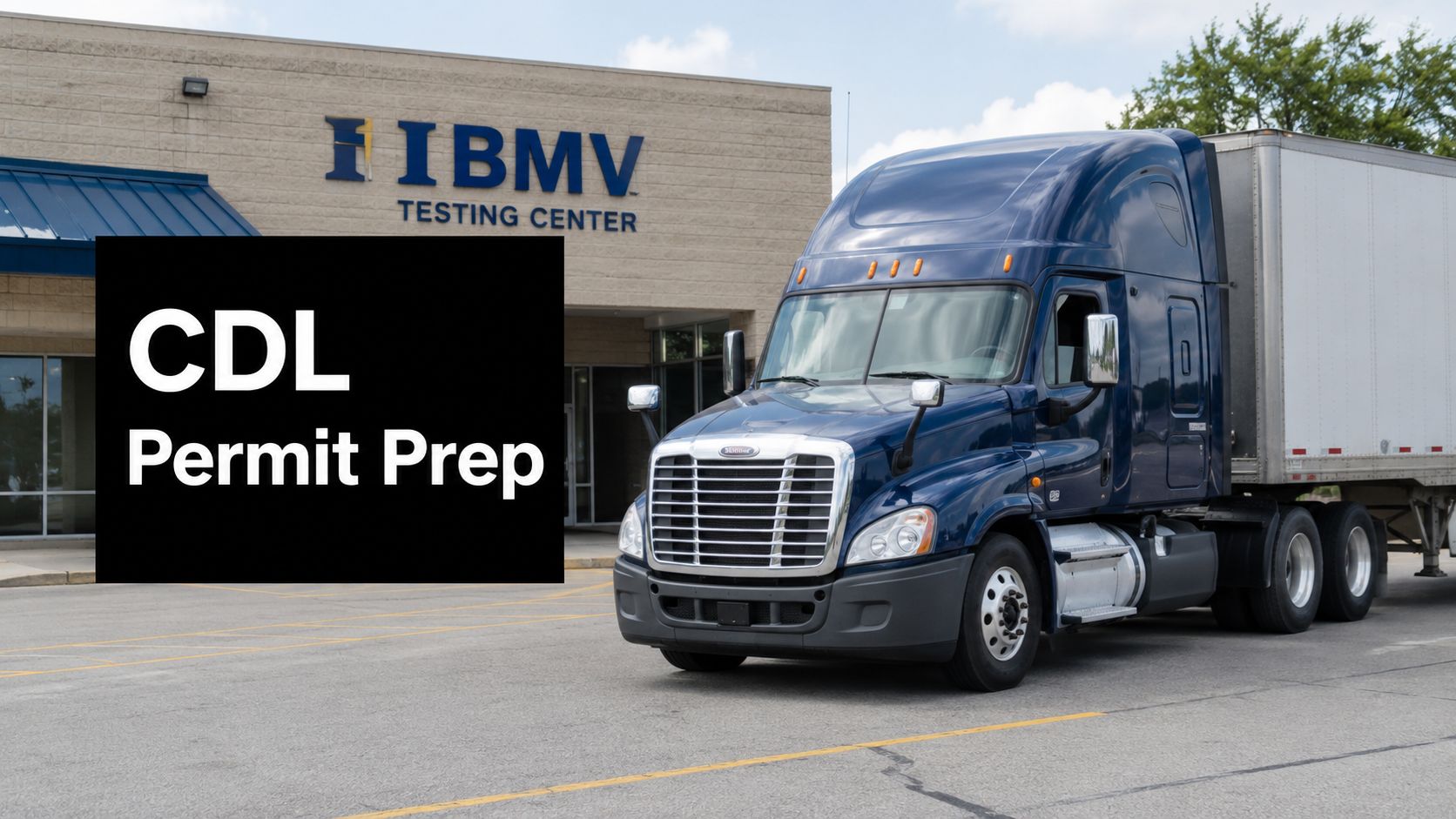
Indiana doesn't give CDL applicants much room for casual preparation. The state has had over 51.9% of test-takers fail their driving tests over a recent four-year period, far above the national failure rate, according to this Indiana driving test analysis. If you're approaching the CDL permit process like it's just another written exam, that number should reset your expectations.
A good result on the Indiana CDL path usually comes from two things. First, you study the written material with a plan instead of cramming. Second, you treat the permit as the start of your road-test preparation, not the finish line. That's the part many people miss, and it's where delays start.
Why the Indiana CDL Permit Test Deserves Your Full Attention
Most applicants focus on one moment: passing the written exam. That matters, but the bigger issue is whether your whole approach is disciplined enough to carry you from permit to license without wasted attempts, expired paperwork, or avoidable retests.
Indiana's testing environment is demanding. The state's overall failure rate tells you something important about the local reality. People walk in underprepared, assume common driving experience will carry them, and learn fast that commercial licensing expects more precise knowledge and more deliberate habits than a standard license process.
What makes this different
The Indiana CDL process asks you to do more than memorize signs and definitions. You need to understand inspection language, air brake concepts if they apply to your path, combination vehicle behavior, and the logic behind safety rules. Commercial driving tests punish shallow studying.
Practical rule: Don't study until material feels familiar. Study until you can explain it clearly without looking.
That's especially true if you're changing careers. Many career changers are excellent workers and solid drivers, but they haven't taken a formal test in years. The challenge usually isn't intelligence. It's organization. When you follow a clean study routine, the permit test becomes manageable. When you wing it, small weak spots stack up.
The cost of treating it lightly
A failed attempt doesn't just bruise your confidence. It can slow your entry into training, work, and income. It also shifts your focus from building momentum to fixing mistakes under pressure.
The Indiana CDL permit test rewards serious preparation. That's the mindset to carry into every step that follows.
Meeting Indiana BMV Requirements Before You Study
A surprising number of Indiana CDL applicants lose time before they ever answer a test question. The problem is usually paperwork, eligibility, or a missed state step, not a lack of effort.
Handle the BMV requirements first. That gives you a clean runway for studying, scheduling, and training.
Start by making sure your documents match across the board. Your identification, Social Security documentation, medical paperwork, and licensing records should all be current and consistent. If your name appears one way on one document and differently on another, fix it now. Small mismatches turn into appointment delays fast.
For a broader checklist, review Patriot CDL's guide to CDL permit requirements. It gives you a practical way to compare your file against what Indiana expects before you make the trip.
A required Indiana step that catches people off guard
Indiana requires first-time CDL applicants to watch and attest to a human trafficking awareness video before applying. Many applicants miss it because they focus on the written material and assume every requirement is handled at the branch.
It is not.
Verify that step is complete before your appointment so you do not burn time on a preventable delay.
What the permit test means for your timeline
The General Knowledge test is the foundation of the Indiana CDL permit process. You need a passing score before you can move on to the next stage, and after you receive your permit, Indiana requires you to hold it for 14 days before taking the skills exam.
That 14-day period matters more than many applicants realize. Strong applicants do not treat it like downtime. They use it to start preparing for pre-trip inspection, backing, and basic control work, because the skills test is where many people struggle. Passing the written test gets you through the gate. Using the permit hold period well puts you in position to finish the job.
If you want a simple way to map out those first two weeks after you pass, download your study planner and block time for permit review, inspection terms, and early skills preparation.
Match your study to the license you actually want
Do not study every section of the CDL manual the same way. Study the sections tied to your path.
A Class A applicant usually needs to prepare for General Knowledge, Combination Vehicles, and often Air Brakes. A Class B applicant may have a narrower set of topics. Endorsements can add more testing. If you are not clear on the license class or endorsements you need, you can waste a week on the wrong material.
That is a common mistake among new applicants. They start with random practice questions, then realize later they never built a plan around their actual training goal.
Set yourself up before the first practice test
Use this short pre-study check:
- Gather your documents in one folder: ID, Social Security documentation, medical paperwork, and any supporting records.
- Confirm your CDL path: Class A, Class B, and any endorsements you plan to pursue.
- Complete Indiana's required pre-application steps: Do not leave state requirements for the last minute.
- Protect your 14-day permit period: Plan to use it for skills test preparation, not just waiting.
That approach saves more than frustration. It keeps your momentum intact, which matters once training starts.
Your Actionable Three Week CDL Permit Study Plan
What many find they need isn't more information. They need a schedule they'll follow. A three-week plan works well because it gives you enough time to learn the manual, test yourself thoroughly, and tighten weak areas without dragging the process out.
Here's a visual roadmap to organize the work.

If you want a simple way to map daily sessions, download your study planner and block out reading, review, and practice sessions before the week gets busy.
Week 1 builds your base
Read the Indiana CDL manual with a pencil or notes app beside you. Don't read like you're trying to finish pages. Read like you're trying to teach the material back to someone else.
Your focus during the first week should be the fundamentals:
- General Knowledge first: Learn the safety concepts, vehicle operation basics, and inspection language that show up repeatedly.
- Write short summaries: After each section, summarize the topic in plain language.
- Flag weak pages immediately: If a topic feels muddy on the first pass, mark it. Don't trust yourself to remember later.
A lot of applicants make the mistake of starting with endless practice questions. That's backward. If you don't build the foundation first, your score won't tell you much except that guessing isn't working.
Week 2 turns reading into recall
Now you begin practice questions. The goal isn't to chase a pretty score. The goal is to expose confusion.
Use practice tests in sets. After each set, review every missed question and every correct question you guessed on. Those guessed answers are warning signs.
For a deeper approach to retention and review, this breakdown of the best way to study for your permit test is worth using alongside your manual work.
This is also the point where many applicants start thinking beyond the written exam, which is smart. Indiana's permit process includes a required hold period, but too many people waste it. According to Roehl's Indiana CDL practice test page, 52% of surveyed new CDL applicants in Indiana failed the skills test due to inadequate pre-trip inspection and alley dock practice, even though the permit hold period exists to create preparation time.
The permit isn't a waiting room. It's your practice window.
That's the gap most online prep misses. They help you answer written questions, then leave you alone with backing maneuvers, inspection wording, and test-day pressure on the skills side.
Week 3 should feel like test conditions
By the third week, stop studying in fragments. Start running full sessions that mimic test conditions. Sit down, remove distractions, and work straight through practice material without checking answers after every question.
After each full run, do two things:
- Identify recurring misses
- Return to the manual only for those exact topics
That process is more effective than rereading everything. Weaknesses are usually clustered. One applicant struggles with air brake logic. Another mixes up inspection terms. Another reads too fast and misses key words like “except” or “must.”
Later in this same period, start preparing your body and habits for the next phase. If you're training with a school or structured program, use the permit window for pre-trip repetition and backing practice. Patriot CDL, for example, trains students on permit support and hands-on skills such as pre-trip inspections and alley dock work during accelerated CDL preparation. That kind of structure matters because the written exam only opens the door.
This short video is also useful when you want a compact review session instead of another long reading block.
What works and what doesn't
What works
- Short daily sessions: Consistency beats occasional marathon studying.
- Error logs: Keep a running list of topics you miss.
- Speaking answers aloud: This helps with both permit memory and later pre-trip inspection language.
What doesn't
- Retaking the same practice test until you memorize it
- Ignoring hands-on preparation during the permit period
- Studying only the night before
Understanding Key CDL Endorsements
Once you're preparing for the permit, it makes sense to think one step ahead. Endorsements can shape the kind of freight you haul and the jobs you can take. If you know your likely direction early, you can line up the right knowledge tests instead of revisiting everything later.

Tanker endorsement
The Tanker (N) endorsement allows you to haul liquid or gaseous loads in the kinds of vehicles that require that authorization. The challenge with tanker knowledge isn't just terminology. It's understanding surge, balance, braking, and how load movement changes vehicle behavior.
Drivers who want local fuel, chemical, or liquid freight work often look at this early.
Doubles and triples endorsement
The Doubles/Triples (T) endorsement applies when you want to pull multiple trailers where allowed. This knowledge area demands attention to coupling, rollover risk, off-tracking, and managing extra trailer movement.
It's a good example of why CDL studying has to go beyond ordinary driving logic. What feels intuitive in a passenger car often doesn't transfer cleanly to a combination rig.
Hazardous materials endorsement
The Hazardous Materials (H) endorsement opens access to freight that requires special handling and regulatory awareness. This isn't just about what's in the trailer. It involves knowledge of identification, handling, security, and safety rules.
Because this endorsement carries extra responsibility, applicants should expect a more careful process and should prepare with the same seriousness they bring to General Knowledge.
Choose endorsements based on the work you want to do, not on what sounds impressive.
If you want a practical overview of how these add-ons fit into your CDL path, this guide to license endorsements is a helpful reference. The main thing is to be intentional. The permit stage is a good time to think about your first job, not just your first test.
Navigating Test Day From Scheduling to Success
A lot of permit test anxiety comes from uncertainty, not lack of knowledge. When applicants know what the day will look like, they make fewer rushed mistakes and use their attention where it belongs.
This quick visual checklist helps keep the process orderly.

Before you leave home
Your first job is administrative. Confirm your appointment details, gather your documents, and make sure your required steps are complete. If you're unsure where you'll be testing or want to plan logistics ahead of time, review Indiana CDL testing site information.
A simple checklist helps:
- Bring your identification documents: Make sure everything matches.
- Bring medical paperwork if required for your application path: Don't assume the system already has what you need.
- Review, don't cram: Go over difficult areas, then stop.
- Sleep like it matters: A tired reader misses easy questions.
How to handle the room
When you sit down for the test, slow yourself down. Most preventable misses happen because applicants read the first half of a question and assume the rest. Commercial testing language often turns on one word.
Use a calm routine:
- Read the full question once
- Read all answer choices
- Eliminate obvious wrong answers
- Choose the safest and most complete answer
If a question rattles you, don't let it infect the next one. Reset and move on.
Test-day advice: If you catch yourself rushing, put both feet flat on the floor and take one full breath before the next question.
What passing leads to next
Passing the permit test is a milestone, but it isn't the hard end of the process. The next major hurdle is the skills exam. According to this CDL skills exam breakdown video, the test includes three components: a pre-trip inspection, a basic control skills exam that includes alley docking and offset backing, and a road trip exam. That same source notes a common pitfall: failing the pre-trip inspection can immediately terminate the exam.
That matters for how you think about test day. If you pass the written exam, your next decisions should focus on repetition, not celebration. Start building inspection language, cone awareness, mirror habits, and backing discipline while the permit process is still fresh in your mind.
What to Do If You Need to Retest
If you don't pass on the first try, treat it as feedback, not identity. Plenty of capable drivers need another attempt. The difference between a short setback and a long delay is what you do in the next few days.
Indiana puts real time limits around the permit process. A Commercial Learner's Permit is valid for 180 days, and applicants may receive only three CLPs within a two-year period, according to the Indiana BMV's commercial learner permit overview. That means retesting is manageable, but it's not something to drift through casually.
Use the failed attempt correctly
Don't restart from page one unless your preparation was completely scattered. Most failed attempts come from a narrower problem:
- You misread questions under pressure
- You had weak command of a few sections
- You memorized practice answers instead of understanding the material
Go back through the topics that gave you trouble. Tighten those first. If your issue was confidence, use structured practice sets and a cleaner pre-test routine. If your issue was broad confusion, a guided approach and stronger feedback loop will save time.
For extra review work before your next attempt, this free CDL practice test resource can help you identify weak spots. The goal isn't to do more questions for the sake of volume. It's to find patterns and fix them.
A retest should feel more focused than the first attempt. Better pacing, better review, fewer surprises.
If you want a more direct path from permit prep to hands-on CDL training, Patriot CDL offers practical instruction on the written exam, pre-trip inspections, backing maneuvers, and the full licensing process so you can prepare for both the permit and the skills test with one plan.