Before you can even think about hitting the open road as a professional truck driver, you have to start with the first essential step: getting your Commercial Learer's Permit (CLP). This isn't just a piece of paper; it's the key that unlocks your hands-on training and starts the engine of your new career.
Your First Step Into Professional Driving
Think of this guide as your personal roadmap. We're going to walk through every single one of the CDL permit requirements together, so you know exactly what to expect. We'll break down everything from the initial eligibility check and gathering documents to acing those written knowledge tests. The goal is to make the rules clear and simple, letting you focus on what really matters—preparing to get behind the wheel.
It's important to understand that getting your CLP is a step-by-step process. You can't skip ahead. It’s a logical path of meeting specific standards, proving your knowledge, and completing the required training before you ever sit in the driver's seat.
This flowchart lays out the entire journey, breaking it down into three main stages.
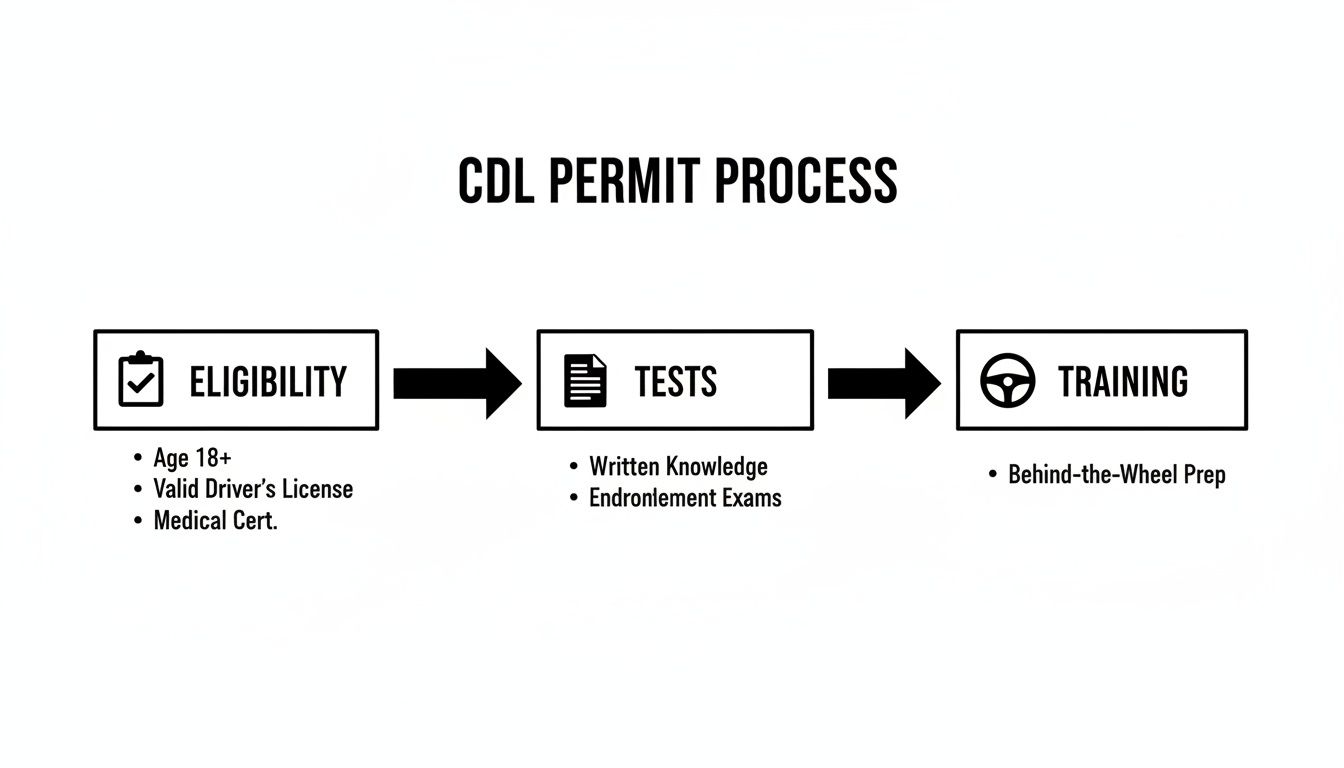
As you can see, it all starts with making sure you're eligible. Only then can you move on to the tests and training.
Key Milestones on Your Journey
Getting your permit is a series of milestones, not a one-and-done event. Each step builds on the last, making sure every new driver has the solid foundation needed for a safe, successful career. Here are the key areas we'll cover in detail:
- Core Eligibility: We'll dive into the specific age, residency, and driving record requirements you’ll need to meet.
- Medical Exams: You'll learn all about the mandatory DOT physical—a critical and non-negotiable part of the process.
- Knowledge Tests: We’ll break down the written exams you must pass, including General Knowledge, Air Brakes, and Combination Vehicles.
- Mandatory Training: We'll also explain the role of Entry-Level Driver Training (ELDT) and why it's so important for today's drivers.
Obtaining your CLP is the first major accomplishment in your professional driving career. It proves you have the essential knowledge required to safely begin your hands-on, behind-the-wheel training with a certified instructor.
Ultimately, we want this guide to be the one place you turn to for answers. From the very first form you fill out to the moment that permit is in your hand, we’ve got your back.
Meeting the Core Eligibility Requirements
Before you even think about getting behind the wheel of a big rig, there are a few fundamental boxes you have to check. Think of these as the gatekeepers to your new career. Both federal and state authorities have set these rules to make sure every driver on the road is qualified, responsible, and ready for the massive responsibility of operating a commercial vehicle.
Getting these initial standards squared away is the non-negotiable first step. They cover your age, your residency, your driving history, and your legal status. Let's break down these core cdl permit requirements so you know exactly where you stand.
Age and Driving Jurisdiction
One of the very first hurdles is your age, which directly determines the kind of driving you’ll be allowed to do. You’ll have to decide whether you want to stick to roads within your state or hit the open highway and cross state lines. This is a big decision that will shape your early job prospects.
Here’s the breakdown:
- Intrastate Driving: If you plan on operating a commercial vehicle only within your home state, you typically need to be at least 18 years old. This is a solid option for anyone looking at local delivery, construction, or agricultural work.
- Interstate Driving: To haul cargo across state lines, federal law is clear: you must be at least 21 years old. This is the ticket to long-haul trucking and opens up a much broader world of career opportunities.
The path you choose here matters. While getting an intrastate license at 18 is a great way to start, most aspiring truckers eventually aim for the interstate qualification at 21 to maximize their career flexibility.
Residency and Driving Record
Beyond age, you have to prove you're a legal resident of the state where you’re applying. This isn't just red tape; it ensures your license and records are managed by the right people. Your local DMV will ask for specific documents to confirm your address, like a recent utility bill, a lease agreement, or a bank statement.
Just as crucial is your driving history. A clean driving record isn't just a suggestion—it's a must. Certain serious traffic violations or past license suspensions can sideline your CDL ambitions, sometimes temporarily, sometimes for good. We're talking about offenses like a DUI/DWI, reckless driving, or leaving the scene of an accident. The Federal Motor Carrier Safety Administration (FMCSA) has very strict rules about these disqualifying offenses.
A clean driving record is more than just a requirement; it’s a reflection of your commitment to safety. It shows potential employers that you are a responsible and trustworthy professional.
Citizenship and Legal Status
Finally, your citizenship or legal status is a make-or-break eligibility factor. You must be a U.S. citizen or a lawful permanent resident to get a CDL. This has become an area of intense scrutiny lately. For a complete look at these standards, check out our detailed guide on CDL requirements.
Regulations in this area have tightened significantly. A major shift happened with the U.S. Department of Transportation's emergency rules in late 2025, which heavily restricted eligibility for non-U.S. citizens and non-permanent residents. For instance, California, a state that handles over 40% of U.S. imports, was discovered to have improperly issued more than 25% of its CDLs to individuals in this category. This federal crackdown forced the state to announce the immediate revocation of 17,000 of those licenses.
Assembling Your Documents and Medical Certificate
Getting your Commercial Learner's Permit (CLP) is a lot like putting together a puzzle. You can't see the full picture until you have all the right pieces in place. Showing up to the DMV with everything organized beforehand is the secret to a smooth, hassle-free experience and is a key part of nailing the cdl permit requirements.
Think of your application packet as your first professional move. It’s not just about filling out a form; it's about presenting a clean, complete file that proves you’re serious and ready to meet the legal standards of the trucking industry. Let's break down exactly what you’ll need to have in hand.
Your Essential Paperwork Checklist
When you walk into the DMV, you’ll be asked for a few core documents that confirm who you are, how old you are, and your legal status. The exact list can differ a bit from state to state, but most follow a similar template. For a closer look at how things work in California, check out our guide on navigating the CDL process in California.
At a minimum, plan on bringing these foundational documents:
- Valid Driver's License: This has to be your current, non-commercial license from the state where you’re applying.
- Social Security Card: Make sure you bring the original. Most DMVs won't accept a laminated copy.
- Proof of U.S. Citizenship or Lawful Permanent Residency: This is a big one. You can use a U.S. birth certificate, a valid U.S. passport, a Certificate of Naturalization, or a Permanent Resident Card (often called a Green Card).
A word of advice: always double-check your state’s DMV website before you go. It’s far better to show up with an extra document you didn't need than to get turned away for one you forgot.
The Mandatory DOT Medical Examination
Besides your personal ID, the single most important piece of paper you'll need is your DOT Medical Examiner’s Certificate. This is much more than a routine physical. It's a federally required exam designed to confirm you're physically and mentally capable of safely handling an 80,000-pound machine. The safety of everyone on the road, including you, depends on it.
You can't just go to your family doctor for this. The exam must be done by a certified professional on the Federal Motor Carrier Safety Administration's (FMCSA) National Registry of Certified Medical Examiners. This ensures the person evaluating you understands the specific health standards that commercial drivers must meet.
The DOT physical is a non-negotiable step that confirms a driver's fitness for duty. It evaluates vision, hearing, blood pressure, and other health markers that could impact safe vehicle operation, ensuring that only qualified individuals get behind the wheel.
The examiner will check your vision, hearing, blood pressure, and overall physical condition. They'll also go over your medical history, paying close attention to any conditions like diabetes or heart problems that might require special monitoring or a specific exemption to drive commercially.
A Note on International Driving Reciprocity
For drivers from other countries, understanding the rules is crucial. The U.S. has very specific reciprocity agreements, meaning it only recognizes commercial licenses from Canada and Mexico for cross-border operations. This isn't arbitrary; it’s rooted in trade agreements like the USMCA, which helps manage over $1 trillion in trade every year.
To put that in perspective, Mexican drivers bring in about 20% of all produce imported into the U.S., while Canadian truckers move nearly 30% of the energy goods that cross our northern border. These clear, established rules are what make that massive flow of commerce possible.
Passing the CDL Knowledge Tests
Alright, with your paperwork squared away, it’s time to hit the books. The next step is passing the written knowledge tests, which is the official "classroom" part of getting your CDL permit.
Think of it this way: before they hand you the keys to an 80,000-pound rig, the DMV needs to know you understand the rules that keep everyone safe. This isn't just about memorizing facts; it's about building the foundation for a safe, successful career behind the wheel.
The Foundation: The General Knowledge Test
The absolute starting point for every aspiring trucker is the General Knowledge test. It doesn't matter if you're aiming for a Class A, B, or C license—this one is mandatory for everyone. It’s the bedrock of commercial driving knowledge.
This exam covers the essentials: pre-trip inspections, basic vehicle control, managing speed and space on the highway, and recognizing road hazards. It also gets into the nitty-gritty of distracted driving, handling bad weather, and other critical safety topics. You can’t move forward without passing it. To see what you're up against, take a look at our detailed guide on the General Knowledge test.
Core Tests for Class A Drivers
If you're going for a Class A license to drive a tractor-trailer, you have two more required tests to tackle. These zero in on the unique physics and systems of combination vehicles.
Air Brakes Test: This is a big one. Almost every heavy-duty truck uses an air brake system, which is completely different from the brakes in your car. You’ll need to prove you know how the system works, how to inspect it, and how to use it properly to stop safely.
Combination Vehicles Test: This test is all about the "combo" part of a tractor-trailer. You'll cover the right way to couple and uncouple, the dangers of rollovers, and how to prevent the infamous "crack-the-whip" effect when you're making a turn.
Nail these three—General Knowledge, Air Brakes, and Combination Vehicles—and you've met the testing requirements for your Class A Commercial Learner's Permit (CLP).
Specializing with Endorsements
Want to open up more job opportunities and increase your earning potential? That’s where endorsements come in. An endorsement is basically a special certification on your CDL that proves you’re qualified to handle specific types of loads or vehicles.
Endorsements are your ticket to specialized, often higher-paying, trucking jobs. Each one you earn not only expands your qualifications but also demonstrates a deeper level of expertise and commitment to your career.
Each endorsement requires passing its own knowledge test. Before you head to the DMV, it's a good idea to know which tests you'll be taking.
Here’s a quick rundown of the most common written tests you'll encounter when getting your Class A CLP and a few key endorsements.
Common CDL Knowledge Tests and Endorsements at a Glance
| Test/Endorsement | What It Covers | Required For |
|---|---|---|
| General Knowledge | Core driving safety, vehicle inspections, and regulations | All CLP applicants |
| Air Brakes | Components, inspection, and proper use of air brake systems | All Class A & B vehicles with air brakes |
| Combination Vehicles | Coupling/uncoupling, turning, and unique physics of tractor-trailers | All Class A applicants |
| T – Doubles/Triples | Pulling multiple trailers, including managing the "crack-the-whip" effect | Operating vehicles with 2 or 3 trailers |
| N – Tanker | Safely hauling liquids, managing "slosh" and high centers of gravity | Operating tanker vehicles |
| H – Hazmat | Rules for transporting hazardous materials, placards, and safety protocols | Transporting placarded hazardous materials |
As you can see, the tests you take directly shape the kind of driving jobs you'll be qualified for right out of school.
A quick note on the Hazmat (H) endorsement: it's a bit different. Beyond passing the written test, you also have to complete a full Transportation Security Administration (TSA) Security Threat Assessment. This involves a detailed background check and fingerprinting, ensuring only properly vetted drivers are trusted with these sensitive loads.
Understanding Entry-Level Driver Training
If you're new to the trucking world, you'll hear a lot about Entry-Level Driver Training, or ELDT. This isn't just a recommendation or a good idea—it's a mandatory federal rule that completely changed how new drivers get their start.
Think of it as the official bootcamp for your trucking career. Before you can even think about taking the final, hands-on CDL skills test, you have to complete this training. It ensures every new driver in the country starts with the same solid foundation of safety knowledge and practical skills, making our roads safer for everyone.
This rule became the law of the land on February 7, 2022. Before then, you could often get a CDL without any formalized training. Now, the Federal Motor Carrier Safety Administration (FMCSA) requires anyone applying for a Class A or B CDL, or adding certain endorsements, to pass an approved ELDT program first.
What Is Entry-Level Driver Training?
So, what exactly is ELDT? It's a standardized curriculum put in place by the FMCSA to create a consistent, nationwide benchmark for what new commercial drivers need to know. It's designed to bridge the gap between reading the rulebook and actually handling a rig.
The training is split into two essential parts:
Theory (Classroom) Instruction: This is where you build your knowledge base. You'll cover everything from basic vehicle controls and safe operating practices to complex vehicle systems, cargo handling, and keeping your hours-of-service logs.
Behind-the-Wheel (BTW) Training: This is where the rubber meets the road, literally. You’ll take what you learned in the classroom and apply it on a practice range and out on public roads, all under the watchful eye of a qualified instructor.
This combination is powerful. You don't just learn what to do; you get the hands-on practice to learn how to do it safely and confidently.
Finding an Approved Training Provider
Here's a critical piece of the puzzle: your training only counts if it's from a school on the FMCSA's official list. This database is called the Training Provider Registry (TPR).
Before you sign up and pay for any CDL course, your first step should be to check that the school is listed on the TPR. If they aren't, the training you complete won't meet the federal requirement, and the DMV will not allow you to take your skills test. It’s a costly mistake you don't want to make.
"The Training Provider Registry is the official federal source for identifying ELDT providers. Completing your training with a registered school is a legal prerequisite to obtaining your CDL, safeguarding both driver quality and public safety."
Verifying a school's status is your responsibility. It's a simple check that protects your investment of time and money and keeps your career path on track.
How ELDT Prepares You for Your Permit and Beyond
While you can often get your Commercial Learner's Permit (CLP) before starting ELDT, the training itself is what truly prepares you for the entire journey. The theory coursework is designed to directly help you ace the CLP knowledge tests, giving you a deep dive into crucial topics like air brakes, combination vehicles, and defensive driving.
At Patriot CDL, our curriculum is built from the ground up to align with these federal standards. You can see how our ELDT program provides the foundational knowledge needed to succeed.
Once you pass both the theory and behind-the-wheel portions, your school handles the final step. They electronically submit your certification to the FMCSA, which then gets forwarded to your state's DMV. This digital handshake is what tells the DMV you're officially eligible to schedule your final CDL skills exam. Without it, your journey to getting your license comes to a complete stop.
Turning Your Permit Into a Full CDL
Getting your Commercial Learner's Permit (CLP) is a huge first step, but the real work is just beginning. Think of your CLP as the key that unlocks the driver's seat for actual, hands-on training. This is where you'll start translating everything you learned from the books into real-world driving skills.
There's one golden rule when you have a CLP: you can never drive a commercial truck alone. Federal law is crystal clear on this. A fully licensed CDL holder has to be in the passenger seat right next to you at all times, ready to guide you or take control if necessary. This isn't just a rule; it's a critical safety net that lets you build skill and confidence without taking unnecessary risks.
Navigating the CLP Timeline
Your permit isn't valid forever. Once issued, a CLP is typically good for 180 days. This gives you a solid six-month window to complete your behind-the-wheel training and successfully pass your final skills test.
It's a firm deadline. If you don't nail the skills test within that timeframe, you’ll probably have to renew your permit. In some states, that could even mean retaking all the written knowledge tests again. Staying on track with your training is the best way to avoid the headache and expense of starting over.
The Three-Part CDL Skills Test
The last hurdle between your CLP and your full CDL is the skills test. This is the big one—the hands-on exam where you prove you can handle a rig safely and professionally. The test is always split into three distinct parts, each designed to test a different, crucial skill.
The Pre-Trip Vehicle Inspection: Before you even turn the key, you have to show you can inspect your vehicle like a pro. This is way more than just kicking the tires. You’ll be asked to point out critical components, explain what they do, and show the examiner that you know how to check everything from the brakes and tires to the coupling system. We break it all down in our guide to the pre-trip inspection.
Basic Control Skills: Next up, you’ll head to a closed course or a large lot, away from traffic. Here, it’s all about precision. You'll perform a set of slow-speed maneuvers like straight-line backing, offset backing, and parallel parking. The goal is simple: prove to the examiner that you can control the vehicle's massive size and length with complete accuracy.
The On-Road Driving Test: This is the grand finale. You’ll take the truck out onto public roads and navigate real-world driving situations. The examiner will be watching everything—how you handle intersections, merge with traffic, change lanes, and manage the truck's speed and position. It’s your chance to show you can operate safely alongside other drivers.
Passing all three parts of the skills test is the ultimate proof that you’re ready. It shows you’ve moved beyond just knowing the rules and have developed the physical skill and judgment needed to be a safe, professional driver.
There’s no substitute for professional training when it comes to preparing for this exam. A good school won't just teach you the bare minimum to pass; it will help you build the solid, safe driving habits that will protect you for your entire career. Mastering these three skills is the final step in turning that learner's permit into a full-blown Commercial Driver's License.
Common Questions About Getting a CDL Permit
Jumping into the world of trucking always brings up a ton of questions, especially when it comes to the first major step: getting your permit. Let's clear up some of the most common things we hear from new drivers just starting their journey.
How Long Is a CDL Permit Valid?
Think of your Commercial Learner's Permit (CLP) as a temporary training pass, not a permanent license. It's designed to give you a specific window to get your behind-the-wheel practice.
By federal law, a CLP is valid for 180 days from the day it's handed to you. While some states might let you renew it, you should really view that six-month period as your target for getting your training done and acing the final skills test.
Can I Drive a Commercial Truck Alone with a CLP?
This is a big one, and the answer is an absolute no. You cannot drive a commercial vehicle by yourself with only a permit. Period. A fully licensed CDL holder has to be in the passenger seat next to you any time you're behind the wheel.
A CLP is strictly a learner's tool. The requirement for a licensed supervisor ensures that you are always supported by an experienced professional who can provide real-time guidance and intervene if necessary, creating a safe training environment.
This isn't just a suggestion; it's a critical safety rule that's strictly enforced. It ensures you build real-world skills under the watchful eye of a pro before you’re ready to command a rig on your own.
What Happens If I Fail a Written Knowledge Test?
Don't panic. Failing one of the written tests isn't the end of your career before it starts. It just means you need to hit the books and try again.
Most states make you wait a bit before you can re-test, usually anywhere from a day to a week. Use that time wisely. Go over the study guide, focusing on the sections that gave you trouble. Every state DMV has slightly different rules and fees for re-testing, so be sure to check their specific policy.
Is a CDL Permit Required Before Trucking School?
This is where a lot of people get mixed up. You might think you need to have your CLP in hand before you can even sign up for a class, but that's not always true.
Many top-tier CDL schools, like Patriot CDL, actually build the permit process right into the beginning of their training program. We guide you through studying for the knowledge tests and make sure you have all your documents in order. It’s a seamless approach that gets you prepared to pass the permit tests as one of the very first things you do with us.
Ready to stop asking questions and start driving? Patriot CDL provides the expert guidance and hands-on training you need to confidently meet all CDL permit requirements and launch your new career. Learn more at https://patriotcdl.com.