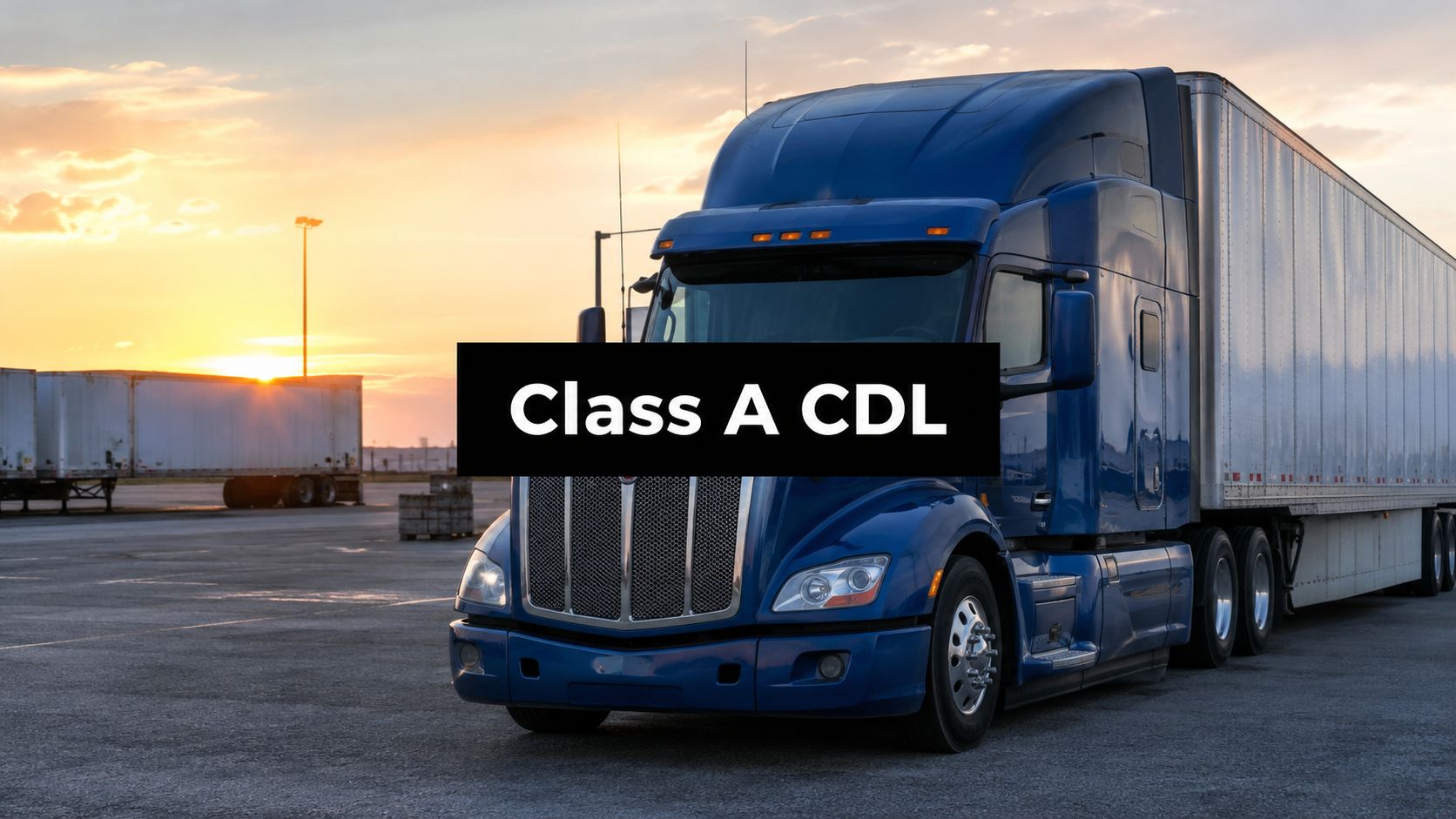
You're probably here because the idea of driving a tractor-trailer sounds simple enough in theory, then the paperwork starts. You hear terms like CLP, ELDT, self-certification, DOT physical, endorsements, and skills test, and suddenly the path feels harder to read than the road signs.
That's normal. Most new drivers don't struggle because they can't learn the job. They struggle because the licensing process is full of small rules that aren't obvious until they block you. One wrong form, one missed wait period, or one assumption about where you're allowed to work can slow your whole plan down.
The good news is that the Class A license requirements make sense once you see them in order.
Your Roadmap to a Trucking Career
A lot of new students start in the same place. They're working a job that doesn't give them much room to grow, they want a trade they can use quickly, and trucking looks like a practical way forward. Then they search for class a license requirements and find a pile of scattered checklists that don't tell them what happens first, what happens next, or what can go wrong.
Think about a student who already knows they want to drive a semi. They walk into the DMV focused on the road test, but they haven't thought about medical certification yet. Then they get the permit, feel excited, and try to schedule the skills test right away. After that, they learn there's a waiting period. Then they hear they also needed federally required training from an approved provider. That kind of confusion is common, and it's avoidable.
A better way to approach the process is to treat it like a route plan. First, make sure you're legally eligible. Then get the medical piece handled. Then take the written tests for your permit. Then complete the required training. Then prepare for the three-part skills exam. Each step enables the next one.
Practical rule: Don't measure your progress by how close you are to “taking the test.” Measure it by whether each legal prerequisite is complete and documented.
Safety matters from the first day, not just after you get hired. If you want a plain-language look at why regulators and employers take training seriously, this overview of understanding common truck accident factors gives useful context. For a broader overview of the license itself, this guide on CDL Class A driver basics is also a helpful starting point.
What a Class A CDL Actually Permits You to Drive
Before you worry about forms and test dates, make sure you know what you're qualifying for.
A Class A CDL is the top tier of commercial licensing for combination vehicles. According to Roadmaster's explanation of Class A CDL standards, to operate a commercial vehicle with a Gross Combined Weight Rating (GCWR) of 26,001 pounds or more while towing a trailer of 10,001 pounds or more, a driver must obtain a Class A CDL, and that license permits driving semi-trucks, tankers, and buses with proper endorsements.

Why Class A sits at the top
The easiest way to understand the license classes is to picture a ladder.
At the top is Class A, built for the biggest and most demanding combination vehicles. These are the setups where a power unit and trailer work together, and the driver has to manage turning space, braking distance, weight transfer, backing angles, and trailer tracking. That's why this license is tied so closely to tractor-trailers and other heavy combinations.
Below that is Class B, which generally covers heavy single vehicles. Class C usually applies to certain smaller commercial vehicles or specialty situations. The key point is that Class A is the credential commonly sought by those aspiring to "drive the big rigs."
Common examples you can drive
With the right endorsements where required, a Class A opens the door to vehicle types such as:
- Tractor-trailers: The archetypal long-haul freight setup.
- Truck and trailer combinations: Useful for many freight operations, including more specialized hauling.
- Tank vehicles: Often used for liquid loads, but they require additional endorsement rules.
- Livestock carriers: Large combinations with their own handling demands.
- Flatbeds: Common in construction, equipment hauling, and oversized freight work.
A Class A isn't just “a bigger license.” It's permission to handle the combination vehicles that require the most control, planning, and situational awareness.
That matters for career planning too. If your goal is over-the-road freight, regional semi work, or specialized trailer work, the class a license requirements are designed to match those higher-responsibility vehicles.
Eligibility and Documentation The First Hurdles
Most licensing problems begin before training ever starts. A student thinks the hard part is learning to back a trailer, but the first real hurdle is getting your eligibility and documents lined up correctly.

Start with the basics
You'll need a valid driver's license from your state, proof of identity, proof of residency, and proof of legal presence that satisfies your state's CDL application rules. States also review your driving history, and you'll need to complete the required medical certification process for commercial driving.
Keep your documents together before you visit the DMV. Don't rely on memory. Put your license, medical paperwork, permit paperwork, and identity documents in one folder and check them the night before every appointment.
If you're not sure what carriers and regulators tend to expect in driver records, this breakdown of essential details for truck driver files helps you understand the kind of documentation culture that exists in the industry.
The age rule that confuses new drivers
Here's the part many people misunderstand. The minimum age and the type of work you can legally do are not the same thing.
According to the Pennsylvania CDL FAQ on self-certification categories, most guides state “18 years old is the minimum age” but fail to clarify that at 18, a driver is legally restricted to intrastate (within-state) driving only in states like Washington, effectively barring them from the majority of national logistics careers that require interstate authority. This distinction is critical because an “Intrastate” certification prevents a driver from legally crossing a state line.
That means an 18-year-old can pursue a CDL path, but not every job that uses a Class A will be available. If your plan is long-haul freight crossing state lines, this distinction changes your options.
The self-certification trap
Self-certification sounds administrative. It isn't. It affects what kind of work you can legally accept.
When you self-certify, you're declaring the type of commercial operation you'll perform. If you choose an intrastate category, you're limiting your legal operating scope. Some students don't realize what they selected until they start applying for jobs and hear that they aren't cleared for interstate work.
Check this twice: Don't guess on self-certification. Read the category descriptions from your state carefully and ask questions before filing.
The DOT medical card matters early
Your medical qualification isn't a final-step item. It's an early-step item. Many students move faster once they handle the physical first, because it confirms they can proceed without medical surprises interrupting training later.
If you need a practical walkthrough, this guide to the medical card for CDL drivers explains what to expect and how to prepare.
The CLP and ELDT Mandate Your Training Pathway
Once your documents and eligibility are in order, the actual training path begins. This part has changed the most for new drivers in recent years, and it's where many people still get tripped up because they assume they only need to study, get a permit, and book a road test.
That's not how the process works for first-time Class A applicants.

The permit comes first
Your first licensing milestone is the Commercial Learner's Permit, usually called the CLP. You earn it by passing the written knowledge tests your state requires for the class and vehicle type you're pursuing. For many Class A applicants, that includes general commercial knowledge plus tests related to combination vehicles and air brakes if applicable to the vehicle setup.
The CLP gives you legal permission to practice in a commercial vehicle under proper supervision. It is not a full license, and it is not permission to skip training.
If you want a straightforward explanation of the permit stage, this overview of what a CLP is and how it fits the process is worth reading before you book anything.
ELDT is not optional
The biggest federal requirement to understand is Entry-Level Driver Training, or ELDT.
According to this summary of the federal ELDT rule, as of February 7, 2022, the federal Entry-Level Driver Training (ELDT) mandate requires all first-time Class A and Class B CDL applicants to complete theory and behind-the-wheel training through a provider listed on the FMCSA's Training Provider Registry (TPR) before they are allowed to take the skills test.
That one sentence answers a lot of common questions. Yes, the training is mandatory. Yes, the provider must be listed on the federal registry. Yes, this happens before the skills test, not after.
A solid visual can help this click:
What the training actually includes
ELDT isn't just classroom time. The federal framework includes both theory instruction and behind-the-wheel training. In practice, that means you should expect work in areas like:
- Theory training: Rules, safety procedures, vehicle systems, inspections, and core operating knowledge.
- Range practice: Closed-course driving where you work on backing, positioning, turning, and low-speed control.
- Road training: Supervised driving in live traffic conditions.
This structure matters because a Class A driver has to do more than move the truck. You have to inspect it, control it precisely, and make safe decisions under pressure.
Training works best when you treat each phase differently. Study theory like you're preparing to explain it. Practice range work like muscle memory. Approach road training like a professional driving evaluation.
Why students get delayed here
The most common problem isn't failing to train. It's poor sequencing.
Some students get the permit and assume the next move is test scheduling. Others finish some practice hours with a friend or employer and assume that counts. But for entry-level applicants, the legal path is tied to approved training and registry completion before the skills exam can happen.
If you remember only one thing from this section, remember this: Regarding class a license requirements, the permit and the ELDT process aren't separate side tasks. Together, they are the pathway.
Passing Your CDL Skills and Knowledge Tests
By the time you reach testing, you should already know the vehicle, the inspection routine, and the control skills well enough to perform them in order under pressure. The examiner isn't looking for guesswork. The examiner wants to see that you can operate safely and consistently.
The written side
The knowledge tests come first in the overall process, but many students underestimate them because they're written instead of behind the wheel. That's a mistake. If your foundation is weak on air brakes, combination vehicle behavior, or inspection concepts, it usually shows up later in your driving habits too.
A good study method is simple. Read the handbook section once for familiarity, then again for detail, then quiz yourself out loud. If you can explain a concept clearly without looking at the page, you usually know it well enough to answer test questions accurately.
For extra preparation, this guide to the Class A permit test can help you sharpen the knowledge side before you walk into the DMV.
The three parts of the skills test
The practical exam is usually divided into three major parts.
Pre-trip inspection
You will demonstrate your ability to inspect the vehicle methodically and identify safety issues before driving. You'll point out parts, describe what you're checking, and show the examiner that you understand how the vehicle should look and function.
Students often lose points here because they know the truck in a casual way but not in a test-ready way. You need a routine. Same order every time. Same language every time. Same calm pace every time.
The pre-trip isn't a memory contest by itself. It shows whether you'll catch problems before they become roadside or highway problems.
Basic control skills
This part happens at low speed on a controlled course. You may be asked to complete backing and positioning maneuvers that show you can control the truck-trailer combination precisely.
What matters most here is patience. Fast hands and rushed corrections usually create bigger mistakes. The best candidates slow everything down, use the mirrors deliberately, and make controlled adjustments.
On-road driving
The road test brings everything together. The examiner watches how you handle turns, lane placement, intersections, traffic awareness, speed control, and overall decision-making.
This section rewards habits, not last-minute effort. If mirror checks, signals, lane discipline, and smooth braking are already part of how you drive, the road test feels like a demonstration. If those habits aren't built yet, the road test feels long.
Understanding Costs Timelines and State Variations
This part frustrates students because they want one clean answer to “How much will this cost?” and “How long will it take?” Realistically, both answers depend on your state, your training provider, your scheduling speed, and whether you hit delays with paperwork, testing, or retakes.
That said, you can still build a practical planning framework.
Where your time goes
The timeline usually stretches across several separate stages: document gathering, medical certification, permit testing, required training, test scheduling, and the final exam. One of the biggest hidden delays is waiting on appointments and availability, not the training itself.
Another common delay comes from sequencing mistakes. If a student books a test before confirming that all training records are complete and all waiting rules are satisfied, they can lose time and have to reschedule.
Where your money goes
Your largest expense is usually training. Beyond that, you may have permit-related fees, licensing fees, medical exam costs, and travel or scheduling costs connected to the testing process. The exact amounts vary enough by location and provider that it's better to ask for a written breakdown than rely on a generic estimate.
If you're planning for the long term, think beyond the license itself. Once you begin working, business-side obligations can become part of the picture too. For example, owner-operators and small fleets often need to find trucking insurance policies that fit the type of hauling they plan to do.
Here's a practical planning table you can use:
| Item | Estimated Cost | Estimated Time |
|---|---|---|
| CDL training program | Varies by school and program | Varies by schedule and provider |
| DOT physical and medical paperwork | Varies by examiner and state process | Usually depends on appointment availability |
| CLP testing and application | Varies by state | Depends on DMV scheduling |
| ELDT completion | Often included in training pathway, but varies | Depends on program pace and completion records |
| Skills test scheduling | Varies by state or third-party site | Depends on local availability |
| License issuance | Varies by state | Usually after passing all required steps |
State rules can add more requirements
Federal rules create the baseline, but states can add their own layers.
A clear example comes from California. According to the California DMV commercial license requirements page, original Class A CDL applicants must complete a minimum of 15 hours of behind-the-wheel training, including 10 hours on public roads, and submit a DL 1236 certification to the DMV, in addition to the federal ELDT requirement.
That's why it's risky to copy a friend's licensing path from another state. The broad class a license requirements may sound the same, but the details can shift enough to affect your schedule and paperwork.
If you're budgeting your own path, this guide on the cost of Class A CDL training can help you frame the questions to ask before enrolling.
Common Pitfalls and Your Test Day Checklist
Most failures and delays don't come from a lack of potential. They come from avoidable mistakes.
The biggest one is timing. According to CDL Jobs' overview of CDL license steps, the minimum wait time to schedule a CDL road skills test after passing knowledge and physical tests is typically 14 days, and applicants must arrange their own CMV for the test since DMVs generally do not provide commercial vehicles. That catches people off guard all the time. They get the permit, feel ready, and only then learn they can't test yet or they don't have a legal test vehicle lined up.

What trips people up most often
- Scheduling too early: The CLP waiting period matters. Don't assume enthusiasm overrides legal timing.
- Showing up without documents: Bring your CLP, medical card, and any required training proof.
- Forgetting the vehicle issue: In many places, the test center won't supply a commercial vehicle.
- Under-preparing pre-trip: Students often practice driving more than inspection, then lose ground on the first part of the exam.
- Rushing maneuvers: Slow, controlled corrections beat fast, messy ones.
Your night-before checklist
Use a simple checklist and don't overcomplicate it.
- Confirm your paperwork: Put every required document in one folder.
- Verify your vehicle plan: Make sure the truck is the correct class and is available.
- Run your pre-trip out loud: Don't just think it through. Say it.
- Practice calm backing: Focus on setup, mirror use, and patience.
- Get sleep: A tired student makes preventable mistakes.
You don't need to be perfect. You need to be prepared, legal, and consistent.
If you respect the process, the class a license requirements stop feeling like a maze. They become a sequence. That shift alone gives most students more confidence on test day.
If you're ready to move from research to real training, Patriot CDL helps students build the permit knowledge, behind-the-wheel skill, and test-day confidence needed for a Class A path. Their accelerated programs, flexible scheduling, and hands-on instruction can make the licensing journey feel far more manageable for first-time drivers and career changers alike.