You're probably dealing with one of three situations right now. You've got a DPS appointment coming up and you're not sure your paperwork is right. You're over 18 and someone told you that you can “just go get your license,” which is only half true. Or you need to get on the road fast for work, school, or family and the wait times are already testing your patience.
That's normal in Texas. The state has the second-highest number of licensed drivers in the United States, with 19,543,658 recorded in 2024, and that total is projected to reach about 22.4 million by 2030 according to licensed driver data compiled here. When that many people are moving through one licensing system, the process gets crowded, slow, and unforgiving.
Many applicants don't fail because driving is too hard. They fail because they show up with the wrong documents, miss an age-based requirement, or book the wrong kind of test. If you want to get drivers license in Texas without wasting a trip, you need a plan that matches how the system works.
Navigating the Path to Your Texas License
You book a DPS slot three weeks out, take off work, show up early, and then the process dies at the counter because your course certificate is missing or your documents do not line up. I see that happen all the time. The people who finish fast are not always the best drivers. They are the ones who handle the steps in the right order.
Texas licensing is straightforward once you stop treating it like a single appointment. For many applicants, especially ages 18 to 24, the primary problem is not driving skill. It is missing one requirement that nobody bothered to explain clearly. That age group gets tripped up more than any other because friends keep giving outdated advice.
Start with the sequence that saves time
Use this order if you want the fewest delays:
- Verify the rules for your age group
- Complete the driver education or certificate requirements that apply to you
- Build your document folder before you book anything
- Choose whether DPS or a third-party tester will handle the road test
- Go to the in-person DPS visit ready to finish, not troubleshoot
That order saves appointments.
A common mistake is booking first and researching later. Then the applicant learns they still need adult driver ed, a supporting identity document, or a car that qualifies for the exam. For drivers ages 18 to 24, that mistake is expensive in time because one missing item can push the whole process back weeks.
The 18 to 24 group has a hidden trap
A lot of adults hear, “You're over 18, so you can just get your license.” That is only partly true in Texas. If you are 18 through 24, you need to pay close attention to the training rules before you ever touch the scheduler.
This is one of the biggest failure points in the state. The applicant feels like an adult, so they assume the teen rules are gone and no education is required. DPS does not care what someone told you. DPS cares whether you brought the right proof for your age bracket on that day.
Your testing choice matters more than people think
Another place people lose time is the road test decision. Many first-time applicants automatically wait for a DPS driving test because they assume that is the standard path. It is not always the smart path.
In many parts of Texas, using a third-party testing service is the faster move. It can cut out long DPS road test waits and give you more scheduling flexibility. The trade-off is cost, and some applicants prefer doing everything in one system. But if your goal is getting licensed quickly for work, school, or family needs, third-party testing can be the difference between driving next week and waiting another month.
You still need to pay attention to details. Bring a test vehicle that is legal, clean, and easy to handle. Know what restrictions can be added to a license and what they mean before test day. This guide on Texas driver license restriction codes, including restriction B helps if you are sorting out license limits ahead of time.
The failures I see most often
These are the problems that stop first attempts cold:
- Age-rule mistakes: Applicants 18 to 24 skip a required course or bring the wrong completion record.
- Bad appointment strategy: They grab the first DPS slot without knowing whether they still need a knowledge test, road test, or both.
- Weak document prep: Names, addresses, or supporting records do not match closely enough to pass review.
- Poor road test planning: They use a vehicle with a warning light, expired paperwork, or another avoidable issue.
- Last-minute errands: They scramble for copies, forms, or signatures on test day instead of handling them beforehand with services like a remote and on-site notary public when needed.
Handle those points early, and the process gets much easier. That is how people pass on the first try.
Your Document and Eligibility Checklist
A failed Texas license appointment usually starts at the counter, not in the car. I have watched applicants do everything right in practice, then get turned away because one name was spelled differently, one residency document was too old, or the insurance card in the glove box had expired.
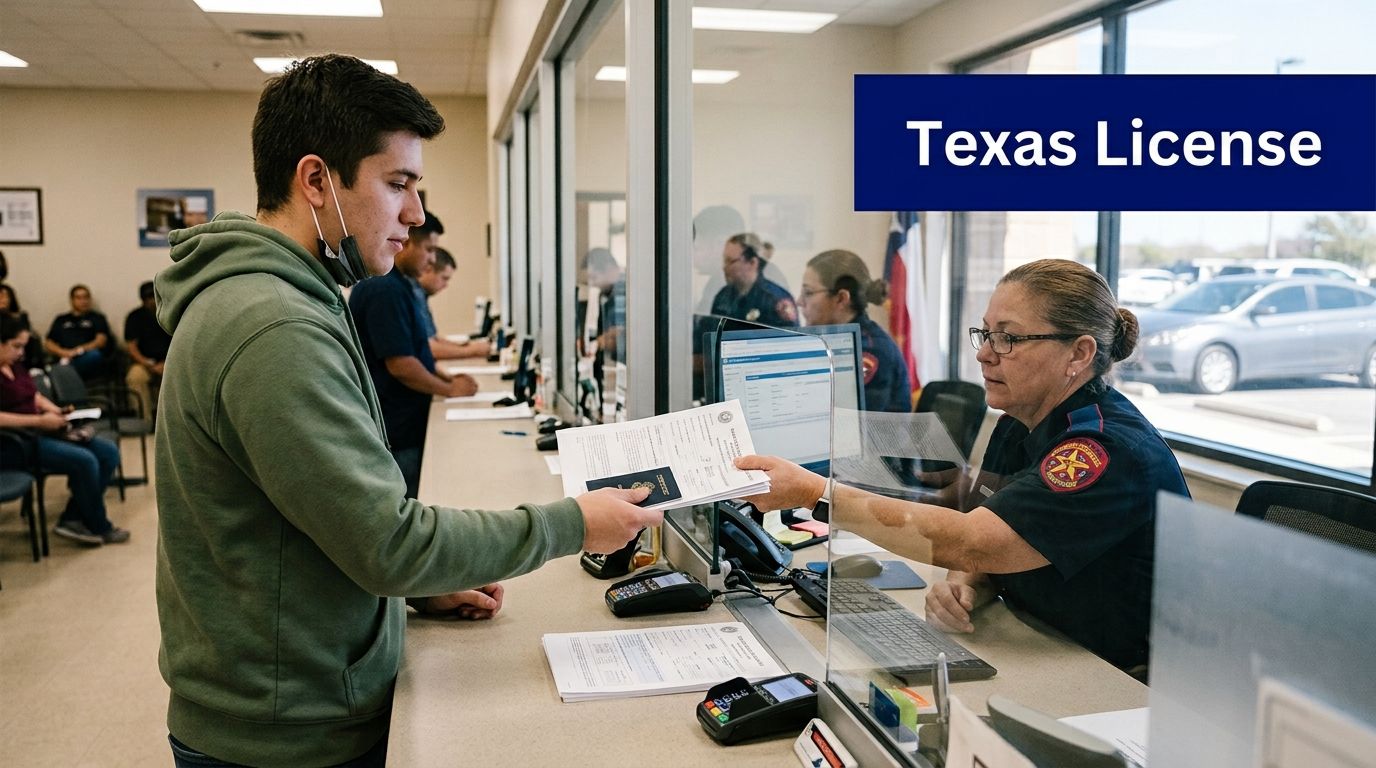
Texas still handles first-time applicants in person. That means you need documents that prove identity, lawful presence or citizenship, Texas residency, and Social Security, plus you will complete the photo, thumbprint, and vision steps on site.

Practical rule: Do not book your appointment until every required document is in one folder and every name, address, and date lines up.
What to bring
Bring paper copies when possible. Phone screenshots slow things down, and if signal or battery becomes a problem, the clerk is not going to wait while you sort it out.
- Proof of identity: A passport or birth certificate is often the cleanest path, depending on your situation.
- Proof of Social Security number: A Social Security card is usually the simplest document to present.
- Proof of lawful presence or U.S. citizenship: Bring the document that directly proves it. Do not rely on a substitute unless you know DPS accepts it.
- Proof of Texas residency: Utility bills, lease documents, bank statements, or other accepted records must show your name and current Texas address clearly.
- Road test vehicle documents: If you are testing in a passenger vehicle, have current registration and insurance ready to hand over fast.
- Driver education record if your age requires it: Adults 18 to 24 often encounter more difficulty than expected with this requirement. They assume adult status means fewer requirements, then show up without the right completion record.
That last point matters more than many applicants realize.
The mistakes that stop approval fast
The biggest paperwork problem is not missing everything. It is missing one small item that blocks the whole transaction.
Teens under 18
Teens need the right course records and stage documents. One missing certificate can end the appointment before any test begins.
Adults 18 to 24
This age group gets caught by hidden eligibility issues more than any other. If you are 18 to 24, check your course completion documents before you ever look for a DPS slot or third-party test date. A lot of wasted appointments start here.
Adults 25 and older
The process can be simpler, but only if your identity and residency documents are clean and current. Adults in this group still lose appointments over address mismatches and expired records.
New Texas residents
Out-of-state documents may prove who you are. They do not replace Texas residency proof. Handle your address documents early, especially if you just moved and your bills, lease, and mail still show mixed addresses.
One problem people underestimate
Name mismatches cause constant trouble. If your Social Security card shows one version of your name, your lease shows another, and your identity document shows a third, fix that before test day. Clerks do not have room to guess.
It also helps to handle supporting paperwork before the appointment if you need identity-related services such as remote and on-site notary public help for related documents.
If you are sorting out possible license limits before you apply, review this guide to Texas driver license restriction codes, including restriction B. It helps you catch issues early instead of after your card is printed.
The Right Driver Education for Your Age
This is the part adults get wrong more than teenagers do.
Teens expect rules. Adults hear that Texas waives the learner's permit requirement for people 18 and older, then assume they can walk in, test, and leave with a license. That misunderstanding causes a lot of rejected appointments.

What applies if you're under 18
Teen drivers follow the graduated path, not the adult shortcut. That means formal driver education, a learner phase, and supervised practice all matter. The main mistake teens make isn't usually overconfidence. It's rushing through the process and assuming completion of one phase automatically means they're ready for the next.
For teens, consistency beats cramming. Short, regular practice sessions help more than one long drive the weekend before a test.
What applies if you're 18 to 24
Here's the hidden rule that catches people. Texas waives the learner's permit requirement for ages 18+, but adults 18 to 24 must still complete a mandatory 6-hour driver education course and the Impact Texas Driver video before applying, as explained in this Texas adult driver license requirement guide.
That means age gets you out of one step, not out of preparation.
If you're 18 to 24 and you show up without the course completion record and the ITD requirement handled, the appointment can unravel before you ever reach the test stage.
What works best for working adults
A lot of applicants in this group delay because they think driver education means sitting in a classroom on someone else's schedule. It doesn't have to. The adult course can be completed through approved providers in a format that fits around work, school, or family obligations.
That flexibility matters. When adults put off the course, they also put off the test, and then the whole license timeline drifts by weeks or longer.
Here's the practical breakdown:
| Age group | Main issue | Best move |
|---|---|---|
| 15 to 17 | Stage-based requirements | Follow the teen path carefully and keep every completion record |
| 18 to 24 | Misunderstanding the permit waiver | Complete the 6-hour course and ITD before booking |
| 25 and older | Assuming no prep is needed | Even if education rules are lighter, test prep still matters |
Driving skill improves faster when training is structured. If you want cleaner habits before the road test, these tips on how to improve driving skills are useful because they focus on repeatable habits, not vague confidence advice.
Passing the Knowledge and Driving Tests
It's common to overcomplicate the written test and underestimate the road test. That's backward.
The knowledge exam rewards focused study. The driving test exposes every sloppy habit you've built while practicing with family or friends who stopped correcting you.
How to handle the written exam
Start with the Texas handbook, but don't stop at passive reading. The people who pass comfortably usually do three things:
- Study by topic: Signs, right-of-way, lane use, speed rules, and penalties are easier to retain in clusters.
- Miss questions on purpose during practice: When you get one wrong, write down why it was wrong. That fixes weak spots faster than rereading whole chapters.
- Review before your appointment, not just the week before: Short review sessions keep rules fresh.
If you need a better study method than reading the same pages again, use a structured approach like the one in this guide on the best way to study for the permit test.
Also remember the earlier requirement for the Impact Texas Driver video if your age group must complete it. People sometimes prepare well for the exam but still get blocked by an unfinished prerequisite.
What examiners watch during the road test
Examiners aren't looking for racing-school precision. They want controlled, predictable, legal driving.
They pay close attention to:
- Observation habits: Check mirrors, scan intersections, and look before lane changes and turns.
- Speed control: Don't crawl, but don't coast over the limit because you're nervous.
- Lane discipline: Stay centered and don't cut corners.
- Stopping behavior: Full stops matter. Rolling through is a classic fail trigger.
- Parking control: Parallel parking and backing don't have to look pretty. They do need to be safe and under control.
What doesn't work
A lot of applicants practice only their favorite parts of driving. They'll cruise neighborhood streets for days and avoid the exact maneuvers likely to appear on the test.
That backfires. If parallel parking makes you tense, that's the thing you should repeat until it feels boring. If right turns drift wide, fix that before the examiner sees it.
Smooth and safe beats flashy every time. Examiners trust drivers who look deliberate.
A simple road test practice plan
Try this on the final stretch before your test:
- Run a pre-drive routine every time. Seat, mirrors, belt, calm start.
- Practice turns and stops in mixed traffic, not just empty streets.
- Repeat parking drills until you can recover calmly from a bad setup.
- Have another adult stay quiet for one full mock test so you can drive without coaching.
The goal isn't perfection. It's removing surprises.
Booking Appointments and Skipping the Lines
Texas licensing delays frustrate people because they assume there's only one path. There isn't.
DPS is still the official center of the licensing process, but it doesn't have to handle every part of your journey. If your timeline matters, you need to think like someone managing a bottleneck, not like someone waiting for permission.

Two paths for the road test
The traditional path is to wait for a DPS test opening. That can work if your schedule is flexible and there's no urgency.
The smarter path for many applicants is to use an approved third-party testing provider. Third-party driving test providers in Texas can issue the official DPS road test pass certificate, eliminating the need to visit a DPS office for testing. In 2025, these providers handled 28% of all road tests in urban counties, according to the Texas DPS driver license application information.
That matters because it changes your waiting problem into a scheduling decision.
Here's a quick visual overview before you choose:
When paying for speed makes sense
Some people hesitate because third-party testing isn't free. That's fair. But cost isn't the only factor.
A third-party test often makes sense if:
- You need a license for a job start date
- You're balancing school or family scheduling
- You've already waited too long for DPS availability
- You perform better when you can choose a faster appointment window
On the other hand, waiting for DPS may be fine if your timing is flexible and you'd rather minimize out-of-pocket expense.
A delayed road test can cost more in lost time than a paid test costs in cash.
What third-party testing does and doesn't solve
It solves the testing wait. It does not eliminate the in-person DPS step required for your actual license issuance. You still need to finish the state process correctly.
That's where people get confused. They think passing elsewhere means they're done. They're not. They've removed one major bottleneck.
If you're planning ahead beyond the first license, it also helps to understand what comes later. This overview of how to renew a Texas license gives you a practical sense of the next stage so you don't treat licensing as a one-time event.
Receiving Your License REAL ID vs Standard
You passed the test, gathered your paperwork, and finally got a DPS appointment. Then the clerk stops the process over a name mismatch, an old address, or missing third-party test paperwork. I see that happen more than people expect, especially with first-time applicants who assume the hard part ended at the road test.
Your license is not issued until DPS finishes the in-person check. That includes your photo, vision screening, identity review, and final document approval. If you used a third-party road test to beat the DPS testing backlog, this is the step that still controls whether you leave with the process finished or with a return trip.
REAL ID or standard license
For nearly every first-time driver, REAL ID is the smarter choice if your documents are clean and consistent. It does not give you extra driving rights. It gives you a card that works better as everyday identification.
Here's the practical difference:
| License type | Best for | Main consideration |
|---|---|---|
| REAL ID-compliant license | Drivers who want one license that also works for broader identification use | Your identity and residency documents need to match cleanly |
| Standard license | Drivers who only want basic driving authorization right now | You may need to replace it later if your ID needs change |
A lot of applicants choose badly because they focus on the card fee or rush through the counter questions. The actual trade-off is convenience now versus another DPS trip later.
The mistakes that slow down issuance
The final visit usually falls apart for predictable reasons:
- Your name does not match across documents
- Your proof of residency is outdated or too weak
- You forgot the paperwork from your third-party driving test
- You turned 18 to 24 and missed a required education or completion record earlier in the process
- You assume DPS can “look it up” instead of bringing the document yourself
That 18 to 24 group gets tripped up more than they should. Official instructions tell you what is required, but they do not always make clear how often applicants show up with one missing certificate, one wrong address, or one document that creates a manual review. Manual review means delay.
What to do before you walk in
Check every document line by line before your appointment. Names, suffixes, apartment numbers, and issue dates matter.
If you tested through a third-party provider, keep that completion paperwork at the front of your folder, not buried in your glove box. If you are already thinking past a standard license and into commercial driving, look at CDL training options in Austin, TX after you finish this step so your next move is planned out early.
One more instructor tip. If your documents are messy, do not gamble on “maybe they'll accept it.” Fix the mismatch first. That decision saves more failed appointments than any test-day driving advice I can give.
From a Driver License to a CDL Career
A lot of Texans get their Class C license, then realize a few months later that the better paycheck is in a box truck, dump truck, bus, or semi. If that is your direction, treat your regular license as the first requirement, not the finish line.
Your standard Texas license gets you in the door. A CDL raises the standard fast. The testing is tighter, the terminology matters, and small habits that slide on a basic road test will cost you points in commercial training.

Where new CDL applicants struggle
The first surprise for many new CDL students is that the toughest part is often before the truck even moves. The pre-trip inspection filters out a lot of applicants because they try to recite lines from memory instead of working through the vehicle in the same order every time.
A widely shared Texas CDL pre-trip discussion points to the pre-trip as a major failure point for applicants, and that matches what instructors see in the yard every week. Backing and shifting matter. So does road control. But the pre-trip is where nervous test-takers lose their sequence, skip a component, or say the right phrase without identifying the part.
That is fixable.
What separates successful CDL trainees
The applicants who pass cleanly usually train with a repeatable routine:
- They follow the same inspection order every practice session
- They touch or point to each part as they name what they are checking
- They explain the condition clearly instead of rushing through memorized wording
- They practice under test-style pressure, not just casual walk-arounds
That last point matters more than people expect. Family help and extra driving time can get many applicants through a regular license test. Commercial driving usually requires a more structured training environment, because the examiner is grading process, safety language, and vehicle awareness at the same time.
Why the transition matters
A CDL can turn basic driving privileges into a job skill with real earning power. It also comes with a bigger commitment in time, discipline, and test prep. That trade-off is worth understanding before you sign up.
If you are serious about trucking or commercial driving, review what CDL training in Austin, TX includes before you choose a school. Good training saves time, fixes bad habits early, and gives you enough repetition on inspections, backing, and road work to test with confidence.
I tell students the same thing every time. Build clean habits at the Class C level, because commercial training gets easier when you already take instructions seriously, follow a sequence, and prepare your paperwork before test day.