You're probably at the stage where trucking sounds like a real opportunity, but the first steps still feel scattered. You know you need a permit. You've heard about the written tests, the medical card, the school options, and the road test. What usually gets missed is how these pieces fit together in real life.
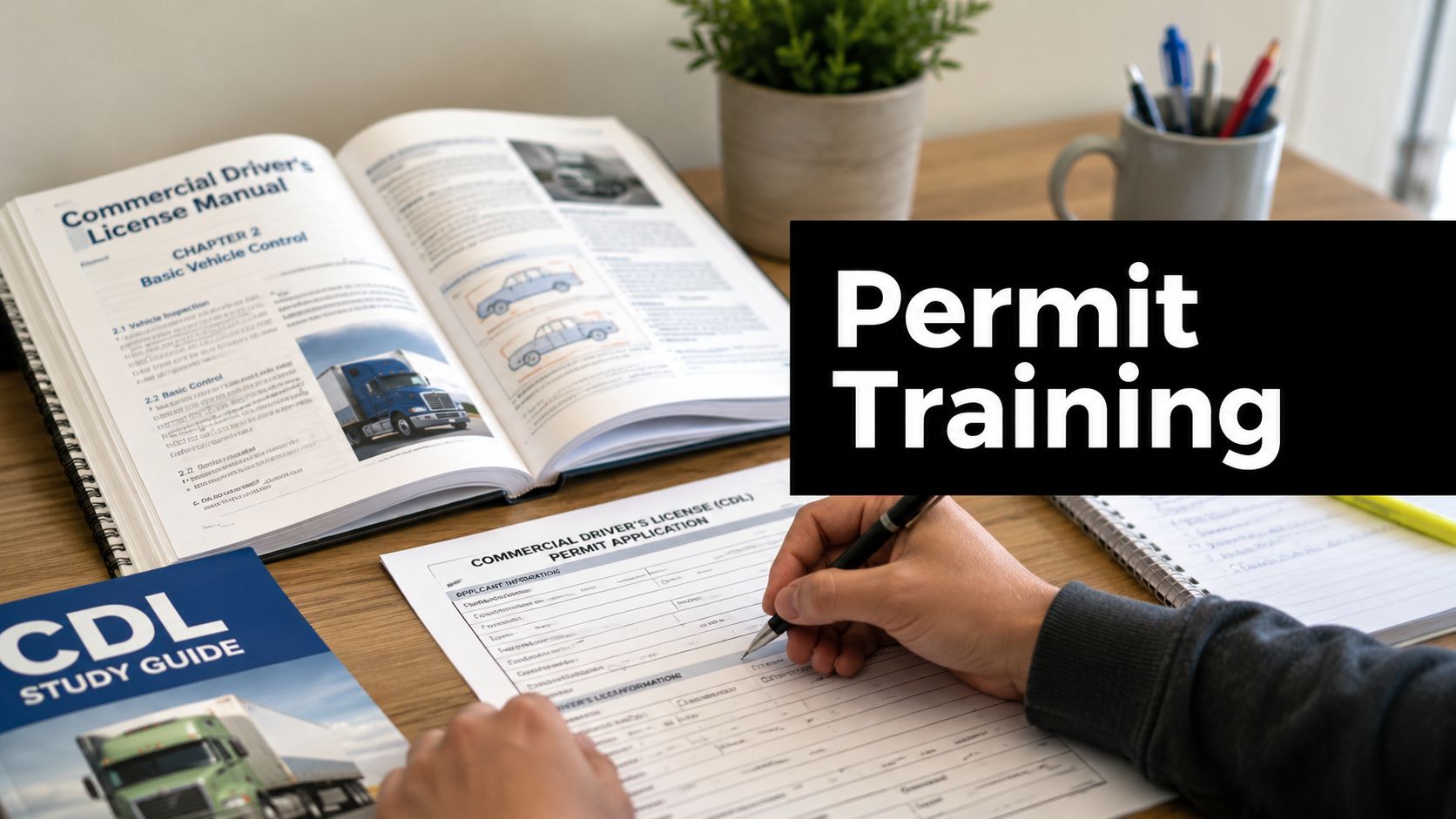
That's where solid CDL permit training matters. Passing the permit test is only one checkpoint. The smarter approach is to learn the written material in a way that prepares you for the truck, the yard, the backing pad, and the examiner. If you build that mindset early, you won't just chase the right answers. You'll understand why the rules exist and how they show up once you're in the driver's seat.
Confirming Your Eligibility and Gathering Documents
You can be motivated, ready to work, and still get stalled before you ever sit for the permit test. Most delays happen because applicants study first and verify paperwork later. That's backwards.
Start with the essential requirements. For interstate commercial driving, which accounts for the majority of well-paid shipping jobs, federal regulations require drivers to be at least 21 years of age. Some states allow testing for the CDL at 18, but those drivers are restricted to intrastate work, which limits job options until they turn 21, as outlined in this overview of CDL school requirements for interstate and intrastate drivers.
What to check before you study
Your first pass should be simple and honest.
- Age and license status: Make sure you hold a valid regular driver's license and that your age lines up with the kind of driving you want to do.
- Driving history: Some programs pull a 10-year driving record during the application process, and a recent serious offense can stop the process before class starts.
- Medical readiness: You'll need a DOT physical certification and a DOT drug screen before training begins at many schools, which is part of the screening process described by Midlands Technical College's CDL program requirements.

A lot of new applicants underestimate the medical side. The DOT physical isn't just another form. It confirms you're medically qualified to operate a commercial vehicle, and if there's an issue with blood pressure, vision, medication documentation, or a missing record, your timeline can slow down fast.
Practical rule: Get your medical card and drug screen handled early. A permit study plan doesn't help much if you can't enter training on schedule.
Build a document packet now
Don't walk into the DMV or a school office digging through your phone and glove box. Put together a folder ahead of time with the documents you're most likely to need.
Bring these in hard copy when possible:
- Driver's license: Current and not expired.
- Proof of identity: Birth certificate or other accepted identity document.
- Social Security documentation: Card or other accepted proof tied to your legal name.
- Proof of residency: Use the documents your state accepts.
- Medical certification paperwork: Keep copies, not just originals.
If you want a fuller breakdown of the paperwork side, this guide to CDL permit requirements is a useful checklist.
Why this step matters more than people think
The permit process rewards organized applicants. The people who move cleanly through it usually aren't smarter. They handle eligibility, identity documents, and medical requirements before they burn time on the wrong task.
Treat this like your pre-trip before the pre-trip. If the foundation is sloppy, the rest of your CDL permit training gets harder than it needs to be.
Mastering the Written Knowledge Tests
You can spot the applicants who studied only to pass. They sit down for the permit exam, recognize a few question patterns, and get through it. Then they hit the range, hear an instructor talk about brake lag, off-tracking, or trailer swing, and the blanks show up fast.
The written tests are your first layer of driver training. Treat them that way. If you understand why the rule exists, you retain it longer, you test better, and you make the jump into hands-on training with fewer bad habits.
Know what you're actually being tested on
Most Class A permit applicants need to prepare for three core knowledge tests:
- General Knowledge
- Air Brakes
- Combination Vehicles
Those topics connect on the road. General Knowledge covers how a commercial vehicle handles space, speed, weight, and hazards. Air Brakes explains what the system is doing before, during, and after a stop. Combination Vehicles covers the added problems that come with pulling a trailer, especially in turns, backing, and emergency situations.
Study them as operating principles, not isolated facts.

A study method that carries into the skills test
Start with your state CDL manual. Practice questions help you check recall, but the manual gives you the language, definitions, and logic the permit test is built on.
Use this sequence:
- Read one section straight through. Keep your focus narrow.
- Restate the key points in plain English. If your explanation sounds fuzzy, go back and clean it up.
- Attach each rule to a real driving task. Link it to stopping distance, downhill control, coupling, backing, lane changes, or pre-trip inspection steps.
- Use practice tests after that. Missed questions should send you back to the manual section you did not fully understand.
That last step matters. Practice tests are useful, but they are a checking tool. They do not replace learning the material.
A simple example. If you miss a question about air brake lag, don't just memorize the right answer and move on. Ask what that delay means in traffic, with a loaded trailer, on wet pavement, or while following too close. That habit helps on the permit exam and later in the truck.
What stronger students do differently
The permit applicants who progress fastest usually ask better questions.
They ask why a pre-trip inspection follows a set order. They ask why a combination vehicle reacts differently in reverse. They ask what a rule is trying to prevent, not just which answer choice sounds familiar. That is the gap between passing a written test and being prepared to learn the job.
I tell new recruits the same thing every cycle. If you build understanding now, the skills yard starts making sense sooner. If you memorize answers without context, the instructor has to reteach the foundation while also trying to teach backing, control, and inspection flow.
If you want a clearer breakdown of what to expect, this guide to the CDL written test is a useful next step.
Aim past the passing score
Many states require a passing score of 80 percent on the knowledge exams. That number matters, but it should not be your whole target.
A better goal is to leave the DMV with permit-level knowledge that already connects to the truck. You should understand why air systems need inspection, why following distance changes with weight, and why combination vehicles demand more patience in turns and backing. That kind of study pays you back twice. It helps you pass the written test, and it shortens the learning curve once hands-on training starts.
Choosing the Right CDL Permit Training Program
A permit in your wallet does not mean you are ready for the yard.
The right program starts closing that gap on day one. It should teach the written material in a way that carries over to backing, pre-trip inspection, and basic control. The wrong program gets people through a schedule, collects tuition, and leaves them confused the first time they have to explain a brake check out loud or recover a bad setup in reverse.

I have seen the difference many times. In a strong program, instructors correct small mistakes before they turn into habits. In a weak one, students spend too much of the day waiting, watching, and guessing what they did wrong.
What separates a strong program from a weak one
Start with instructor access. If one instructor is trying to manage too many students, your wheel time drops and your feedback gets vague. That matters most in backing and pre-trip, where small errors stack up fast.
Look for a program that does four things well:
- Keeps training groups manageable: Less standing around usually means more repetitions and more correction.
- Coaches backing step by step: Good instructors teach setup, sight picture, pull-ups, and how to fix a drift before it becomes a failed attempt.
- Teaches pre-trip as a sequence with a purpose: You need to know what you are checking, why it matters, and how to say it clearly under pressure.
- Connects permit study to the skills test: Air brakes, combination vehicles, and safety rules should carry straight into range work and road training.
That last point gets missed in a lot of online advice. A school should not treat the permit test and the CDL skills test as separate jobs. The best programs build one foundation for both.
Questions worth asking before you enroll
Price matters. So does start date. Neither tells you much about how well the school teaches.
Ask direct questions and listen for direct answers:
| What to ask | Why it matters |
|---|---|
| How many students work with one instructor at a time? | Too many students usually means less seat time and less individual correction. |
| How do you teach backing to beginners? | Strong schools have a method, not just repeated attempts and general comments. |
| How do you teach pre-trip inspection? | You need a system you can remember under stress, not a script with no logic behind it. |
| What happens if a student falls behind? | Extra coaching is a good sign. A rushed answer is not. |
If the staff cannot explain their process clearly, training often feels the same way once class starts.
Here's a closer look at what a training environment can feel like in practice.
Cheap training often costs more later
Low tuition can be a fair trade if the school is organized and instructors stay engaged. Low tuition becomes expensive when students lose hours waiting for a turn, get rushed through pre-trip, or receive the same generic advice no matter what mistake they made.
That is where recruits start building bad habits. A sloppy backing setup gets repeated. A weak inspection routine never gets cleaned up. Then the student shows up for the skills test with permit knowledge that never turned into usable skill.
On the range, personalized correction beats extra lecture every time.
If you're comparing schools, this overview of truck driving school options can help you size up programs the right way.
Good CDL permit training should leave you with more than a passing score. It should leave you better prepared to learn the truck, handle correction, and make faster progress once practice starts.
Navigating Test Day and Endorsement Logistics
Test day is easier when you treat it like an operations check, not a dramatic event. Most permit failures aren't about intelligence. They come from rushing, bringing the wrong documents, or letting nerves break concentration.
Start the day before, not the morning of. Confirm your appointment time, your location, and exactly what your state wants you to bring. Put your identification and permit paperwork in one folder. Don't assume the DMV will be flexible if something is missing.
What to bring and how to show up
A clean test-day routine helps more than people think.
- Bring your ID packet: Use the same organized document set you built at the beginning of the process.
- Arrive early enough to settle down: Walking in flustered raises your error rate.
- Read every question fully: Many misses happen because applicants answer the question they expected, not the one on the screen.
- Don't change answers impulsively: If you know the concept, trust your reasoning.
If you need help finding the right location and planning logistics, review these CDL testing sites.
Managing nerves without overcomplicating it
Nerves are normal. The fix isn't hype. The fix is a process.
Use a short reset if you feel your focus slipping. Plant both feet, slow your breathing, and read the next question as if it's the only one that matters. On the permit side, calm usually beats speed.
For the later skills phase, nervousness often shows up in backing mistakes and skipped steps. That's one reason good training matters so much. The student who has repeated the right process enough times is less likely to unravel under pressure.
Read slowly. Most test-day mistakes are self-inflicted.
Endorsements to think about early
Some applicants wait too long to consider endorsements. That creates extra trips and extra delays. If you already know the kind of freight or equipment you want to work with, ask your state or school which endorsements make sense to add during the permit stage.
| Endorsement Code | Description | Required Test |
|---|---|---|
| H | Hazardous materials | Written knowledge test |
| N | Tank vehicles | Written knowledge test |
| T | Doubles and triples | Written knowledge test |
| P | Passenger transport | Written knowledge test |
| S | School bus | Written knowledge test and additional state requirements |
Not every new driver needs every endorsement. But if you know you want tanker work, passenger driving, or specialized freight later, it's smart to understand the endorsement path now instead of rebuilding momentum later.
From Permit to Practice Your Next 14 Days
The day you receive your Commercial Learner's Permit feels like a win, and it is. But it's also where a lot of people waste time. They treat the permit as a pause. It isn't. It's the point where training becomes physical.
Federal law requires applicants to hold a Commercial Learner's Permit for a minimum of 14 days before they can schedule the final road skills test, which is explained in this summary of CDL license steps and CLP timing. Those 14 days aren't there to slow you down. They're there to give you supervised practice time that sticks.

What the first few days should look like
The strongest start is simple. Get around the truck. Learn the cab layout. Start connecting written knowledge to physical components and movement.
A productive early sequence often includes:
- Pre-trip repetition: Learn the order, not just the words.
- Basic control: Straight backing, lane placement, slow-speed steering inputs.
- Setups and reference points: Understand where the trailer goes when the tractor moves.
- Observation habits: Mirrors, pull-ups, and stopping to reset instead of forcing a bad angle.
At this stage, many students realize the extent of their permit material comprehension. If air brakes, combination behavior, and inspection language are already familiar, behind-the-wheel instruction lands faster.
The middle of the waiting period
By this stage, the permit holder usually stops feeling like a test taker and starts feeling like a trainee. That shift matters.
One day you're reciting pre-trip items. A few sessions later, you're spotting why a rushed inspection misses defects. One day you're reacting late in backing. A few sessions later, you're slowing down, correcting early, and using the space better.
That's what supervised repetition does. It turns a permit from a document into a skill-building window.
If you're mapping out that transition, this guide to behind-the-wheel training is a practical next step.
What not to do during these 14 days
Don't spend the waiting period acting busy while avoiding the hard parts.
Avoid these mistakes:
- Skipping pre-trip because it feels repetitive
- Chasing advanced maneuvers before basic control feels steady
- Practicing while mentally rushed
- Treating mistakes as embarrassment instead of feedback
The permit gives you legal access to supervised practice. Use every day like it matters, because it does.
A student who uses those 14 days well usually arrives at the skills test with a different attitude. Less guessing. Less panic. More routine. That's the purpose of CDL permit training.
Your Next Steps Toward a Trucking Career
By this point, the process should look a lot clearer. First, make sure you're eligible and document-ready. Then study for the written tests in a way that builds real understanding, not just short-term recall. After that, choose a training program that gives you coaching, correction, and enough repetition to improve. Once you have the permit, use that waiting period for disciplined supervised practice.
That sequence matters because each stage feeds the next one. Clean paperwork makes enrollment smoother. Better written prep makes truck instruction easier to absorb. Better hands-on training reduces test-day panic. Strong use of the permit period gives you a better shot at walking into the skills exam prepared instead of hopeful.
A trucking career doesn't start when the plastic license arrives in the mail. It starts when you begin acting like a professional trainee. That means showing up organized, learning the why behind the rules, and taking correction without ego.
If you're already thinking beyond the permit, spend some time looking at the kind of work available to new drivers. This roundup of truck driving jobs hiring now can help you connect your training path to actual employment goals.
The permit is the gate. The road test is the checkpoint. Your habits in training decide what happens next.
If you're ready to turn permit prep into real progress, Patriot CDL offers a direct path from classroom knowledge to hands-on training. It's a practical next step for students who want structured guidance, strong instruction, and a faster route into a trucking career.