Picking the right truck driving school is easily the most critical first step you'll take toward a career on the open road. These programs are where you get the hands-on, real-world training needed to pass your Commercial Driver's License (CDL) exam and learn to handle a tractor-trailer like a pro.
Your Roadmap To A Professional Trucking Career
Let's be honest: starting a new career is a huge deal, and trucking is no different. It’s a path that promises independence, great pay, and solid job security in a field that's always hiring—often without the time and expense of a four-year degree. But before you can hit the road, you need the right training. This guide is your map, built to walk you through every part of the process, from what you'll learn in school to landing your first driving job.
A top-notch truck driving school does a lot more than just teach you how to pass a test. It instills the fundamental skills that will keep you safe and successful for your entire career. It’s like learning to fly a plane; you wouldn't just read a manual and hop in the cockpit. You need an experienced instructor and hours of hands-on practice to really master the controls.

What This Guide Covers
Every journey needs a good map. We've laid this guide out to answer the big questions you probably have right now and help you feel confident about what's next. Here's what we'll get into:
- The Curriculum: A deep dive into what you'll actually learn, both in the classroom and behind the wheel.
- Licenses and Endorsements: Breaking down the different CDL classes and how adding special endorsements can open up better-paying jobs.
- Costs and Financing: An honest look at tuition and the different ways you can pay for your training.
- Choosing a School: The key things to look for to find the program that’s the right fit for you.
- Career Prospects: A look at the kind of job opportunities waiting for you once you have your CDL in hand.
A career in trucking is one of the few professions where your investment in training can pay for itself in the first year. The demand for qualified drivers is consistently high, ensuring strong job security.
At the end of the day, the school you choose has a massive impact on your future. A great program hands you more than just a license; it gives you a direct launchpad into a stable, well-paying profession. We’ll explore how different types of training can set you up for success. To see an example of what this looks like in practice, you can learn more about our CDL program offerings and see how they're designed to get you on the road faster.
What You'll Learn in Truck Driving School
Think of truck driving school like learning a new language—the language of the open road. Your training is deliberately split into two key parts: classroom instruction and hands-on, behind-the-wheel practice. This combo ensures you don’t just know the rules, but you can confidently handle an 80,000-pound machine in the real world.

It all starts in the classroom. This is where your instructors lay down the groundwork, giving you all the knowledge needed to pass your written permit exam. Consider it your ground school before you ever climb into the cab.
You'll get a deep dive into the federal and state regulations that govern every professional driver. This isn’t just about passing a test; it's about making smart, safe, and legal decisions when you're a thousand miles from home.
Mastering the Classroom Material
Your classroom time is all about learning the "why" behind every single thing you'll do as a driver. It’s less about memorizing random facts and more about truly understanding the systems and safety protocols that will keep you and everyone else on the road safe.
Here's a look at what you'll cover:
- Air Brake Systems: You'll learn the nuts and bolts of how air brakes work, including the right way to test them for leaks to make sure they're road-ready.
- Combination Vehicles: This gets into the physics of pulling a massive trailer, from managing the "crack-the-whip" effect to understanding how your trailer cuts corners tighter than your tractor (off-tracking).
- Federal Motor Carrier Safety Regulations (FMCSR): This is basically the professional driver's bible. It covers everything from how many hours you can legally drive to what needs to be checked on your truck.
- Logbooking and Hours of Service: You'll master how to properly log your driving time and your rest periods. It’s a non-negotiable skill for staying compliant and, more importantly, avoiding dangerous fatigue.
This knowledge is the foundation for everything you do on the road. Just as other trades have detailed learning paths, like in forklift training guides, trucking education is structured for mastery.
Getting Behind the Wheel
Once you've got the theory down and have your commercial learner's permit in hand, the real fun begins. Behind-the-wheel training is where all that classroom knowledge comes to life. You'll start with the basics on a closed course and work your way up to navigating public roads with your instructor right there to guide you.
The very first hands-on skill you'll learn is the pre-trip inspection. This is a meticulous, bumper-to-bumper check of the entire rig. It’s a daily ritual that guarantees your truck is safe before you turn the key. To get a jump on this, check out our guide on the pre-trip inspection right here: https://patriotcdl.com/pre-trip-inspection/
The hands-on portion of your training is where confidence is truly forged. Nailing a tricky alley dock or a parallel park on the training pad prepares you for the high-pressure environment of a real-world loading dock.
As your skills develop, you'll tackle the essential maneuvers every pro needs to know. You'll learn the art of shifting a non-synchronized manual transmission—a skill that’s all about feel and timing. From there, you'll move on to the backing skills that separate the amateurs from the pros.
- Straight-Line Backing: The foundation for every other backing maneuver.
- Offset Backing: Essentially changing lanes while in reverse.
- Alley Dock: Backing the trailer perfectly into a tight spot, just like at a shipping dock.
- Parallel Parking: The ultimate test of your control and spatial awareness with a 53-foot trailer.
While the demand for good drivers is as strong as ever, training itself is also evolving. Many schools now use advanced simulators and other tech-focused lessons to get you ready for the modern trucking industry. It’s all about making sure you graduate with the skills needed for today’s roads and tomorrow’s challenges.
Understanding CDL Licenses and Endorsements
Not all trucking jobs are the same, and the license you need reflects that. A Commercial Driver's License (CDL) isn't a one-size-fits-all piece of paper; it's broken down into different classes that dictate what kind of rig you're legally allowed to get behind the wheel of.
The entire point of a good truck driving school is to get you ready for the specific license that matches where you want to go in your career. For most folks dreaming of hitting the open road as a long-haul trucker, the goal is a Class A CDL. It’s the most versatile license and your ticket to the best-paying jobs in the industry.
The Three Classes of CDL Explained
Each CDL class—A, B, and C—is all about the truck's Gross Vehicle Weight Rating (GVWR). Getting a handle on these differences is the very first step in mapping out your future on the road.
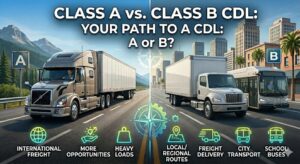
Class A CDL: This is the big one. It gives you the keys to any combination of vehicles with a GVWR of 26,001 pounds or more, as long as the trailer you're pulling is over 10,000 pounds. This is the license for the classic tractor-trailer, and it's what most comprehensive CDL schools focus on.
Class B CDL: This license is for single vehicles weighing 26,001 pounds or more, or for a big truck towing a smaller trailer that doesn't go over 10,000 pounds. Think dump trucks, cement mixers, or local delivery straight trucks—this is the license for those jobs.
Class C CDL: This one is more specialized. You'll need it to drive vehicles designed to carry 16 or more passengers (like shuttles or some buses) or to transport placarded hazardous materials in a smaller vehicle.
While our main focus is on getting you ready for a Class A, a lot of the fundamental skills you learn will apply across the board. If you want to dig deeper into all the specific qualifications, check out our full guide on CDL requirements.
Unlocking Better Pay with Endorsements
Once you've earned your CDL, the learning doesn't have to stop. You can add endorsements, which are basically special certifications proving you have the extra knowledge to handle specific types of trailers or cargo. Each endorsement you add makes you a more capable and valuable driver, which almost always means more job opportunities and a bigger paycheck.
Think of it this way: endorsements are like adding new tools to your professional toolbox.
The more tools you have, the more jobs you're qualified for, and the more you can earn. A driver with a HazMat endorsement can take loads that other drivers have to turn down.
Here’s a look at some of the most common endorsements you can get to boost your career.
CDL Class and Endorsement Overview
This table is a quick reference to help you see which CDL class and endorsements might line up with different trucking careers.
| License / Endorsement | What You Can Drive | Common Career Paths |
|---|---|---|
| Class A CDL | Tractor-trailers (semis), truck and trailer combinations over 26,001 lbs. | Long-Haul Trucking, OTR (Over-the-Road), Freight Hauling, Regional Driving |
| Class B CDL | Straight trucks, box trucks, dump trucks, cement mixers. | Local Delivery, Construction, Public Transit (Buses), Waste Management |
| Class C CDL | Passenger vans, small HazMat vehicles. | Airport Shuttle Driver, Non-Emergency Transport, Small-Scale HazMat Delivery |
| T – Doubles/Triples | A tractor pulling two or three trailers. | LTL (Less-Than-Truckload) Freight, Specialized Long-Haul Carriers |
| N – Tank Vehicle | Tanker trucks carrying liquids or liquefied gases. | Fuel Hauling, Chemical Transport, Food-Grade Liquid Transport (e.g., milk) |
| H – Hazardous Materials | Vehicles carrying placarded hazardous materials. | Chemical Companies, Fuel Transport, Industrial Waste Hauling |
| X – Tanker/HazMat Combo | A tanker truck carrying hazardous liquids. | Gas & Oil Industry, Specialized Chemical Transport |
Choosing the right combination of license and endorsements is a crucial step in building the career you really want.
Depending on where you are and the specific type of truck you want to drive, you might also look into other certifications. For example, some jobs might require a Class 2 Driver license, which qualifies you for certain types of rigid, non-articulated trucks.
Deciding which endorsements to pursue comes down to your career goals. A top-notch truck driving school won't just teach you how to pass the CDL exam; they'll sit down with you and offer real-world advice on which endorsements will help you get where you want to go.
How to Fund Your Commercial Driving Education
Let's talk about the elephant in the room: cost. Getting your CDL is a serious career investment, and like any good investment, it comes with an upfront cost. You can expect tuition for a quality program to run anywhere from $3,000 to over $10,000.
That price tag might seem steep, but it covers a lot. We're talking classroom time, countless hours of hands-on training in a real big rig, the fuel you'll burn (and that's a lot!), and even the use of their truck for your final exam. Still, it’s smart to ask what’s not included—things like DOT physicals, permit fees, or retake costs can sometimes be extra.
The license you're aiming for, typically the Class A, is what really determines your future earning potential. It’s the top of the food chain in the trucking world.

As you can see, a Class A license puts you in the driver's seat of the biggest rigs on the road, which opens the door to the most opportunities and the best paychecks.
Exploring Your Payment Options
Don't let that initial number scare you off. Paying the full amount out of pocket is an option, but it's certainly not the only one. Most students find a way to make it work, often by combining a few different funding strategies.
Think of it like putting together a toolkit—you have several different tools you can use to get the job done.
- Student Loans: Many schools and private lenders offer loans specifically for trade and vocational programs. The terms can be different from a four-year college loan, so be sure to look closely at interest rates and how you'll pay it back.
- Grants and Scholarships: This is the best kind of funding because you don't have to repay it. Seriously. Look into groups like the Women In Trucking Foundation or other industry organizations that offer awards to help new drivers get started.
- Workforce Innovation and Opportunity Act (WIOA): This is a federal program designed to get people into high-demand jobs, and trucking definitely qualifies. Your local career center is the place to start to see if you're eligible for a WIOA grant.
The most important thing to remember is that you have options. A good truck driving school will have people on staff whose entire job is to help you navigate financial aid and find every dollar you qualify for.
Company-Sponsored Training and Veteran Benefits
Another really common route is company-sponsored CDL training. Here’s the deal: a large trucking company pays for your entire education. In return, you agree to drive for them for a contracted amount of time, usually about a year.
The upside is huge—you get your CDL with little to no money down. The trade-off, of course, is that you're locked into a contract. If you decide to leave before it’s up, you'll likely be on the hook for the full cost of tuition. It’s a great deal, but one you need to enter with your eyes wide open.
For military veterans, the GI Bill® is a game-changer. It can cover most, or even all, of your tuition costs. In some cases, it might also provide a housing allowance while you attend school. If you've served, make sure you find a VA-approved school to take full advantage of the benefits you've earned.
Digging into these different paths will help you find the one that fits your budget and goals. You can always read more on our blog for extra tips on getting your new career on the road.
How to Choose the Best Truck Driving School
Picking the right training provider is probably the biggest decision you'll make when starting your trucking career. Let's be honest, not all schools are created equal. The quality of your education is what builds your confidence, your skills, and ultimately, your job prospects.
Think of it this way: you wouldn't hire a contractor with shoddy tools to build your house. The same logic applies here. You want a school with a great track record, modern equipment, and instructors who are truly invested in your success.

A top-notch truck driving school does more than just teach you how to pass the CDL exam. It drills safety habits and real-world know-how into you—the kind of stuff that will keep you safe and successful for years to come.
With the high demand for drivers, the training industry has boomed. The global driving school market was valued at USD 108.15 billion in 2026 and is expected to hit USD 130.53 billion by 2030. That growth is driven by new training methods, like advanced driving simulators, which are helping produce better, more prepared drivers right out of the gate.
What to Look For in a School
When you start looking at schools, it’s easy to get lost in the sea of websites and brochures. To really figure out which programs are worth your time and money, you need to focus on what matters most: the hands-on training.
Don’t be afraid to ask direct questions about what your training will actually involve.
- Student-to-Instructor Ratio: How many other students will you be sharing an instructor with? A small ratio, like 3-to-1 or 4-to-1, is ideal. It means you get more direct coaching and personalized feedback when you're behind the wheel.
- Behind-the-Wheel (BTW) Time: This is the big one. Get a specific number of hours you will personally spend driving—not just observing—on both the practice range and on public roads. More time in the driver's seat is what builds real skill.
- Fleet Quality and Condition: What kind of trucks do they have? You want to train on modern, well-maintained equipment that’s similar to what companies are using today. Learning on an ancient rig won't do you any favors.
You absolutely have to visit the campus in person. It’s the only way to see the trucks for yourself, meet the people who will be teaching you, and just get a general vibe for the place. Any good school will be happy to show you around.
Questions to Ask on Your Campus Tour
Think of your campus tour as an interview—where you're the one asking the questions. This is your chance to dig past the sales pitch and find out what the school is really all about.
Here’s a checklist to help you get the answers you need:
- What is your CDL exam pass rate? A high first-time pass rate, especially anything over 80%, is a great sign that their teaching methods actually work.
- What happens if I need to retest? Find out if they offer extra practice time or support if you don't pass on the first try. Also, ask if there are extra fees for retesting.
- Do you offer job placement assistance? A solid school will have connections with reputable trucking companies and someone on staff dedicated to helping you with resumes, applications, and interview prep.
- Which trucking companies hire your graduates? Ask for a list of their hiring partners. This will give you a good idea of the kinds of jobs you can expect to be qualified for after graduation.
- Is your school certified and accredited? Make sure the school is licensed by the state and meets all the Federal Motor Carrier Safety Administration (FMCSA) requirements for Entry-Level Driver Training (ELDT). This is non-negotiable.
Asking these kinds of practical questions shows you're serious and helps you see what a truck driving school truly offers. Making a smart choice now is the first step toward a long, successful career on the open road.
Your Career Opportunities After Graduation
Getting your CDL isn't the end of the road; it's just the beginning. Think of it as the key that unlocks a stable, well-paying career with a kind of independence you just can't find in most other jobs. The time and money you put into a quality truck driving school start paying off right away, as you'll be stepping into an industry that’s hungry for new talent.
This isn't just talk. There's a real, persistent need for qualified drivers. Right now, the United States is short more than 80,000 drivers, and that number could double by 2030 if things don't change. For you, that translates directly into solid job security and competitive pay. The median annual wage for heavy and tractor-trailer truck drivers is around $57,440, and with a little experience under your belt, you can earn a whole lot more.
OTR, Regional, and Local Driving Explained
Once that new license is in your hand, you've got choices to make. The type of driving job you take really shapes your lifestyle—from the routes you run to how often you're home for dinner. Getting a handle on these main career paths is the first step to finding a job that fits you perfectly.
Let's break down the big three:
- Over-the-Road (OTR): This is what most people picture when they think of trucking. OTR is the long-haul life, where you’re crossing state lines and might be on the road for weeks at a time. It’s a great way to see the country while moving freight over long distances.
- Regional: This is a nice middle-ground option. Regional drivers stick to a specific part of the country, like the Northeast or the Midwest. You're still putting in serious miles, but you're usually home every weekend.
- Local: Want to be home every night? A local driving job is your ticket. These gigs involve making deliveries within a single city or metro area, and they often follow a more typical workday schedule.
Advancing Your Career with Experience
Your first year on the road is all about building your foundation. It’s where you prove you can handle the job safely and professionally. After you have a solid year of clean driving on your record, all sorts of new doors start to open, leading to specialized roles that pay even better.
For example, getting endorsements for things like hazardous materials (HazMat) or tanker trucks makes you a much more valuable driver to any company. These extra certifications let you haul specific types of freight that almost always come with higher pay rates.
Your CDL is more than a license; it's a passport to opportunity. The skills you master at truck driving school and sharpen during your first year are the building blocks for a long, successful career.
At the end of the day, experience gives you control. Seasoned drivers have more power to pick their routes, negotiate for more home time, or even move into different roles like becoming a driver trainer or a fleet manager. And if you start out driving an automatic, you might later decide to get your E-restriction removed to open up even more job opportunities. You can check out our guide on the E-restriction removal course to see what that involves. Your journey is just getting started.
Your Top Questions About Truck Driving School, Answered
Jumping into a new career is a big step, and it's natural to have a lot of questions. Let's tackle some of the most common things people ask when they're thinking about truck driving school. Getting straight answers will help you feel more confident about starting this new adventure.
A question I hear all the time is, "Do I need to have my own truck for training?" The answer is a definite no. Any legitimate school will provide the rigs you'll be learning on. Your tuition covers the use of their tractor-trailers for all your behind-the-wheel practice and for taking your official CDL skills test.
Another common worry is what happens if you don't pass the CDL exam on your first try. Honestly, it happens, and it's nothing to be ashamed of. A good school expects this and will have a solid plan to get you back on track. They should offer extra practice time to help you nail down the tricky parts. Make sure to ask about their retesting policy and any associated fees before you sign up.
How Long Does This Take, and Is It a Good Career for Women?
Okay, let's get to the big one: How long until you're actually out on the road, earning a paycheck?
- Fast-Track Options: If you can commit full-time, you can be ready for your Class A CDL exam in as little as three to four weeks. These accelerated programs are intense but perfect for anyone eager to start their new career quickly.
- Part-Time Programs: If you're juggling a job or family, don't worry. Many schools offer part-time or evening classes that take a few months to complete, letting you learn at a more relaxed pace.
Finally, a question that's thankfully becoming more common: Is trucking a good career for women? Absolutely, yes. In fact, the industry is actively seeking more female drivers, who are finding amazing opportunities and real success behind the wheel.
Here's the great thing about trucking: it's one of the few professions where your pay is based on performance—things like miles or hours—not your gender. It's a truly level playing field.
Companies are also putting a real focus on creating safer, more supportive work environments for everyone. With its independence, solid job security, and equal pay, trucking is a fantastic and rewarding career for any woman looking to break into a field with huge demand. It all starts with finding the right truck driving school.
Are you ready to take control of your future and start a rewarding career on the open road? At Patriot CDL, we provide the expert training and hands-on experience you need to earn your CDL and land a great job.