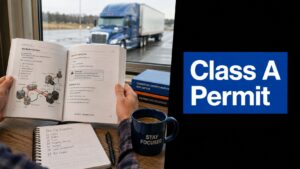
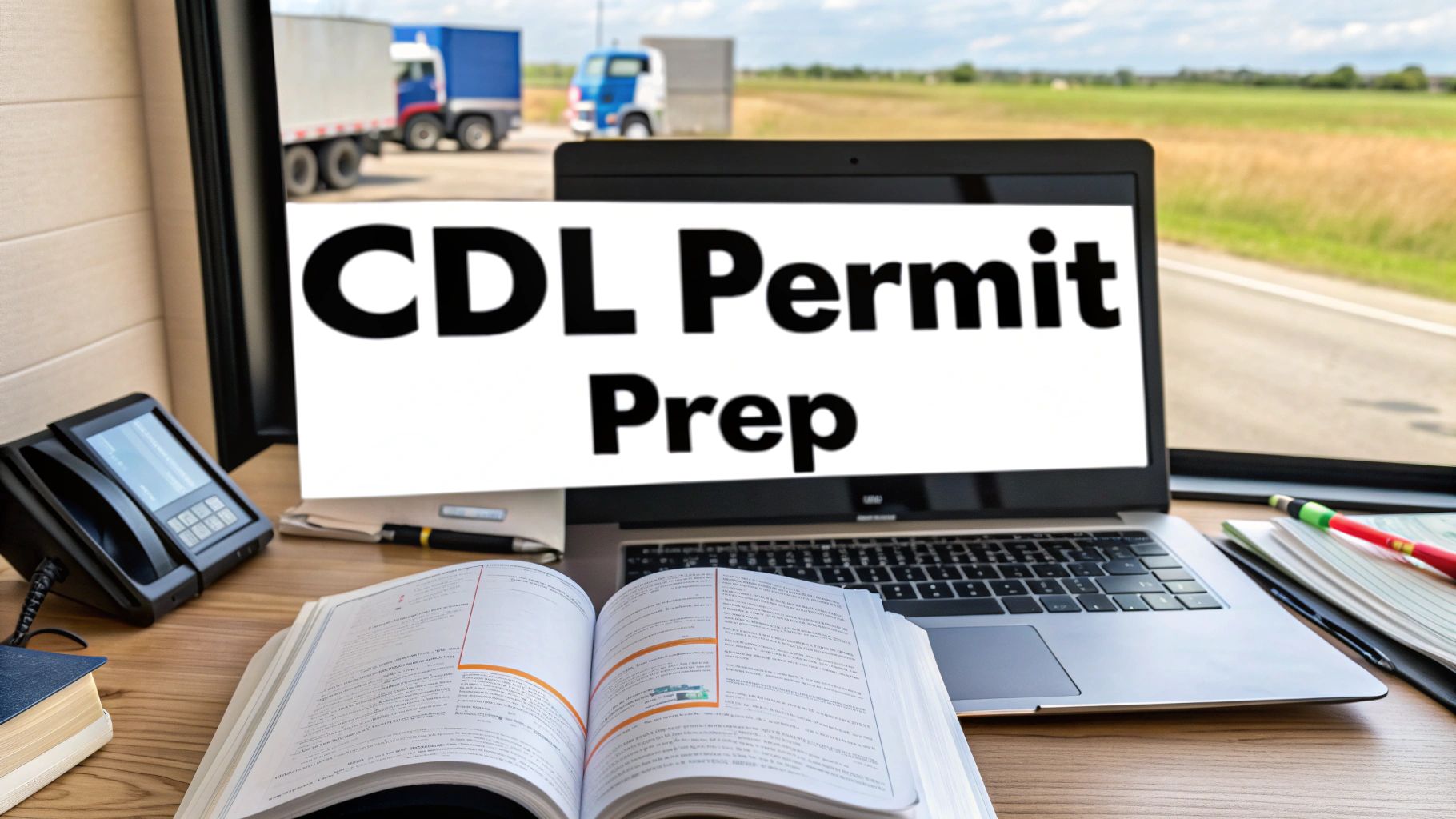
It all starts with one essential document: your state's official Commercial Driver's License manual. Forget everything else for a moment. This book is the single most important resource you'll touch. It's not just a suggestion; it's the source material for every single question on your written exam. Mastering this manual is the bedrock of your entire study plan.
Your Starting Line for CDL Permit Success
Getting your Commercial Driver's License permit is a huge step. It's not just about passing another test—it’s the official launch of your career as a professional driver. Before you dive into practice tests or flashcards, you need to lay the right groundwork. Think of this as the pre-trip inspection for your study plan; get this part right, and the rest of the journey gets a whole lot easier.
The very first thing you need to do is get your hands on the official CDL manual from your state's DMV (or whatever they call their licensing agency). This is the source of truth. While other guides and apps are great supplements, the test questions are pulled directly from the information in this state-specific manual.
Remember, federal and state rules require most aspiring drivers to get a CDL learner's permit before they can even think about getting behind the wheel for training. This means passing a comprehensive written exam that covers vehicle inspections, basic controls, critical safety practices, and federal regulations.
To help you get started on the right foot, here's a quick guide to the first few critical actions you should take.
CDL Permit Study Quick Start Guide
| Action Step | Why It's Critical | Where to Begin |
|---|---|---|
| Get the Official State Manual | The test is written based only on this document. Everything else is secondary. | Visit your state's official DMV/RMV website to download the PDF. |
| Decide on Class & Endorsements | This focuses your studying on only the sections you need, saving you time and effort. | Think about the job you want. Tractor-trailer? Dump truck? School bus? |
| Verify Your Eligibility | You don't want to study for weeks only to find out you're disqualified. | Check your driving record, age, and schedule a DOT physical exam. |
Taking these steps ensures you're not wasting time and that your study efforts are aimed at the right target from day one.
Understanding CDL Classes and Endorsements
Not all CDLs are created equal. The type of truck you want to drive will directly shape what you need to study. There are three main classes you'll see.
- Class A: This is for the big rigs. It covers combination vehicles (like a tractor-trailer) with a Gross Combination Weight Rating (GCWR) of 26,001 pounds or more, where the trailer itself is over 10,000 pounds.
- Class B: Think single, heavy-duty vehicles. This is for straight trucks, dump trucks, or buses with a Gross Vehicle Weight Rating (GVWR) of 26,001 pounds or more. You can also tow a smaller trailer, but it can't be over 10,000 pounds.
- Class C: This class is a bit different. It’s for vehicles built to carry 16 or more people (including you, the driver) or any vehicle used to haul placarded hazardous materials.
On top of the license class, you might need endorsements for special types of loads. These require passing extra knowledge tests. Some of the most common ones are for Tankers (N), Hazardous Materials (H), and School Buses (S). If you know what kind of career you're aiming for, you can focus your studies on those specific sections right away.
You can learn more by exploring our complete guide to securing a CDL permit.
Checking Your Eligibility Before You Start
Before you crack open that manual and spend hours studying, you have to confirm you meet the non-negotiable requirements. These are firm, and there's no getting around them.
Key Insight: Don't waste time studying if you have an eligibility issue. Verifying your driving record and medical fitness upfront saves you from potential disappointment and lost time. Address these requirements first.
To even apply for a permit, you absolutely must meet these criteria:
- Age Requirements: You need to be at least 18 years old for intrastate driving (staying within your state’s borders) and 21 to drive commercially across state lines (interstate).
- Valid Driver's License: You must already have a standard, non-commercial driver's license from your state.
- Clean Driving Record: The DMV will pull your driving history. Major violations like a DUI or leaving the scene of an accident can get you disqualified.
- Medical Fitness: You have to pass a Department of Transportation (DOT) physical. This has to be done by a nationally certified medical examiner who will confirm you're physically fit to safely operate a massive commercial vehicle.
Once you’ve confirmed these details, your path forward is clear. With your manual in hand and your goals defined, you’re officially ready to start studying the right way.
How to Actually Master the CDL Manual
Let's be honest: the official CDL manual from your state’s DMV is the single most important study tool you have. Every question you'll face on the permit test comes directly from this book. But if you try to read it cover-to-cover like a novel, you're setting yourself up for a long, frustrating slog. It's dense, packed with technical jargon, and can feel completely overwhelming.
The real trick isn't just reading it; it's about how you attack it. You need a game plan to break down all that information, figure out what really matters for the test, and lock it into your memory. This approach turns that intimidating government document into your best weapon for passing the exam.
Get the Lay of the Land First
Before you even think about starting on page one, take a step back. Your first move should be a quick reconnaissance mission. Flip straight to the table of contents and get a feel for the overall structure. This gives you a mental map, showing you how all the pieces fit together and where to find specific topics later.
Once you have the big picture, you need to identify the heavy hitters. While everything in the manual is fair game, some sections are guaranteed to make up the bulk of your test.
Your must-know, non-negotiable sections are almost always:
- General Knowledge: This is the bedrock of your CDL. It covers everything from basic vehicle controls and spotting hazards to managing the space around your rig.
- Air Brakes: This section is critical. In most states, if you fail the air brakes portion, you fail the entire test. You absolutely have to know the components, how the system operates, and the full inspection process inside and out.
- Combination Vehicles: If you’re going for a Class A license, this part is essential. It's all about coupling and uncoupling, hooking up air lines, and understanding the unique physics of a combination rig, like the infamous "crack-the-whip" effect.
Knowing where to focus from the start lets you spend your study time much more wisely. You can pour your energy into the areas that will make or break your score.
Stop Reading and Start Interacting
Now it’s time to dig in, but not by just letting your eyes glaze over the pages. That’s passive reading, where the information goes in one ear and out the other. You need to be an active learner, which means getting your hands dirty and forcing your brain to engage with the material.
Think of it this way: your goal isn't just to consume the information, but to wrestle with it. Highlighting, making notes, and summarizing are the tools that get this done. It turns studying from a passive chore into an active process of building real-world knowledge.
So, grab a highlighter and a pen. As you work through a chapter, physically mark up the manual. The key is to be strategic, not just to color everything in sight.
- Highlight Key Terms & Definitions: Zero in on specific vocabulary you see, like "off-tracking," "gross vehicle weight rating," or "controlled braking."
- Underline Specific Numbers: Any time a number pops up—stopping distances, tread depth requirements (4/32-inch for front tires, 2/32-inch for all others), or air pressure levels—that’s a giant red flag that it's prime test material.
- Scribble Notes in the Margins: Put complex ideas into your own words. If a dense paragraph on pre-trip inspections is confusing, write your own simplified checklist right next to it. For instance, next to the section on checking your trailer connection, you could just jot down, "Check 5th wheel, air/light lines, kingpin secure."
This hands-on approach forces you to slow down and actually process what you’re reading, which makes a world of difference for your memory.
Use Flashcards for the Facts You Can't Forget
Some information just has to be memorized, period. There's no way around it. This is especially true for specific measurements, acronyms, and regulations. And for that, old-school flashcards are your best friend. The very act of making them helps you learn, and drilling with them cements the facts in your brain.
Keep your flashcards short and to the point. They're for concrete, testable facts, not long-winded explanations.
Here’s what makes for a perfect flashcard:
| Category | Front of Card (Question) | Back of Card (Answer) |
|---|---|---|
| Measurements | Min. tread depth on steering tires? | 4/32 of an inch |
| Acronyms | What is GCWR? | Gross Combination Weight Rating |
| Procedures | Following distance: 40ft truck under 40 mph? | 4 seconds (1 sec per 10 ft) |
| Regulations | Legal BAC for CDL holder? | 0.04% |
Stuff a small stack in your pocket and pull them out whenever you have a few dead minutes—waiting in line, on your lunch break, or right before you call it a day. This technique, known as spaced repetition, is scientifically proven to be way more effective for long-term recall than one massive cram session. It's a simple habit that delivers powerful results.
Building a Study Schedule That Actually Works
Let's be real—finding time to study for your CDL permit is tough. Life doesn't hit pause just because you’ve decided to launch a new career. Between a full-time job, family, and everything else on your plate, squeezing in hours of study can feel completely overwhelming. But here's the good news: you don't have to quit your job or become a hermit for a month to pass this test.
The secret is crafting a realistic and consistent study schedule that fits the life you already have. This isn't about stressful, last-minute cramming. It's about building a sustainable habit that gives you genuine confidence on test day. A smart plan is your best defense against burnout and ensures the information actually sticks.
Choosing Your Timeline: Two Paths to Success
Most people can get fully prepped for the permit test in two to four weeks, but it really depends on what you know coming in and how much time you can carve out each day. Your personal situation is the only thing that matters here.
The 2-Week Intensive Sprint: This plan is for anyone who can dedicate a serious block of time every day. It’s an aggressive approach, perfect if you're between jobs or have a clear two-week window. You'll need to commit to 2-3 hours of focused study daily. The idea is to tackle one major topic a day and save the last few days for review and practice tests.
The 4-Week Balanced Approach: This is a much more manageable pace if you’re working full-time or juggling other big responsibilities. The goal here is consistency, not intensity. Aim for 45-60 minutes of study, 5-6 days a week. This slower burn prevents you from getting overwhelmed and gives your brain the time it needs to absorb complex topics, like the entire air brake system.
Before you jump in, make sure you know exactly which tests you need to take. For a clear breakdown of what your state requires for different license classes, check out our guide to state-specific CDL requirements. This will help you focus your study plan only on the material that matters for your license.
This image gives you a solid visual for how to organize your study tools for the best results.
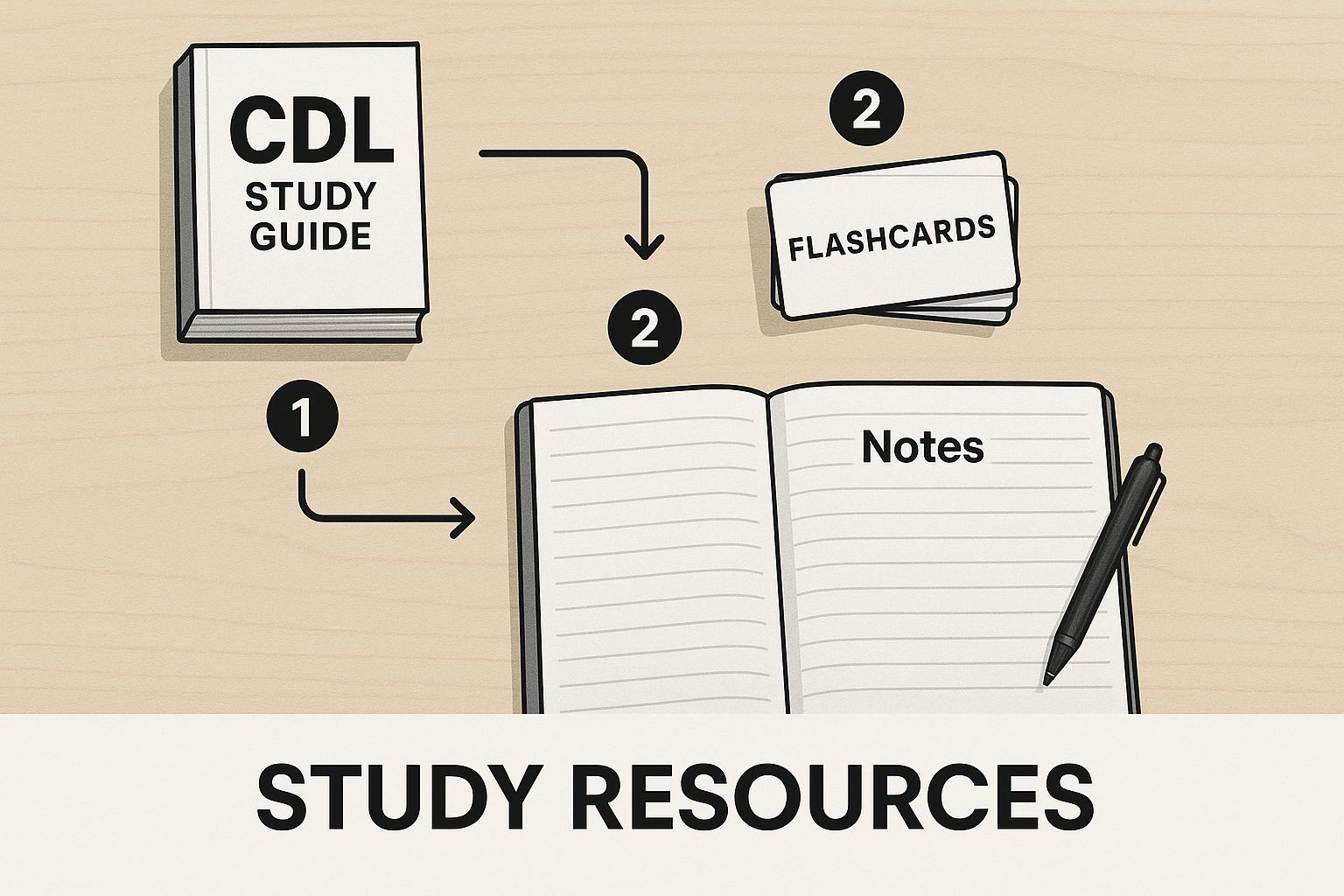
As you can see, the magic happens when you combine the official manual with active learning tools like flashcards and your own notes.
The Topic-a-Day Method to Avoid Burnout
One of the biggest mistakes I see aspiring drivers make is trying to swallow the entire CDL manual at once. That's a recipe for disaster. A much smarter strategy is the "topic-a-day" method, where you dedicate each study session to one specific section.
For instance, your week could look something like this:
- Monday: General Knowledge, Chapter 1 (Introduction & Vehicle Inspection)
- Tuesday: General Knowledge, Chapter 2 (Basic Control & Shifting)
- Wednesday: The Air Brakes Section
- Thursday: The Combination Vehicles Section
- Friday: Review and a practice test covering everything from the week.
This approach makes the mountain of information feel much more climbable. You get small, daily wins, which does wonders for keeping you motivated.
Key Takeaway: Consistency beats cramming every single time. A little bit of focused effort each day builds a much stronger foundation than pulling a few all-nighters right before your test.
Lock in Knowledge with Review and Recall
Just reading a chapter doesn't mean you'll remember it under pressure. To truly know the material, you have to actively practice recalling it. This is where the simple but powerful "review and recall" technique comes in.
At the beginning of every study session, spend the first 10-15 minutes reviewing what you covered the day before. But don't just re-read your notes—that's too passive. Instead, try to recall the key points from memory first. Then, open your notebook and see how you did. Quiz yourself with questions like, "What are the three main components of the air brake system?" or "What's the proper following distance in good weather?"
This simple habit forces your brain to retrieve the information, strengthening the neural pathways that move knowledge from short-term to long-term memory. It's one of the most effective ways to make sure you walk into the DMV ready for whatever they throw at you.
Using Practice Tests to Sharpen Your Skills
Reading the CDL manual gives you the raw facts, but that's only half the battle. To truly prepare, you need to build your test-taking muscle. This is exactly where practice tests come in. They are, without a doubt, your single best tool for moving from simply knowing the material to being able to apply it under pressure.
Taking practice tests strategically is about much more than just seeing if you can pass a quiz. It’s about simulating the real DMV experience, getting comfortable with the unique—and sometimes tricky—wording of the questions, and learning to manage your time. When you use them right, you walk into that test center feeling prepared, not panicked.
Finding High-Quality Practice Tests
A quick search online will show you a ton of "free CDL practice tests," but be careful—not all of them are created equal. Using a bad or outdated test is actually worse than using nothing at all. It can give you a false sense of security and drill the wrong information into your head. A high-quality test should feel like a dress rehearsal for the real thing.
So, how do you separate the good from the bad? Here's what I tell my students to look for:
- Based on the Current Manual: Regulations change. A test from five years ago might have outdated rules. Make sure the practice test aligns with the most recent version of your state’s official CDL handbook.
- Covers Specific Endorsements: Good resources won't just lump everything together. They'll have separate tests for General Knowledge, Air Brakes, Combination Vehicles, Hazmat, and other endorsements so you can focus your efforts where they're needed.
- Provides Explanations: This one is huge. The best practice tests don't just tell you you’re wrong; they explain why the correct answer is right. This is absolutely critical for learning from your mistakes.
Expert Tip: Don't just chase a passing score on practice tests. Your real goal is to understand the logic behind each question. An explanation for a wrong answer is more valuable than a hundred correct guesses.
Turning Practice into a Powerful Study Tool
Just taking the same tests over and over again won't get you very far. You need a system. Think of your first few practice tests as diagnostics—their main job is to find your blind spots.
Don't sweat your score on that first attempt. Instead, use it to build a personalized study plan. If you keep missing questions about air brake system checks but you’re acing the ones on basic vehicle control, you know exactly where to hit the books next.
After you take a practice test, sit down and analyze your results. Ask yourself:
- Where am I weakest? Make a list of the sections where you lost the most points. This is your new study priority list.
- Why did I get this specific question wrong? Was it a simple memory lapse? Did I misunderstand a core concept? Or did the weird wording of the question just trip me up?
- Are there patterns in my mistakes? For instance, do you consistently stumble on questions that involve specific numbers, like following distances or inspection measurements?
Answering these questions turns a simple quiz into a powerful diagnostic tool. You can find some excellent practice resources, including a complete CDL general knowledge test, to start pinpointing your weak areas right away.
Simulating the Real Test Environment
As you get closer to your test date, how you use practice tests needs to change. It's no longer just about finding weaknesses; it's about building the mental endurance to handle the pressure of the real exam.
To do that, you need to simulate the real DMV testing conditions as closely as you can.
- Time Yourself: The real test has a clock. Set a timer and stick to it. This gets you comfortable with the pace you need to maintain so you don't run out of time.
- Eliminate Distractions: Find a quiet spot. Turn off your phone, silence the TV, and close any extra tabs on your computer. Create a bubble for yourself.
- No Cheating: This is the most important part. Resist the urge to look up answers. The whole point is to see what you actually know under pressure, not what you can find with a quick search.
This kind of focused practice does more than just test your knowledge—it builds the confidence you need to perform when it really counts. It trains your brain to stay calm, ensuring that test-day jitters don't derail all your hard work. When you've already faced the clock and the tough questions dozens of times from home, the real thing just feels like another practice round.
Your Game Plan for Test Day Success
All that studying, all those practice tests—it all comes down to this one day. How you perform on the CDL permit test isn't just about what you know; it's about how well you handle the pressure. Let's walk through the final steps to make sure you walk into the DMV calm, collected, and ready to pass.
This final prep is absolutely critical, especially if you're not used to the fine print of American driving laws. For example, statistics show that applicants from countries without reciprocity agreements often see a pass rate that's 10-15% lower on their first try. That number alone shows just how important it is to be dialed in on the specific rules here in the U.S.
The Night Before and Morning Of
Your real test day prep starts the evening before. What you do in these last 24 hours can make or break your focus.
First things first: do not cram. Seriously. The night before is not the time to be frantically trying to learn new material. You’ll just spike your anxiety and wreck your sleep. Instead, do a light, 30-45 minute review of your notes or flashcards, then put them away. Your brain needs that downtime to lock in everything you’ve learned.
Next, get all your paperwork together. Nothing creates a last-minute panic like digging through a junk drawer for your Social Security card.
Your Essential DMV Checklist:
- A valid, current driver's license
- Proof of residency (a recent utility bill or bank statement works)
- Your Social Security card
- Your DOT medical card (Med-Cert)
- Any other documents your state specifically requires
Go to your state’s DMV website and double-check their list. Once you have everything, put it all in a folder and leave it by the door. On test morning, fuel up with a solid breakfast—think protein and complex carbs like eggs and whole-wheat toast. Skip the sugary cereal that’ll lead to an energy crash halfway through the exam.
In-Test Strategies to Maximize Your Score
Once you’re sitting at that computer, it's all about strategy. Knowing how to take the test is just as important as knowing the answers.
The DMV isn't trying to trick you, but the questions can be worded in a very specific, technical way. Read every single word carefully before you even glance at the answers. One little word like "not" or "always" can flip the entire meaning of the question.
If a question completely stumps you, don't just sit there staring at it. Most of these computerized tests have a "skip" or "flag for review" button. Use it. Burning five minutes on one tough question will only build up your anxiety and steal time from easier questions you could be banking. Run through and answer all the ones you know first. This builds momentum and confidence. Then, you can circle back to the tougher, flagged questions at the end with a clearer head.
This approach is even more crucial when you get into the more technical parts of the CDL process. For instance, when it's time to get hands-on, you can check out our detailed guide to the pre-trip inspection to see how that book knowledge translates into real-world action.
Using the Process of Elimination
When you're stuck between a few answers, the process of elimination is your best tool. With multiple-choice questions, you can often find the right answer simply by spotting the wrong ones.
Scan the options and look for anything that’s obviously incorrect. You can usually knock out one or two choices right away. This instantly boosts your odds, even if you end up making an educated guess between the remaining two. For example, if a question is about safe following distance and one answer is "one car length," you know that's flat-out wrong and can dismiss it immediately.
By getting rid of the bad answers first, you're no longer taking a wild guess—you're making a calculated decision. And that’s exactly the kind of clear-headed thinking that separates a good driver from a great one.
Common Questions About the CDL Permit Test
As you get ready for the big test day, questions are bound to pop up. It's totally normal. Knowing what to expect about the test itself—and what comes after you pass—can take a lot of the pressure off, letting you focus on studying.
Let's walk through some of the most common questions I hear from aspiring drivers. Getting these details sorted out gives you a clear roadmap from start to finish.
How Many Questions Are on the Test and What Is a Passing Score?
This is probably the number one question on everyone's mind. While the exact number can shift a little depending on your state and which endorsements you're going for, the basic structure is pretty consistent.
For the main General Knowledge test, you're looking at about 50 questions. The magic number you need to hit is 80%, which means you have to get at least 40 of those questions right. That 80% passing score is the standard across the board for the endorsement tests, too, though they usually have fewer questions.
- Air Brakes: Typically around 25 questions.
- Combination Vehicles: Also about 25 questions.
- Other Endorsements (like Tanker or Hazmat): These generally have 20-30 questions each.
The key takeaway here is simple: 80% is the gold standard. There isn't much wiggle room for mistakes, which is why your study strategy has to be solid.
How Long Is My CDL Permit Valid After I Pass?
Once you've passed your written tests, you'll be handed your Commercial Learner’s Permit (CLP). This is the document that officially allows you to start training behind the wheel of a commercial vehicle.
Your CLP is typically valid for 180 days (that's about six months) from the day it’s issued. Most states will let you renew it one time for another 180 days. This gives you up to a full year to finish your hands-on training and pass the final skills test to get your full CDL.
Keep in mind, federal rules say you have to hold that CLP for at least 14 days before you can even take the final road test. This is to make sure you get some real practice time on public roads with a licensed CDL holder next to you. Before you can start formal training with a school, you also have to complete the federal Entry-Level Driver Training (ELDT) requirements. You can get the full scoop on our guide to the federally mandated ELDT program.
What Happens If I Fail the Permit Test?
First off, don't panic. Failing a test is a setback, not a dead end. It happens to plenty of people, and every state has a system in place for you to try again.
If you don't pass one of the knowledge tests, you usually can't retake it the same day. Most DMVs make you wait at least one business day. Honestly, this is a blessing in disguise. It forces you to go home, hit the books again on the sections that tripped you up, and come back stronger.
You might find there's a limit to how many times you can retest in a short period, and you'll almost certainly have to pay the testing fee for each attempt. The best way to look at a failed test is as a diagnostic report. It's not a failure; it’s direct feedback showing you exactly where you need to focus your efforts.
Ready to stop worrying and start training? The expert instructors at Patriot CDL can guide you through every step of the process, from mastering the permit test to acing your final road exam. Visit our website to learn more about our accelerated programs and launch your new career. https://patriotcdl.com