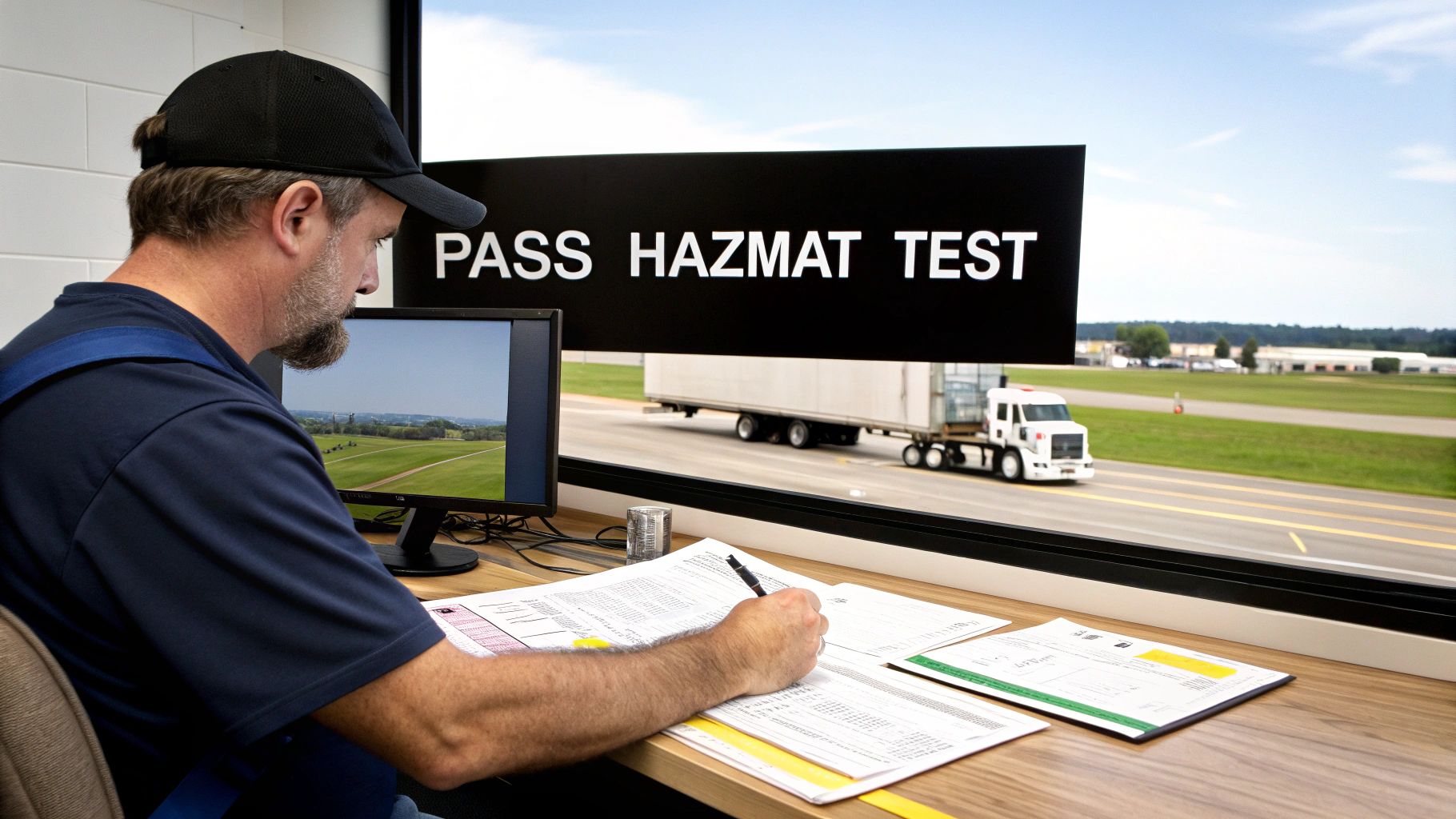
If you're a commercial driver looking to transport hazardous materials, you'll need to pass the CDL Hazmat Test. This isn't just another box to check; it's a critical written exam that proves you can handle sensitive cargo. Passing earns you the Hazmat (H) endorsement on your CDL, which is the law for hauling anything that requires a placard—think flammable liquids, explosives, or corrosive chemicals.
What Is the CDL Hazmat Endorsement
Getting a Hazmat (H) endorsement on your Commercial Driver's License (CDL) is about much more than passing an exam. It’s a serious responsibility. This endorsement shows you have the specialized knowledge to safely transport materials that could otherwise threaten public safety and the environment.
Legally, you can't haul placarded hazardous materials without it. That means a driver with a full tanker of gasoline or a truckload of industrial chemicals absolutely must have a current H endorsement.
Why This Endorsement Matters
Without the H endorsement, you’re shut out from these kinds of loads, which can really cap your career growth. The federal government, specifically the Transportation Security Administration (TSA), puts a great deal of faith in drivers with this certification. When you pass the CDL Hazmat test and the required security threat assessment, you’re proving you're both capable and reliable.
But it’s not just about following the rules. The H endorsement can unlock better-paying, more specialized jobs in the trucking world. Fleets are always looking for drivers qualified to handle sensitive loads, which often translates to:
- Higher Pay Rates: It’s no secret that drivers with a Hazmat endorsement often earn more. It's common to see a salary bump of several thousand dollars a year compared to non-endorsed drivers.
- Increased Job Opportunities: A lot of high-value freight is classified as hazardous. Having the H endorsement makes you eligible for a much broader pool of assignments.
- Greater Job Security: Specialized skills make you a more valuable part of any team. This boosts your demand and gives you more stability in your career.
This entire process builds on a solid foundation. Before you even start studying for the Hazmat test, you need to have a valid CDL or be working toward one. Getting your commercial learner's permit is the non-negotiable first step.
Think of this endorsement as a direct investment in your career. It signals a deep commitment to safety and a readiness to take on more complex work, positioning you as a top candidate for the best driving jobs out there.
Navigating the TSA Security Threat Assessment
Before you even crack open a study guide for the CDL Hazmat test, there’s a major federal requirement you need to handle first: the Transportation Security Administration (TSA) Security Threat Assessment. This isn't your average background check. It's a comprehensive security screening to make sure only the most trustworthy drivers are cleared to haul hazardous materials.
You have to get this process started before you can even schedule your written knowledge test. The first move is to fill out the Hazmat Endorsement Threat Assessment application, which you can usually knock out online. Once you've submitted the application and paid the fee, the next step is scheduling an in-person appointment to get your fingerprints taken.
The Application and Fingerprinting Process
That in-person appointment is a non-negotiable part of the process. You'll head to a designated application center, and it's crucial to show up with the right paperwork in hand. Requirements can differ a bit from state to state, but you should always be ready with:
- Proof of U.S. Citizenship or Lawful Permanent Residence: Think U.S. Passport, birth certificate, or a Green Card.
- A Valid Commercial Driver's License (CDL) or Permit: You need to have your CDL or at least a commercial learner's permit already.
- Your Valid DOT Medical Card: You’ll need to prove you’re medically certified to drive.
At the appointment, they’ll scan your fingerprints electronically and shoot them over to the FBI for a full criminal history check. This is where you really see how serious the government is about this endorsement.
The whole point of the threat assessment is to weed out anyone who might be a security risk. It’s a clear sign of how seriously federal authorities view the responsibility of transporting hazardous materials on our roads.
This mandatory screening was a game-changer for the Hazmat endorsement. After the USA Patriot Act of 2001, this federal security check became a requirement for anyone applying for or renewing their HME. The whole thing, from fingerprints to the final federal background check, typically takes 30 to 90 days and will set you back between $80 and $110.
Understanding Disqualifying Offenses
The TSA is incredibly strict about what criminal offenses will get you disqualified. We're not talking about a speeding ticket here; these are serious crimes that are an automatic "no." Some offenses, like espionage, murder, terrorism, or treason, will permanently bar you from ever getting the endorsement.
Then there are what’s known as interim disqualifying offenses. These are also serious crimes, but they’ll disqualify you if the conviction or your release from prison was within the last five to seven years. This category includes felonies like arson, kidnapping, robbery, and bribery. You can find the full, official list on the TSA website, and if you have any doubts about your eligibility, you need to read it carefully. For a broader overview, you can also review our guide to better understand the full scope of CDL requirements.
This infographic shows you what to focus on while you're waiting for your TSA clearance to come through.
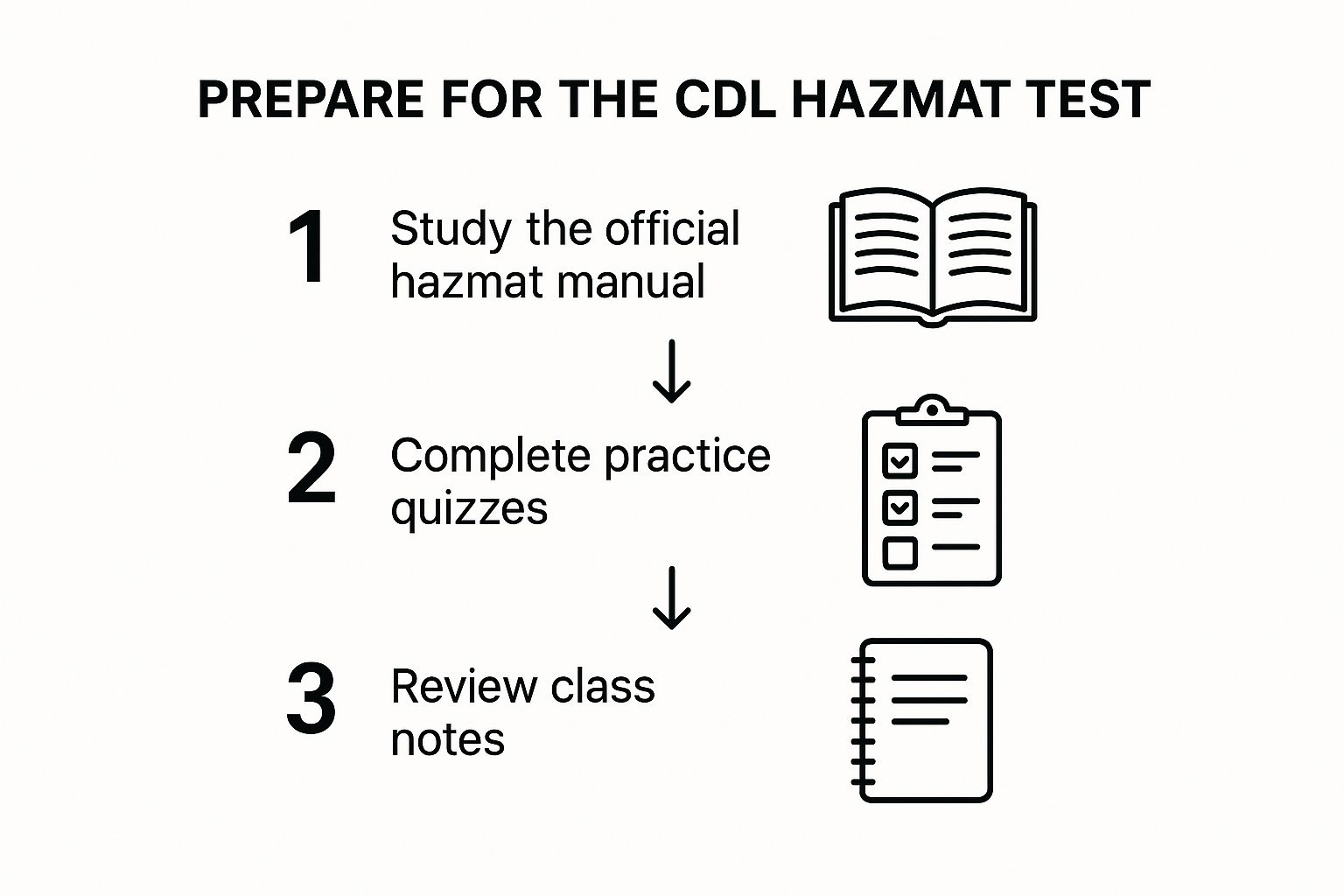
As you can see, the key is to have a structured study plan. Making a habit of reviewing the manual, hitting practice questions, and going over your notes is what will ultimately get you a passing score.
Mastering the Core Hazmat Knowledge Areas

Passing the CDL Hazmat test comes down to truly understanding a few key areas. This isn’t about cramming random facts; it’s about internalizing the systems that keep you, the public, and the environment safe. The absolute bedrock of this knowledge is the placarding system.
Think of placards as the universal language of risk on the road. Those diamond-shaped signs on a trailer tell everyone from law enforcement to first responders exactly what they’re dealing with at a glance. You'll need to know the nine classes of hazardous materials cold—everything from Class 1 Explosives to Class 8 Corrosives. The test will absolutely grill you on identifying these placards and knowing when they must be displayed.
But knowing what's inside is only the first step. You also have to prove you know how to handle it. This means mastering the proper procedures for loading and unloading, which are all designed to prevent spills, leaks, or dangerous reactions between chemicals.
Safe Loading and Cargo Securement
One of the most critical, and heavily tested, topics is the segregation of materials. You can't just load things wherever they fit. For instance, you would never load certain oxidizers next to flammable liquids. The DOT gives you a detailed segregation table, and you need to know how to use it. A mistake here isn't just a wrong answer on a test; it's a recipe for a disaster on your trailer.
Making sure that cargo is properly secured is just as important. The rules are non-negotiable. Your load must be braced, blocked, and tied down so it can't shift an inch during transit. A shifting barrel of hazardous chemicals can easily lead to a catastrophic accident.
Understanding these core concepts isn't just for the exam. It’s the foundation of your career as a professional driver. Every single rule, from placarding to securement, is a link in the chain of safety that protects everyone on the road.
Your grasp of the regulations also has to cover the mountain of paperwork that comes with every hazmat load. Shipping papers are your bible on the road. They tell you exactly what you’re hauling, how much of it there is, and its specific hazard class.
Understanding Shipping Papers and Emergency Response
The test will check if you know where to find this critical information and how to interpret it. In an emergency, first responders will depend on those papers to understand the situation. This brings us to another core skill: knowing what to do when things go wrong.
You have to be comfortable using the Emergency Response Guidebook (ERG). This is your playbook for the first 30 minutes of a hazmat incident. The ability to quickly look up a substance and follow the initial safety protocols is a skill that saves lives.
To help you get familiar with the different placards, I've put together this quick reference table. It's a great tool for memorization.
Hazard Class Placards at a Glance
| Hazard Class | Class Name | Common Examples |
|---|---|---|
| Class 1 | Explosives | Dynamite, Ammunition, Fireworks |
| Class 2 | Gases | Propane, Oxygen, Chlorine |
| Class 3 | Flammable Liquids | Gasoline, Alcohol, Paint Thinner |
| Class 4 | Flammable Solids | Matches, Sodium, Sulfur |
| Class 5 | Oxidizers & Organic Peroxides | Ammonium Nitrate, Hydrogen Peroxide |
| Class 6 | Toxic & Infectious Substances | Medical Waste, Arsenic, Pesticides |
| Class 7 | Radioactive Materials | Uranium, Plutonium, Medical Isotopes |
| Class 8 | Corrosive Substances | Sulfuric Acid, Hydrochloric Acid, Batteries |
| Class 9 | Miscellaneous Hazardous Materials | Lithium-ion Batteries, Dry Ice, Asbestos |
Memorizing this table is a fantastic start. The more you can recall these classes without hesitation, the better you'll do.
The requirements for your knowledge test are all part of a larger federal framework. For example, in states like Utah, you must pass a 30-question written test focused on these very regulations. New drivers also have to complete the Entry-Level Driver Training (ELDT) theory course before they can even sit for the test. This ensures every driver has a baseline of safety knowledge. While this guide covers hazmat specifics, you can always brush up on the fundamentals with our guide to the CDL general knowledge test.
Proven Study Strategies for Passing the Test
So, you know what to study for the CDL Hazmat test. That's half the battle. But the real secret to walking out with a passing score is how you study. It’s all about using methods that actually help you remember complex rules when you're sitting in that testing center.
Your absolute best friend in this process is your state's official CDL manual. Seriously. Every single question on your test will come directly from this book. Read the hazmat section until you practically know it by heart. Everything else—apps, online courses, study groups—is just a bonus.
Don't Just Read—Engage
Staring at the pages won't cut it. You have to get your hands dirty with the material to make it stick. A classic technique that works wonders is making your own flashcards. This is especially powerful for nailing down the nine hazard classes and their placards. The simple act of writing them out yourself helps burn them into your brain.
Another great trick is to use mnemonic devices. For example, to remember the first three hazard classes (Explosives, Gases, Flammable Liquids), you could come up with a phrase like "Every Good Firefighter." Get creative! Silly, simple phrases for different rules or classifications can be lifesavers when you're trying to recall them on the test.
The point of studying isn't just to get a passing grade. It's to build the kind of deep knowledge that keeps you and everyone else safe on the road. Good study habits give you confidence for the exam and for your entire career.
How to Use Practice Tests Effectively
Once you've got a decent handle on the manual, it's time to start hitting the practice tests. But don't just go through the motions. The most valuable practice tests are the ones that give you detailed explanations for every single answer, right or wrong.
This is the key. You need to understand why an answer is correct and, just as importantly, why the other options are wrong. This builds real comprehension, which is far more powerful than just memorizing answers. It’s what will help you figure out those tricky questions you’ve never seen before on the actual test.
Here are a few tips to get the most out of them:
- Aim for understanding, not just memorization. If you get a question wrong, don't just look at the right answer. Go back to your CDL manual and reread that entire section.
- Recreate test day. Find practice tests that have a timer. You need to get comfortable working under the same pressure you'll face at the DMV.
- Talk it through. Find another student or an experienced driver and talk through the tougher concepts, like when to placard or how to segregate materials. Hearing it explained in a different way can make it finally click.
Remember, your hazmat knowledge is just one piece of the puzzle. Being a safe, professional driver means staying sharp on everything. Regularly brushing up on things like a detailed pre-trip inspection guide keeps you in the habit of being meticulous—a skill that's absolutely critical when you're hauling hazardous materials. This well-rounded approach is what truly prepares you for the realities of the job.
Your Game Plan for Test Day and Retakes

You’ve put in the hours, and now the day for your Hazmat endorsement test is here. True confidence comes from knowing you’re ready for everything, not just the questions on the screen. The last thing you want is to be turned away because of a simple paperwork mistake you could have easily avoided.
Your Test Day Checklist
To sidestep any last-minute stress, get all your documents together the night before. Walking into the testing center should feel routine, not frantic.
Make sure you have this packet ready to go:
- Your Valid Commercial Driver’s License (CDL): Sounds obvious, but give it a quick check to make sure it hasn't expired.
- Your Current DOT Medical Card: This proves you're medically cleared to be behind the wheel of a CMV.
- Proof of TSA Security Threat Assessment: Have your printed confirmation or official email showing you’ve passed the background check.
- Proof of Identity and Citizenship/Residency: Even if you used them for the TSA check, bring them again. A passport, birth certificate, or similar document is perfect.
Testing centers are incredibly strict about verification, and for good reason. A 2008 report to Congress revealed that the FMCSA had identified over 15,000 drivers suspected of getting their CDL through fraudulent means. This history has led to meticulous document checks, so having everything in order is non-negotiable.
Managing Nerves and Using Smart Test Tactics
Feeling some butterflies is completely normal. The trick is channeling that energy instead of letting it cloud your thinking.
One of the best pieces of advice I can give is to read every single question twice. It's a simple habit that catches those easy-to-miss details and prevents you from making a silly mistake on a question you actually know the answer to.
If a question completely stumps you, don't waste time panicking. Instead, immediately switch to the process of elimination. Getting rid of the answers you know are wrong can often make the right choice stand out. It’s a powerful tactic that dramatically improves your odds.
Failing the CDL Hazmat test isn’t the end of your journey—it’s just a detour. Think of it as a diagnostic tool showing you exactly which areas need a little more polish before your next attempt.
The Strategy for a Retake
So, you didn't pass on the first go. It happens to the best of us. What matters now is having a solid, positive plan to bounce back.
The first thing you should do is get feedback on which sections tripped you up. Was it the placarding rules, segregation tables, or maybe the emergency response procedures? Pinpoint those weak spots.
Most states have a mandatory waiting period before you can retest, which is actually a blessing in disguise. Use that time strategically. Dive back into the CDL manual and hit those problem sections hard. Take more practice tests, but this time, zero in on the topics that gave you trouble. And while you're at it, don't let other crucial knowledge get rusty. It can be helpful to run through other material like the air brakes test to keep all your skills sharp. This targeted approach will have you walking into your retake with confidence and a much better shot at success.
Common Questions About the Hazmat Endorsement
As you get ready for the CDL Hazmat test, you're bound to have some questions. It's totally normal. Getting the right answers upfront helps you study smarter and navigate the whole process without hitting any snags.
How Long Is the Hazmat Endorsement Good For?
Once you pass the test and get your endorsement, it’s typically valid for five years. This isn't an arbitrary number—it’s directly linked to your TSA Security Threat Assessment, which also expires on the same five-year cycle.
When it's time to renew, you can't just get a new license. You have to go through the whole process from the top. That means passing another written Hazmat knowledge test and submitting a fresh application for the TSA background check, complete with a new set of fingerprints.
The Hazmat endorsement isn't a one-and-done deal. Think of it as a credential that proves your ongoing commitment to safety and security. The five-year renewal cycle is how the industry ensures every endorsed driver stays sharp and current on the rules.
Do I Need to Take the Entry-Level Driver Training?
Yes, if you're a new applicant, completing the Entry-Level Driver Training (ELDT) is mandatory. Federal regulations are clear: anyone applying for a Hazmat (H) endorsement for the first time must complete the specific ELDT theory curriculum.
You can't just take any course, either. The training has to come from an approved provider listed on the official Training Provider Registry. The DMV won't even let you sit for the written test until your training is successfully logged in their system.
Can I Transfer My Hazmat Endorsement to a New State?
You can, but you have to act fast. When you move and apply to transfer your CDL to a new state of residence, your H endorsement doesn't just come along for the ride automatically.
To keep it, you'll almost certainly need to:
- Pass the Hazmat knowledge test in your new state.
- Fill out whatever state-specific forms they require.
- Sometimes, you might even have to start a new background check process in that state.
Every state handles this a little differently and has its own deadlines. Your best bet is to call the new state's DMV the moment you know you're moving. This will help you understand their exact rules and prevent you from losing your hard-earned endorsement.
How Many Questions Are on the Test?
The number of questions on the CDL Hazmat test varies a bit from state to state, but you can generally expect around 30 multiple-choice questions. The bar for passing is high—you'll need to score at least 80%, which means getting a minimum of 24 questions right.
Don't forget, this is a written exam only. Unlike some other endorsements, there's no separate driving skills test just for Hazmat. Your entire focus should be on mastering the material inside that CDL manual.
At Patriot CDL, we provide the focused, expert instruction you need to pass your exams and build a successful driving career. Our hands-on training and dedicated support make getting your CDL and valuable endorsements a straightforward process. Learn more about our programs and get started today