Think of the CDL permit practice test as your single most important tool for kicking off a career in trucking. It’s more than just a quiz; it’s a full-on simulation of the real DMV test. These practice exams are designed to take dense federal regulations and break them down into clear, straightforward questions, giving you the confidence you need to earn your Commercial Learner's Permit (CLP).
Your First Step in a Professional Trucking Career
Starting a career as a professional truck driver all comes down to one critical first step: passing the Commercial Learner’s Permit (CLP) exam. This isn't just checking a box. It’s the official gateway to getting your hands on the wheel for behind-the-wheel training. The whole point of the written test is to make sure every new driver has a solid grasp of safety, basic vehicle mechanics, and the rules of the road before they ever climb into the cab.
A well-designed CDL permit practice test is your best friend at this stage. It does a lot more than just drill you on facts. A good one will mirror the exact format, question types, and even the time pressure of the real state exam. This helps eliminate surprises and takes a huge bite out of that test-day stress.
It’s About More Than Just Memorizing Rules
The best practice tests push you beyond rote memorization. They challenge you to apply what you know to situations you'll actually face on the road. For instance, instead of just asking for the definition of "following distance," a quality practice question will give you a scenario—maybe it's raining, and you're hauling a heavy load—and ask you to pick the safest following distance.
This method is vital. The Federal Motor Carrier Safety Administration (FMCSA) regulations aren't just a list of rules to be memorized; they are the fundamental principles of operating a commercial vehicle safely. Genuinely understanding them isn't optional.
The real goal here is to internalize the principles of safe driving from day one. Passing the test is the immediate objective, but true comprehension is what keeps everyone safe.
Understanding the Federal Standard
The Commercial Driver's License (CDL) has been a federal requirement across the U.S. since April 1, 1992. Before you can even think about getting a full CDL, you have to pass the written knowledge exam to get your CLP. The main test everyone takes is the General Knowledge test, which is usually 50 questions that you have to answer in 60 minutes.
To pass, you need to score at least an 80%, which means getting 40 out of 50 questions right. That high bar really highlights how seriously you need to take your preparation.
- Builds a Solid Foundation: Practice tests walk you through everything, from pre-trip inspections and air brakes to what to do in an emergency.
- Shows You Where You're Weak: Are you constantly getting the air brake questions wrong? Now you know exactly what section of the manual to hit hard.
- Builds Your Test-Taking Endurance: Answering dozens of technical questions under a time limit takes focus. Practice builds the mental stamina to stay sharp from the first question to the last.
When you work through practice questions over and over, you're doing more than just studying for a test. You’re building the bedrock of knowledge that will protect you, your truck, and everyone else on the road.
For anyone ready to get started, it helps to see the whole picture. Our guide on what you need to get your CDL permit is the perfect resource to pair with your practice tests. It makes sure you have everything in order before you even walk into the DMV.
Breaking Down The CDL Knowledge Exams
Before you can ace the test, you have to understand what you’re up against. The CDL knowledge exam isn't one single test; it's a series of exams, each one digging into a different part of commercial driving. Knowing exactly what to expect is the first real step in preparing to pass.
The foundation of it all is the General Knowledge test. This is the big one—every single applicant has to pass it, no matter what kind of truck they plan on driving. It covers the universal rules of safety, vehicle inspection, and basic control that apply to all commercial motor vehicles (CMVs).
The Core Tests Everyone Faces
Your journey to getting a CDL starts with the General Knowledge exam. Think of it as the most important part of the written test phase. It’s the longest, most comprehensive section, and you absolutely have to pass it to get your Commercial Learner's Permit (CLP). You'll generally have 60 minutes to get it done, so it's a test of both what you know and how well you manage the clock.
Right after that, if you're aiming to drive a standard tractor-trailer (a Class A vehicle), you'll need to pass two other key tests:
- Air Brakes: This one is a must for anyone who will operate a vehicle with an air brake system. It gets into the nitty-gritty of the components, how to use them correctly, and the proper inspection process for these critical systems.
- Combination Vehicles: Planning on driving a tractor-trailer? You have to pass this test. It focuses on the unique challenges of connecting, disconnecting, and safely maneuvering a vehicle with multiple parts, including how to handle the "crack-the-whip" effect.
These three—General Knowledge, Air Brakes, and Combination Vehicles—are the essential trio for most people shooting for a Class A license.
Understanding The Test Structure
The good news is that the format of these exams is pretty much the same everywhere in the country. The General Knowledge test is almost always 50 multiple-choice questions. Endorsement tests are shorter. For instance, the Air Brakes test usually has about 25 questions, and the Combination Vehicles test is around 20. If you're going for a Hazardous Materials (Hazmat) endorsement, that's another 30 questions.
While the General Knowledge test is a strict one-hour exam, the endorsement tests often give you a bit more breathing room. Knowing these details helps you build a smarter study plan, and using a cdl permit practice test becomes much more effective.
The passing score for every single CDL knowledge test is a firm 80%. There's no gray area or partial credit. This high standard means you need to really know your stuff, not just try to cram at the last minute.
Of course, before you get too deep into studying for endorsements, you have to meet the basic legal requirements. This chart gives you a quick look at the minimum age for different driving situations.
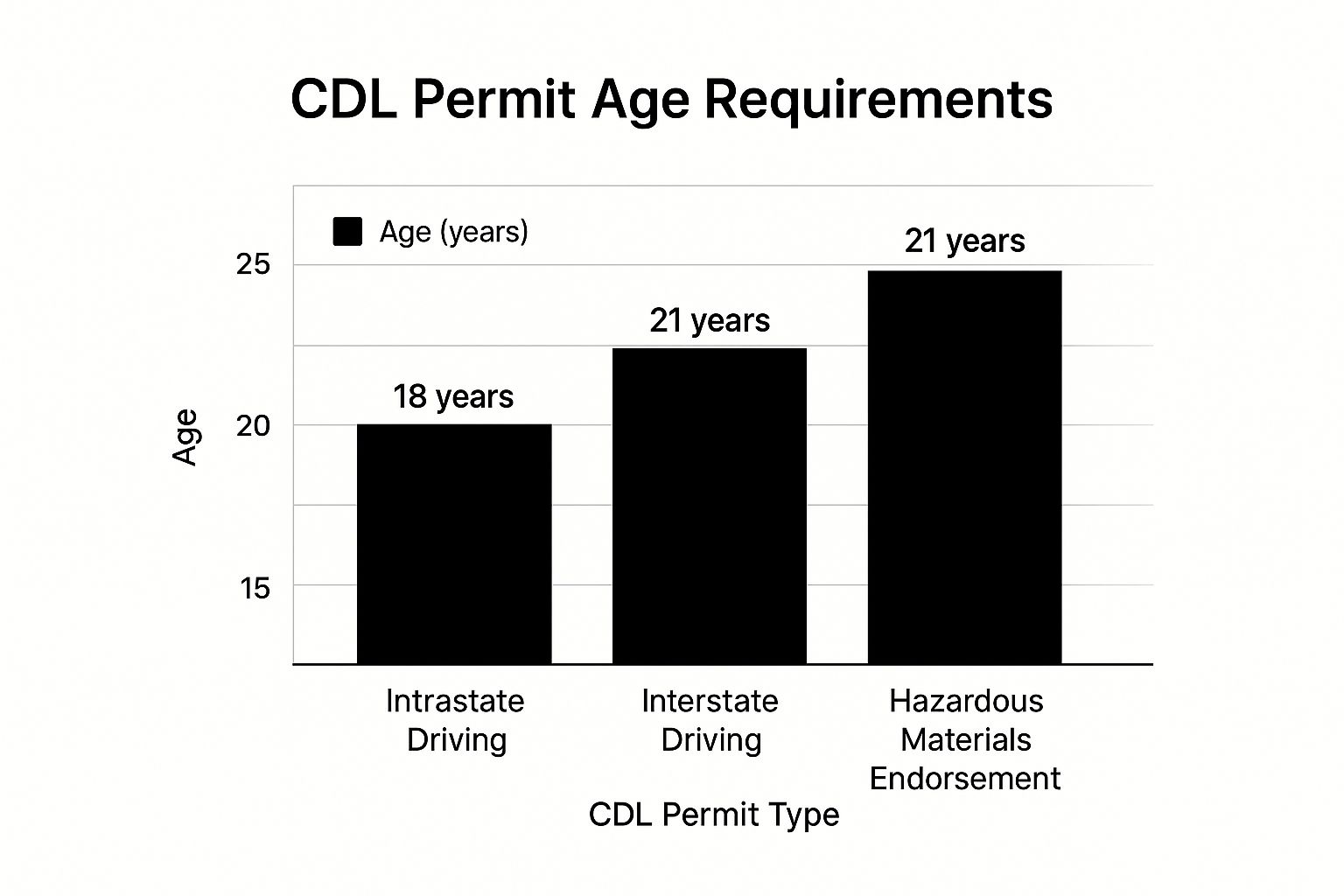
As you can see, you have to be 21 years old to drive across state lines (interstate) or to transport hazardous materials. That's a huge factor to consider when mapping out your career. It's always a good idea to check the complete list of CDL requirements to make sure you’ve got everything covered long before test day.
To help you get a clearer picture, I've put together a table that breaks down the most common sections of the CDL written exam.
CDL Knowledge Test Sections at a Glance
This table gives you a snapshot of what each test involves, from the number of questions to the key topics you'll be tested on. Use it to figure out where to focus your study time.
| Test Section | Typical Number of Questions | Passing Score Requirement | Key Topics Covered |
|---|---|---|---|
| General Knowledge | 50 | 80% (40 correct) | Vehicle inspection, basic control, shifting gears, seeing hazards, emergency procedures, controlling speed, and managing space. |
| Air Brakes | 25 | 80% (20 correct) | Air brake system parts, dual air brake systems, inspecting air brakes, and using air brakes properly on the road. |
| Combination Vehicles | 20 | 80% (16 correct) | Driving combination vehicles safely, combination vehicle air brakes, coupling and uncoupling, and inspecting combinations. |
| Hazardous Materials (Hazmat) | 30 | 80% (24 correct) | The intent of regulations, communication rules, loading and unloading, and specific rules for different material classes. |
Having this breakdown makes it much easier to tackle your preparation one piece at a time. By knowing what's on each test, you can study more efficiently and walk into the DMV with confidence.
Making the Most of Modern Study Tools

Forget spending hours poring over a dusty, highlighted manual. The way we prep for the CDL exam has completely changed. These days, the smartest approach involves using digital resources, from powerful mobile apps to comprehensive online platforms that genuinely sharpen your knowledge. These aren't just fancy flashcards; they're designed to replicate the real testing experience.
This digital shift gives you a huge leg up. Instead of just passively reading material, you can actively engage with it. The real game-changer is the ability to study anytime, anywhere. That spare ten minutes waiting for a load or on your lunch break can become a valuable prep session, keeping the information fresh and ready.
Simulating the Real Deal with Exam Mode
One of the most powerful features you'll find in a quality CDL permit practice test platform is what's often called "Exam Mode." Don't mistake this for a simple quiz. Think of it as a full-dress rehearsal for your trip to the DMV, building the mental muscle you need to pass.
When you start an Exam Mode test, it puts you right into the official test environment. You’ll get a set number of questions, typically 50 for General Knowledge, pulled from a huge database. More importantly, a clock starts ticking, giving you the same 60-minute window you’ll have on test day. This is crucial because it introduces the same pressure you'll feel, teaching you how to manage your time and stay focused when it really matters.
Here’s why this is so effective:
- You Master the Clock: You get a feel for the right pace, learning how to answer each question thoughtfully without rushing or, even worse, running out of time.
- It Calms Your Nerves: The more you face that timer, the less intimidating it becomes. What was once a source of anxiety turns into a familiar routine.
- You Get a Real Score: Finishing a full-length, timed exam gives you an honest snapshot of your readiness. You'll know if you are consistently hitting that critical 80% passing score needed at the DMV.
By making Exam Mode a regular part of your study routine, you’ll walk into the testing center feeling prepared and confident, not just with the material, but with the entire process.
Turning Mistakes into Strengths with Practice Mode
While Exam Mode is your final check, "Practice Mode" is where the real learning happens. This is your secret weapon for turning wrong answers into genuine understanding. It doesn't just tell you you're wrong; it shows you why.
In Practice Mode, you get instant feedback after every single question. Getting one right is great, but the true value comes from the detailed explanations for the ones you miss. This immediate correction is vital for truly grasping complex topics like air brake checks or hazardous materials rules. You can zero in on the sections you're struggling with and hammer away at those questions until the concepts finally click.
The goal isn't just memorizing answers to pass a test. It's about understanding the core principles behind the rules. That's the knowledge that will keep you safe on the road long after you have your license.
High-quality CDL permit practice test apps have made this kind of focused study incredibly easy. The best ones offer massive question banks, some with over 500 questions, that cover General Knowledge and all major endorsements. These tools are built to help you find and fix your weak spots, ensuring your study time is spent where it counts the most.
Get a Feel for the Real Test with Realistic Questions
https://www.youtube.com/embed/t04o9UAdyq4
It's one thing to read the CDL manual and another thing entirely to apply that knowledge when the pressure is on. This is where a good cdl permit practice test really shines. It’s not about just memorizing facts; it’s about forcing you to think through the real-world situations you'll face on the job. This is how you start turning book smarts into road smarts.
Let's break down some tough questions you’re guaranteed to see on the CDL permit exam, covering General Knowledge, Air Brakes, and Combination Vehicles. I’ll show you the right answer, but more importantly, I’ll explain why it’s right and why the other choices are traps.
General Knowledge in Action
The General Knowledge test is the bedrock of your CDL. These questions are all about the fundamental safety rules that apply to every commercial driver, no matter what you're hauling. They often put you in a scenario and ask you to make the safest call.
Here’s a classic example you’ll see in some form on your test.
Sample Question:
You are driving a 40-foot vehicle at 35 mph. The road is dry, and visibility is good. How much space should you keep in front of you?
- A) 2 seconds
- B) 3 seconds
- C) 4 seconds
- D) 5 seconds
Correct Answer: C) 4 seconds
Explanation:
This is all about the "rule of thumb" for following distance. The formula is simple: one second for every 10 feet of vehicle length when driving under 40 mph. So, for a 40-foot vehicle, you need 4 seconds. Answer B (3 seconds) is dangerously close for a vehicle this size. While 5 seconds (D) isn't wrong—more space is always better—the question is asking for the standard minimum. The test is looking for you to know that specific rule.
If you want to get comfortable with hundreds of questions just like this one, working through a dedicated General Knowledge test is the best way to drill these concepts into your head.
Deconstructing Air Brake Questions
The Air Brakes test is notoriously tricky and full of technical details. You'll be hit with questions about specific pressure readings, system checks, and what to do in an emergency. You can't just have a vague idea of how air brakes work; you need to know the numbers and procedures cold.
Take a look at this scenario-based question a cdl permit practice test might throw at you.
Sample Question:
During a static leakage test, what is the maximum amount of air pressure a combination vehicle can lose in one minute?
- A) 1 psi
- B) 2 psi
- C) 3 psi
- D) 4 psi
Correct Answer: C) 3 psi
Explanation:
This is a detail straight from the federal regulations. For a combination vehicle (like a tractor-trailer), the system can't lose more than 3 psi in one minute during a static test. The trick here is that the limit for a single vehicle is 4 psi (Option D). They include that option specifically to catch people who haven't studied the difference. This is a perfect example of why precision matters.
I see drivers mix this up all the time. They confuse the air loss limits for single trucks versus combination rigs. The DMV knows this and writes questions to test you on it. The only way to get it right every time is to practice until it's second nature.
Navigating Combination Vehicle Physics
The Combination Vehicles test is all about handling a rig with multiple sections. These questions get into the nitty-gritty of turning, braking, and avoiding ugly situations like rollovers or the infamous "crack-the-whip" effect from the trailer.
Here’s a practical question that tests whether you understand how trailers behave.
Sample Question:
When you make a right turn with a long combination vehicle, where should you position your tractor as you begin the turn?
- A) Keep the rear of the tractor close to the curb.
- B) Swing wide as you start the turn.
- C) Turn as you would in a passenger car.
- D) Drive straight through the intersection before turning.
Correct Answer: B) Swing wide as you start the turn.
Explanation:
The key concept here is off-tracking. It means the rear wheels of your trailer take a much shorter path than your tractor's front wheels. To stop your trailer from hopping the curb or hitting a sign, you have to swing your tractor out wide. This gives the trailer the space it needs to follow you around the corner cleanly. If you pick A, you're almost guaranteed to take out that curb with your trailer tires. Options C and D are just flat-out dangerous and show a complete lack of understanding of how these rigs move.
By tackling these kinds of realistic questions on a cdl permit practice test over and over, you’re not just memorizing answers. You’re building the mental muscle to think through any scenario the real test—and the road—can throw at you.
Build Study Habits That Actually Work
Let's be real—passing the CDL permit test isn't about cramming the manual the night before. That's a surefire way to feel stressed and forget crucial details the second you sit down at the DMV. From what I’ve seen, the drivers who succeed are the ones who build real, lasting knowledge through smart, consistent effort.
The key is to have a plan. You need a proven roadmap that breaks down this mountain of information into something you can actually tackle. Think of this as your personal game plan, designed to help you walk into that test feeling prepared, confident, and ready to pass.
Carve Out a Realistic Study Schedule
The official CDL manual is a beast. Trying to swallow it whole is like trying to drink from a fire hydrant—it’s just too much at once. A much better approach is to divide and conquer.
Don't just block off two hours on your calendar for "studying." Get specific and give yourself clear, achievable goals. Here’s a sample schedule that works for a lot of people:
- Monday: Just focus on Section 1 (Introduction to a CMV) and Section 2 (Driving Safely). That's it.
- Tuesday: Move on to Section 3 (Transporting Cargo Safely). Then, take a cdl permit practice test that only covers what you’ve studied so far.
- Wednesday: Dedicate the entire session to Air Brakes. It’s a dense topic. Read the chapter, then find a practice test specifically for Air Brakes.
- Thursday: Use this day to review everything from the week. Take a mixed practice test to see what’s sticking and, more importantly, what isn’t.
This method keeps you from feeling overwhelmed and helps your brain actually process and store the information. It turns one massive task into a series of small wins, which builds serious momentum and confidence.
Use the “Teach-Back” Method to Make It Stick
Here’s a powerful learning trick that’s surprisingly simple: explain what you just learned to someone else. It's called the "teach-back" method, and it's brutally effective.
When you have to put a concept into your own words, you immediately find out if you truly get it or if you just skimmed the page. You don't even need a live audience—explain it to your spouse, your dog, or the wall. The simple act of verbalizing something complex, like the steps for a pre-trip inspection or the physics of off-tracking, cements it in your mind.
If you can't explain it simply, you don't understand it well enough. This is your personal lie detector for your own knowledge, revealing gaps that passive reading will always miss.
Once you can confidently explain why the acceptable air pressure loss for a combination vehicle is 3 psi in a static test, you've gone from just memorizing a number to understanding a critical safety standard. That’s the kind of deep knowledge the real exam is looking for.
Have a Strategy for Test Day
All the knowledge in the world won't help if you panic on test day. Having a clear strategy before you walk into the DMV can be the difference between passing and failing.
First, be smart with your time. The General Knowledge test gives you 60 minutes. Don't get bogged down on one tough question. If you’re not sure, flag it for review and move on. Bank all the easy points first to build your score and confidence, then circle back to the tricky ones if you have time.
Second, read every single word of the question and every answer choice. Test creators are masters of writing plausible-sounding wrong answers. They love using absolute words like "always" or "never," or including an answer that would be correct in a slightly different scenario.
For example, a question might ask about safe following distance in the rain, but one of the options will be the correct distance for perfect, dry conditions. You learn to spot these traps by taking quality practice tests over and over. Working through plenty of sample questions, like the ones in our general knowledge test prep guide, will train you to spot these decoys and lock in the right answer.
Common Questions About the CDL Permit Test
Even with a great study plan, you're bound to have some questions as you work your way toward getting your CDL. It’s a big process, and it’s smart to get answers. Let's tackle some of the most common things aspiring drivers wonder about the permit test and what happens right after.
How Many Times Can I Retake the CDL Permit Test?
Failing the permit test isn't a dead end, but what happens next really depends on your state. Just about every state lets you try again, but they almost always make you wait a bit. That waiting period could be just one business day, or it might be a full week or even longer.
The thing you really need to watch out for is a limit on how many times you can fail. Some states will make you start the entire application over from scratch—fees and all—if you fail too many times, which is often three. Honestly, the best and cheapest way to handle this is to prepare so well that you pass on your first attempt. A solid cdl permit practice test is your best friend here.
Are Online CDL Practice Tests Accurate?
Yes, the good ones are incredibly accurate. Reputable online practice tests are your single best tool for preparation because they're built directly from the official state CDL manuals and federal FMCSA regulations. That means the material they cover is exactly what you'll be tested on.
Now, the questions won't be a word-for-word copy of what you'll see at the DMV. But they do an excellent job of mimicking the multiple-choice format, the kind of scenarios they’ll throw at you, and the overall difficulty. It’s the closest you can get to taking the real thing without actually being there.
Don't just see them as sample questions. Think of practice tests as a full-blown dress rehearsal for the main event. You're not just learning the material; you're getting used to the pressure and timing, which builds the confidence you need.
What Should I Do After Passing the Permit Test?
Passing the written tests is a huge step! Once you do, you’ll be handed your Commercial Learner's Permit, or CLP. This is your green light to start practicing behind the wheel on public roads, but you must have a licensed CDL holder sitting right next to you.
From there, your path is pretty clear:
- You need to complete your Entry-Level Driver Training (ELDT) with a provider that's on the FMCSA’s official registry.
- You must hold your CLP for at least 14 days before you're even allowed to take the final CDL skills test (the driving portion).
- Once that waiting period is over and your ELDT is done, you can book your three-part skills test: the vehicle inspection, basic control skills, and the on-road driving test.
Should I Study for All Endorsement Tests at Once?
It’s tempting to try and knock out every single endorsement right away, but from my experience, that’s not the smartest move. It's much more effective to be strategic. Focus on passing the core tests you need for the job you want right now.
For most new drivers looking to get behind the wheel of a tractor-trailer, that means zeroing in on these three:
- General Knowledge
- Combination Vehicles
- Air Brakes
This approach keeps your studying focused and a lot less overwhelming. You can always go back later in your career to add endorsements like Hazmat, Tanker, or Doubles/Triples when a new opportunity comes up. This gets your CLP in your hand faster so you can start the hands-on training. Mastering the technical side of the rig is vital, and using a dedicated air brakes practice test will make sure you’ve got that critical system down cold.
At Patriot CDL, we provide the hands-on training and expert guidance you need to turn your Commercial Learner's Permit into a successful, high-paying career. Learn more about our programs and get on the road to success.