If you're gearing up for your commercial driver's license, the CDL air brake practice test is one of the most important hurdles you'll face. This isn't just about memorizing some facts and figures for an exam. It’s about building a deep, practical understanding of the very systems that keep a massive commercial vehicle under control.
Why Mastering the Air Brake Test Is So Critical
Looking at the requirements for the air brake endorsement can feel a little daunting, but it's a non-negotiable part of the process for anyone serious about driving heavy vehicles. It's far more than just another item to check off the list of general CDL requirements. This test certifies your ability to handle a vehicle with incredible stopping power, where knowing the system inside and out can mean the difference between a normal day and a very bad one.
Our job here is to get you ready. We'll walk you through how a good CDL air brake practice test is more than just studying—it's the best way to become a safer, more skilled driver and nail the official test on your first try.
Understanding the High Stakes
There’s a reason the official test is tough. Take the California CDL air brake test, for example. It throws 25 questions at you covering everything from system components and proper operation to stopping distances and routine maintenance. To pass, you have to answer at least 20 questions correctly, putting the pass mark at a firm 80%. That standard is there for a reason: to make sure only drivers who truly know their stuff get behind the wheel.
This infographic really drives home the connection between passing the test and being a safer driver on the road.
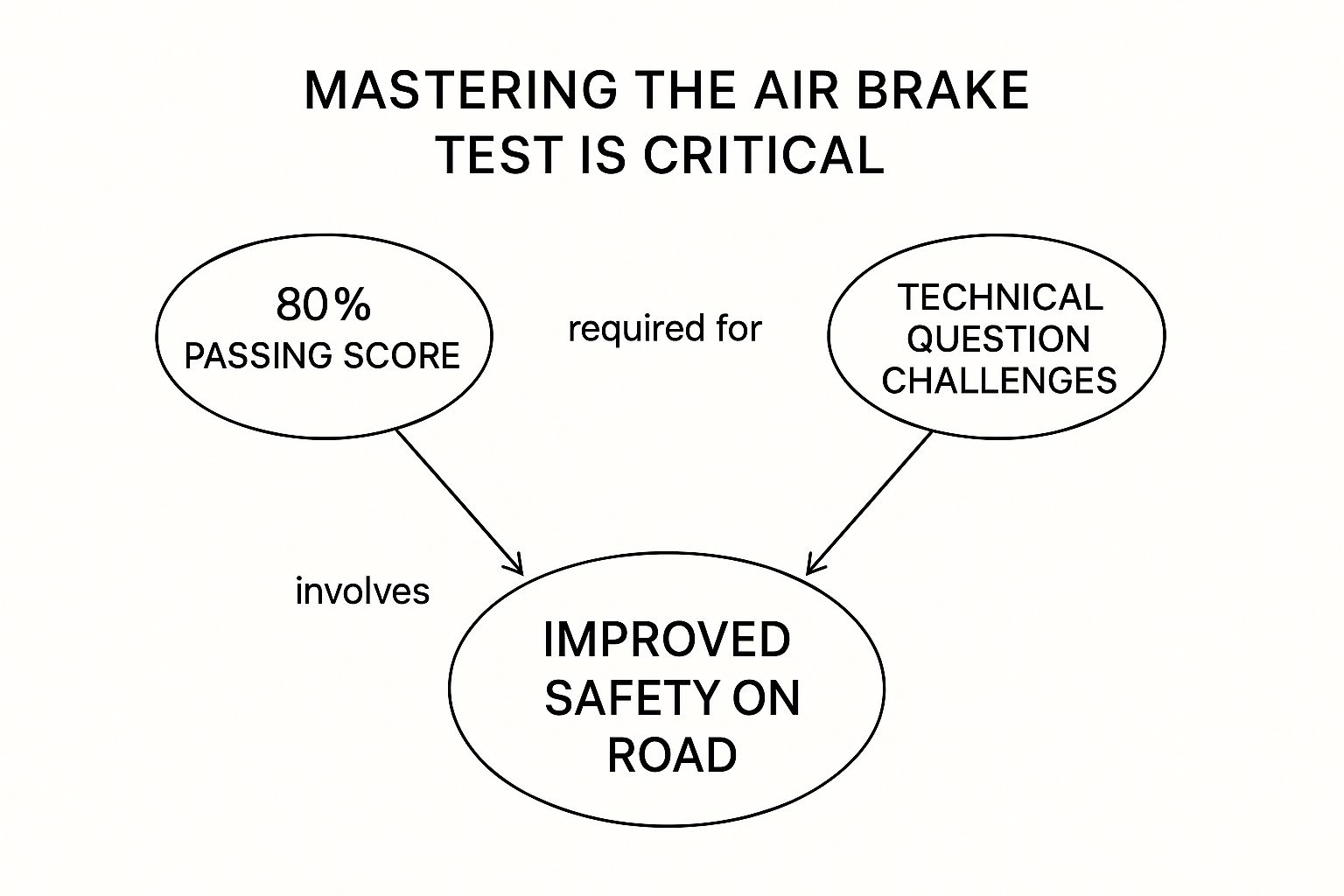
As you can see, both the high bar for passing and the technical depth of the questions are intentionally designed to forge drivers with top-notch safety skills.
More Than Just Passing a Test
Sure, hitting that 80% mark is what gets you the endorsement, but the real prize is the knowledge you pick up on the journey. When you truly grasp concepts like brake lag, proper air pressure, and what to do in an emergency, you're building real-world competence. This knowledge is what you'll rely on during your pre-trip inspection when you have to physically demonstrate that you know what you're doing.
The air brake endorsement is a cornerstone of your professional driving career. It's your proof that you have the technical skill to manage one of the most critical safety systems on any big rig or bus.
At the end of the day, this is about more than a piece of paper. It’s about building a professional skill set that keeps you, your cargo, and everyone else on the road safe. Acing a practice test builds the confidence and mental readiness you need to perform when it really matters.
How an Air Brake System Actually Works
Before you can ace the test, you need to get a feel for how a commercial truck's air brake system really works. It’s a powerful and incredibly reliable setup, but it’s a whole different world from the hydraulic brakes in your personal car. The easiest way to wrap your head around it is to think of it as a journey for compressed air.
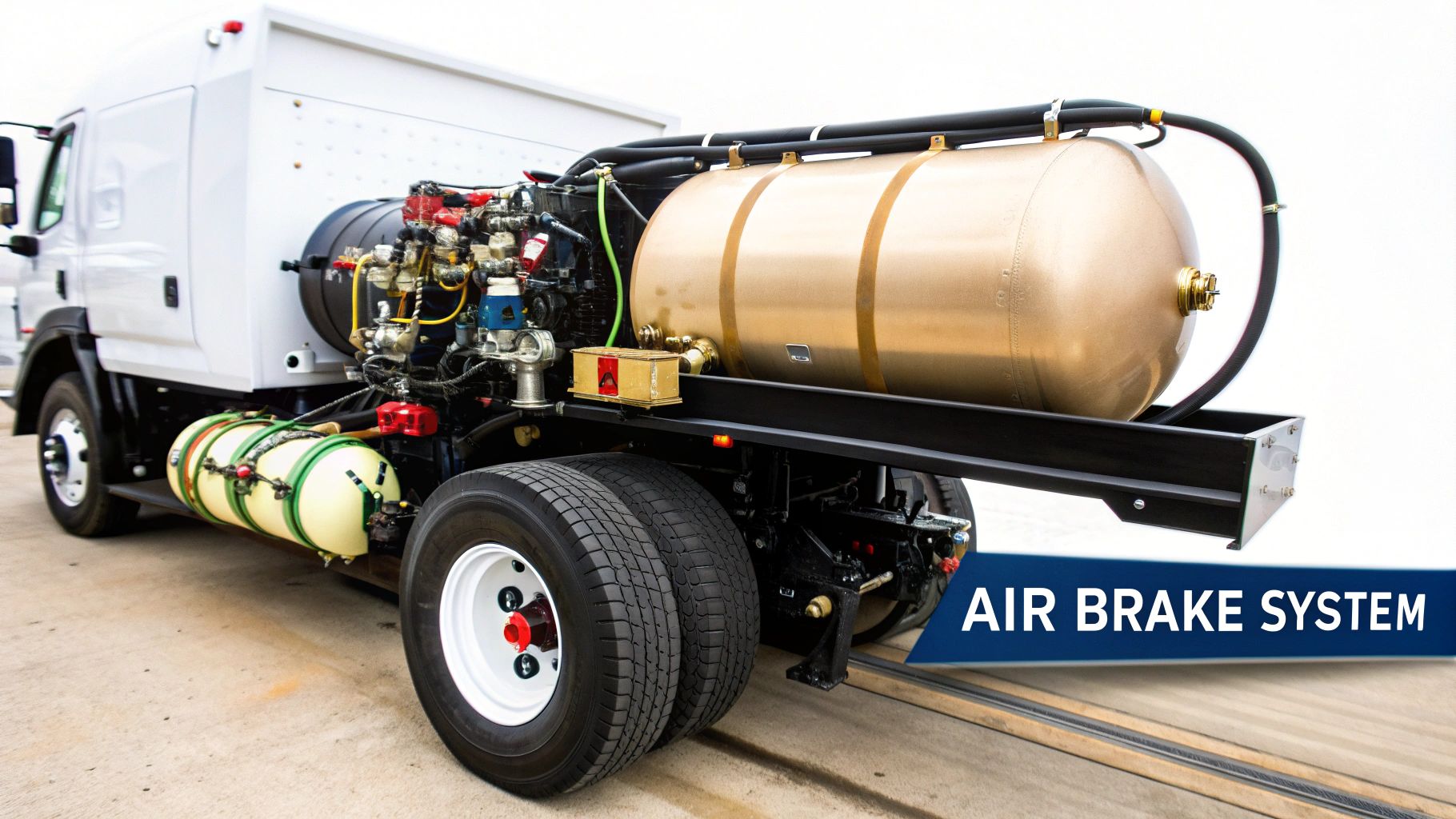
The whole show starts with one key player: the air compressor. This is the heart of the system. It’s driven by the engine and does exactly what its name says—it pulls in outside air and squeezes it down, creating the force that will eventually stop your rig.
But you can't just have the compressor running wild. That’s where the air compressor governor steps in. Think of it as the system’s brain. It’s a smart little device that tells the compressor when to kick on (at around 100 PSI) and when to shut off (at about 125 PSI). This keeps the system perfectly charged without overworking the components.
The Storage and Delivery Network
Once the compressor does its job, all that high-pressure air needs somewhere to go. It’s stored in air storage tanks until you’re ready to use it. A typical truck has several of these tanks holding air at the ready. You’ll also notice they have drain valves—a crucial feature for bleeding out any moisture or oil that builds up. Forgetting to drain your tanks is a rookie mistake you don't want to make.
From there, the air just waits for your command. When you step on the brake pedal, you're not pushing fluid through a line like in a car. Instead, you're cracking open a valve that unleashes that stored, compressed air, sending it rushing through a network of hoses.
It's a simple but powerful idea: your foot on the pedal is like opening a floodgate. You're releasing a massive surge of air that travels almost instantly to the wheels. This is exactly why knowing your air pressure levels is a huge part of any CDL air brake practice test.
This blast of air shoots out to the brake chambers at each wheel. Inside the chamber, the air pressure shoves against a diaphragm, which in turn moves a rod known as a pushrod.
Turning Air into Stopping Power
That moving pushrod is where the real work begins. The pushrod connects to a slack adjuster, which acts as a lever to multiply the force. As the pushrod extends, the slack adjuster cranks on the brake camshaft.
The rotating camshaft then forces the brake shoes outward, pressing them hard against the inside of the brake drum. That creates an enormous amount of friction, and it’s this friction that slows the wheels and brings a vehicle weighing tens of thousands of pounds to a safe, controlled stop.
Here's the chain of command:
- Brake Pedal: Your command center. It releases air from the tanks.
- Brake Chambers: Take that air pressure and turn it into mechanical force.
- Slack Adjusters: Act as levers, amplifying that force and passing it on.
- Brake Shoes & Drums: The end of the line, creating the friction that stops the truck.
Getting this sequence down is absolutely essential. Federal rules mandate that all new drivers complete specific training on these very components before they can even attempt their skills test. You can get more details on the required Entry-Level Driver Training (ELDT) theory that covers this material. Understanding this system from start to finish is your ticket to nailing those tricky situational questions on the exam.
Key Air Brake Concepts That Appear on the Test
Knowing the individual parts of an air brake system is a good start, but the official CDL test is going to dig deeper. It's designed to see if you understand the core concepts that dictate how these systems actually behave out on the road. To really ace your CDL air brake practice test, you need to get past simple memorization and understand the why behind it all.
You'll find that a lot of the trickiest questions on the exam circle back to just a few fundamental ideas. Let’s break down the dual air brake system, get a handle on brake lag, and clarify the critical job of spring brakes.
The Dual Air Brake System Explained
Modern trucks don't rely on a single air brake system—they have two. This is called the dual air brake system, and it's a game-changing safety feature. It essentially gives you a complete backup system in case one fails.
Think of it as two separate, independent circuits. The primary circuit typically handles the brakes on the rear axles, while the secondary circuit controls the front axle. Both get their air from the same compressor, but each has its own air tanks, hoses, and valves. That separation is key.
If you spring a major leak in the primary system, the secondary system doesn't even flinch. It keeps working, giving you the stopping power you need to get the truck safely to the shoulder. This is a hot topic on the test because it highlights the system's built-in redundancy.
Your dashboard will have two air pressure gauges, one for each of these circuits. As a driver, you have to watch both like a hawk. If one needle starts dropping while the other holds steady, you’ve got a leak in that circuit and need to act fast.
Understanding Critical Brake Lag
One of the biggest adjustments when moving from a car to a truck is brake lag. This is the small but significant delay between you hitting the brake pedal and the brakes actually engaging.
That delay is simply physics at work. It takes a fraction of a second for compressed air to travel all the way from the tanks, through the lines, and into the brake chambers at each wheel. It might only be half a second, but that half-second has a huge impact on your total stopping distance, especially when you're moving at highway speeds.
Your total stopping distance is more than just how hard you brake. It’s the sum of a few different stages:
- Perception Distance: How far you travel while your brain recognizes a hazard.
- Reaction Distance: How far you travel in the time it takes to move your foot to the brake.
- Brake Lag Distance: How far you travel while the air is activating the brakes.
- Braking Distance: The distance your truck covers after the brakes are fully applied.
Here's a dose of reality: at 55 mph, a brake lag of just half a second means your rig travels an extra 40 feet before the brakes even start doing their job. This is exactly why a safe following distance is non-negotiable for a professional driver. It's a central theme in both safe driving and the CDL general knowledge test material.
The Role of Spring Brakes
Finally, let's talk about spring brakes. These aren't the brakes you use for normal slowing and stopping. Instead, they have two very specific and critical jobs: parking and emergency braking.
The best way to think of them is as powerful springs that are constantly trying to apply the brakes. The only thing stopping them is air pressure. When you pull the parking brake knob, you're actually releasing the air pressure holding them back. This allows those massive springs to expand and mechanically lock the wheels, keeping your truck put. They work with zero air pressure.
This design gives you an incredible fail-safe. If you have a catastrophic failure in your service brakes and air pressure plummets to a critical level (usually between 20 and 45 PSI), the spring brakes take over. They start to apply automatically, bringing your vehicle to a stop and preventing a potential runaway truck.
Air Brake System Warning Indicators
Your air brake system is designed to give you plenty of warning before a critical failure. The test will expect you to know the specific pressure levels that trigger these warnings and actions. This table breaks down what happens and when.
| Indicator | Activation Pressure (PSI) | What It Means for the Driver |
|---|---|---|
| Low Air Warning Light & Buzzer | Activates at or before 60 PSI | This is your first alert. You must find a safe place to stop immediately to diagnose the issue. |
| Tractor Protection Valve | Closes between 20-45 PSI | Stops air supply to the trailer to preserve air for the tractor's brakes. |
| Parking Brake Pop-Out Valve | Pops out between 20-45 PSI | This automatically applies the spring brakes on the truck/tractor, bringing you to a stop. |
Knowing these numbers isn't just about passing the test; it's about understanding the sequence of events that will happen if your air system fails, allowing you to react safely and professionally.
Your Complete CDL Air Brake Practice Test
Alright, time to roll up our sleeves and see what you’ve learned. Reading the theory is one thing, but applying it when the pressure is on is what really counts. The best way to get ready for the real deal is to work through a high-quality CDL air brake practice test. It’s the bridge between knowing the concepts and nailing them on exam day.
We’ve put together a comprehensive, 25-question practice test that mirrors what you'll face at the DMV. It hits all the key topics—from compressor governors and pressure ranges to brake lag and emergency procedures.
But here’s the most important part: this isn’t just about getting a score. After every single question, you’ll find a detailed explanation. We break down exactly why an answer is correct and, just as crucially, why the other choices are wrong. This is how you truly cement the information in your head and walk into the test with confidence.
Air Brake Practice Questions
Ready to give it a shot? Take your time, read each question like you’re in the testing booth, and choose the best answer.
1. At what PSI should the low air pressure warning light and buzzer activate?
A) At or above 80 PSI
B) At or before 60 PSI
C) Between 20-45 PSI
D) At 125 PSI
Answer & Explanation: The correct answer is B) At or before 60 PSI. Think of this as your first line of defense. Federal rules mandate that your low air warning light and buzzer must kick on when pressure in either air circuit drops to 60 PSI or slightly below. It’s the truck’s way of screaming, "We have an air supply problem!"
2. What is the main purpose of the air compressor governor?
A) To filter oil out of the air supply
B) To control when the air compressor pumps air
C) To drain moisture from the air tanks
D) To apply the spring brakes in an emergency
Answer & Explanation: The correct answer is B) To control when the air compressor pumps air. The governor is basically the boss of the air compressor. It tells the compressor when to start pumping air (the "cut-in" pressure, around 100 PSI) and when to stop (the "cut-out" pressure, around 125 PSI). This keeps your system perfectly pressurized without overworking the compressor.
3. What are spring brakes?
A) Brakes that are used for gentle stops in city traffic
B) An extra set of service brakes for added power
C) Brakes that use powerful springs to apply them for parking and emergency stops
D) Brakes that are controlled by hydraulic fluid instead of air
Answer & Explanation: The correct answer is C) Brakes that use powerful springs to apply them for parking and emergency stops. This is a fail-safe system. Air pressure is actually used to hold back these powerful springs. When you pull the parking brake knob—or if you have a catastrophic air loss—that pressure is released, and the springs mechanically force the brakes on.
4. Brake lag distance is the distance your vehicle travels from the moment you…
A) See a hazard to when you apply the brakes
B) Push the brake pedal until the brake shoes make contact with the drum
C) Apply the brakes until the vehicle comes to a complete stop
D) Begin slowing down until you are at a safe speed
Answer & Explanation: The correct answer is B) Push the brake pedal until the brake shoes make contact with the drum. This is unique to air brake systems. Unlike the instant response of hydraulic brakes in your car, it takes a fraction of a second for the air to travel through the lines and physically apply the brakes. At 55 mph, that tiny delay can add over 40 feet to your stopping distance.
5. How often should you drain your air tanks?
A) Once a week
B) Once a month
C) At the end of each day of driving
D) Only when you see water in the air lines
Answer & Explanation: The correct answer is C) At the end of each day of driving. This is a non-negotiable daily habit. The compression process creates moisture (and can introduce a little oil), which collects in the tanks. Draining them daily prevents that gunk from freezing in cold weather or corroding your brake components from the inside out.
6. The service brake system applies and releases the brakes when you…
A) Use the parking brake control
B) Have a major air leak
C) Use the brake pedal during normal driving
D) Connect the trailer air lines
Answer & Explanation: The correct answer is C) Use the brake pedal during normal driving. The "service brakes" are just the industry term for your everyday brakes. They’re the ones you use with the foot pedal to slow down and stop under normal conditions.
7. A dual air brake system has two separate air brake systems that use a single set of controls. The primary system typically operates the brakes on the…
A) Front axle
B) Trailer axles
C) Rear axles
D) Steering axle
Answer & Explanation: The correct answer is C) Rear axles. Modern trucks have two independent circuits for safety. The primary circuit usually handles the rear drive axles, while the secondary circuit takes care of the front steering axle. This built-in backup means that if one system fails, you still have braking power on the other half of the vehicle.
8. When testing the air compressor governor cut-in and cut-out pressures, what is the normal cut-out pressure range?
A) 80-90 PSI
B) 100-110 PSI
C) 120-135 PSI
D) 140-150 PSI
Answer & Explanation: The correct answer is C) 120-135 PSI. During your pre-trip inspection, you should see the air pressure gauge climb and then stop somewhere in the 120-135 PSI range. That’s the governor telling the compressor its job is done and the tanks are full.
9. During a static leak test (engine off, brakes released), what is the maximum allowable leakage per minute for a straight truck or bus?
A) 1 PSI
B) 2 PSI
C) 3 PSI
D) 4 PSI
Answer & Explanation: The correct answer is B) 2 PSI. For a single vehicle (like a straight truck), the air pressure can't drop more than 2 PSI in one minute with the brakes off. If you’re in a combination rig, the limit is 3 PSI. It’s a key safety check.
10. What is the purpose of an alcohol evaporator?
A) To remove alcohol from the air system
B) To inject alcohol into the air system to prevent ice buildup
C) To cool the air coming from the compressor
D) To measure the alcohol content in the fuel
Answer & Explanation: The correct answer is B) To inject alcohol into the air system to prevent ice buildup. In regions with harsh winters, this little device is a lifesaver. It adds a bit of alcohol vapor to the air system, which acts like antifreeze for any moisture in the lines, preventing ice blockages that could lead to brake failure.
11. The braking power of the spring brakes depends on…
A) The amount of air pressure in the system
B) The adjustment of the service brakes
C) The driver pressing the brake pedal
D) The temperature outside
Answer & Explanation: The correct answer is B) The adjustment of the service brakes. This is a tricky one that catches a lot of people. Spring brakes use the exact same brake shoes and drums as your service brakes. If your service brakes are out of adjustment, the spring brakes won't have the mechanical leverage to hold the truck securely. Properly adjusted brakes are essential for everything to work.
12. When the parking brake knob is pulled out, you are…
A) Sending air pressure to apply the brakes
B) Releasing the air pressure holding back the spring brakes
C) Activating the hydraulic brake system
D) Engaging the service brakes manually
Answer & Explanation: The correct answer is B) Releasing the air pressure holding back the spring brakes. Pulling that yellow knob on your dash vents all the air from the spring brake chambers. Without air pressure holding them back, the massive springs expand and mechanically lock the brakes in place.
13. During an applied air leakage test (engine off, brakes fully applied), what is the maximum allowable leakage per minute for a combination vehicle?
A) 2 PSI
B) 3 PSI
C) 4 PSI
D) 5 PSI
Answer & Explanation: The correct answer is C) 4 PSI. With the brake pedal pushed down hard, a combination vehicle shouldn't lose more than 4 PSI in one minute. The limit for a single vehicle is 3 PSI per minute. Any more than that, and you have a leak that needs to be fixed before you roll.
14. If your vehicle has a dual air brake system and the low air pressure warning comes on for only one system, what should you do?
A) Continue driving to your destination and check it later
B) Stop and park safely as soon as possible
C) Pump the brake pedal to try and build pressure back up
D) Increase your speed to get off the road faster
Answer & Explanation: The correct answer is B) Stop and park safely as soon as possible. A warning for just one system is still a major problem. It means half of your braking power is compromised. The only safe move is to get the truck pulled over and find out what's wrong.
15. The S-cam is responsible for…
A) Pushing the brake shoes against the inside of the brake drum
B) Adjusting the slack in the brake linkage
C) Storing compressed air for the brake system
D) Cooling the brake components
Answer & Explanation: The correct answer is A) Pushing the brake shoes against the inside of the brake drum. When you hit the brakes, air moves the pushrod, the pushrod moves the slack adjuster, and the slack adjuster turns the camshaft. The "S" shaped head of the cam then forces the brake shoes outward into the drum, creating the friction that stops the truck.
To get even more comfortable with these concepts, trying different sets of questions is a smart move. You can find another great resource with this CDL air brakes practice test series to see the material from a slightly different angle.
16. What is the most common cause of brake fade?
A) Brakes being out of adjustment
B) Brakes getting too hot
C) Not enough air pressure
D) Driving too slowly
Answer & Explanation: The correct answer is B) Brakes getting too hot. Brake fade is a scary situation where your brakes become less and less effective. It’s caused by excessive heat, usually from relying on them too much on a long downhill grade. The heat makes the drums expand and the linings lose their grip.
17. The tractor protection valve will close automatically if the air pressure falls into which range?
A) 100-125 PSI
B) 60-80 PSI
C) 20-45 PSI
D) 0-10 PSI
Answer & Explanation: The correct answer is C) 20-45 PSI. This valve is a critical safety feature for combination vehicles. If your trailer has a massive air leak (like a torn gladhand line), this valve will pop, stopping air from leaving the tractor and preserving what's left for you to stop safely. It also triggers the trailer's emergency brakes.
18. What is "fanning" the brakes?
A) Applying and releasing the brake pedal repeatedly
B) Using a fan to cool down hot brakes
C) A technique for improving fuel economy
D) A method for testing brake adjustment
Answer & Explanation: The correct answer is A) Applying and releasing the brake pedal repeatedly. Fanning is a bad and dangerous habit. Every time you press and release the brake pedal, you use up a chunk of air from your tanks. Doing it repeatedly can drain your air supply faster than the compressor can keep up, leaving you with little to no braking power.
19. What should the air pressure in the system be before driving?
A) At least 60 PSI
B) At least 85 PSI
C) At least 100 PSI
D) At least 125 PSI
Answer & Explanation: The correct answer is C) At least 100 PSI. As a rule of thumb, you should not move the vehicle until the air pressure in both circuits is at least 100 PSI. This ensures you have enough air for safe, effective braking right from the start.
20. What is a supply pressure gauge used for?
A) It tells you how much pressure is in the air tanks
B) It tells you how much pressure you are applying to the brakes
C) It tells you the pressure in your tires
D) It tells you the engine oil pressure
Answer & Explanation: The correct answer is A) It tells you how much pressure is in the air tanks. The supply gauges show how much air you have in storage, ready to be used. Don't confuse this with the application gauge, which shows how much air pressure you're sending to the brakes each time you press the pedal.
21. If the slack adjuster on an S-cam brake moves more than about ______ where the pushrod attaches, it needs adjustment.
A) 1/2 inch
B) 1 inch
C) 2 inches
D) 3 inches
Answer & Explanation: The correct answer is B) 1 inch. This is a must-know for your pre-trip inspection. When you pull on it by hand, if the pushrod travel is more than one inch, the brakes are too loose. This leads to poor stopping power and is a serious safety hazard.
22. On long downhill grades, experts recommend using a low gear and…
A) Riding the brakes gently all the way down
B) Applying the brakes firmly for short periods and then releasing
C) Pumping the brakes frequently to keep them cool
D) Turning the engine off to save fuel
Answer & Explanation: The correct answer is B) Applying the brakes firmly for short periods and then releasing. This method, often called "snub braking," is the key to preventing brake fade. Use your engine brake, let your speed build to a safe limit, then apply the brakes firmly to drop about 5 mph. Release and repeat. This gives the brakes time to cool down in between applications.
23. Why should you be in the proper gear before starting down a hill?
A) To prevent the engine from stalling
B) Shifting gears on a downgrade can be difficult or impossible
C) It helps the air conditioner work better
D) It is required by federal law
Answer & Explanation: The correct answer is B) Shifting gears on a downgrade can be difficult or impossible. Once gravity takes over, you’ve lost your chance to downshift easily. If you miss a gear, you could end up free-wheeling down the hill with no engine braking to help you. Always choose your gear at the top of the grade.
24. What is the function of the check valve?
A) It prevents air from leaking out of the tires
B) It allows air to flow in one direction but not the other
C) It checks the air pressure automatically
D) It releases excess air pressure from the system
Answer & Explanation: The correct answer is B) It allows air to flow in one direction but not the other. Think of it as a one-way door for air. The check valve lets compressed air into the tanks but prevents it from leaking back toward the compressor if a line fails. This keeps the stored air safe and ready for braking.
25. When you apply the trailer hand valve (also known as the trolley valve), you are…
A) Applying the brakes on the tractor only
B) Applying the brakes on the trailer only
C) Applying the brakes on both the tractor and trailer
D) Activating the emergency brake system
Answer & Explanation: The correct answer is B) Applying the brakes on the trailer only. The trailer hand valve lets you apply the trailer brakes by themselves. Its only proper use is to gently test the connection after hooking up (the "tug test"). Never use it to brake while driving—that's a classic recipe for a jackknife.
Putting Your Knowledge to the Test: The Pre-Trip Air Brake Inspection
Passing the written CDL air brake practice test is a huge step, but it's only half the battle. Now comes the part where you have to prove you can apply all that theory in the real world during your pre-trip inspection. This is where the rubber meets the road, literally. You’ll show the examiner you have what it takes to confirm your rig is safe before you even think about putting it in gear.
Think of this section as your playbook for nailing every step of the required air brake checks. Getting this sequence down cold isn't just about passing an exam; it's about building a rock-solid habit that will protect you, your truck, and everyone you share the road with. This whole process is a make-or-break part of the complete CDL pre-trip inspection, and you can bet the examiner will be watching your every move.
Air Pressure Buildup and Governor Tests
First up, you need to check the heart of your air brake system: the compressor and governor. You're making sure they're working together properly to build and regulate air pressure. This isn't a single check, but a specific, three-part sequence.
Air Pressure Buildup Rate: Get the engine running at a normal idle, somewhere around 1,000 to 1,200 RPM, and keep your eyes glued to the air gauges. The pressure needs to climb from 85 PSI to 100 PSI in 45 seconds or less. If it’s taking its sweet time, you could be looking at a weak compressor or an air leak somewhere in the system.
Governor Cut-Out Test: Now, let the engine keep running and watch those needles climb. You're listening for that distinct "pssh" sound from the air dryer. That's your signal that the governor has hit its "cut-out" pressure and told the compressor to take a break. This has to happen at or below 135 PSI.
Governor Cut-In Test: With the engine still on, start fanning the brake pedal to slowly bleed air out of the system. As the pressure drops, watch the gauges like a hawk. The governor should "cut-in," telling the compressor to get back to work, at or above 100 PSI. You’ll see the needles on your gauges start to rise again.
Nailing these three steps shows the examiner you truly understand how the air supply works. You’re proving that the system can generate and manage air pressure within the safe, federally required operating limits.
Static and Applied Air Leakage Tests
Once you've confirmed your system can make air, you have to prove it can hold it. That means checking for leaks, and there are two crucial tests you have to perform.
Static Leak Test: For this one, you'll shut the engine off and release the parking brakes (after chocking your wheels, of course). Let the system settle for a second, then start your timer. Over one full minute, a single truck can't lose more than 2 PSI. For a combination vehicle, that limit is 3 PSI.
Applied Leak Test: Right after the static test, keep the engine off but press down firmly and steadily on the brake pedal. Hold it there for another full minute while watching the gauges. With the brakes applied, a single vehicle is allowed to lose no more than 3 PSI, and a combination vehicle no more than 4 PSI.
These tests are absolutely non-negotiable. An air leak is a critical safety defect that could lead to total brake failure. If you don't perform these checks correctly or your truck fails, the examiner will end your test on the spot.
This focus on hands-on skill isn't just a local thing; it's a global standard. While the specifics of commercial licensing can vary from place to place, the emphasis on air brake competency is universal for a good reason—safety. In the U.S., federal rules mandate that all drivers of air-brake-equipped vehicles earn a special endorsement, typically requiring at least an 80% passing score on the written test to even get to this practical stage.
Answering Your Questions About the Air Brake Test
Even after hours of studying and running through a solid CDL air brake practice test, you probably still have a few questions buzzing around in your head. That’s perfectly normal. Let's tackle some of the most common ones we hear from student drivers so you can walk into your test with confidence.
We'll cover what happens if you don't pass, how long the endorsement lasts, and the simple mistakes that trip people up during the inspection.
What Happens If I Don't Pass?
First off, don't panic. Failing the air brake test—either the written part or the hands-on inspection—isn't the end of your driving career before it even starts.
Every state has slightly different rules, but you'll generally have to wait a set amount of time before you can try again. In many places, this is around 14 days. Think of it not as a failure, but as a chance to zero in on what you struggled with. Hit the books, take more practice tests, and get back in there.
How Long Is the Air Brake Endorsement Good For?
Here's some good news: once you earn that air brake endorsement, it’s part of your CDL for good. As long as you keep your main commercial license active and in good standing, you won’t have to retake the air brake test every time you renew.
Just keep in mind, this doesn't apply to every endorsement. Something like a Hazmat endorsement, for example, requires regular retesting and background checks to stay current.
What are the Most Common Pre-Trip Inspection Mistakes?
During the practical, hands-on part of the test, examiners see the same slip-ups over and over. Knowing what they are ahead of time is a huge advantage.
- Forgetting the "Script": The pre-trip inspection is a performance. You have to say what you're doing and why. Many drivers get nervous, rush through it, and miss a critical step or phrase. The key is to practice until it's second nature, then perform it slowly and deliberately on test day.
- Botching the Leak Test: A classic mistake is not holding the brake pedal down firmly for the full minute during the applied leak test. The examiner is watching the clock and the air gauges—so should you.
- Not Knowing Your Numbers: You absolutely must know that the maximum allowable pushrod travel on a slack adjuster is 1 inch. Getting this wrong is a common reason for an automatic fail.
Ready to stop practicing and start your professional driving career? Patriot CDL provides the expert, hands-on training you need to pass your exams and get on the road to freedom. Learn more and enroll today.