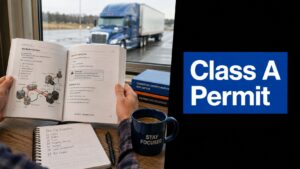
The Commercial Driver's Permit (CDL) test is your official starting line. Before you can even think about getting behind the wheel of a big rig, you need to pass this foundational written exam. Passing it earns you a Commercial Learner's Permit (CLP), which is the golden ticket to start your hands-on training.
Your First Step to a Commercial Driving Career
Think of your Commercial Learner's Permit (CLP) as the first major milestone on your journey to becoming a professional driver. The permit test isn't just another box to check—it’s designed to build your core understanding of safety, federal regulations, and the nuts and bolts of your vehicle.
It’s a lot like ground school for a pilot. Before a pilot ever takes control of a plane, they have to master the principles of flight, navigation, and emergency procedures on paper. The CDL permit test works the same way; it confirms you've got the essential knowledge down before you're in command of an 80,000-pound vehicle.
Building Your Foundation for Success
Passing this test isn't about cramming a bunch of random facts the night before. It's about building a solid foundation of knowledge that will serve you every single day on the road, keeping you and everyone else safe. The test really zeroes in on a few key areas:
- Vehicle Safety and Inspections: You'll need to know the pre-trip inspection like the back of your hand. This is all about catching small mechanical issues before they become big problems.
- Basic Vehicle Control: This covers the theory behind handling a large vehicle—things like making wide turns, proper braking techniques, and just managing the sheer size and weight.
- Federal and State Regulations: You've got to master the rules of the road for commercial drivers, like hours-of-service limits and how to properly secure your cargo.
- Emergency Procedures: The test ensures you know how to react when things go wrong, whether it's a brake failure or navigating treacherous weather.
Why Proper Preparation Matters
Let's be blunt: a lot of people fail the CDL permit test on their first try simply because they weren't prepared. Walking in cold is a recipe for disappointment. A structured study plan is your best bet for making sure you're ready for whatever the state throws at you on test day.
Think of this guide as your personal roadmap. My goal is to demystify the entire process, so you can walk into the DMV feeling confident and ready to ace the test, not anxious and unsure.
Keep in mind that recent federal rules now require specific training before you can take your final CDL skills test. It’s a good idea to learn about the Entry-Level Driver Training (ELDT) requirements to see how it fits into your career plan. As you take this crucial first step, you might also find it helpful to get some expert career guidance to help map out your future.
Understanding the CDL Permit Test Format
To pass the CDL permit test, you first have to know what you're up against. It isn't just one big exam. Instead, think of it as a series of smaller tests covering different parts of being a professional driver. It's a lot like building a custom rig: everyone starts with the same basic chassis, and then you add the specific components you need for the job you want.
This breakdown shows the typical path you'll follow, from getting your permit all the way to launching your career.
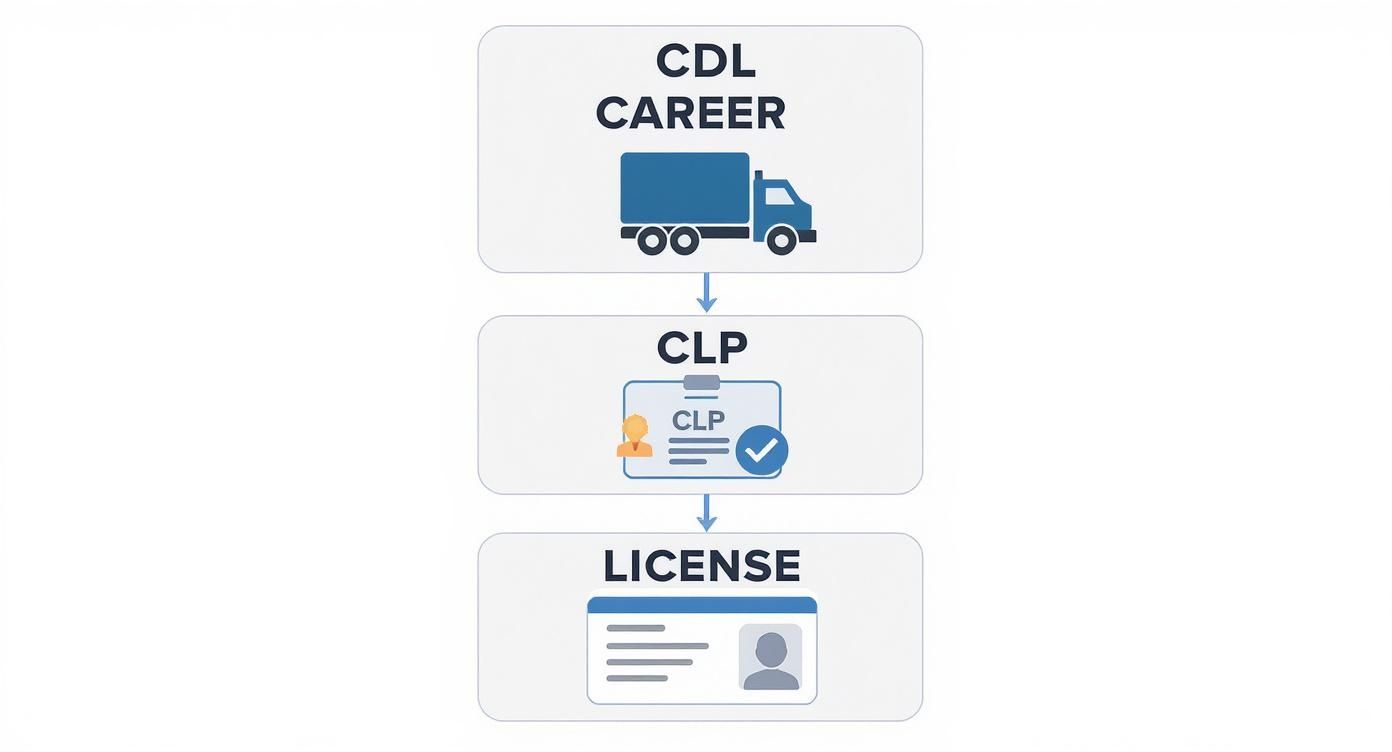
As you can see, locking down your Commercial Learner's Permit (CLP) is the first major milestone. It's the key that unlocks the hands-on training you need to earn your full license and get on the road.
The Cornerstone: General Knowledge Test
At the very heart of the CDL permit test is the General Knowledge section. This is the mandatory starting line for every single driver, no matter what kind of truck they plan to drive. It's the "chassis" of your CDL education, covering the absolute essentials every pro driver must master to operate safely.
This test is all about the universal principles of trucking, including:
- Basic vehicle control and the safe driving techniques specific to large vehicles.
- The critical steps and components of a thorough pre-trip inspection.
- Proper ways to communicate with other drivers, from signaling to managing your space cushion.
- How to handle emergencies, whether it's bad weather or a sudden mechanical failure.
Most states set the bar high, requiring you to get at least 80% of the questions right to pass. This section is a beast, so a big chunk of your study time should be spent right here. For a much deeper dive, check out our full guide covering the General Knowledge test for detailed study points and tips.
Essential Endorsements You'll Almost Certainly Need
Once you’ve got General Knowledge down, it's time to add endorsements. These are special qualifications added to your CDL that prove you're certified to handle specific types of vehicles or cargo. If you're aiming for a standard Class A license, two endorsements are pretty much non-negotiable.
Think of endorsements as your specializations. The General Knowledge test proves you can drive, but endorsements prove you can handle the specific equipment for most trucking jobs—like tractor-trailers.
First up is the Air Brakes endorsement. This one's a practical necessity since nearly all heavy-duty commercial trucks rely on air brake systems. The test covers how these complex systems work, how to inspect them properly, and how to use them correctly to prevent brake failure.
Next is the Combination Vehicles endorsement. This is the big one for anyone who wants to drive a tractor-trailer. This test hits on the unique challenges that come with pulling a trailer, like coupling and uncoupling, managing the "crack-the-whip" effect in turns, and maneuvering a long, articulated vehicle safely.
A Closer Look at the Test Structure
To help you map out your study plan, here's a quick look at the core sections of the CDL permit test and what they cover.
CDL Permit Test Sections at a Glance
| Test Section / Endorsement | Primary Focus Areas | Required For |
|---|---|---|
| General Knowledge | Vehicle inspection, safe driving rules, cargo transport, and emergency protocols. | All CDL Classes (A, B, and C) |
| Air Brakes | Air brake system components, inspection procedures, and proper usage. | Vehicles equipped with air brakes |
| Combination Vehicles | Coupling/uncoupling, turning, and controlling articulated vehicles (tractor-trailers). | Class A CDL |
Understanding this breakdown is your key to success. By tackling one piece at a time—starting with General Knowledge and then moving to the endorsements you need—you can build your knowledge step-by-step and walk into the DMV feeling confident and prepared.
Navigating State-Specific Requirements
Think of the federal trucking regulations as the universal rules of the road—the big stuff everyone has to follow. But when it comes to actually getting your Commercial Learner's Permit (CLP), each state's DMV has its own way of doing things. It's like a local dialect; the core language is the same, but the accent and specific procedures can be a little different.
The Federal Motor Carrier Safety Administration (FMCSA) sets the standards, but your state handles the paperwork, the appointment, and the exact process. Getting these local details right from the start is key. The last thing you want is a simple documentation issue sending you home on test day.
The Universal Must-Haves
Before we get into the state-by-state differences, let's cover the foundational requirements. These are the non-negotiables you'll need to meet no matter where you live.
- Minimum Age: You have to be at least 18 years old to get a CLP for driving within your own state (intrastate). If you plan on crossing state lines (interstate), the federal minimum jumps to 21.
- Valid Driver's License: You can't get a commercial license without first having a standard, valid driver's license from your state.
- DOT Medical Card: Every aspiring trucker must pass a Department of Transportation (DOT) physical. A certified medical examiner will check to make sure you're physically fit to handle a big rig, and then they'll issue you a medical certificate, or "med card."
Think of these as your ticket to the game. Without them, you can't even get in the door to take your permit test. For a deeper dive into these universal standards, check out our complete guide on CDL requirements.
Common Differences Between States
This is where you need to put on your detective hat and check your local DMV's website. States often have small but crucial variations in their processes that can trip people up.
Here are a few of the most common things that change from one state to the next:
- Proof of Residency: Some states are happy with a utility bill and a bank statement. Others might demand a formal lease agreement or even a notarized letter. Don't guess—find your state's official list of accepted documents.
- Identity Verification: The exact mix of documents needed to prove who you are (like a birth certificate, Social Security card, or passport) can also differ.
- Test Question Nuances: While the core knowledge comes from the federal CDL manual, some states like to throw in a few questions about specific local laws or regulations. Your state's official CDL manual is the only reliable source for this.
The Role of the CDLIS
Ever wonder how they stop a driver with a suspended license in Texas from just getting a new one in Oklahoma? The answer is the Commercial Driver's License Information System (CDLIS). It’s a national database that connects every state DMV.
When you apply for your permit, the clerk will run your information through this system to check your record nationwide.
The CDLIS is what enforces the "one-driver, one-license, one-record" rule. It’s the backbone of commercial driving safety, ensuring that a driver’s complete history is transparent and follows them wherever they go.
This system also plays a part in managing international agreements. The U.S. has arrangements with Mexico and Canada that allow their commercial drivers to operate here. CDLIS helps track everything to maintain safety standards across North America.
Crafting a Winning Study Strategy
Let's be honest: just reading your state's CDL manual cover-to-cover isn't a study plan. It's a recipe for burnout. To actually pass the cdl permit test, you need a real game plan, one built on smart, active learning instead of just passively flipping pages.
A winning strategy starts by ditching the idea of cramming everything at once. The key is to break down the dense material in the manual into smaller, more manageable chunks. Focus on mastering one topic completely before you even think about moving on to the next one.
This focused approach keeps you from getting overwhelmed and builds real confidence along the way. Think of it like loading a flatbed—you secure one piece of cargo perfectly before you move on to the next.
Mastering One Topic at a Time
Imagine trying to learn everything about a big rig in a single afternoon—the engine, air brakes, coupling, and all the regulations. It's just too much. A much better approach is to isolate each key section of the CDL manual and tackle it individually.
For example, you could dedicate your first few study sessions entirely to the air brake system. Read that chapter, take detailed notes, and don't move on until you've got a solid handle on how the whole system works. To really test your knowledge, try working through a specialized Air Brakes Test.
Once you’re consistently hitting high scores and feeling confident, then it’s time to move on to the next big subject, like Combination Vehicles. This methodical approach builds a rock-solid foundation, piece by piece.
Embrace Active Learning Techniques
Passive reading is when information goes in one ear and right out the other. Active learning is when you actually engage with the material, forcing your brain to process it and lock it in. This is the secret to truly understanding the concepts, not just memorizing answers for test day.
Here are a few powerful ways to study actively:
- Teach It to Someone Else: Try explaining a complex topic, like the proper steps for a pre-trip inspection, to a friend or family member. If you can’t explain it simply, you probably don’t understand it well enough yourself.
- Make Your Own Flashcards: Jot down a question or a term on one side of a card and the answer on the other. This classic method is still one of the best ways to drill key facts, weight limits, and regulations into your memory.
- Summarize in Your Own Words: After you finish a chapter in the manual, close the book. Then, write a short summary of the most important points from memory. This forces you to recall and rephrase the information, which cements it in your mind.
The goal here isn't just to remember facts long enough to pass a test. It's to internalize this knowledge so it becomes second nature when you're behind the wheel. Active learning builds the professional instincts you'll need for a long, safe career.
Using Practice Tests the Right Way
Practice tests are a crucial part of your prep, but only if you use them correctly. Don't just take them over and over, hoping to memorize the answers through sheer repetition. Instead, use them as a diagnostic tool to find out where you're struggling.
Every time you take a practice cdl permit test, dig into your results. Pay close attention to the questions you missed. Was it a simple mistake, or do you have a real knowledge gap on that topic?
Your wrong answers are a signal. They tell you exactly which sections of the official CDL manual—your ultimate source of truth—you need to go back and review. This targeted approach is way more efficient than just re-reading entire chapters.
Plus, taking practice tests gets you comfortable with the style and wording of the questions you'll face on the real exam. This helps shake off those test-day nerves and lets you manage your time better. For more great study tips, you might check out these general strategies for passing online certification courses quickly, as many of the same principles apply.
What to Expect on Test Day
You’ve put in the hours studying, but knowing the material is only half the battle. The other half is knowing what you’re walking into on test day. Heading to the DMV can be a nerve-wracking experience, but a little preparation goes a long way in calming those nerves so you can focus on what matters: the questions.
Think of it like a pre-trip inspection for your career. You wouldn’t hit the road without checking your rig, and you shouldn't walk into the testing center without knowing the process inside and out.
Let's walk through the day step-by-step so you can arrive prepared and confident.
The Check-In Process
Your first stop at the DMV or testing center will be the check-in counter. This is your first test, really—having all your paperwork in order. The last thing you want is a simple administrative hiccup to throw you off your game.
You'll need to present a handful of key documents. While the exact requirements can vary slightly from state to state, here’s what you should have ready:
- Proof of Identity and Residency: Bring your current driver's license, Social Security card, and a couple of documents proving you live where you say you do, like a recent utility bill.
- DOT Medical Card: This is a big one. Your valid Medical Examiner's Certificate is an absolute must-have.
- Application Forms: If your state lets you fill out the application ahead of time, do it. It saves a ton of time.
After the clerk verifies your documents and you've paid the fees, they’ll point you toward a testing station.
Taking the Actual Test
The CDL permit test is almost always taken on a computer. The setup is pretty simple, and they'll give you a quick rundown on how to navigate the system—it’s just a standard multiple-choice test.
The key here is managing your time and your nerves. You'll likely have plenty of time, so don't feel rushed. Make it a point to read every question twice and then read all the answer choices before you click. It’s easy to jump on the first answer that looks good, but sometimes a better one is waiting.
The magic number for most CDL written tests, including the big General Knowledge section, is 80%. That’s the passing score. It doesn't give you a lot of wiggle room, so treat every single question with care.
If you run into a question that stumps you, don't let it derail your focus. Most testing systems let you flag it and come back later. My advice? Answer all the questions you're sure about first. This builds confidence and momentum, and you can circle back to the tough ones with the time you have left.
Understanding Your Results
Once you submit your final answer, the moment of truth arrives almost instantly. The computer will tell you right then and there if you passed or failed each section you attempted.
If you passed, take a deep breath and celebrate! The DMV clerk will finalize your paperwork and hand you your official Commercial Learner's Permit (CLP). This is your ticket to start training behind the wheel with a licensed CDL holder. For a detailed look at the next steps, check out our guide to getting your permit.
And if you didn't pass? Don't sweat it. It happens to a lot of people. The good news is you only have to retake the specific section you failed. Most states make you wait a day or so before you can try again, which is the perfect amount of time to brush up on the material that gave you trouble. You’ll get it next time.
Avoiding Common Test Day Mistakes
It’s a tough pill to swallow, but plenty of great candidates walk away from their CDL permit test without passing. They put in the hours studying, only to get tripped up by a simple, avoidable mistake. Think of this section as your guide to the most common pitfalls—knowing what they are ahead of time makes it a whole lot easier to steer clear.
The single biggest mistake? Underestimating the test. It happens all the time. A driver-to-be will skim the manual, ace a few practice questions, and figure they're good to go. But the General Knowledge test is no joke; it’s dense with details, especially around things like the pre-trip inspection or securing your cargo. These aren't just minor points; they are core safety principles you’ll see again and again on the exam.
Another classic blunder is studying from old or sketchy materials. Trucking regulations change, and so do the tests. That study guide your buddy used five years ago or some random app you found online could be completely out of date. You’ll end up studying the wrong information and be totally unprepared for the actual questions you see on test day.
Dissecting Tricky Questions
Let's be honest, some questions on the CDL permit test are designed to be tricky. You’ll often run into scenarios where more than one answer seems pretty good. The whole point is to find the best possible answer, not just one that's technically correct. This is where just memorizing facts falls apart and genuine understanding takes over.
For example, you might get a question about how to handle a specific emergency on the road. A couple of the options might sound reasonable, but only one will be the exact procedure laid out in the official CDL manual. The trick is to slow down, read every single option, and start ruling out the ones that aren't quite perfect.
The key is to think like a safety inspector, not just a test-taker. Always choose the option that prioritizes safety and follows regulations to the letter, as that’s what the examiners are looking for.
Avoiding Tunnel Vision in Your Studies
The last major mistake I see is when people put all their eggs in one basket. They'll get hooked on a single study method, like only using one app or just grinding out practice tests over and over. A well-rounded approach is always going to serve you better.
To make sure you're truly ready, you need to mix it up. Here’s a solid strategy:
- Primary Source: Treat your state’s official CDL manual like the bible. It's the ultimate source of truth.
- Practice Tests: Use these to pinpoint your weak areas and get a feel for the rhythm and style of the real test.
- Active Recall: Don't just read. Use flashcards to test yourself or try explaining a concept to a friend. If you can teach it, you know it.
By mixing up your study habits and learning from where others have gone wrong, you stack the deck in your favor. This isn't just about dodging failure; it's about building a solid base of knowledge that will stick with you for your entire career. Knowing which potholes to avoid makes the road to a first-time pass a whole lot smoother.
Frequently Asked Questions
It's totally normal to have a few nagging questions pop up as your test day gets closer, even when you've been studying hard. Let's clear up some of the most common ones so you can walk into the DMV feeling completely prepared and confident.
Think of this as tying up the last few loose ends. Getting these details straight helps you focus on what really counts: acing that exam.
How Long Is a Commercial Learner's Permit Valid?
Once you get your Commercial Learner's Permit (CLP), the clock starts ticking. It's generally valid for 180 days—that’s a solid six-month window for you to get behind the wheel and start your hands-on training.
Some states will let you renew it once for another 180 days, but don't count on it without checking first. The most important thing to remember is the federal rule: you have to hold your CLP for at least 14 days before you can even think about taking the final on-road skills test. This isn't just red tape; it's a mandatory period to ensure you get real-world practice with a licensed CDL holder riding shotgun.
What Happens If I Fail One Part of the Test?
Don't panic! Failing one part of the CDL permit test doesn't mean you've failed the whole thing. It’s actually pretty common. If you ace the General Knowledge and Combination Vehicles sections but stumble on Air Brakes, you typically only have to retake the Air Brakes portion.
Your passing scores are safe and will stay valid for a certain amount of time, though you'll want to check with your state DMV for the exact window. Most places make you wait a day or so before you can try again. This setup is a lifesaver because it means you don't have to start over from square one. You can just zero in on the material that gave you trouble and come back stronger.
A failed section isn’t a dead end—it’s just a signpost telling you where to focus your studying. See it as a chance to truly master the material, not as a setback.
Are Online Practice Tests a Good Way to Study?
Absolutely, but with a big catch: they should be a tool in your toolbox, not the only tool. High-quality practice tests are fantastic for getting a feel for how the real CDL permit test questions are worded and structured.
Here’s how to use them smartly: take a practice test to see where you're weak. If you bomb the Air Brakes section, you know exactly which chapter in the CDL manual needs your attention. The official state CDL manual is, and always will be, your number one source of truth. It's what the test is based on.
Treat practice tests as a final check-up to test your knowledge and build your confidence before the main event. They’re a supplement, not a substitute.
Ready to stop studying and start driving? Patriot CDL offers expert, hands-on training to get you on the road fast. Learn more about our CDL programs and begin your journey to a new career.