If you're serious about landing a top-tier trucking job, you need to view the air brakes practice test as more than just another hoop to jump through. It’s your first step toward mastering the very system that lets you safely control an 80,000-pound rig.
Why Mastering the Air Brakes Test Is So Important
Passing this endorsement test is about more than getting a piece of paper. It’s about building the fundamental knowledge you'll rely on every single day of your career. Without this endorsement, your CDL gets stamped with an 'L' restriction, which immediately locks you out of driving the vast majority of Class A and Class B commercial vehicles.
Think about it in real-world terms. You need to know exactly how that air brake system will behave when you're crawling down a steep mountain grade or when a car cuts you off in rush hour traffic. That's not something you can guess. Passing this test proves you have that non-negotiable skill and can prevent a catastrophic failure on the road.
Unlocking Better Career Opportunities
Let's be blunt: the trucking industry runs on air brakes. From the tractor-trailers crossing the country to local dump trucks and city buses, these powerful systems are the industry standard.
When you earn your air brakes endorsement, you're sending a clear signal to employers. You're telling them you have the core knowledge to operate their expensive fleet safely and responsibly. It shows you’re a professional who can be trusted with their equipment and their customers' cargo.
Having that endorsement dramatically improves your employability and ensures you're compliant with Federal Motor Carrier Safety Administration (FMCSA) regulations. It removes that restrictive 'L' from your license, opening the door to virtually any heavy commercial vehicle out there.
It's More Than Just a Written Exam
While the practice tests help you nail the written questions, the knowledge you build is put to the test during your hands-on skills exam. The examiner is going to have you perform a full, in-cab air brake system check from start to finish.
You'll have to point out the components, walk through the steps for testing air pressure buildup, and check for leaks—all while explaining what you're doing. A solid understanding, built from studying and practice, is what will give you the confidence to ace that inspection under pressure.
The air brakes endorsement is your ticket to versatility. It ensures you can handle the most common vehicle configurations in the industry, making you a more valuable and employable driver from day one.
Ultimately, this test is one of the key CDL requirements that separates a truly qualified professional from a restricted driver. Treat it with the respect it deserves, and you'll be building the foundation for a long, safe, and successful career on the open road.
How Your Air Brake System Actually Works
If you really want to ace the air brakes practice test, memorizing facts won't be enough. You need to get a feel for the entire system—how one part flows into the next. I like to think of it less like a complex machine and more like the circulatory system for your rig. Every component has a critical job, and they all have to work in perfect harmony.
The whole process kicks off with the air compressor. This is the heart of your braking system. It’s a pump, driven by the engine, that pulls in outside air and pressurizes it. Its only job is to keep your air storage tanks full, so you have stopping power on demand.
But the compressor doesn't just run wild. It's managed by the air compressor governor, which is basically the system's brain. The governor tells the compressor when to kick on (the "cut-in" pressure, usually around 100 psi) and when to shut off (the "cut-out" pressure, which is typically 125 psi). This constant cycle keeps the air pressure in that sweet spot without overworking the system.
From Storage to Stopping Power
After the air is compressed, it’s piped directly into the air storage tanks. These are your reservoirs. A typical truck will have multiple tanks to ensure there’s enough air to handle several brake applications, even if the compressor were to suddenly fail. This is also why draining your tanks daily is non-negotiable—water and oil can collect in there, and in cold weather, that stuff can freeze solid and lead to total brake failure.
Now, when you hit the brake pedal (you'll hear it called a treadle valve or foot valve), you aren't physically applying the brakes yourself. What you're really doing is opening a valve. This sends a blast of pressurized air from the tanks shooting through the brake lines to every wheel.
Here's the most important thing to grasp about air brakes: their fail-safe design. If you have a leak in a hydraulic system, you lose your brakes. With air brakes, it's the opposite—they're designed to engage if air pressure drops too low. This is a core concept you absolutely have to know for the test.
At each wheel, that pressurized air floods into a brake chamber. The force of the air pushes against a diaphragm, which moves a pushrod. The pushrod then activates the slack adjuster, a lever that turns the S-cam. As the S-cam rotates, it forces the brake shoes out against the brake drum. That friction is what stops your truck. It sounds like a lot of steps, but this entire chain reaction happens in an instant.
This infographic breaks down why mastering this system is so important for your career.
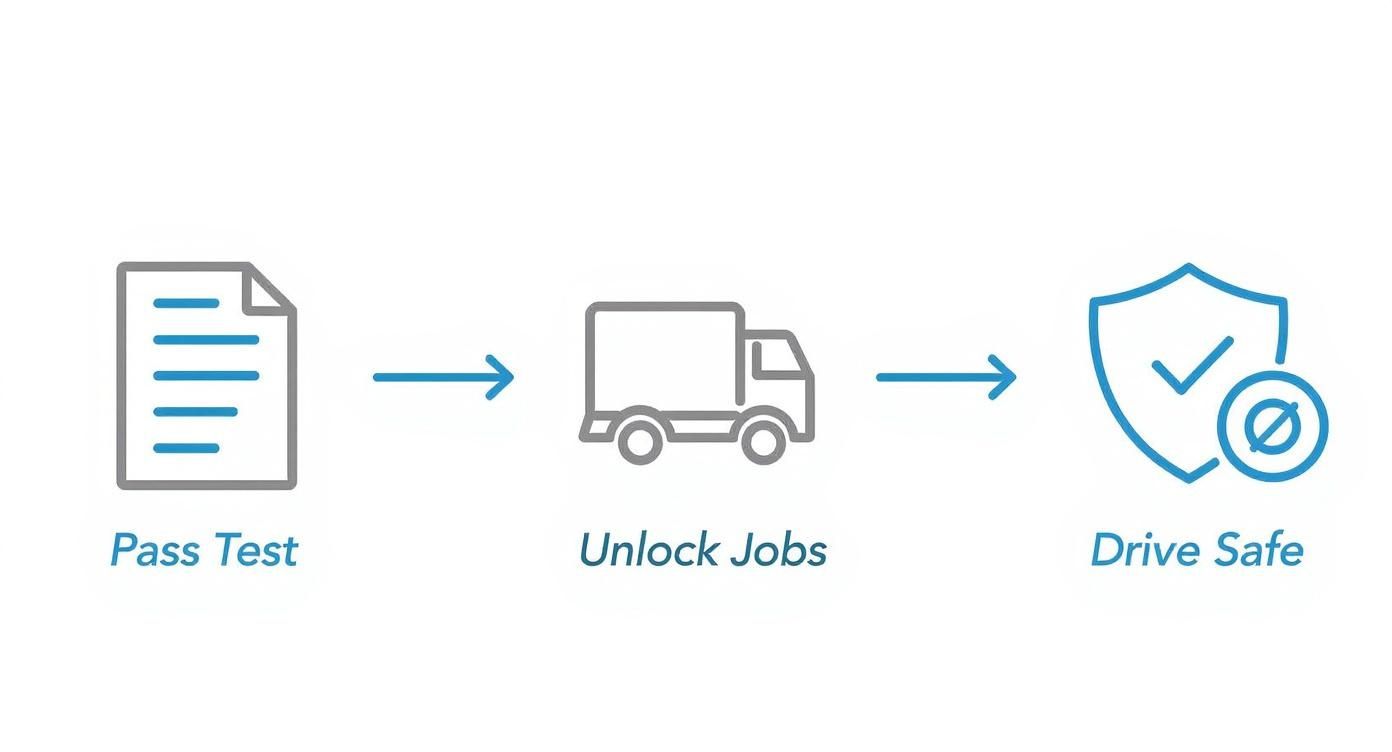
As you can see, passing your test isn't just about a piece of paper; it’s the first real step toward becoming a safer, more employable driver.
The Role of Parking and Emergency Brakes
Finally, let's talk about the spring brakes. These double as your parking brakes and your emergency brakes. In reality, they are massive, powerful springs that are held back by air pressure. When you pull that yellow knob on your dash, you're dumping the air pressure from the system. This allows the springs to expand and mechanically force the brakes on. That loud "pssh" you hear is the air escaping.
Understanding this whole process isn't just for the written test. It’s what helps you troubleshoot on the road. For example, if your air pressure is dropping too fast, you'll know exactly where to start looking for leaks—from the tanks, through the lines, and into the chambers. This is the kind of practical knowledge you'll need for your hands-on vehicle inspection. To get the full rundown, check out our guide on how to perform a proper pre-trip inspection, which gets into the nitty-gritty of the air brake check.
Know Your Numbers: The Key to Passing the Air Brakes Test
If there's one thing that trips people up on the air brakes exam, it's the numbers. Let's be blunt: you can understand the theory inside and out, but if you don't have the specific pressure and timing values memorized cold, you're going to have a hard time. These aren't just suggestions; they are the hard-and-fast rules of a safe air brake system.
The sheer volume of numbers can feel overwhelming at first. Don't try to swallow the whole elephant at once. The smart way to tackle this is to zero in on the values that consistently appear on the air brakes practice test and are required knowledge for your in-cab inspection.

The Compressor and Governor Cycle
Think of your air compressor and governor as a team. The compressor builds the air pressure, and the governor tells it when to start and when to stop. You absolutely must know the PSI range they operate in.
- Governor Cut-Out: The point where the compressor stops pumping. This should happen at or below 140 psi, but you'll typically see it kick off around 125 psi in most trucks.
- Governor Cut-In: This is when the compressor kicks back on. It needs to start building air again once the pressure drops to about 100 psi.
These two figures define the normal operating range. Get ready to see questions about them on the written test and to point them out during the skills portion.
The core concept is simple: the system works to keep your air tanks between roughly 100 psi and 125 psi. The governor is the brain of that operation.
Air Leakage and Pressure Buildup
A huge part of your pre-trip inspection—and the test—is checking for air leaks and making sure your compressor can keep up. These numbers are non-negotiable.
For example, when you test your air pressure buildup rate, your system must be able to raise the pressure from 85 to 100 psi within 45 seconds. This is done with the engine running at a fast idle. If it takes longer, it points to a problem.
Then you have the static leakage tests. With the engine off and the service brakes released, you can't lose more than 2 psi per minute for a straight truck or 3 psi per minute for a combination vehicle.
Your Safety Warning Systems
Finally, you have the numbers that could save your life. These are the pressure levels that trigger your warning systems before a catastrophic failure.
- Low Air Warning: Your dashboard light and buzzer must activate when the pressure drops to 60 psi (or slightly above). This is your first and most urgent sign to pull over safely.
- Spring Brake Activation: If air pressure continues to fall, the parking brakes will automatically engage. This is designed to happen somewhere between 20 and 45 psi, bringing the truck to a stop.
Knowing these values isn't just about passing the test. It's about fundamental safety, just as critical as anything you learned for the general knowledge test.
To help you keep these critical numbers straight, here’s a quick-reference table. Print it out, make flashcards—whatever it takes to burn these into your memory.
Critical Air Brake System Pressure and Timing Values
| System Check | Required Value or Action |
|---|---|
| Governor Cut-Out Pressure | At or below 140 psi (typically 125 psi) |
| Governor Cut-In Pressure | Around 100 psi |
| Low Air Warning (Light & Buzzer) | Activates at or above 60 psi |
| Spring Brake Auto-Activation | Between 20-45 psi |
| Air Pressure Buildup | From 85 to 100 psi in 45 seconds |
| Static Air Leakage (Straight Truck) | No more than 2 psi per minute |
| Static Air Leakage (Combination) | No more than 3 psi per minute |
Mastering this table puts you in a great position. When these questions pop up on your exam, you won't have to guess—you'll know the answer instantly.
Let's Get Real: Analyzing Sample Test Questions
Knowing the textbook definition of a gladhand is one thing. Figuring out what to do when your low-air buzzer screams at you on a steep grade? That’s the real test.
The key to acing the air brakes exam isn’t just memorizing facts—it's about understanding why things work the way they do. When you get the logic, you can answer almost any question they throw at you.
Let's break down a few typical questions to show you what I mean.
Question 1: Knowing Your Parts
First up, a classic component identification question. You have to know what each part does, plain and simple.
Sample Question:
Which component's primary function is to tell the air compressor when to start and stop pumping air?
- A) The S-cam
- B) The air compressor governor
- C) The treadle valve
- D) The slack adjuster
Correct Answer: B) The air compressor governor
Why it's the right answer: Think of the governor as the boss of the air compressor. It’s the only part on that list responsible for regulating the compressor's on/off cycle. The other parts have totally different jobs: the S-cam and slack adjuster are down at the wheels doing the physical work of braking, and the treadle valve is simply the foot pedal you press. Easy points if you know your components.
Question 2: Thinking on Your Feet
Now for a scenario-based question. These test your ability to apply knowledge in a real-world (and often stressful) situation.
Sample Question:
You are driving on a level, dry highway. If your low air pressure warning light and buzzer come on, what should you do?
- A) Downshift and use your engine brake to slow down.
- B) Stop as quickly as possible on the shoulder of the road.
- C) Continue driving to the next exit to find a safe place to park.
- D) Stop your vehicle as soon as it is safe to do so.
Correct Answer: D) Stop your vehicle as soon as it is safe to do so.
Why it's the right answer: This one is all about safety and procedure. That low-air warning is a five-alarm fire for your braking system. Your service brakes are failing. While B sounds urgent, slamming on the brakes is a recipe for disaster. And C? Driving to the next exit is a massive gamble you can't afford to take. The only correct and professional response is to get the truck stopped safely, right now.
Pro Tip: Your low-air warning is the final heads-up before the spring brakes kick in automatically. If you ignore it, the truck will stop itself, and it won't care if you're in the middle of a live lane of traffic.
Question 3: The Numbers Game
Finally, you'll get questions that are purely about the numbers. There’s no way around it—you just have to know them cold.
Sample Question:
During a static leakage test on a combination vehicle, what is the maximum amount of air pressure loss allowed per minute?
- A) 1 psi
- B) 2 psi
- C) 3 psi
- D) 4 psi
Correct Answer: C) 3 psi
Why it's the right answer: This is a straight-up knowledge check from the pre-trip inspection rules. It’s also a common trip-up point for new drivers. Remember, the federal standard is specific: a straight truck can lose no more than 2 psi per minute, but a combination rig gets a little more leeway at 3 psi per minute.
Mixing those two up is an easy way to lose a point. If you're feeling shaky on these figures, running through a full air brakes practice test is the best way to drill them into your head.
As you can see, the test covers everything from mechanical knowledge to on-the-road decision-making and critical safety numbers. Mastering all three areas is your ticket to passing with confidence.
Smart Study Strategies to Prepare for Test Day
https://www.youtube.com/embed/xA70Isel8V4
Knowing the material is one thing, but performing well under pressure on test day is what really counts. The right study habits will make the difference between walking in nervous and walking in confident. Simply re-reading the CDL manual over and over again just won't cut it.
A surprisingly effective technique is to explain the entire air brake system out loud. Find a friend, a family member, or even just stand in front of a mirror and describe how everything works, from the compressor building up air to the service brakes engaging. This simple act forces you to organize your thoughts and immediately exposes any fuzzy areas in your understanding.
Dig Into Your Practice Test Results
Taking an air brakes practice test is a good starting point, but the real learning starts after you get your score. Don't just glance at the number and move on. Every wrong answer is a breadcrumb trail leading you to exactly what you need to study.
- Group Your Mistakes: Look for patterns. Are you consistently missing questions about specific PSI numbers, component names, or emergency procedures? Grouping your errors will shine a spotlight on your weakest topics.
- Teach Yourself the Right Answer: For every question you got wrong, dig back into your manual and write down, in your own words, why the correct answer is right. This active process is far more effective than just re-reading.
- Watch for Tricky Wording: Sometimes, you know the material cold but get caught by how a question is asked. Make a note of these so you can spot similar phrasing on the real test.
Remember, today's air brake test isn't just about memorizing leakage rates. It also covers practical knowledge of techniques like stab braking and controlled braking, both of which are critical for preventing wheel lockup. These topics were added to driver training for a reason—they are key safety skills that have significantly reduced brake-related accidents, which were once a leading cause of truck crashes.
Ditch the Passive Rereading
You have to actively engage with the information. Passively rereading your notes might feel productive, but it often creates a false sense of security. To truly master the material, you need to force your brain to recall it from memory.
One of the best ways to do this is by creating your own practice tests from your notes. This method forces you to think about the material from a different angle and is a fantastic way to solidify complex topics.
The biggest trap you can fall into is just memorizing the answers to one or two practice tests. Make sure you use several different sources and a wide variety of questions. The goal is to learn the concepts inside and out, not just a specific sequence of A, B, C.
By using these focused strategies, you're not just studying harder—you're studying smarter. This builds real confidence and ensures you're ready to prove you know your stuff and earn that air brakes endorsement.
Common Questions About the Air Brakes Test
Even after you've spent hours hitting the books for the air brakes practice test, it's totally normal to have a few questions buzzing around your head about the real deal. Let's tackle some of the most common ones so you can walk into the DMV feeling like you own the place.
What’s the Test Actually Like?
One of the first things everyone wants to know is the basic format. While it can vary a little from state to state, you can typically expect about 25 multiple-choice questions.
To get a passing grade, you’ll need to nail at least 80% of them. It's always smart to glance at your state's official CDL manual just in case, but that 80% score is the magic number you should be aiming for on all your practice runs.
Where Do People Go Wrong?
So, what are the most common trip-ups? It almost always comes down to the numbers. A lot of drivers get the general idea of how an air brake system works, but they fumble the specific PSI values.
You have to know these figures cold. Things like:
- Governor cut-in and cut-out pressures
- When the low-pressure warning alarm should activate
- Acceptable air leakage rates
Mixing up the leakage allowances is another huge one. For example, people forget that a straight truck is allowed to lose 2 psi per minute, while a combination vehicle gets a bit more slack at 3 psi per minute. These details matter.
What Happens if I Don't Pass?
Failing the air brakes test isn't the end of your driving career, but it does have immediate consequences. The good news is you probably won't have to retake other written tests you've already passed, like General Knowledge.
The bad news? Your CDL will come with an 'L' restriction. This is a big deal because it means you're legally prohibited from driving any truck with air brakes, which knocks out most of the good-paying jobs.
If you find yourself in this spot, don't panic. A focused E restriction removal course can give you the targeted review you need to go back and ace the retest.
The single best way to prepare is to hammer away at high-quality online practice tests. They're designed to feel just like the real exam, showing you exactly where you're weak before it's too late.
At the end of the day, consistent practice and knowing the answers to these common questions will make sure there are no surprises when you sit down for the official test.
Ready to stop practicing and start your professional driving career? Patriot CDL offers accelerated, hands-on training to get you on the road fast. Learn more at https://patriotcdl.com.