Getting your Class A CDL training is the first, and most important, step on the path to driving big rigs like tractor-trailers. Think of it as flight school for truckers—it's where you build the core skills needed for a safe, long-lasting career on the open road.
Why Class A CDL Training Is Your First Step
Becoming a professional truck driver is about so much more than just learning to steer a massive vehicle. It's about mastering a complex machine and fully grasping the responsibility that comes with it. The Class A Commercial Driver's License (CDL) is the highest tier you can earn, giving you the authority to operate combination vehicles with a Gross Combination Weight Rating (GCWR) of 26,001 pounds or more, pulling a trailer that weighs over 10,000 pounds.
This license is your ticket to driving the iconic rigs that are the lifeblood of our economy. But you can't just hop behind the wheel of an 80,000-pound machine and figure it out. Proper, structured Class A CDL training isn't just a good idea—it's the law.
Building the Foundation of Your Driving Career
A good training program does more than just teach you enough to pass the final exam. It's designed to build the muscle memory, safety reflexes, and technical know-how you’ll rely on every single day. You'll start with the basics and steadily progress to real-world driving situations, making sure you're truly ready for whatever the road throws at you.
A quality training program is your roadmap to success. It takes a mountain of complex rules and skills and breaks it down into a clear, manageable process, giving you the confidence to handle any situation you might face as a professional driver.
This structured learning is critical because the trucking industry is built on a foundation of safety and strict regulations. In fact, a major shift in driver education came on February 7, 2022, with the Federal Motor Carrier Safety Administration's (FMCSA) Entry-Level Driver Training (ELDT) mandate. This rule made it official: all new CDL applicants must complete a standardized training curriculum before they're even allowed to take their final skills test.
The journey from student to professional driver follows a clear, three-stage path, as you can see below.
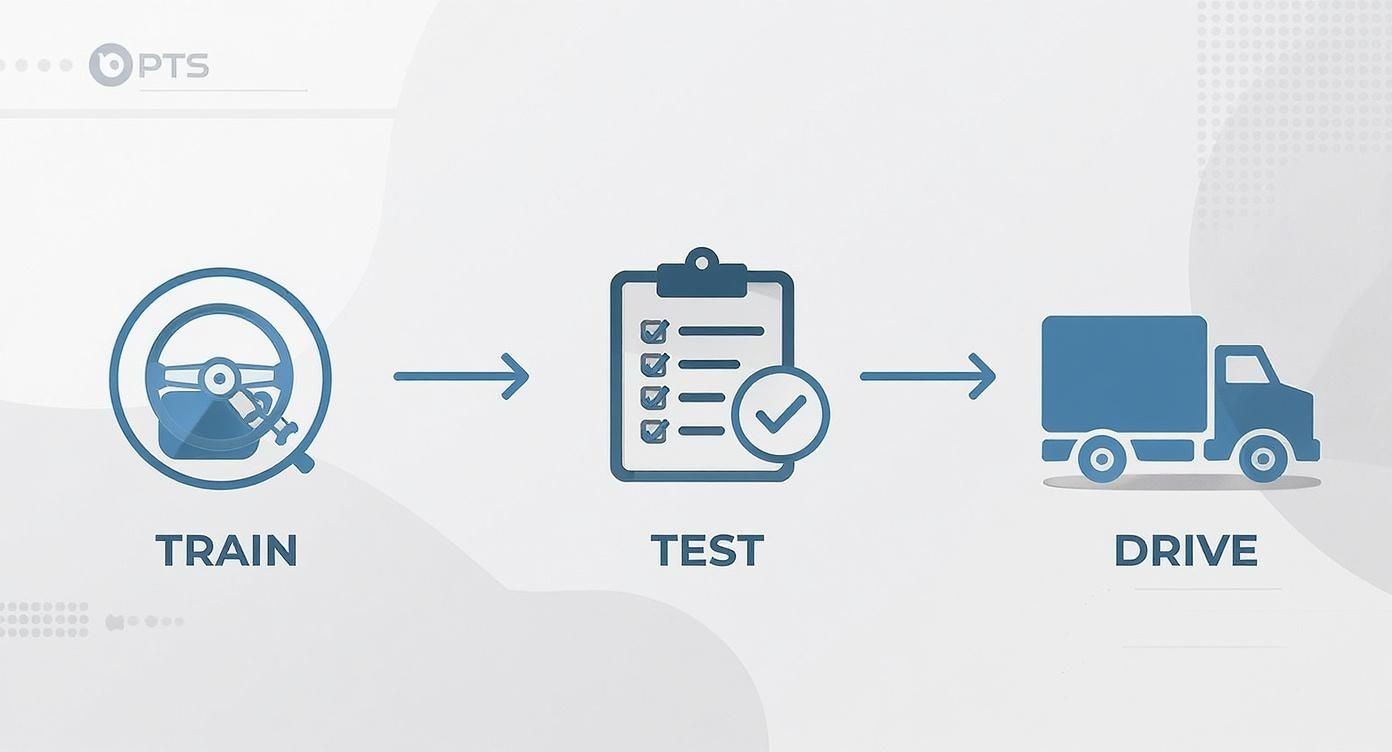
The process is straightforward: you train, you test, and then you drive. Each step builds on the last, shaping you into a competent and safe professional. A solid educational program is designed to walk you through every phase, ensuring you meet all federal and state requirements along the way.
Meeting the Requirements for Enrollment
Before you can even think about climbing into the cab for your Class A CDL training, there are a few boxes you need to check first. It's a lot like getting your passport in order before a big trip—these are the non-negotiable legal and safety hurdles every aspiring professional driver has to clear. They’re the foundation for a safe, long-lasting career on the open road.

The first step is simply making sure you meet the basic eligibility rules. These regulations are in place to ensure every student is truly ready for the responsibilities that come with driving a big rig. While some small details might differ from state to state, the core requirements are set at the federal level and are pretty much the same everywhere.
Foundational Eligibility Criteria
To drive a truck across state lines (interstate), you have to be at least 21 years old. It's a hard and fast rule. Some states will let you get a CDL at 18, but you'll be restricted to driving only within that state's borders—what's called intrastate commerce—until you hit 21.
Beyond your age, your driving record is a huge deal. A clean Motor Vehicle Record (MVR) is a must, as both the school and your future employers will be taking a close look for any red flags.
Here's what you'll typically need to get started:
- A Valid Driver's License: You need to have a standard, non-commercial driver's license from the state you live in.
- A Clean Driving Record: Schools are looking for a history that’s free of major offenses like DUIs, reckless driving charges, or license suspensions.
- Proof of U.S. Citizenship or Lawful Permanent Residency: Get your documents ready, like a birth certificate, passport, or green card.
- The Ability to Pass a Drug Screening: This is standard practice in the industry, from the moment you start training to well into your career.
These are just the first few steps on the path. For a more detailed look, you can learn more about the complete list of CDL requirements to make sure you have all your ducks in a row.
The DOT Medical Exam and Your CLP
Once you've cleared the basic criteria, there are two more critical steps before you can get behind the wheel: passing the Department of Transportation (DOT) physical and getting your Commercial Learner's Permit (CLP).
The DOT physical is a health check-up done by a certified medical examiner. It’s designed to confirm you're physically up to the task of safely handling an 80,000-pound vehicle. The examiner will check your vision, hearing, blood pressure, and overall health for any conditions that might get in the way of your driving.
The DOT medical card isn’t just a piece of paper. It's your official certification of fitness, protecting you, your freight, and everyone else on the road. It confirms you’re medically qualified to handle the physical demands of the job.
After you pass, you'll get a medical certificate that you have to keep with you. With that taken care of, it's time to hit the books and study for your CLP. The CLP is basically a trucker's "learner's permit." It gives you the legal right to practice driving a commercial truck on public roads, as long as you have a licensed CDL holder sitting right there in the passenger seat.
To earn your CLP, you’ll need to pass a few written knowledge tests at your local DMV. These tests cover general knowledge, air brakes, and combination vehicles—all subjects your Class A CDL training school will prepare you for. Passing these tests and getting that CLP in your hand is the final green light you need to start the hands-on, behind-the-wheel part of your training.
What to Expect in Your CDL Training Program
Think of getting your Class A CDL like learning to be a pilot. You wouldn't just jump into the cockpit; you’d spend a lot of time on the ground learning the principles of flight first. Truck driver training works the same way. It’s a mix of crucial classroom theory and hands-on, behind-the-wheel practice, with each part building on the last.
The first part of your journey is all about building that foundation of knowledge. Before you even climb into the driver's seat, you need to understand the rules of the road—and the physics of the rig. This isn't just about memorizing facts to pass a test; it's about understanding why things are done a certain way to keep you and everyone else safe.
Mastering the Theory in the Classroom
Your first stop is the classroom, where you'll dive deep into the federal and state regulations that are the backbone of the trucking industry. This knowledge is what separates a professional driver from someone who just holds a steering wheel. The goal here is to get you ready for your permit exams and the real challenges you'll face every day.
You can expect the classroom portion to cover essentials like:
- Hours of Service (HOS) Regulations: You’ll get familiar with the strict rules on drive time, mandatory breaks, and how to properly manage your electronic logbook.
- Trip Planning and Map Reading: This goes way beyond punching an address into a GPS. You'll learn to plan routes that avoid low bridges, weight-restricted roads, and other hazards.
- Vehicle Systems: Get ready for a crash course on what makes your truck tick, from the air brake system to the engine and electrical components.
- Cargo Securement: Learn the right way to load, balance, and tie down freight so it doesn't shift, slide, or fall off mid-trip.
This is the stuff you absolutely must know to pass your written tests. The biggest one you'll face is the general knowledge test, which covers a little bit of everything.
Developing Skills Behind the Wheel
Once you’ve got the theory down and earned your Commercial Learner's Permit (CLP), it's time for the fun part: applying what you’ve learned in a real truck. Your Class A CDL training moves from the classroom to a controlled driving range—a big, open lot where you can get a feel for the machine without the pressure of traffic.
This is where the book smarts turn into road smarts. With an instructor by your side, you'll start building the muscle memory and confidence needed to handle a tractor-trailer.
Behind-the-wheel training is the bridge between knowing what to do and actually doing it. It’s one thing to read about backing a 53-foot trailer, but it's another thing entirely to do it smoothly with an 80,000-pound vehicle.
You’ll practice the core skills over and over until they feel like second nature. That repetition is key, not just for passing the CDL skills test, but for being a safe, competent driver.
Perfecting Maneuvers on the Practice Range
The practice range is your sandbox. It's a safe place to learn, make mistakes, and ask questions without any real-world consequences. Here, the focus is on mastering the low-speed maneuvers that often trip people up on their CDL exam.
You'll spend most of your range time on:
- Pre-Trip Inspection: Learning the step-by-step process of inspecting every critical part of the truck and trailer. You'll do this every single day of your career, and you have to perform it perfectly to pass your test.
- Backing Maneuvers: This is the big one. You'll practice straight-line backing, offset backing, and the one everyone dreads—the alley dock.
- Shifting: Getting the hang of a non-synchronized manual transmission with 9, 10, or even 13 speeds is a unique skill. You'll learn how to shift without grinding the gears.
- Coupling and Uncoupling: You'll master the precise, safety-focused process of hooking the tractor to a trailer and disconnecting it.
Navigating Real-World Road Conditions
After you've built a solid foundation on the range, you'll head out onto public roads with your instructor. This is where it all comes together. You'll learn to apply your new skills in unpredictable, real-life traffic.
Your instructor will take you through a variety of driving environments, including:
- Heavy City Traffic: Making tight turns, navigating four-way stops, and dealing with cars cutting you off.
- Rural Roads: Handling narrow lanes, different pavement types, and hills.
- Interstate Highways: Getting comfortable with merging into fast-moving traffic, changing lanes safely, and keeping a proper following distance.
This final phase of your training is what turns you from a student into a capable, entry-level professional driver who’s ready to ace the CDL exam and start a new career.
How to Choose the Right CDL Training Program
Picking a school for your Class A CDL training is a huge first step. Honestly, it’s one of the most important decisions you’ll make as you get started. Not every school is the same, and where you learn to drive will have a real impact on your skills, your wallet, and the kind of job you land right out of the gate.
Think of it this way: you wouldn't trust a shoddy mechanic with a high-performance engine. Your career deserves that same level of care. You need a program that fits your life, your budget, and where you want to go. Let's look at the different paths you can take to find the one that sets you up for success.
Comparing Your Training Options
Most folks end up choosing from three main types of programs: a private truck driving school, a local community college, or training sponsored by a trucking company. Each one has its own set of pros and cons, especially when you look at the cost, how fast you can get on the road, and what kind of commitment you're making.
- Private Truck Driving Schools: These are schools that do one thing and one thing only: train truck drivers. They're usually fast-paced, with accelerated programs that can have you licensed and ready for a job in a matter of weeks.
- Community College Programs: A lot of community colleges have excellent CDL courses. These programs often take a bit longer—sometimes a full semester—but they can be incredibly thorough and dive deeper into the industry.
- Company-Sponsored Training: You’ve probably seen ads for "paid CDL training." Here, a trucking company pays for your school, and in return, you agree to work for them for a set amount of time, usually about a year.
Getting a handle on these differences is the first step. For a lot of people, a private school hits that sweet spot between speed and quality, focused instruction that gets you job-ready without delay.
To help you see the differences more clearly, here's a quick side-by-side comparison.
Comparing CDL Training Program Types
A side-by-side look at the different types of Class A CDL training programs to help you find the best path.
| Program Type | Typical Cost | Pros | Cons |
|---|---|---|---|
| Private CDL School | $3,000 – $10,000 | Fast (3-8 weeks), flexible schedules, strong job placement focus. | Higher upfront cost, can be very intensive. |
| Community College | $3,000 – $8,000 | Often more affordable, may offer financial aid, comprehensive curriculum. | Slower pace (full semester), less flexible scheduling. |
| Company-Sponsored | $0 upfront | No initial tuition cost, guaranteed job after graduation. | Requires a contract (1-2 years), less freedom to choose your first employer. |
Ultimately, the "best" option is the one that works for you. Consider your financial situation and how quickly you need to start earning before you make a final decision.
Key Factors to Consider
When you start looking at schools, try to look past the price tag. The quality of the instructors, the condition of the trucks, and the school’s reputation in the industry matter so much more in the long run. A cheap program that puts you in old, worn-out equipment and offers zero help finding a job isn't a bargain—it's a roadblock.
Your investment in Class A CDL training is an investment in your future earning potential. The quality of your training directly influences your confidence, safety, and the job opportunities available to you right after graduation.
Before you sign any papers, you need to do your homework and ask some direct questions. A good, reputable school will be upfront and happy to answer anything. If you want to get a feel for what a quality program looks like, feel free to contact us to discuss what makes a quality training program. We’re happy to walk you through it.
Here’s a checklist of what you absolutely need to ask any school you're considering:
- What’s your student-to-instructor ratio? You want to know how much one-on-one time you’ll actually get behind the wheel. Smaller groups mean more personalized feedback when it matters most. You don't want to get lost in the crowd.
- What kind of trucks will I be training on? Ask how old their fleet is. You should be learning on modern equipment with the kind of transmissions—manual or automatic—that companies are actually using today.
- What's your job placement rate? A great school has strong relationships with trucking companies and a real track record of helping graduates get hired. Ask for the numbers: what percentage of grads find a job within 30 days of passing their test?
- Is the school fully licensed and accredited? This is a big one. Make sure the school is certified by the state and meets all FMCSA rules for Entry-Level Driver Training (ELDT). This is a legal requirement, not a suggestion.
- What does the tuition really cover? Get a detailed, itemized list of every single cost. Does that sticker price include your test fees, DOT medical card, and books, or are you going to get hit with surprise expenses down the line?
How to Fund Your CDL Training
Let's talk about the money. Seeing the price tag on a quality Class A CDL program can feel like hitting a wall, but it doesn't have to be a career-ender before you even start. There are several solid ways to cover the cost, even if you don't have a pile of cash ready to go. Figuring out the funding is just as crucial as picking the right school.
Most people get their training paid for by tapping into one of a few common sources: traditional financial aid, special programs for veterans, or by getting a trucking company to foot the bill. The trick is finding the path that fits your life and your goals.
Exploring Financial Aid and Assistance Programs
Your first move should be to hunt for grants and scholarships. This is free money—you don't pay it back—and it can make a huge dent in your tuition. The financial aid office at any good private school or community college is the best place to start asking questions.
For veterans, there are some incredible benefits on the table that can cover the entire cost of training. Be sure to look into these:
- The GI Bill®: A cornerstone of veteran education benefits, this is accepted by tons of approved CDL schools.
- Vocational Rehabilitation and Employment (VR&E): If you have a service-connected disability, this program is designed to help you train for and find a great job.
These programs exist specifically to help former service members transition into in-demand civilian jobs, and trucking is at the top of that list.
The trucking industry needs good drivers, badly. That's why government agencies and private companies are willing to invest in new talent. Funding your training is really just about finding the right program that sees your potential.
Another fantastic route is getting a trucking company to pay for your training directly. It’s probably the most common way people get their CDL without any upfront cost.
Understanding Company-Sponsored Training
With company-sponsored training—sometimes called "paid CDL training"—a carrier pays for your schooling. The catch? You agree to work for them for a specific period of time, usually about a year, once you get your license. It’s a compelling offer because it solves two huge problems at once: it pays for your training and lines up a job for you right out of the gate.
Just be sure to read the contract with a fine-tooth comb. You need to know exactly what you're signing up for: the pay, the work requirements, and what happens if you leave before your commitment is up. It's an amazing opportunity, but you're trading a bit of freedom for that financial security.
The Role of Job Placement Assistance
No matter how you pay for school, its job placement services are worth their weight in gold. The best training programs have built-in relationships with a whole network of trucking companies. Their staff will help you connect with recruiters, get your resume in shape, and prep you for interviews, sometimes before you've even graduated.
The need for Class A drivers is no joke. Back in 2021, the American Trucking Associations reported a staggering shortage of 80,000 drivers, and that number is only expected to climb. For new drivers, that means good pay and plenty of job security. You can read more about the current state of the trucking industry to see the opportunity for yourself. In this kind of market, getting solid training and connecting with the right employer is everything. A school with a great job placement team is your biggest advantage.
What Happens After You Get Your Class A CDL?
Getting that Class A CDL in your hand isn’t the finish line—it’s the starting gun for your new career. This is the moment all that hard work in the classroom and behind the wheel starts to pay off. The journey from student to professional driver is a good one, and it all begins with that first year on the road.

Most new drivers kick things off with a company's finishing program, riding shotgun with an experienced driver trainer or mentor. Think of it as a paid apprenticeship. You'll be putting all your training into practice in the real world, from backing into a tight dock at a busy warehouse to managing your logs on a long haul, all with a seasoned pro right there to guide you.
Finding Your Niche on the Road
After you wrap up that initial company training, the world of trucking really opens up. This industry is incredibly diverse, with different jobs to fit just about any lifestyle you can imagine. You're never locked into one type of driving for your whole career.
Generally, your first opportunities will fall into a few categories:
- Over-the-Road (OTR): This is the classic, cross-country trucking job. You’ll be out for weeks at a time, seeing the country from a unique perspective and earning solid pay.
- Regional: Want to stay a bit closer to home? Regional drivers stick to a specific part of the country, like the Midwest or the Southeast. These routes often mean you’re home every weekend.
- Local/Dedicated: This is the gig for drivers who want to be home every night. You’ll handle deliveries in a smaller, specific area, making it a great fit if you have a family.
Your Class A CDL is a key that unlocks countless doors. The experience you get in that first year is gold—it builds the foundation for better pay, better routes, and more specialized jobs down the line.
The industry is massive and essential. Right now, the United States has over 1.24 million working Class A CDL drivers. And it's an accessible career path; with 39% of drivers having a high school diploma as their highest education, it's clear that good training is your most direct route to a stable, well-paying job.
Growing Your Trucking Career
Your career doesn't have to stay in one lane. As you build up experience and maintain a clean safety record, you become more and more valuable to employers. You can bump up your earning potential by adding endorsements for things like hauling hazardous materials (HazMat) or driving tanker trucks.
Some drivers start with a restriction for only driving automatic transmissions. If you want to open up every possible job opportunity, you can take a specialized course to master a manual gearbox. You can learn more about that in our e-restriction removal course.
With enough miles under your belt, you can move into roles like becoming a driver trainer yourself or even shift gears into a management or logistics position. Once you’ve earned that CDL, you’re ready to hit the job market. You can explore effective strategies to apply for jobs and get hired faster to help you make that first big move.
Got Questions About CDL Training? We've Got Answers
Stepping into a new career always brings up a lot of questions. For folks looking at Class A CDL training, I hear the same ones all the time: How long does it take? Just how hard is the test? And what if I mess up and fail?
Let's clear the air on these common concerns so you can feel good about taking the next step.
One of the first things everyone wants to know is the time commitment. It makes sense—you want to know when you can start earning. The timeline really boils down to the kind of program you sign up for and how many hours a week you can put in.
How Long Does Class A CDL Training Take?
There's no single answer here, but most quality programs fall into a few general buckets. You can usually find a pace that works for your life and your goals.
- Fast-Track, Full-Time Programs: Think of these as a total immersion. You're living and breathing trucking for a few weeks straight. It's intense, but it's also the quickest way to get licensed—often in as little as three to four weeks.
- Standard Programs: This is the most common route, offered by private schools and community colleges. These programs typically run for about six to eight weeks, giving you a solid, well-paced education without the all-out sprint of an accelerated course.
- Part-Time or Weekend Classes: Juggling a job or family? These flexible options are designed for you. The training is spread out over several months, letting you learn the ropes without putting the rest of your life on hold.
How Difficult Is the Class A CDL Test?
Let's be honest: the CDL test is tough. It has to be—we need safe, skilled drivers out on the road. The exam is broken down into three main parts: a meticulous pre-trip inspection, a skills test covering backing and tight maneuvers, and finally, a road test in real traffic.
I’ll let you in on a little secret: the pre-trip inspection is what trips up most students. You have to memorize a ton of components and call them out perfectly. A good school will drill this with you relentlessly until it’s pure muscle memory.
While it’s definitely a challenge, the test is 100% beatable if you put in the work. Your instructors will have you practice every single part, running mock tests over and over until you walk into the real thing feeling prepared, not panicked.
What Happens If I Fail My CDL Exam?
First off, don't sweat it. Failing the CDL exam isn't the end of the world—in fact, it happens more often than you’d think. The most important thing is to shake it off and get back to work.
Most states just require a short waiting period before you can retest. This gives you the perfect opportunity to home in on what went wrong. Any school worth its salt will stick by you, offering extra practice and coaching on the specific skills that gave you trouble. Remember, persistence is part of being a professional driver. Plenty of veteran truckers I know didn't pass on their first go.
Ready to stop wondering and start driving? Patriot CDL offers accelerated, hands-on training that gets you from the classroom to a career, fast. Find out more about our programs.