Passing your CDL exam really boils down to two things: knowing the official manual inside and out for the written part, and getting as much time behind the wheel as you can for the skills test. The secret isn't a secret at all. You have to treat it like a job, focusing on strategic study, mastering the truck, and knowing the common mistakes before you even show up for your test.
Your Guide to a First-Time CDL Pass
Earning your Commercial Driver's License is a huge step toward a great career, but let's be honest—the process can feel overwhelming. This guide is your no-nonsense roadmap. It’s built to cut through the confusion and give you a clear, actionable plan to pass on your first try.
We're going to move past just memorizing facts. The goal here is to help you build a real understanding of the material and the hands-on skills you need to handle a commercial vehicle safely and with confidence.
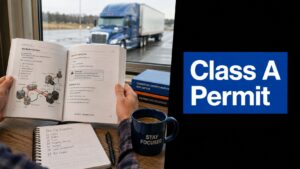
Your journey starts well before you ever climb into the cab. The first order of business is getting the fundamentals squared away. You’ll need a DOT medical card and then your Commercial Learner's Permit (CLP), which is basically your ticket to start your hands-on training. You can learn more about the specific CDL requirements for your state to make sure you have all the necessary paperwork.
Understanding the Core Components
The CDL exam isn’t just one big test; it’s a series of evaluations that check different skills. Knowing this from the start helps you manage your study time a lot better. To really nail your CDL exam the first time around, you need a solid plan that covers both book smarts and practical skills, much like you would when following a complete success guide for high-stakes evaluations.
Your preparation will fall into two main phases:
Written Knowledge Tests: This is where you’ll live in your state’s official CDL manual to pass a few multiple-choice exams. The big ones are General Knowledge, Air Brakes, and Combination Vehicles.
Three-Part Skills Test: This is the hands-on, in-person part of the exam. It breaks down into a meticulous Pre-Trip Inspection, Basic Vehicle Control (your backing maneuvers), and the On-Road Driving test.
Take this from someone who's seen it a hundred times: The skills test, specifically the pre-trip inspection, is where most people get tripped up on their first attempt. If you dedicate a serious amount of your practice time to this one part, you’ve already boosted your odds of passing significantly.
A Quick Look at What You're Facing
To help you get organized, the table below gives you a bird's-eye view of what to expect from each part of the CDL exam.
CDL Exam Components at a Glance
This table summarizes the main sections of the CDL exam, what each one involves, and where you should focus your energy to prepare effectively.
| Exam Component | What It Covers | Primary Skill Tested | Key to Passing |
|---|---|---|---|
| Written Knowledge Test | Traffic laws, vehicle systems (air brakes, combinations), and safe operating procedures. | Theoretical Knowledge & Recall | Consistent study of the official CDL manual and taking practice tests. |
| Pre-Trip Inspection | A comprehensive, systematic check of the entire vehicle's safety and operational components. | Attention to Detail & Verbalization | Following a repeatable sequence and clearly explaining each step to the examiner. |
| Basic Vehicle Control | A series of backing maneuvers, such as straight-line backing, offset backing, and parallel parking. | Precise Vehicle Maneuvering | Mastering mirror usage, slow speed control, and making minor steering corrections. |
| On-Road Driving Test | Operating the vehicle in real-world traffic, including turns, lane changes, and intersection navigation. | Safe Driving Habits & Situational Awareness | Demonstrating control, obeying all traffic laws, and anticipating hazards. |
Understanding these pieces helps you build a focused preparation strategy, which is the best way to walk into your exam feeling confident and ready.
Nailing the CDL Written Knowledge Tests
Before you ever climb into the cab, your first real test is on paper. Passing the written knowledge tests is the foundation for your entire CDL journey, and doing it on the first try comes down to having a smart game plan. This isn't about cramming the night before; it's about actually understanding the rules of the road for a commercial driver.
The single best tool you have is your state's official CDL manual. Treat it like the bible for your exam. I know it looks thick and intimidating, but the trick is to digest it one piece at a time. Don't just read it—study it.
Breaking Down the Core Written Exams
The written portion is split into a few key exams, but there are three you absolutely have to master to get your permit. You need to pass all of them, so give each one the respect it deserves. They cover the non-negotiable, essential knowledge for operating a rig safely.
Here’s what you’ll be facing:
- General Knowledge: This is the big one. It's the longest and covers the widest range of topics, from vehicle control and hazard perception to speed management and communication. Our guide on the general knowledge test is a great place to see exactly what's on it.
- Air Brakes: This test gets deep into the technical weeds. You'll need to know every component of the air brake system, how to conduct a proper inspection, and exactly how to use them on the road.
- Combination Vehicles: This one is mandatory if you’re going for a Class A license. It’s all about the unique physics of driving a tractor-trailer, covering everything from proper coupling and uncoupling to the dynamics of preventing a rollover.
A classic mistake I see all the time is drivers blowing past the Air Brakes section. They'll spend weeks on General Knowledge but just skim the technical details of the air brake system. That section is packed with specific numbers and procedures, and you're expected to know them cold.
The test format itself is pretty straightforward. Most states give you 50 multiple-choice questions and a 60-minute time limit. The bar is high, though—you need to hit at least 80% to pass, which means getting 40 out of 50 questions right. That doesn't leave much room for error, which is why your study strategy is so critical.
How to Actually Study and Practice
Just reading the manual from cover to cover won't cut it. You have to actively engage with the material to make it stick. A good study routine is all about balance.
The best approach is to pair your reading with a heavy dose of practice tests. Taking practice tests online is the closest you'll get to the real thing. It gets you comfortable with how the questions are worded, shines a bright light on your weak areas, and lets you see your progress in real-time.
Here's a simple, effective routine:
- Step 1: Focus on a Chapter: Pick one section from the manual, like "Controlling Your Vehicle," and read it thoroughly.
- Step 2: Test Yourself Immediately: Right after you finish the chapter, take a practice test that only covers that topic. This locks in the information.
- Step 3: Analyze Your Wrong Answers: Don't just glance at the correct answer and move on. Figure out why you missed it. Did you forget a specific detail, or did you fundamentally misunderstand a concept? This is where the real learning happens.
- Step 4: Expand Your Scope: Once you're consistently scoring 90% or higher on the individual topic tests, start taking the full-length, comprehensive practice exams that mix everything together.
This read-test-review cycle is, without a doubt, the fastest way to build real knowledge and the confidence to go with it. You're no longer just a passive reader; you're actively applying what you've learned—which is exactly what you need to do to walk out of the DMV with a passing score.
Conquering the Three-Part CDL Skills Test
Getting through the written exams is a great feeling, but the three-part skills test is where the rubber really meets the road. This is the hands-on portion of your CDL journey, where you have to prove you can handle the rig—not just on paper, but in real life with an examiner watching your every move. It's about precision, safety, and showing a deep, practical understanding of your vehicle.
Let's be real: this is where most people stumble. Some states report that as many as 80% of applicants fail the road test on their first try. That number isn't to discourage you; it's to get you focused. A huge chunk of those failures happen before the truck even moves, during the pre-trip inspection.
The skills test is broken down into three make-or-break sections. You have to pass all three to get your license. There's no partial credit.
The path forward is simple, but it demands discipline: study, practice, and then pass.
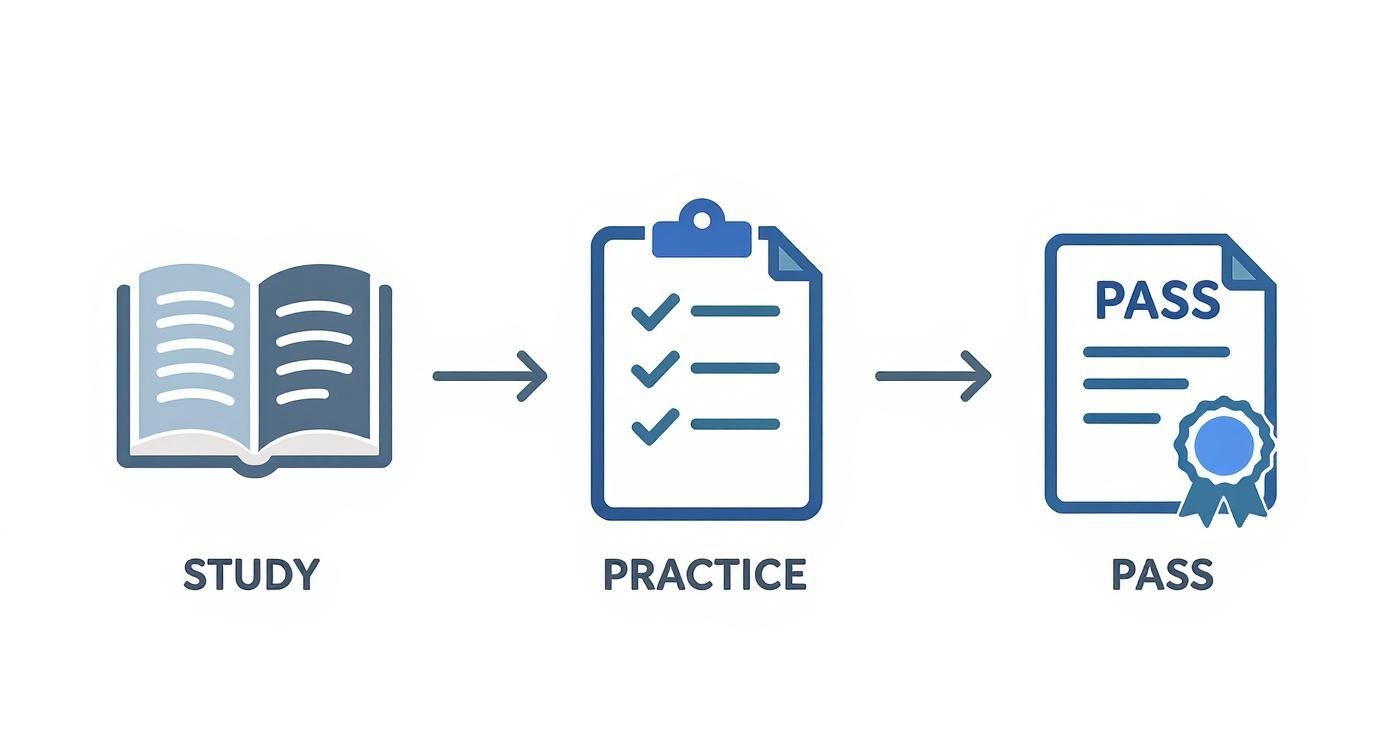
There's no luck involved here. Success is a direct result of putting in the work.
Dominating the Pre-Trip Vehicle Inspection
This is the number one reason people fail the CDL exam. Period. It’s not just about pointing at parts; it's about conducting a methodical inspection and talking the examiner through every single step. You have to prove you know what you’re looking at, why you're touching it, and what makes it safe or unsafe.
The only way to nail this is with a rock-solid routine—a repeatable, top-to-bottom method you can do in your sleep.
- Start the Same Way, Every Time: Kick things off with a quick walk around the truck, looking underneath for any leaks or obvious damage. Then, pop the hood and dive into the engine compartment.
- Talk Through Everything: As you check components like the alternator, water pump, and air compressor, you have to say the magic words: “securely mounted, not cracked or broken, and not leaking.” For hoses, you're checking for abrasions, bulges, and cuts (the ABCs). Belts need to be checked for cracks and proper tension.
- Follow a Logical Path: Move systematically down one side of the tractor, then focus on the coupling system, and finish with the trailer. A consistent flow is your best defense against forgetting something crucial like a slack adjuster or brake chamber.
Your examiner isn't just listening for a memorized script. They want to see a driver who can confidently confirm a vehicle is safe for the road. It’s about demonstrating competence. For a much deeper dive, check out our comprehensive guide on mastering the pre-trip inspection.
Mastering Basic Vehicle Control
Once you’ve passed the inspection, it's time to show you can handle the rig in tight quarters. This is the backing portion of the test, and it’s all about low-speed precision. You'll typically be asked to perform a few different maneuvers, including:
- Straight-Line Backing: The foundation of all other backing skills. It sounds simple, but keeping an 80,000-pound vehicle perfectly straight while going backward takes practice.
- Offset Backing (Right or Left): This involves backing your trailer from one lane into the one right next to it.
- Parallel Parking (Driver or Conventional Side): Just like parking a car, but with a whole lot more vehicle to manage.
Success here boils down to a few things. First, get this into your head: slow is smooth, and smooth is fast. Rushing is the fastest way to over-correct and fail. Second, get comfortable living in your mirrors. You need to be constantly scanning from one to the other to see how your trailer is tracking. A small steering input makes a massive difference at the back of the trailer.
Acing the On-Road Driving Test
This is the final piece of the puzzle. The on-road test is where you put it all together in live traffic. The examiner needs to see that you can operate safely and professionally, demonstrating total control and awareness of everything happening around you.
You're going to be graded on all the fundamentals:
- Turns: Can you make a wide right turn without climbing the curb? Can you execute a proper left turn without cutting the corner or drifting into another lane?
- Lane Changes: You need to signal well in advance, check your mirrors thoroughly, and then make a smooth, decisive move.
- Intersections: This means stopping correctly behind the line, looking left-right-left, and only proceeding when it's absolutely safe.
- Speed Management: Obeying the speed limit is the bare minimum. You also need to adjust your speed for traffic, weather, and road conditions.
Your ability to see and react to potential hazards is just as critical as your mechanical skill. Keep your eyes moving, look far down the road, and check your mirrors every 5-8 seconds. The examiner wants to sign off on a safe, confident, and professional driver—and with focused practice in these three areas, that’s exactly who they’ll see.
Don't Let These Common Mistakes Derail Your Test Day
Knowing the material inside and out is only half the battle. The other half is navigating the test itself and avoiding the simple, bone-headed mistakes that trip up so many applicants. Trust me, I've seen skilled drivers fail because of a momentary lapse in focus.
From the pre-trip inspection all the way through the road test, examiners are looking for precision. A small oversight can be enough to send you home. They aren't just checking if you can drive a truck; they're ensuring you have the discipline and attention to detail that the job demands.
The good news? These common failures are completely avoidable. If you know what the examiner is looking for, you can prepare yourself to execute cleanly and show them you’re ready for the road.
Critical Errors That Cause Instant Fails
Some mistakes are so serious they're considered an automatic fail. There's no coming back from these. You need to burn them into your brain so avoiding them becomes second nature.
These are the big ones:
- Rolling a Stop Sign: This isn't a suggestion. You have to come to a full and complete stop behind that white line. I always tell my students to count to three and look both ways before even thinking about touching the gas. A "California stop" will end your test immediately.
- Hitting a Cone or Curb: Any contact with a cone, barrel, or curb during your backing maneuvers is a dealbreaker. It screams a lack of vehicle control, and that's it—test over.
- Forgetting Your Turn Signal: Every. Single. Time. Whether you're turning, changing lanes, or pulling over, that signal needs to be on. Forgetting it just once is often enough for an examiner to fail you.
- Not Checking Your Mirrors: The examiner is watching your head and eyes just as much as they're watching the truck. You need to be actively scanning your mirrors every 5-8 seconds. It has to look like a habit, not an afterthought.
One of the most overlooked critical errors happens before you even start the engine: failing to verbalize the pre-trip inspection. You can't just point. You have to talk the examiner through every single check, explaining what you’re looking for and why it matters. Silence is the same as not doing it at all.
Pass rates have been a hot topic for years. A 1996 survey found that some schools had a nearly 95% pass rate, which made regulators question how tough the test really was. In response, states have tightened things up, especially around critical safety systems like air brakes. Take a look at the detail required on the Patriot CDL air brakes test to see what I mean.
Managing Those Test Day Jitters
Look, it's normal to have butterflies in your stomach. The trick isn't to eliminate your nerves but to manage them so they don't cause you to make a silly mistake.
Get a good night's sleep and eat a decent breakfast—don't show up running on fumes and caffeine. Get to the test center with time to spare so you aren't rushing. Before you hop in the cab, take a few slow, deep breaths. It really does help.
Remember, the examiner isn’t your enemy. They just want to see a safe, competent driver. Be polite, listen closely to their instructions, and if you’re unsure about something, ask for clarification. Projecting a little confidence goes a long way.
Your Essential Test Day Checklist
There's no easier way to fail than by not even being allowed to take the test. The last thing you want is to be sent home because you forgot a single piece of paper.
Before you leave the house, triple-check you have all of this on you:
- Your valid Commercial Learner’s Permit (CLP)
- Your current Driver’s License
- Your valid DOT Medical Card
- Proof of Insurance and Registration for the test vehicle
- Proper footwear (sturdy, closed-toe shoes or boots are a must)
Walking in with all your documents ready shows the examiner you’re organized and professional. It sets a positive tone from the very start and lets you focus on what really matters: passing that test.
What to Do After You Pass the CDL Exam
Passing your CDL exam is a massive accomplishment. It’s that incredible moment where all your hard work studying the manual and grinding through skills practice finally pays off. You've officially punched your ticket to a new career.
But after the initial celebration, you're probably asking yourself, "Okay, what's next?" This isn't the finish line; it’s the starting block. The moves you make right now are what will turn that newly earned license into a steady paycheck and a long, successful career on the road.
From Paperwork to Plastic License
First things first: you need to make it official. You won’t walk out of the testing center with your permanent CDL in hand. The next step is a trip back to your local DMV or licensing agency. Bring your passing paperwork, and they'll get your official Commercial Driver's License issued.
While you're there, this is the perfect time to think about beefing up your qualifications. Getting endorsements now makes you a much more valuable hire right out of the gate.
- Tanker (N): This is usually just a written test and immediately opens up jobs hauling all kinds of liquids.
- Hazmat (H): This one takes a bit more effort—a background check and another written test—but it can seriously boost your earning potential.
- Doubles/Triples (T): Another written test that qualifies you for hauling multiple trailers, which is common in LTL (less-than-truckload) freight.
Staying compliant is just as crucial as getting licensed. Your DOT medical card typically needs a refresh every two years. Mark that date on your calendar right now. If it expires, your CDL becomes invalid, and you’re sidelined until you pass a new physical.
Building Your Professional Driver Resume
With your license sorted, it's time to craft a resume that gets you noticed. This document is your first handshake with a potential employer, and it needs to scream "qualified professional," even if you have no paid driving experience yet.
Don't worry about a blank work history—your training is your experience. Make sure your resume clearly highlights:
- Your Class A CDL right at the top.
- A list of all endorsements you've earned (Tanker, Hazmat, etc.).
- The name of the CDL school you graduated from.
- A quick summary of the skills you mastered, like pre-trip inspections, backing maneuvers, and defensive driving.
After passing the exam, you're officially qualified for a whole new world of career opportunities. Companies are always on the lookout for new heavy and tractor-trailer truck drivers.
Finding Entry-Level Trucking Jobs
So, where do you find that first driving job? The good news is, many of the big carriers have dedicated programs specifically for recent grads. They've built entire systems to give new drivers the support they need to succeed in those critical first few months.
Look for companies offering a "finishing" or "driver training" program. This is where the real learning happens. You'll be paired with an experienced driver trainer for several weeks, getting real-world, over-the-road experience in a structured environment. It’s the perfect bridge from the schoolyard to going solo.
Also, be aware of what employers are looking for. Some jobs still require you to operate a manual transmission. If your license has an E restriction (automatic only), taking an E restriction removal course can unlock a lot more doors for you.
When you land that first interview, be ready to talk about your commitment to safety above all else. Carriers want to hire professionals who prioritize safe operation over speed. Show your enthusiasm, act like a pro, and get ready to start your journey. Passing the test was the first big win—now it's time to build your career.
Your CDL Exam Questions Answered
When you're working toward your CDL, a million questions can pop into your head. It's totally normal. Getting straight answers about timelines, test day rules, and what happens if things don’t go perfectly helps you stay focused and confident.
Let's clear up a few of the most common questions we hear from new drivers. Knowing the answers will help you plan your training and walk into the test center prepared for whatever comes your way.
How Long Does It Take to Prepare for the CDL Exam?
There’s no single answer here—it really comes down to your learning style and how you approach your training.
If you jump into a full-time CDL school, you’re on the fast track. These programs are intense, immersive, and can have you ready for your test in as little as three to seven weeks. But if you're studying on your own, you'll want to give yourself more runway. A realistic timeline for self-study is probably closer to four to eight weeks of consistent, focused effort.
It’s not just about clocking hours. The quality of your practice is what truly matters. Getting the pre-trip inspection and backing maneuvers down to muscle memory takes a ton of repetition, and that’s often where most of your time will go.
What Happens If I Fail a Portion of the CDL Exam?
First off, don't panic. Failing a part of the CDL exam happens more often than you’d think, and it’s not the end of the road. The system is built for second chances.
The good news is that most states won't make you retake the entire thing. You’ll just need to re-do the specific part you failed, whether it was the pre-trip inspection, a backing skill, or the road test itself. Just keep a few things in mind:
- Waiting Period: You'll likely have a mandatory waiting period before you can try again, usually a few days to a week. Check your state's rules.
- Limited Attempts: States typically limit how many times you can retake the test within a specific timeframe.
- Feedback is Fuel: This is huge. If you can, ask the examiner for specific feedback on what went wrong. That insight is pure gold and tells you exactly what to practice for your next attempt.
Can I Use My Own Truck for the CDL Skills Test?
Technically, yes, you can often use your own vehicle for the skills test, but it comes with some serious strings attached. The truck has to be the exact right type for the license you’re testing for—for example, you need a full Class A tractor-trailer for a Class A test.
More importantly, your truck will have to pass a rigorous safety check by the examiner right then and there. It needs to be properly registered, insured, and in perfect working order. If they find any safety issue, even a single burnt-out light, your test is over before it even starts. Honestly, it’s why most people find it way easier and less stressful to just use a test-ready vehicle from a certified driving school.
Ready to stop wondering and start driving? At Patriot CDL, we provide the hands-on training and expert instruction you need to pass your CDL exam with confidence. Visit us at https://patriotcdl.com to find a program that fits your schedule and start your journey today.