If you're looking to really boost your paycheck as a trucker, getting your Hazmat endorsement is one of the smartest moves you can make. It's more than just an extra credential; it's a direct path to higher-paying, specialized jobs. Think of it this way: carriers see that "H" on your license and know you've got advanced training and can be trusted with sensitive loads. Using a solid CDL Hazmat practice test is your first and most important step to unlocking that next level in your career.
Why a Hazmat Endorsement Unlocks Higher-Paying Trucking Jobs
In the world of trucking, specialization is king. The more skills you have, the more you earn, and the Hazmat (H) endorsement is one of the most valuable credentials you can get. It’s a game-changer that opens up better routes, more job options, and a much more stable career path.
Why the pay bump? Simple. Companies pay more for drivers qualified to haul hazardous materials because those loads carry higher freight rates. They need drivers they can count on, and they're willing to pay a premium for that peace of mind. We're not talking about a few extra cents per mile—this is a serious increase in your annual income.
The Financial Advantage of Hauling Hazardous Materials
The salary difference between a driver with a standard CDL and one with a Hazmat endorsement is striking. While you can make a good living with a Class A CDL, adding the H endorsement catapults your earning potential into a whole new bracket.
This chart lays it out pretty clearly.
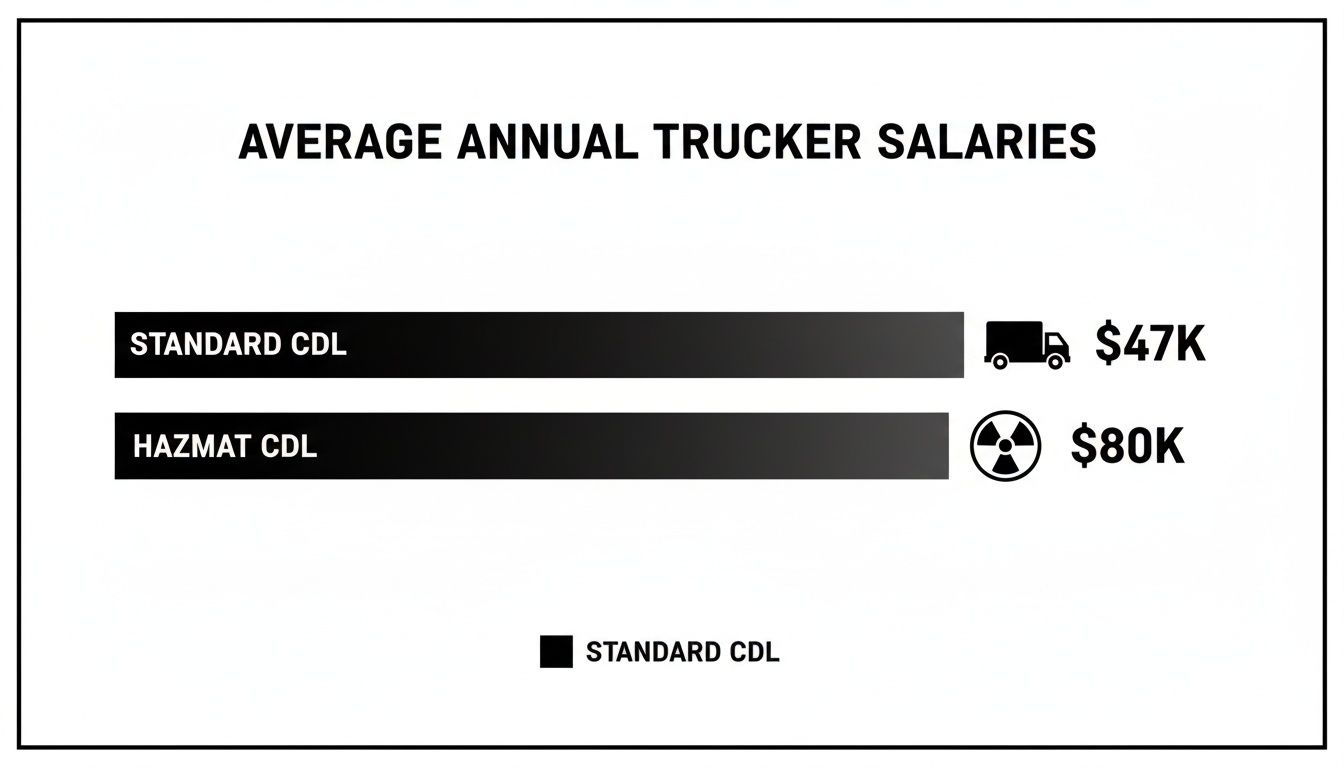
The numbers don't lie. Drivers with the Hazmat endorsement often earn tens of thousands more each year, showing a clear and immediate return on the time you invest in getting certified.
This extra pay comes from the added responsibility. You have to be an expert on safety regulations, know your placards inside and out, and be prepared for emergency situations. These are skills that get tested and proven through the endorsement process. This expertise makes Hazmat drivers essential for companies serving critical industries like manufacturing, energy, and agriculture. Of course, before you can get any endorsement, you have to meet the baseline CDL requirements.
The table below breaks down the earning potential even further, showing just how significant the financial upside can be.
Hazmat Endorsement Salary Potential Vs Standard CDL
| Driver Profile | Average Annual Salary (Standard CDL) | Potential Annual Salary (With Hazmat) |
|---|---|---|
| Entry-Level Driver | $47,000 | $65,000+ |
| Experienced Driver (2-5 years) | $55,000 | $75,000 – $85,000 |
| Veteran Driver (5+ years) | $62,000 | $80,000 – $90,000+ |
As you can see, at every stage of your career, the Hazmat endorsement provides a substantial boost, making it a powerful tool for long-term financial growth.
Real-World Earning Potential
This isn't just about averages; top carriers put their money where their mouth is. They know how valuable Hazmat-endorsed drivers are and structure their pay to reflect that.
For example, it's not uncommon for leading companies to guarantee Hazmat drivers a minimum of $1,000 per week with just one year of experience under their belt. Pay-per-mile often starts around 52 cents for the first couple of years, climbing to 54 cents with two to five years of experience, and hitting 56 cents for seasoned pros.
With a pay structure like that, you could be looking at an annual salary between $70,000 and $90,000, depending on how many miles you run. That's a huge leap from the average trucker's salary of around $47,000 without any endorsements.
This tangible pay increase makes studying for and passing the Hazmat test a no-brainer. Demand for qualified drivers is always high, and those with the H endorsement are the first ones companies call. Prepping with a good CDL Hazmat practice test is the most efficient way to pass the exam on your first try and start cashing in on these better-paying opportunities right away. It's a direct investment in your future.
What to Expect on the Official Hazmat Knowledge Test

Walking into the DMV for your Hazmat knowledge test can be nerve-wracking if you're going in blind. But here’s the good news: the exam isn’t designed to trick you. It follows a pretty standard formula across the country, making sure every driver with an H endorsement is on the same page when it comes to safety.
If you know what's coming—the format, the types of questions, and the key topics—you can walk in with confidence.
The test itself is almost always 30 multiple-choice questions. If you've already taken the general knowledge test, the format will feel familiar. The goal isn't just about memorizing rules; it's about proving you genuinely understand the federal regulations and safety protocols that keep everyone safe.
To pass, you’ll need a score of 80% or better, which means you can only miss six questions. That sounds like a tight margin, but it’s completely doable with the right preparation. The test is timed, usually around an hour, and you get your score right on the spot.
Core Topics You Must Master
The questions are pulled straight from the hazardous materials section of your state's CDL manual. No curveballs, just the essential, practical knowledge you'll actually use on the job.
You'll definitely see questions covering these areas:
- Regulations and Responsibilities: This is all about the legal stuff. You'll need to know the roles of the shipper, the carrier, and the driver. Who is responsible for what?
- Placarding Requirements: Get ready to identify and display placards correctly. They'll test you on different hazard classes, quantities, and when a placard is or isn't needed.
- Loading and Unloading Procedures: This covers everything from properly segregating different types of cargo to blocking and bracing. It also includes the attendance rules for staying with certain materials.
- Shipping Papers and Documentation: You have to be able to read shipping papers inside and out. That means quickly identifying the hazardous materials, understanding the descriptions, and knowing where to find emergency contact info.
- Emergency Response and Security: This section is critical. It covers what to do if there's a leak, spill, or accident, along with security threat awareness.
Understanding the "why" behind the rules is just as important as knowing the rules themselves. The test confirms you grasp the safety principles that protect you, the public, and the environment.
The Bigger Picture of Endorsement
Passing the knowledge test is a huge step, but it’s just one piece of the puzzle. To get your HazMat endorsement, you also need to be at least 21 years old, hold a valid CDL, prove your legal status, and pass a full TSA threat assessment.
At Patriot CDL, we build our Entry-Level Driver Training (ELDT) programs to cover all these moving parts in just a few days. By knowing what to expect from the 30-question test and its 80% pass requirement, you can focus your energy where it counts and be ready for test day.
Your Full-Length CDL Hazmat Practice Test with Answers
Okay, this is where the theory ends and the real work begins. Reading the Hazmat manual is one thing, but sitting down and tackling the questions is how you truly lock in the knowledge.
This full-length, 30-question practice test is built to feel just like the one you'll face at the DMV. Each question is followed by the correct answer and, more importantly, a detailed explanation. Don't just scan for the right letter. Take a second to read the why behind each answer. That's how you turn a simple quiz into a serious study session and build the confidence to pass on your first try.
Practice Test Questions and Answers
Find a quiet spot, grab a pen and paper, and treat this like the real deal. No distractions. Let's see what you've got.
1. A driver must have a CDL with a hazardous materials endorsement to transport hazardous materials of a type or quantity that requires:
A. Special permits
B. Placarding
C. An escort vehicle
D. A police escort
Answer: B. Placarding
Explanation: This is a core concept. The moment your load is big enough to require placards under Department of Transportation (DOT) rules, you absolutely must have the Hazmat endorsement on your CDL. It's the main trigger.
2. Shipping papers describing a hazardous materials shipment must be located:
A. In a locked glove box
B. In a pouch on the driver's door or on the driver's seat
C. In the trailer with the cargo
D. Filed in the back of the cab
Answer: B. In a pouch on the driver's door or on the driver's seat
Explanation: Think about an emergency. First responders need those papers fast. The rules are specific: they have to be within your immediate reach while you're belted in and obvious to anyone who opens the door.
3. What is the main purpose of the DOT Hazard Classification System?
A. To organize chemicals by their weight
B. To identify hazardous materials by the specific risk they pose
C. To list materials alphabetically for easy reference
D. To separate liquids from solids
Answer: B. To identify hazardous materials by the specific risk they pose
Explanation: The whole system is about risk. Is it flammable (Class 3)? Corrosive (Class 8)? Poisonous (Class 6)? The hazard class groups materials by the danger they present so everyone knows how to handle them safely.
Don't underestimate the power of practice tests. Studies have shown that drivers who work through practice exams can boost their scores by up to 25% compared to those who just read the book. It gets the information out of the manual and into your head.
4. When are you allowed to move an improperly placarded vehicle carrying hazardous materials?
A. Only if it is for a short distance
B. During an emergency to protect life or property
C. After getting verbal approval from your dispatcher
D. Never, under any circumstances
Answer: B. During an emergency to protect life or property
Explanation: Safety trumps the rulebook here. While you should never plan to drive without the right placards, the regulations allow you to move the vehicle if you're in a genuine emergency—like a fire—to prevent a disaster.
5. Which of the following is considered a Class 1 hazardous material?
A. Flammable Gas
B. Explosives
C. Poisonous Substances
D. Radioactive Materials
Answer: B. Explosives
Explanation: Hazard Class 1 is all about explosives. This category covers everything from dynamite and ammunition to fireworks.
6. If you discover your hazardous materials shipment is leaking at a rest stop, what is the first thing you should do?
A. Call your dispatcher for instructions
B. Try to patch the leak yourself
C. Keep other people away from the area
D. Drive to the nearest repair shop
Answer: C. Keep other people away from the area
Explanation: Your immediate job is to protect the public. Before you call anyone or do anything else, you have to secure the scene. Get people away from the danger. That's priority number one.
Test Your Placard and Paperwork Knowledge
The next few questions get into the nitty-gritty details that can trip drivers up. Pay close attention to the specifics of placards, shipping docs, and loading rules.
7. On a shipping paper, the hazard class number must appear:
A. After the proper shipping name
B. In the first column of the shipping paper
C. Before the ID number
D. In the same column as the material's weight
Answer: B. In the first column of the shipping paper
Explanation: The DOT is very particular about the layout of shipping papers for a reason: consistency. The hazard class is a critical piece of information and needs to be easy to find, right there in the first column.
8. A container of hazardous material has a "Poison Inhalation Hazard" label. You must placard the vehicle if you are carrying:
A. Any amount of it
B. More than 100 pounds
C. More than 500 pounds
D. More than 1,001 pounds
Answer: A. Any amount of it
Explanation: Anything labeled "Poison Inhalation Hazard" is considered extremely dangerous. The risk is so high that there's no minimum weight threshold. If you're hauling any amount, the truck must be placarded.
9. Who is responsible for providing the necessary placards for a hazardous materials shipment?
A. The driver
B. The carrier
C. The shipper
D. The receiver of the freight
Answer: C. The shipper
Explanation: The shipper's job is to correctly classify, package, and mark the freight. That responsibility includes giving the driver the right placards for the load. Your job is to make sure they're displayed correctly, but the shipper has to provide them.
10. What does the term "reportable quantity" or "RQ" on shipping papers mean?
A. The shipment is fragile and must be reported on arrival
B. The carrier must report a spill of that quantity to the proper authorities
C. The driver must report the quantity to their dispatcher daily
D. It is the quantity required for placarding
Answer: B. The carrier must report a spill of that quantity to the proper authorities
Explanation: Seeing "RQ" on the paperwork is a big deal. It means that if you spill an amount equal to or greater than that quantity, it’s a federally reportable incident. You'll need to contact agencies like the National Response Center immediately.
Scenario-Based Emergency Questions
The real Hazmat test isn't just about memorizing facts. It's about applying them in the real world, especially when things go wrong. Think these scenarios through.
11. You are driving a truck with corrosives. You are involved in an accident and your vehicle is spilling its contents. What should you do?
A. Immediately attempt to clean up the spill
B. Move the truck off the road, regardless of the spill
C. Keep people away and warn them of the danger
D. Cover the spill with dirt
Answer: C. Keep people away and warn them of the danger
Explanation: Just like with a simple leak, your first move in an accident is crowd control. Protect the public. Warn people to stay back and create a safe perimeter until the emergency crews arrive and take over.
12. When transporting explosives, you must have a written route plan and follow it. You can only deviate from this plan if:
A. You find a faster shortcut
B. You need to stop for a meal
C. An emergency occurs
D. You are running late
Answer: C. An emergency occurs
Explanation: Route plans for explosives are dead serious. You can't change them for convenience. The only legal reason to deviate from your planned route is a true emergency, like an unexpected road closure, a major accident blocking your path, or another unforeseen hazard.
13. A "DANGEROUS" placard is used when:
A. You are hauling any amount of two or more different hazardous materials
B. You have a mixed load of two or more table 2 materials totaling more than 1,001 lbs
C. The shipper requests it for a high-value load
D. You are transporting more than 5,000 lbs of any single hazardous material
Answer: B. You have a mixed load of two or more table 2 materials totaling more than 1,001 lbs
Explanation: This one is specific. The "DANGEROUS" placard is for mixed freight. When you're carrying two or more types of Hazmat from Table 2 in the rulebook, and the combined weight is over 1,001 pounds, you use this single placard instead of several different ones.
14. If you're carrying Division 1.1, 1.2, or 1.3 explosives, you must not park the vehicle:
A. Within 5 feet of the traveled part of the road
B. Within 300 feet of a bridge or tunnel
C. Next to a parked vehicle
D. All of the above
Answer: D. All of the above
Explanation: The parking rules for high-risk explosives are extremely strict for obvious reasons. You have to keep a safe distance from active roadways, structures like bridges, and even other parked vehicles to minimize the risk of a catastrophe.
15. What is the primary role of the Emergency Response Guidebook (ERG)?
A. To help drivers plan their routes
B. To provide a list of approved repair shops
C. To aid first responders in identifying hazards and initial actions
D. To track a driver's hours of service
Answer: C. To aid first responders in identifying hazards and initial actions
Explanation: The ERG is the first responder's bible in a Hazmat incident. It lets them look up a material by its ID number (from the placard or shipping papers) and instantly get critical info on its risks, what protective gear to wear, and how to handle a fire or spill.
How Are You Doing So Far?
Halfway there. Take a quick break. Are you noticing a pattern? Maybe the placard rules or emergency procedures are giving you some trouble. That’s not a failure; that's good information. It tells you exactly where to focus your study time.
Feeling good? Great. Keep that momentum going. The key isn't just getting the answer right, but truly understanding the safety principle behind the rule.
If you're finding you need a more structured approach to really nail this stuff, check out our program. You can sign up for Patriot CDL’s comprehensive training courses and get the focused prep you need to ace the exam.
Loading, Unloading, and In-Transit Rules
16. When loading or unloading a placarded cargo tank, a qualified person must always remain:
A. Within 100 feet of the vehicle
B. Within 25 feet of the vehicle and have a clear view of it
C. In the driver's seat with the engine running
D. On the phone with the dispatcher
Answer: B. Within 25 feet of the vehicle and have a clear view of it
Explanation: This is the "attendance rule." When you're transferring product from a bulk tank, someone qualified has to be within 25 feet with an unobstructed view the entire time. No exceptions. This ensures they can react instantly if something goes wrong.
17. "Cargo segregation" refers to:
A. Securing cargo with straps and braces
B. Loading hazardous materials away from incompatible materials
C. Separating the shipping papers from the bill of lading
D. Placing heavier items on the bottom of the trailer
Answer: B. Loading hazardous materials away from incompatible materials
Explanation: Segregation is all about preventing dangerous chemical reactions. You wouldn't load certain acids and cyanides together, because if they mix, they can create a deadly gas. The segregation table in the regulations tells you exactly what can't touch.
18. Smoking is prohibited within how many feet of a vehicle placarded for Class 1, Class 3, or Division 2.1 materials?
A. 10 feet
B. 25 feet
C. 50 feet
D. 100 feet
Answer: B. 25 feet
Explanation: The 25-foot no-smoking rule is a hard-and-fast safety measure. It keeps ignition sources away from anything explosive (Class 1), flammable liquids (Class 3), or flammable gases (Division 2.1).
19. When must you check the tires on a placarded vehicle?
A. Only during your pre-trip inspection
B. Every time you stop
C. Once every 24 hours
D. At the beginning and end of each trip
Answer: B. Every time you stop
Explanation: The stakes are higher with a Hazmat load. That's why the rules require you to check your tires every single time you stop. A hot tire can become an ignition source, so this quick check is a non-negotiable part of the job.
20. Which of the following is the proper shipping name?
A. Corrosive Fluid
B. Gas, Pressurized
C. Sulfuric Acid
D. Fuel for Cars
Answer: C. Sulfuric Acid
Explanation: Proper shipping names are technical and precise. Descriptions like "Corrosive Fluid" or "Fuel for Cars" are too generic. Sulfuric Acid is the official, specific name you'll find in the Hazardous Materials Table.
Final Stretch: Comprehensive Review Questions
You're almost there. These last ten questions pull from all the topics we've covered. This is your chance to show you have a solid, all-around understanding of your responsibilities as a Hazmat driver.
21. A placard must be placed on:
A. The front and rear of the vehicle
B. Both sides of the vehicle
C. All four sides of the vehicle
D. Only the rear of the trailer
Answer: C. All four sides of the vehicle
Explanation: Placards need to be visible from every angle. That means they must be securely displayed on the front, back, and both sides of the vehicle. This helps first responders identify the hazard no matter how they approach the scene.
22. If shipping papers are lost or destroyed during an accident, the driver should:
A. Try to recreate them from memory
B. Provide emergency responders with the placard information
C. Wait for the shipper to send new copies
D. Inform responders that the information is unavailable
Answer: B. Provide emergency responders with the placard information
Explanation: If the paperwork is gone, the placards are your backup. The color, symbol, and UN/NA ID number on the placard give first responders enough information to use their ERG and figure out what they're dealing with.
23. A driver transporting hazardous materials must carry a certificate of registration from which federal agency?
A. Federal Motor Carrier Safety Administration (FMCSA)
B. Department of Transportation (DOT)
C. Pipeline and Hazardous Materials Safety Administration (PHMSA)
D. Environmental Protection Agency (EPA)
Answer: C. Pipeline and Hazardous Materials Safety Administration (PHMSA)
Explanation: This is an administrative detail that's easy to forget. Carriers dealing with certain types of Hazmat must register with PHMSA every year, and the driver is required to have a copy of that registration certificate in the truck.
24. What is the National Response Center (NRC)?
A. A non-profit organization for truck drivers
B. The central point for reporting oil and chemical spills
C. A government agency that issues Hazmat endorsements
D. A dispatch service for Hazmat carriers
Answer: B. The central point for reporting oil and chemical spills
Explanation: The NRC is the federal government's 24/7 emergency call center. It's the one number you call to report spills of oil, chemicals, and other hazardous substances into the environment.
25. A material's hazard class is based on:
A. Its price per gallon
B. The manufacturer's preference
C. Its primary hazardous characteristic
D. The state it is being shipped to
Answer: C. Its primary hazardous characteristic
Explanation: The classification is pure science. A material is put into a hazard class based on its most significant danger—is it flammable? Toxic? Corrosive? That primary characteristic determines its class.
26. You are carrying hazardous materials. Another driver pulls up next to you at a light and tells you your tire is smoking. You should:
A. Pull over immediately and check the tire
B. Tell them thank you and continue to the next truck stop
C. Increase your speed to put the fire out
D. Ignore them, as they are probably mistaken
Answer: A. Pull over immediately and check the tire
Explanation: A smoking tire is a fire waiting to happen, and fire is a Hazmat driver's worst nightmare. You need to pull over as soon as it's safe to do so, get out, get away from the truck, and assess the situation from a distance. Don't wait.
27. A portable tank is considered "bulk packaging" if it has a capacity of at least:
A. 55 gallons
B. 119 gallons
C. 500 gallons
D. 1,001 gallons
Answer: B. 119 gallons
Explanation: This is a key number to remember. For liquids, the line between non-bulk and bulk packaging is drawn at 119 gallons. Any container with a capacity greater than 119 gallons is considered bulk, which triggers a different set of rules.
28. Who is responsible for checking that the shipper correctly named, labeled, and marked a hazardous materials shipment?
A. The shipper only
B. The driver
C. The carrier
D. The receiver
Answer: C. The carrier
Explanation: This is a shared responsibility. The shipper is supposed to do it right in the first place, but the carrier is legally required to double-check that work before accepting the load. As the driver, you're the carrier's representative on the front line, so that check often falls to you.
29. You may not park a vehicle carrying hazardous materials within how many feet of an open fire?
A. 100 feet
B. 200 feet
C. 300 feet
D. 500 feet
Answer: C. 300 feet
Explanation: Another critical parking rule. You must maintain a 300-foot buffer zone between your placarded truck and any open flame, like a campfire or even a barrel fire. It’s a common-sense rule to prevent ignition.
30. The shipper's certification on the shipping papers states that:
A. The driver is fully trained and qualified
B. The shipment has been prepared according to the regulations
C. The freight charges have been paid in full
D. The vehicle has passed a safety inspection
Answer: B. The shipment has been prepared according to the regulations
Explanation: That signature from the shipper is a legal statement. They are certifying that everything about that shipment—the classification, the packaging, the marking, the labeling—has been done in complete compliance with all DOT Hazmat regulations.
How to Build a Study Plan That Actually Works

Knowing the material is just one piece of the puzzle. Having a solid strategy to learn and retain it is what separates a passing score from a failing one. A good study plan takes that mountain of information in the CDL manual and breaks it down into manageable daily goals. This way, you're building your knowledge steadily, not just cramming at the last minute.
Forget about pulling an all-nighter before the exam. You’ll be far better off spending an hour of focused study each day for a week than trying to absorb everything in one massive eight-hour session. A consistent approach helps the complex details stick and keeps you from feeling burned out.
A Realistic One-Week Study Schedule
The worst way to study is to just read the manual from front to back. A much smarter approach is to break the core topics into themed days. This ensures you’re not accidentally skipping over the tough stuff.
Here’s a sample schedule you can make your own:
- Days 1-2: Placarding and Hazard Classes. This is the visual language of the road. Get comfortable with the nine hazard classes, what their placards look like, and the specific rules for when you need to display them.
- Days 3-4: Shipping Papers and Security. Time to hit the books on documentation. Learn how to scan shipping papers for the proper shipping name, UN/NA ID number, and other critical info. This is also when you should cover the security protocols and threat assessment.
- Days 5-6: Loading and Emergency Response. These days are all about the hands-on aspects. You'll cover the rules for loading, segregating incompatible materials, and bracing cargo. Then, pivot to what you need to do in an emergency—spills, leaks, or accidents.
- Day 7: Final Review and Practice Test. This is your dress rehearsal. Take a full-length CDL Hazmat practice test to get a feel for the real thing. Once you're done, go back and carefully review every question you got wrong.
I see this all the time: drivers study what they already know because it feels good. Don't fall into that trap. Your practice test is a diagnostic tool. It will show you exactly where you're weak, so you can spend your final day turning those weaknesses into strengths.
Smart Study Tips and Test-Day Advice
Great studying isn't about putting in more hours; it's about making those hours count. Little tricks can make a huge difference in remembering facts under pressure. Think about using mnemonics to memorize the nine hazard classes or making flashcards for specific placard rules and definitions.
When test day arrives, your mental game is just as important as what you’ve learned. Get a good night's sleep—a tired mind makes silly mistakes. Before you even look at the answer choices, read every single question twice. This tiny habit prevents you from missing crucial words like "not" or "except" that can flip the entire meaning of the question. For a lot of drivers, being confident in every aspect of their vehicle, including the transmission, is a big part of being prepared. Broadening your skillset with something like the E restriction removal course can add to that confidence.
Finally, don't be afraid to use the process of elimination. If a question stumps you, start by crossing out the answers you know are definitely wrong. Narrowing the field from four options to two dramatically boosts your chances of guessing correctly.
So You Passed the Test—What Happens Now?

Passing the Hazmat knowledge test is a huge milestone. It’s a tough exam, and you should feel proud. But don’t head out to celebrate just yet. Passing the test isn't the finish line; it’s more like the starting gun for the final lap of getting your endorsement.
Think of it like this: the written test proves you know the rules of the road for hazardous materials. Now you have to prove you’re a person who can be trusted to follow them. This next phase is all about security and making sure only the most responsible drivers are transporting these sensitive loads.
First Up: The TSA Threat Assessment
Your very next move is to tackle the TSA Security Threat Assessment. This isn't optional—it's a mandatory federal background check for every single driver who wants to haul HazMat. The whole point is to ensure that people with access to potentially dangerous materials don't pose a national security risk.
Getting it done involves a few distinct steps:
- Fill Out the Application: You can usually get this started online, which saves a lot of time.
- Get Your Fingerprints Taken: You’ll need to schedule an appointment at an authorized enrollment center to get this done electronically.
- Pay the Fee: Be ready for a non-refundable fee to cover the cost of the background check.
This is a deep dive into your history. They'll look at criminal records, check your immigration status, and run your name against multiple federal security watchlists. Don't expect it to be instant. The process can take several weeks, so get the ball rolling the minute you pass your knowledge test.
A lot of drivers think passing the DMV test is the final hurdle. The truth is, your "H" endorsement isn't official until the TSA gives you the green light on your security assessment.
State-Level Paperwork and Getting the Endorsement on Your CDL
While the TSA check is a federal process, the final act of getting that shiny "H" endorsement printed on your CDL happens at the state level. Every state’s DMV (or equivalent agency) has its own way of doing things once your TSA approval comes through.
For example, some states will get an electronic notification directly from the TSA, while others will require you to bring in your approval letter in person. You absolutely have to check with your local DMV to find out their exact procedure. Never assume it works the same way it did in another state you lived in.
This final part is what connects all your hard work to a bigger paycheck. Using a solid CDL Hazmat practice test gets you ready for the exam—which is the key that unlocks this whole process. A good practice test will feel just like the real thing, which usually has 30 questions and requires a minimum 80% passing score to show you know your stuff on federal rules for placarding, handling emergencies, and proper loading.
Getting through these last administrative steps is what officially puts you on the road to a more secure and profitable career.
Got Questions About the Hazmat Endorsement? We've Got Answers.
Getting your Hazmat endorsement can feel like navigating a maze of rules and requirements. It's totally normal to have a ton of questions. We hear them all the time from drivers just like you.
Let's cut through the confusion and get you some straight answers to the most common questions we get asked.
How Long Is the Hazmat Endorsement Good For?
Think of your Hazmat endorsement as having a five-year lifespan. That's because its validity is tied directly to your TSA security threat assessment. When that expires, so does your endorsement.
This isn't like a standard license renewal where you just pay a fee. You have to go through the whole nine yards again: a new TSA application, fresh fingerprints for another background check, and paying the fees. Some states will even make you retake the written knowledge test. Be sure to check with your local DMV well ahead of time so there are no surprises.
What Happens If I Bomb the Hazmat Test?
First off, don't panic. Failing the test isn’t the end of your career. Most states let you try again, but you’ll likely have to wait a day and pay the testing fee for each attempt.
This is exactly why walking in prepared is so important. A good CDL Hazmat practice test can save you a world of time, money, and frustration. The idea is to get it right the first time.
A failed test isn't a dead end; it's a roadmap. It shows you exactly which areas—like placarding rules or emergency response—need more of your attention before you go back for round two.
Can I Get a Hazmat Endorsement with a Felony on My Record?
This is a big one, and the honest answer is: it depends. The TSA security check is no joke—it’s a deep dive into your background. Certain felonies, especially anything related to terrorism, espionage, or treason, are a permanent "no."
Other felonies might get you a temporary disqualification. This usually lasts for seven years from the conviction date or five years after you’re released from prison. The TSA has a detailed list of disqualifying offenses on their website, which is the best place to check for your specific situation.
Is Entry-Level Driver Training a Must?
Yes, absolutely. Since February 7, 2022, the federal government requires all new Hazmat (H) endorsement applicants to complete an Entry-Level Driver Training (ELDT) theory course. It's not a suggestion; you can't even take the knowledge test without it. This is as fundamental as knowing your equipment inside and out, which is why a thorough pre-trip inspection is such a critical skill for any professional driver.
You can't just take any course, either. The training has to come from a provider listed on the FMCSA's official Training Provider Registry. This rule ensures every driver hauling hazardous materials starts with the same solid, federally approved safety knowledge.
Ready to stop wondering and start training? At Patriot CDL, we offer accelerated, hands-on courses designed to get you past the test and into a higher-paying job, fast. Learn more and get started at https://patriotcdl.com.