Using CDL tanker endorsement practice tests is, without a doubt, the smartest way to get ready for the real N endorsement exam. They do more than just quiz you; they drop you right into a simulation of the actual test, quickly showing you where you're strong and where you need to hit the books, especially on tricky topics like liquid surge or safety rules.
Why Practice Tests Are Your Fast-Track to a Tanker Career
Getting your N endorsement is a major step. It’s not just about adding another letter to your license—it’s your ticket into a specialized corner of the trucking world where demand is high and the work is steady. When you use practice tests to get ready, you're not just cramming facts. You're making a calculated move to boost your future earnings and secure your place in a sought-after field.
The trucking industry has been talking about a driver shortage for years, and it's a real problem that directly pumps up demand for specialized drivers. Right now, there are about 3.5 million professional truckers in the U.S., but industry experts say we need over 60,000 more immediately. That gap is even more pronounced for tanker jobs because so few drivers have the N endorsement, making it an incredibly valuable certification to hold.
Unlocking Higher Pay and Stability
Drivers with a tanker endorsement are in a different league. They're trusted to haul everything from milk and juice to gasoline and chemicals. That level of responsibility and skill comes with a bigger paycheck and much better job security. You’ll find that companies are always on the lookout for drivers who have proven they can handle the unique demands of tanker work by passing this exam.
When you sit down with CDL tanker endorsement practice tests, you’re building the exact knowledge you’ll need for these top-tier jobs. This focused prep ensures you truly understand the material, not just for the test, but for being a safe, competent driver on day one.
Think of practice tests as a bridge. On one side is your current license. On the other is a career with better pay and more opportunities. Every practice test you complete is like taking another solid step across that bridge, getting you closer to where you want to be.
A Direct Path to a Specialized Skillset
The N endorsement exam is full of questions about challenges you just don't encounter in a standard dry van. We're talking about managing a high center of gravity with a shifting liquid load or knowing your way around complex valve and pump systems. A smart, focused study plan makes sure you're ready for the questions on the test and the real-world situations they represent.
Investing in a solid training program like the one offered at Patriot CDL School gives you the structured foundation you need to tackle any endorsement with confidence. You can learn more about our comprehensive CDL training program here.
As you work toward your tanker career, keep in mind that passing the test is the first big hurdle. The next is presenting your new qualifications effectively to land the best jobs.
Cracking the Code of the Tanker Endorsement Exam
Before you can ace the N endorsement exam, you need a solid game plan. This isn't just about memorizing rules from the manual; it’s about getting a feel for the unique physics and safety protocols that come with hauling thousands of gallons of liquid. Think of it as understanding the why behind the rules. Nailing these core concepts is your first mission, even before you start using cdl tanker endorsement practice tests to check your progress.
Driving a tanker is a different world compared to a dry van or flatbed. You’re dealing with forces that most truckers never have to consider. It all builds on the fundamentals, of course, so if your general trucking knowledge feels a bit rusty, it's worth taking a look at our guide for the CDL general knowledge exam to brush up.
Mastering this material doesn't just get you a new letter on your license—it opens up a clear path to better-paying jobs, as this flowchart shows.
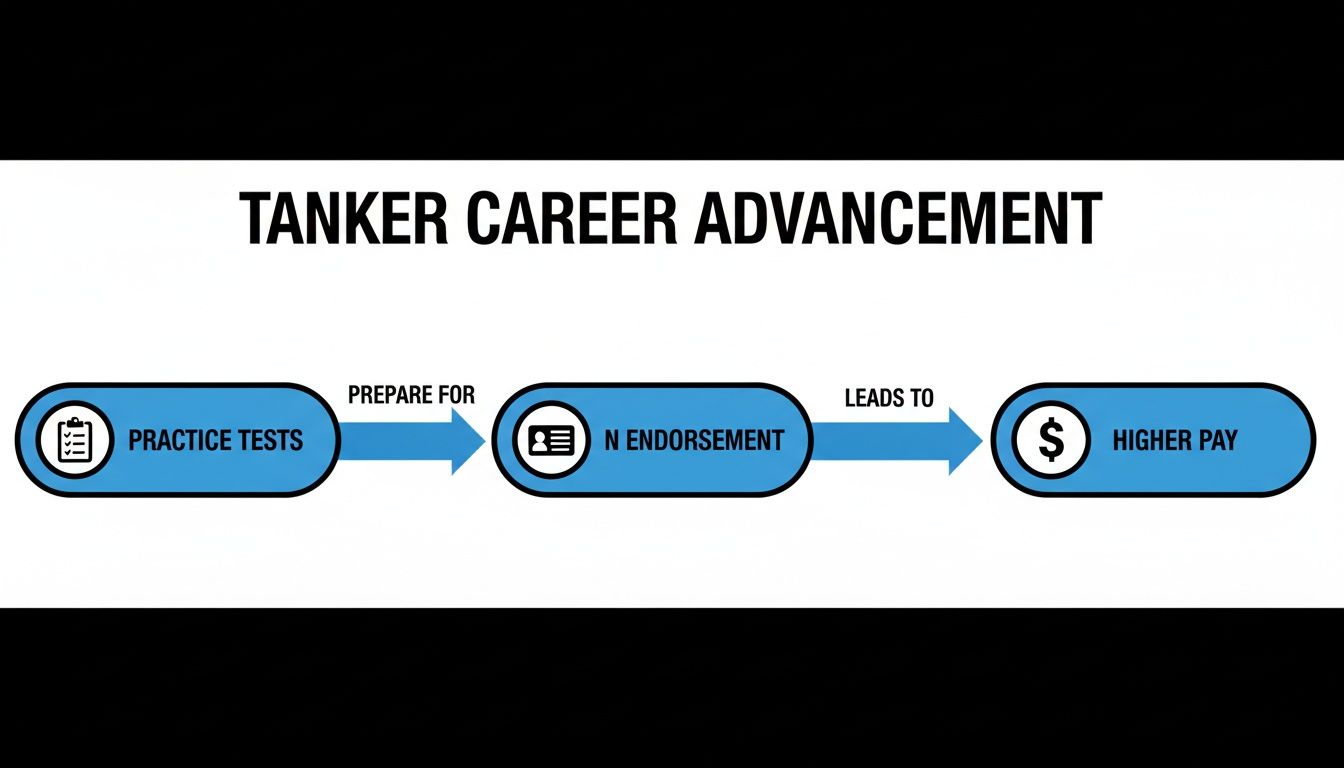
As you can see, dedicated practice is the direct route to earning that endorsement, which is your ticket to more specialized, higher-paying work in the industry.
Core Topics on the CDL Tanker Endorsement Exam
The tanker exam is laser-focused on keeping you, your truck, and everyone else on the road safe. It tests your grasp of the principles that govern liquid cargo. The table below breaks down the essential topics you'll need to master. Think of this as your study roadmap.
| Exam Topic | What You Need to Know | Why It Matters on the Road |
|---|---|---|
| Liquid Surge | How liquid movement affects braking, turning, and acceleration. You'll need to understand the difference between smooth bore, baffled, and compartmented tanks. | A powerful surge can push you into an intersection, or worse, cause you to lose control in a turn. Baffles help, but they don't eliminate the force. |
| High Center of Gravity | Why tankers are prone to rollovers and how load volume impacts stability. You'll be tested on safe speeds for curves, on-ramps, and off-ramps. | A partially loaded tanker can be even more dangerous than a full one because the sloshing liquid raises the center of gravity. Taking a corner too fast is a rookie mistake with serious consequences. |
| Vehicle Inspections | The specific components of a tanker pre-trip, including valves, pipes, manholes, vents, and emergency shut-off systems. You must know how to spot a potential leak. | A small drip can turn into a major environmental and safety hazard. Knowing your equipment inside and out is non-negotiable for every single trip. |
| Loading & Unloading | The right way to handle loading, including grounding to prevent static electricity, managing weight distribution, and calculating outage (expansion room for the liquid). | Overfilling a tank can lead to spills when the liquid expands from heat. Improper grounding during loading can literally cause an explosion with flammable materials. |
| Driving Techniques | How to adapt your driving to minimize surge. This means smooth acceleration, gentle braking, and looking much further ahead than you normally would. | Slamming on the brakes can feel like another truck just rear-ended you. Smooth, deliberate movements are key to staying in control of the vehicle. |
| Emergency Response | The correct procedures for spills, leaks, or accidents. This covers containment, who to notify, and how to use the emergency equipment on your truck. | In an emergency, you are the first responder. Knowing what to do in the first few minutes can prevent a bad situation from becoming a catastrophe. |
Getting a firm handle on these subjects is what separates the pros from the novices. It’s not just about passing a test; it’s about being a safe, competent tanker driver from day one.
Beyond the Basics: Operational Know-How
The written test goes beyond the physics and gets into the nitty-gritty of daily operations. You have to prove you know how to manage the truck and its cargo safely from the moment you pick it up until the delivery is complete.
One of the biggest areas people struggle with is outage. This is the empty space you have to leave in a tank to allow liquids to expand with temperature changes. The test will absolutely have questions on this, so be ready.
You’ll also face scenarios about driving in different conditions. Remember, a tanker needs about 1.5 to 2 times the stopping distance of a regular tractor-trailer, especially on wet or icy roads. The exam wants to see that you understand how to increase your following distance and plan your moves way in advance.
A common mistake is just memorizing facts without understanding the physics. The test isn’t trying to trick you; it's confirming you grasp the why. Knowing that liquid surge can push you through a red light is a lot more valuable than just reciting a stopping-distance rule.
By really digging into these core areas, you can turn practice tests into powerful diagnostic tools. Instead of just aiming for a passing score, you can analyze your results to find your weak spots—maybe it's outage calculations or emergency protocols—and then hit the CDL manual to turn those weaknesses into strengths.
A Smarter Way to Use Practice Tests

It’s easy to fall into the trap of just grinding through one cdl tanker endorsement practice test after another. It feels like you're working hard, but it’s not the most effective way to learn. There's a much smarter way to do this, and it starts with your very first attempt.
Think of that initial test as a diagnostic, not a final exam. Your score doesn't matter yet. The real goal is to get a baseline—a raw, honest look at what you already know and, more importantly, what you don't. This first run is all about pinpointing your weak spots.
Building Your Personalized Study Plan
After you get those initial results, you can finally stop guessing and start studying with a purpose. Did you bomb the questions on outage and ullage? Or maybe the high center of gravity risks tripped you up? Great. Now you know exactly what to work on.
This is where you build a targeted plan. Instead of rereading the entire manual, you can dedicate focused study sessions to the specific areas where you struggled. Go back to the CDL manual and really dig into the why behind the questions you missed. This approach transforms your study time from a passive review into an active hunt for knowledge.
A word of caution: don't just gloss over the questions you got right. Ask yourself if you can explain why your answer was correct and the other options were wrong. If you can’t, you might have just gotten lucky. That knowledge isn't locked in yet, and you can't count on luck on test day.
This kind of deep dive is what truly prepares you. It’s the difference between scraping by and walking into the DMV with the confidence that you’ve got this handled.
Beyond Memorization to True Understanding
The real tanker exam is designed to test your understanding, not just your ability to memorize. The questions will often be worded differently than what you’ve seen in practice. If you’ve only memorized answers, a simple rephrase can throw you completely off course.
To really get the material, you have to go deeper. Try these techniques:
- Teach It Out Loud: After you study a concept like liquid surge, try explaining it to a friend, a family member, or even just your dog. If you can break it down simply enough for someone else to understand, you've truly mastered it.
- Look for Real-World Scenarios: Hop online and find videos or news stories about tanker rollovers. Seeing the real-life consequences of a high center of gravity or improper braking will make that concept stick in your brain way better than just reading a definition.
- Always Ask "Why": Why do baffles help reduce surge but not stop it completely? Why is it so critical to ground a tanker during loading? Connecting the rules to the reasons behind them builds a solid foundation that you can rely on under pressure.
Simulating Real Exam Conditions
As your test day gets closer, your strategy for using practice tests should change. For your last few practice runs, you need to recreate the official testing environment as much as possible.
Find a quiet spot where you won't be interrupted. Set a timer, put your phone on silent and out of reach, and work through the test without any notes. The idea is to build up your mental stamina and get used to the pressure of the clock. This makes the real test feel like just another practice run, which is a huge help for managing test-day nerves.
Many drivers find that a structured program gives them the tools and discipline to prepare properly. If you’re ready to commit to passing, you can sign up for a Patriot CDL training program and get on the right track. By practicing like it's the real deal, you eliminate the chance of any surprises when it actually matters.
Getting a Handle on Tricky Questions and Common Mistakes
The official tanker endorsement exam isn't just a memory test. It's designed to see if you can think on your feet and truly grasp the physics of hauling thousands of gallons of liquid. The questions are almost always situational, forcing you to apply what you know to real-world scenarios. This is where using CDL tanker endorsement practice tests becomes your secret weapon—they teach you how to spot the common traps that trip people up.
A classic stumbling block for many drivers is anything to do with liquid surge, especially when different tank types are involved. A common mistake is thinking baffles are a magic bullet that stops surge completely. They don't. They only slow the front-to-back motion; that powerful side-to-side force is still a huge factor when you're taking a turn or navigating a curve.
Let's Break Down a Sample Question
Here's a perfect example of a tricky question you're likely to see. Thinking through it shows you how to analyze the situation, not just spit back a memorized fact.
Sample Question:
You are driving a tanker with baffles. When making a turn, you should:
- Increase your speed slightly to power through the turn.
- Maintain your normal driving speed.
- Slow down before the turn, then accelerate gently through it.
- Brake firmly while in the middle of the turn.
Thinking Through the Answer:
The only safe option here is 3. Slow down before the turn, then accelerate gently through it. Why? Because while the baffles are helping with the forward surge, they do next to nothing for the side-to-side slosh. That lateral movement can easily tip you over in a turn. Getting your speed down before you even start turning is critical. The gentle acceleration as you come out of it helps stabilize the truck and its liquid cargo.
Why the Other Answers Are Dead Wrong:
- Option 1 is a one-way ticket to a rollover. It multiplies the dangerous forces acting on your high center of gravity.
- Option 2 is just plain negligent. It completely ignores the unique dangers of liquid surge and a high center of gravity.
- Option 4 is a recipe for total disaster. Braking hard in the middle of a turn is how you lock up your wheels and cause a jackknife or rollover.
Common Pitfalls to Watch Out For
Beyond just misunderstanding surge, there are a few other common areas where drivers get tripped up. Knowing what they are is half the battle.
- Outage Calculation Errors: It's easy to forget that "outage" is the empty space left for liquid to expand. Test questions love to frame this in a confusing way, talking about the amount loaded versus the space left. Always read the question carefully to see which one they're asking about.
- Mixing Up Tank Types: You have to know the difference between a smooth bore (unbaffled), a baffled, and a compartmented tank like the back of your hand. A common error is applying the handling rules for one to another—for instance, a smooth bore tank requires the absolute smoothest, most careful driving of all.
- Forgetting Inspection Details: The exam will hit you with specific pre-trip inspection questions. You need to be able to point out and explain the purpose of things like vents, manholes, and the emergency shut-off systems.
The whole point of the tanker endorsement is public safety. That’s why the questions are all about managing risk in the real world. When you truly understand these principles, you're not just ready to pass the test—you're ready for the immense responsibility of being on the road.
This level of responsibility is also why the pay is so good. CDL tanker drivers command much higher paychecks than drivers hauling standard freight. The salary reflects the specialized skills needed for both hazardous and non-hazardous liquids. The average salary for a tanker driver with an N endorsement falls somewhere between $75,000 and $106,250 a year, which blows the national average of $38,000 for standard CDL drivers out of the water. This makes putting in the time to study a very smart investment.
Of course, before you can safely haul a tanker, you have to be an expert on your truck's most basic systems. If you need a refresher on one of the most vital components, take a look at our guide on the CDL air brakes test. That knowledge is the foundation for controlling any big rig, tanker or not.
Your Final 48-Hour Prep and Test Day Plan
Alright, you’re in the home stretch. The last two days before your tanker endorsement test aren't about cramming new information. Trust me, trying to force-feed your brain at this point usually backfires, leaving you stressed and exhausted.
It's time to shift gears from heavy-duty studying to smart review and getting your head in the game. Put the big manual away. Your job now is to sharpen what you already know, not to learn something from scratch. I always recommend taking one last CDL tanker endorsement practice test just to stay familiar with the question format. Maybe flip through some notes on key safety rules, but don't get bogged down in your weak spots.
Getting Everything in Order
The biggest favor you can do for yourself in these last 48 hours is to handle the logistics. Nothing kills your focus faster than scrambling around on test morning. A simple checklist the night before can be a lifesaver.
- Round Up Your Paperwork: Make a small pile with your driver's license, your commercial learner's permit (CLP), and any required proof of residency. Check your state's DMV site one last time to be sure you have what they need.
- Lock Down the Details: Double-check the testing center's address and your appointment time. Figure out your route and plan for traffic. Aim to walk through their doors at least 15-20 minutes before you’re scheduled.
- Prep Your Morning: Lay out your clothes. Plan a simple breakfast that won't give you trouble—this isn't the morning to try something new.
I can't stress this enough: get a good night's sleep. Your brain needs that downtime to file away everything you've learned. Aim for a solid 7-8 hours. Showing up rested and clear-headed is half the battle.
Managing Test Day Jitters
Feeling nervous is completely normal; it just means you care. The trick is not letting those nerves take over. If you feel your heart start to pound while you’re waiting, just take a few slow, deep breaths. It sounds simple, but it really works to calm you down and help you focus.
Once the test starts, make it a habit to read every question twice before even glancing at the answers. This small step prevents simple mistakes. If a question stumps you, don't sit there and stare at it. Mark it for review and move on. You can circle back to it later after you've confidently answered the ones you know. This keeps you moving and builds momentum.
Remember, while each state has its own test, they all follow federal guidelines. The good news is the fees are usually pretty low—often just $15 to $30—making this one of the most affordable endorsements you can get. And once you pass, that "N" endorsement is on your CDL for good, with no extra renewals.
Of course, before you can get any endorsement, you need the permit itself. If you're just starting out, our guide on getting your CDL permit will walk you through that entire process.
Got Questions About the Tanker Endorsement Test? We've Got Answers.
As your test day gets closer, it's natural for a few last-minute questions to pop up. Getting them answered now can calm your nerves and make sure you walk into the DMV feeling prepared and confident. Let's tackle some of the most common questions I hear from drivers about the tanker endorsement test.
How Many Questions Are on the Test?
Most states use a test with around 20 to 30 multiple-choice questions. The key thing to remember is the passing score—you’ll typically need to get at least 80% right.
That doesn't leave much wiggle room. It’s why hammering those cdl tanker endorsement practice tests is so crucial. You need to be ready for anything they throw at you, from calculating outage to handling a surge in an emergency.
How Long Does the Endorsement Last?
Here's the great news: once you earn your N endorsement, it's good for as long as your CDL is valid. There are no special renewal exams or continuing education requirements for the tanker endorsement itself.
You pass the written test once, and you're done. It's a one-and-done investment in your career that pays dividends for years.
Should I Get My Hazmat Endorsement, Too?
Thinking ahead? Smart move. Getting your Hazmat (H) endorsement at the same time is one of the best things you can do for your career. When you combine the Tanker (N) and Hazmat (H) endorsements, you get the coveted X endorsement.
This instantly qualifies you for a much wider pool of high-paying gigs, since a huge portion of liquid loads are hazardous materials. It does mean another test and a federal background check, but the payoff is making yourself a far more versatile and valuable driver.
Many of the best-paying tanker jobs aren't just looking for an N endorsement—they require the X endorsement. Getting both isn't just adding a letter to your license; it's opening the door to a whole new level of career opportunities.
Are Online Practice Tests Really Enough on Their Own?
Practice tests are an incredible tool, but they work best as part of a one-two punch. Your state's official CDL manual is your primary source of truth—it's the textbook that has every single regulation and concept you're responsible for knowing.
Start with the manual to build that solid foundation. Then, use practice tests to see what you've actually retained, pinpoint your weak areas, and get a feel for the real test's format and pace. Combining deep study with repeated testing is, without a doubt, the surest way to pass.
Ready to stop practicing and start your professional driving career? Patriot CDL offers accelerated, hands-on training to get you on the road fast. Learn from expert instructors and master the skills you need to pass your exams with confidence. Find the right program for you at Patriot CDL.