So, you’re wondering how much truckers really make. It's the first question everyone asks, and the answer isn't as simple as one single number.
Let's start with the official figures. The median annual wage for heavy and tractor-trailer truck drivers hovers around $57,440, which works out to about $27.62 an hour. But here's the thing: that's just a starting point. Your actual paycheck can look very different depending on your experience, the type of driving you do, and even where you live.
Your Quick Guide to Truck Driver Pay
Think of trucker pay like a roadmap with a bunch of different routes to your financial destination. Some routes are steady and predictable, while others are more demanding but can lead to a bigger reward. The key is figuring out which path best fits your life and career goals.
This guide is here to give you a straight-up, no-nonsense look at your earning potential. We're going to dig into the details that actually determine your pay so you can steer your career in the right direction.
A Snapshot of Trucker Earnings
To get a clearer picture, let's look at how trucker pay is actually structured. A driver's income is shaped by how their company pays—whether it's by the mile, by the hour, or a set salary—and, of course, their experience level.
This means two drivers could put in the same number of hours behind the wheel but end up with completely different paychecks. It’s all about the details of the job.
Key Salary Benchmarks
According to the Bureau of Labor Statistics, that median annual wage for heavy and tractor-trailer truck drivers was $57,440. The Economic Research Institute reports a similar number, with an average of $58,474 annually. These figures give us a solid baseline, but it's important to remember that many, many truckers earn significantly more.
The first step toward hitting those higher numbers is getting the right training. Our CDL training program is built to get you on the road and earning a professional salary as quickly as possible.
Your starting salary is just the beginning. With experience, specialized endorsements, and a solid work ethic, your income can grow substantially year after year. The trucking industry rewards skill and dedication.
The table below gives you a quick overview of what you might expect at different stages of your career, depending on the pay model. This should help set some realistic expectations as you get started or plan your next move.
Here's a quick look at what you can expect based on different pay structures and your time in the industry.
Truck Driver Salary Snapshot
| Pay Structure | Entry-Level Range | Experienced Range | National Average |
|---|---|---|---|
| Per-Mile Pay | $45,000 – $60,000 | $75,000 – $95,000+ | $69,000 |
| Hourly Pay | $42,000 – $55,000 | $65,000 – $85,000+ | $62,000 |
| Owner-Operator | $60,000 – $90,000 | $150,000 – $300,000+ | $220,000 (Gross) |
As you can see, the path you choose—from the type of job to becoming your own boss—has a massive impact on your bottom line.
What Different Trucking Jobs Pay
When people ask, "How much do truckers make?" there's no single answer. The truth is, your paycheck depends almost entirely on the type of driving job you take. The world of trucking isn't one-size-fits-all; it's a collection of different career paths, each with its own lifestyle and earning potential.
Think of it this way: a pilot who flies international routes has a totally different job—and pay scale—than a city bus driver. Both are professional drivers, but their day-to-day work, time away from home, and compensation couldn't be more different. Trucking works the exact same way.
The three main paths you'll encounter are Over-the-Road (OTR), Regional, and Local. Getting a handle on what each one entails is the first step to figuring out which route is the best fit for your life and your wallet.
Over-the-Road (OTR): The Long-Haul Lifeline
OTR is what most people picture when they think of a trucker: crisscrossing the country, seeing the sights from a big rig, and being on the road for weeks at a time. These drivers are the absolute backbone of our national supply chain, hauling goods thousands of miles from coast to coast. It's a demanding lifestyle, for sure, but the trade-off is often a bigger paycheck.
Since OTR drivers live on the road, their pay is almost always calculated by the mile (often called cents per mile, or CPM). It's a simple formula: the more miles you run, the more money you make. This structure puts you in control of your earnings and usually leads to the highest annual salaries for company drivers.
An OTR driver's paycheck is a direct reflection of the miles they log. Your earning potential is tied to the open road, making this one of the most lucrative paths if you're willing to put in the time.
For new drivers especially, OTR often offers the best starting pay. You can realistically expect to make anywhere from $65,000 to $85,000 a year, and sometimes even more depending on the company and the type of freight you're hauling.
Regional Driving: A Balance of Road and Home
What if you want to make good money but can't stomach the thought of being away for a month at a time? That's where regional driving comes in. Regional drivers stick to a specific part of the country—say, the Southeast or the Pacific Northwest. You're still logging serious miles, but you're usually home every single weekend.
This job gives you a much more predictable schedule, blending the long-haul feel of trucking with a better work-life balance. Pay for regional gigs can be structured a couple of different ways:
- Per-Mile Pay: Just like OTR, but your weekly mileage totals will naturally be a bit lower.
- Hybrid Models: Some companies offer a base mileage rate plus extra pay for tasks like loading or unloading.
While a regional driver might make a little less than a top-earning OTR driver, the trade-off of being home for the weekend is worth its weight in gold for many. A typical salary for a regional driver lands in the $60,000 to $75,000 range. Of course, before choosing any path, you need to meet the essential qualifications. Our guide on CDL requirements walks you through everything you need to know.
Local Trucking: Home Every Night
Local drivers are the final link in the supply chain, handling the "last mile" deliveries within a specific city or metro area. These are the men and women you see driving dump trucks, delivery vans, and day cabs. They follow set routes, make multiple stops, and—best of all—get to sleep in their own bed every night.
Because local work involves a lot of stopping, waiting at docks, and dealing with city traffic, these drivers are almost always paid by the hour. This makes perfect sense; you're compensated for all your time on the clock, not just the miles you cover between traffic lights. This hourly structure gives you a steady, predictable paycheck week in and week out.
The annual salary might start a bit lower than OTR, but the consistency and daily home time are huge benefits you can't put a price on. Local drivers can expect to earn between $55,000 and $70,000 a year, with plenty of room to grow, especially in high-demand cities or with specialized skills.
How Truckers Actually Get Paid: A Look Beyond the Annual Salary
Those big annual salary numbers are great, but they don't really tell you how a trucker's paycheck gets built week by week. It’s not just one lump sum; your pay is calculated based on how you work, where you drive, and what you haul.
Think of it this way: a carpenter can charge by the hour, per project, or a cut of the total job cost. Trucking works in a similar way. The three main pay structures you'll run into are cents per mile (CPM), hourly wages, and a percentage of the load.
Each one has its pros and cons, and they usually line up with specific types of trucking jobs. Getting a handle on these is the key to figuring out what a job offer really means for your wallet.
Cents Per Mile (CPM): The King of the Open Road
Cents per mile, or CPM, is the bread and butter for most Over-the-Road (OTR) and many regional drivers. It's exactly what it sounds like: you earn a fixed amount for every mile you drive. Today, that rate typically falls somewhere between $0.48 to $0.95 per mile, depending on your experience, the company, and the freight you're hauling.
Let's do some quick math. If your CPM rate is $0.60 and you log 2,500 miles in a week, you’ve earned $1,500 before taxes ($0.60 x 2,500). Simple. This system directly rewards drivers who can keep the wheels turning, which is why it’s the standard for long-haul work. Your pay is literally tied to the odometer.
One small detail to watch for, though, is how a company calculates miles. Some pay for "practical miles" (the most efficient GPS route), while others might use "hub miles" (a straight line, as the crow flies). It might not seem like a big deal, but those miles can really add up over a year.
Hourly Wages: Predictable Pay for Local Routes
CPM is great for crisscrossing the country, but it makes no sense for a local driver who spends half their day in city traffic or waiting at a loading dock. That's why local jobs are almost always paid by the hour. This structure ensures drivers get compensated for all their time on duty, not just the time spent moving.
Hourly pay gives you a predictable paycheck. You know exactly what you’re making for your shift, whether you're stuck on the interstate for an hour or making a dozen quick drop-offs. For drivers who want to be home every night and prefer a steady, reliable income, hourly is the way to go.
Percentage of the Load: A True Partner in Hauling
The third model, earning a percentage of the load, is most common for owner-operators and drivers at smaller, specialized carriers. Instead of a flat rate, you earn a cut of the total revenue the load brings in. This can range from 25% to 85%, with the highest percentages going to owner-operators who bring their own truck and trailer to the table.
This pay structure essentially makes you a business partner. Your income is directly linked to the value of the freight. High-value cargo means a bigger payday.
For instance, if a load pays the carrier $2,000 and your agreement is for 30%, you’ve just made $600 for that one trip. This method has the highest earning potential but also the most risk, since your income can swing with the ups and downs of the freight market.
This visual gives you a good sense of the career paths tied to these different pay models.
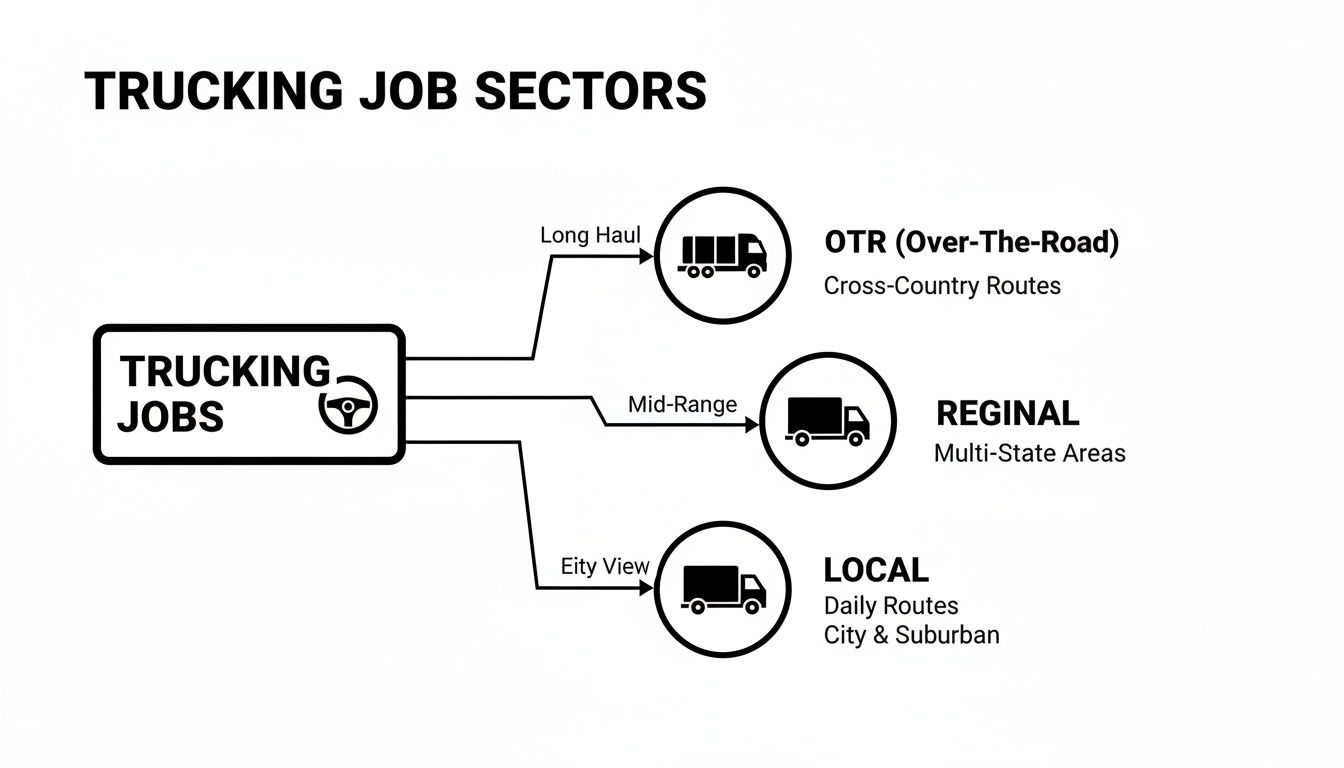
As you can see, whether you go OTR, Regional, or Local, the job suits a different lifestyle and comes with its own way of getting paid.
No matter which road you decide to take, every professional driving career starts in the same place: getting your commercial learner's permit. To get a jumpstart, check out our guide on how to get your CDL permit.
What Can Boost Your Trucking Salary?
Your starting salary as a new truck driver is really just that—a starting point. The real answer to "how much do truckers make?" evolves as you build your skills, because several key factors can take your paycheck from good to great.
Think of it like this: your basic CDL gets you in the door. But every endorsement you add, every year of safe driving you log, and every specialized load you learn to haul is like adding a high-powered tool to your professional toolkit. These are the things that let you take on the more complex, higher-paying jobs.
If you want to steer your career toward a bigger income, you need to know what those factors are.
Experience Is King
In the world of trucking, nothing speaks louder than experience. The pay gap between a rookie driver fresh out of school and a seasoned pro with five years under their belt is huge. Why? Because companies pay a premium for drivers they can count on—drivers with a proven track record of being safe, reliable, and efficient.
As you put more miles behind you, your value to an employer climbs steadily. A driver with one year of experience might be making around $60,000, which is solid. But hang in there for five years, keep your record clean, and you could easily be commanding $80,000 or more, just for being a proven, dependable professional.
Unlock Better Jobs with Endorsements
Think of CDL endorsements as special keys that unlock doors to better-paying, more specialized work. Each one proves you’ve got the skills to handle specific types of cargo or equipment, which often come with more responsibility and, you guessed it, more pay.
Here are a few of the most common salary-boosting endorsements:
- Hazmat (H): This lets you haul hazardous materials like chemicals or fuel. The extra training and risk involved almost always come with a nice pay bump.
- Tanker (N): Hauling liquids requires a unique skill set to manage the "slosh" and prevent rollovers. Companies reward that expertise with higher per-mile or hourly rates.
- Doubles/Triples (T): Pulling two or three trailers is a serious skill. It's more challenging than a standard load, and carriers are definitely willing to pay more for drivers who can handle it.
Grabbing just one or two endorsements can instantly put you on the radar for top-paying trucking companies. It's one of the fastest ways to give your income a serious boost.
Even something as simple as being able to drive a manual transmission can make a difference. Many modern fleets are moving to automatics, but if your license has a restriction limiting you to them, you're closing yourself off from a lot of great jobs. Removing that restriction opens up more opportunities. You can learn more by checking out our E-restriction removal course.
What You Haul and Where You Haul It
The type of freight you move and the routes you run are two other massive pieces of the pay puzzle.
Specialized freight that requires extra care, like temperature-controlled goods in a refrigerated trailer ("reefer") or oversized machinery on a flatbed, almost always pays more than hauling standard boxes in a dry van.
Your home base plays a big role, too. If you live and work in a region with major shipping ports, manufacturing centers, or just a ton of freight moving through, the pay scales are often higher. Companies in states like Pennsylvania, Ohio, or Kentucky, for example, tend to offer very competitive wages because they're right in the middle of busy freight corridors.
The good news? Driver pay has proven to be incredibly resilient. The American Trucking Associations recently reported that the median pay for a truckload driver hit $76,420. That’s a 10% jump in just two years, even when the freight market was a bit soft. It shows that great drivers will always be in demand and well-compensated.
The Owner-Operator Path to Higher Earnings
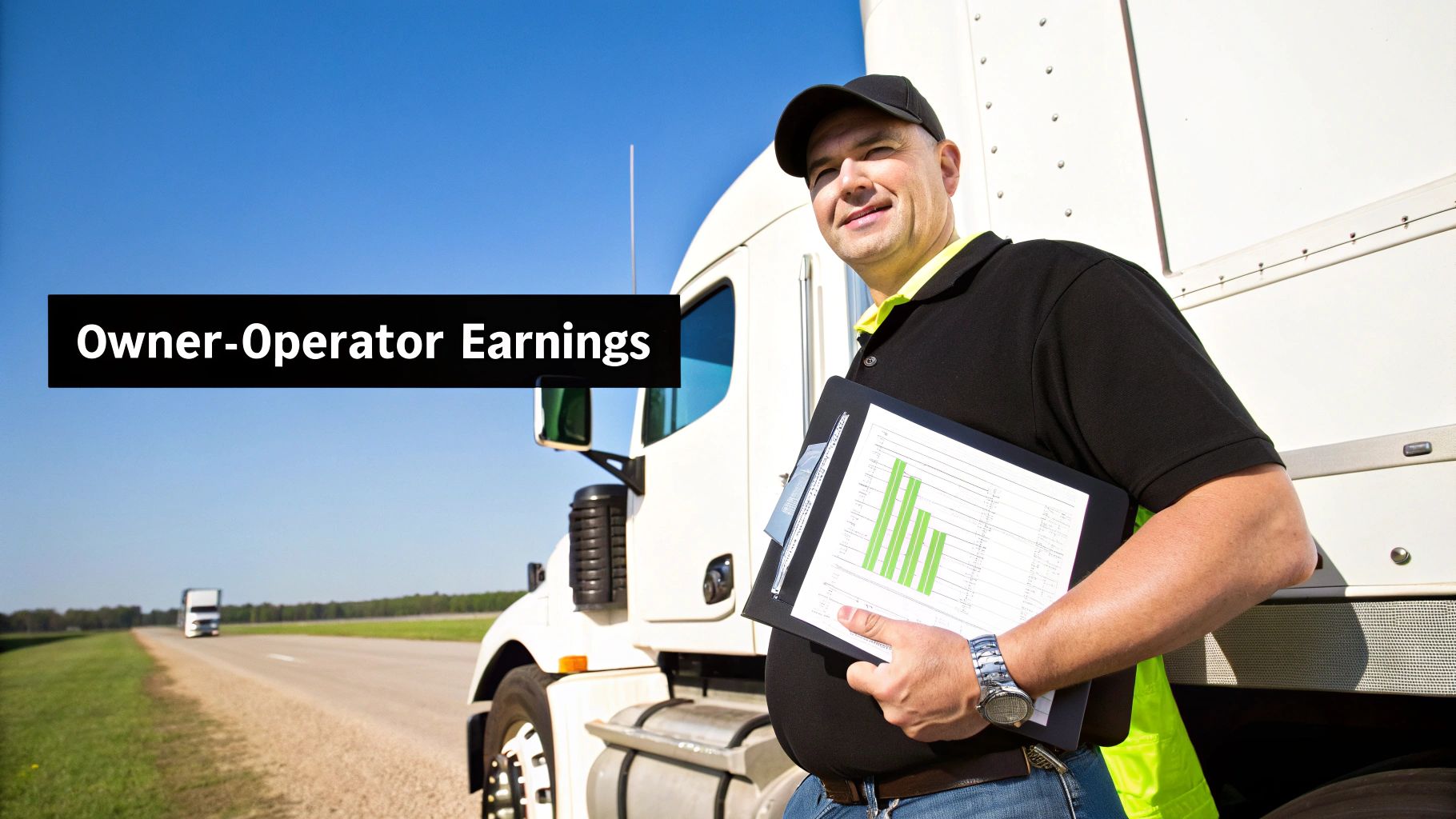
For the trucker with an entrepreneurial streak, one path offers a shot at earnings that company drivers can only dream of: becoming an owner-operator. This isn't just a promotion; it's a total career shift from employee to business owner. You own the rig, you pick the loads, and you pocket a much bigger slice of the revenue you generate.
This move represents the absolute peak of a trucker's earning potential. But make no mistake, it’s far more than a driving job—it’s running a business on wheels. While a company driver’s main focus is the road ahead, an owner-operator is juggling a dozen other things at once.
Suddenly, you're the one in charge of everything. We're talking about managing fuel costs, scheduling maintenance, paying for hefty insurance policies, sourcing your own freight, and handling all the bookkeeping. It’s a demanding gig that requires a sharp business mind to go along with your driving skills.
The Trade-Off: High Risk for High Reward
So, why would anyone willingly take on all that stress and financial risk? The answer is simple: the potential payoff is huge. Owner-operators aren't just earning a paycheck; they're building a business and have direct control over how much they bring home.
This is where you’ll find the most lucrative opportunities in the entire trucking industry. Drivers who own their equipment can pull in an average of around $290,000 per year in gross revenue. The real top-performers in specialized niches can even see that number climb past $400,000, though that's definitely the cream of the crop.
Becoming an owner-operator means you are no longer just a driver. You are the CEO, CFO, and lead driver of your own company, with an income ceiling far higher than any company driver position.
That kind of earning potential is exactly what tempts so many seasoned drivers to make the leap. It’s the difference between earning a good living and truly building personal wealth. You can dive deeper into industry trends and driver stories over on our blog.
Key Responsibilities of an Owner-Operator
Before you even think about buying a truck, it’s critical to understand the daily grind. Your success will hinge just as much on keeping costs down as it will on finding high-paying loads.
- Vehicle Maintenance: Every single repair, from a simple oil change to a full engine overhaul, is on you. A reliable, well-maintained truck is your money-maker.
- Fuel Costs: This is your biggest and most unpredictable expense. Smart routing, good driving habits, and fuel discount programs directly impact your profit.
- Insurance and Permits: You have to shop for and pay for your own commercial trucking insurance—a major annual expense—along with all the required permits and licenses to operate legally.
- Business Management: This is the office work: invoicing customers, meticulously tracking every expense for tax time, and managing your cash flow to avoid shortfalls.
For those serious about the owner-operator path, getting a handle on the financials is non-negotiable. You might even find it helpful to look into specialized services for truck drivers to stay on top of the numbers. Juggling all these responsibilities is the real key to unlocking the six-figure income that makes this career so attractive.
How to Accelerate Your Earning Potential
Knowing the different lanes in trucking is one thing, but the biggest factor in how much you’ll make right out of the gate comes down to the speed and quality of your training. While trucking has great long-term earning potential, your CDL program is the launchpad. It’s what separates a slow, grinding start from a rapid climb to a professional salary.
Think about it. Many careers demand years of college, piling up debt that can take a decade or more to pay off. Trucking completely flips that script. A top-notch CDL program is built to get you skilled, licensed, and behind the wheel of a paying rig in a matter of weeks, not years. This approach lets you sidestep the time and financial quicksand of traditional education and jump straight into a stable, well-paid career.
From Training to Earning in Record Time
The whole point of a quality training program isn’t just to help you pass a test—it’s to mold you into a confident, road-ready professional from day one. The best carriers are looking for drivers who can handle the real world, and hands-on training gives you that immediate advantage. You’ll walk away with practical skills that companies are desperate for, putting you on the fast track to better job offers the moment you graduate.
This accelerated path is about more than just getting your license quickly. It’s about building your career efficiently.
- Immediate Skill Application: You’re not just reading about trucking. You learn essential maneuvers and safety protocols and then immediately get behind the wheel to apply them.
- Endorsement Guidance: A good instructor can give you the inside scoop on which endorsements, like Hazmat or Tanker, will give you the biggest salary boost in your specific job market.
- Direct Career Launch: Most graduates from solid programs have job offers lined up before they even finish, letting them start earning a real salary almost instantly.
The fastest way to boost your income is to shrink the time between starting your training and starting your career. An accelerated CDL program is the most direct path to a professional paycheck.
Ultimately, this guide has shown that a truck driver's salary has massive room for growth. The key is to start strong. By choosing an efficient training path, you’re not just learning to drive a truck—you’re making a smart, strategic investment in your financial future. You're turning all the potential income we've talked about into your reality, setting yourself up for a long and profitable career on the open road.
Got Questions About Truck Driver Pay? We've Got Answers.
If you're thinking about a career behind the wheel, one of your first questions is probably, "What can I actually make?" Let's break down some of the most common questions we hear from aspiring drivers and get you some straight answers.
What Can a Rookie Driver Make in Their First Year?
In your first year on the road, you can realistically expect to earn somewhere between $50,000 and $65,000. Where you land in that range really depends on who you drive for, the type of routes you run (OTR, regional, or local), and whether the company offers a sign-on bonus. OTR drivers, who rack up the most miles, usually find themselves on the higher end of that scale.
This is where solid training really pays off. When you graduate with real-world, hands-on skills, the best companies notice, and you’re in a much better position to snag a top-tier starting offer.
Which Trucking Jobs Have the Biggest Paychecks?
If you're chasing the highest pay, you’ll want to look at specialized hauling or becoming an owner-operator. Jobs that require extra skill and risk—like hauling hazardous materials (Hazmat), pulling a tanker, or moving oversized loads—always command a premium. You'll also find that private fleet drivers for big names like Walmart or Target are some of the best-paid company drivers out there.
But if you want to see the highest income potential, becoming an owner-operator is the way to go. You're running your own business, and while it's more responsibility, your earnings can easily clear six figures. It's not uncommon for successful owner-operators to bring in well over $200,000 a year.
The real money in trucking is in specialization. Getting endorsements or buying your own truck is what separates a standard driver from a high-value logistics expert, and your pay will jump to match.
Does It Matter Where I Live?
Absolutely. Where you hang your hat has a huge impact on your paycheck. Drivers based in areas with major shipping hubs, tons of freight, or a higher cost of living generally see better pay rates. For example, if your home base is near a major port or in a state with a ton of industry, like Pennsylvania or Ohio, you'll likely find more lucrative jobs.
On top of that, companies will often sweeten the deal in regions where they're desperate for drivers. Your home base can definitely give your bottom line a boost.
How Fast Can I Start Making Good Money?
This is one of the best parts about a trucking career: you can start earning a solid, professional salary incredibly quickly. With a focused CDL program, you can get licensed and behind the wheel in just a matter of weeks. Most graduates have a job lined up and are earning a real paycheck almost immediately.
Unlike other careers that demand years of college and debt, trucking gets you into the workforce fast. You'll see your pay climb significantly within your first one to three years as you build that all-important on-the-road experience.
Ready to put your career in the fast lane? At Patriot CDL, we give you the expert training to hit the road and start earning in just a few weeks. Learn more about our CDL programs.