Getting your hands on a good CDL Class A permit study guide is the absolute first step you should take. It’s the playbook that will get you through the written exams and on your way to a real career in trucking. Before you can even think about driving, you'll need what's called a Commercial Learner's Permit (CLP), which is basically your ticket to start training behind the wheel with a licensed instructor.
Your Roadmap to a Trucking Career

So, you're ready to start your journey as a professional driver. Excellent. The very first milestone on that journey is securing your Commercial Learner's Permit (CLP). Think of it like a student driver's permit, but for the big rigs. It’s the official document that says you’ve got the book smarts down and are cleared to start practicing on public roads—as long as a qualified CDL holder is riding shotgun.
This guide is built to be the only roadmap you'll need to ace those written tests. It's not about cramming facts overnight; it's about truly understanding the "why" behind the rules that keep you, and everyone else, safe on the road.
Why The Permit Comes First
There’s a reason you can't just hop in a semi and go. The path to a full-blown CDL Class A is a step-by-step process, and it's all laid out by federal law to make sure every new driver is ready for the responsibility.
The CLP stage is where you prove you’ve done your homework. You'll have to pass a few written knowledge tests covering everything from air brakes to combination vehicles. This isn't optional—it's the gatekeeper to any hands-on, behind-the-wheel training.
The CLP is more than just a piece of paper. It’s proof that you have the essential knowledge to safely begin operating a complex commercial vehicle. It shows you’re serious about the profession before you even turn the key.
What To Expect On Test Day
The permit "test" is actually a series of smaller exams, each zeroing in on a critical piece of the trucking puzzle. State procedures can vary a bit, but you'll almost always face multiple-choice questions on the core subjects. If you want to dive deeper into the specific qualifications, take a look at our detailed breakdown of CDL requirements.
To get your permit, you need to show you know your stuff in a few key areas:
- General Knowledge: This is the big one. It covers a massive range of topics, from basic vehicle control and spotting hazards to communicating on the road and handling emergencies.
- Combination Vehicles: This test is specific to Class A drivers. It's all about the unique physics of driving a tractor-trailer, like understanding the "crack-the-whip" effect and knowing the right way to couple and uncouple.
- Air Brakes: Nearly every Class A truck uses air brakes, so you have to prove you know the system inside and out. This means understanding how they work, how to inspect them, and how to use them properly.
This might seem like a lot, but breaking it down by subject makes it much more manageable. Let's take a quick look at how these core areas fit together.
CDL Class A Permit Exam Core Subjects Overview
Here's a quick summary of the essential knowledge areas you'll need to master for the CDL Class A written permit test. Think of this as your high-level study checklist.
| Core Subject | What You Need to Know | Why It's Critical |
|---|---|---|
| General Knowledge | Vehicle control, hazard perception, communicating, and emergency procedures. | This is the foundation for safe driving in any commercial vehicle. |
| Combination Vehicles | Coupling/uncoupling, air line connections, turning, and the "crack-the-whip" effect. | Tractor-trailers handle differently than any other vehicle; this knowledge prevents rollovers and accidents. |
| Air Brakes | System components, inspection procedures, and proper braking techniques. | Air brake failure is catastrophic. Understanding the system is non-negotiable for safety. |
Mastering these subjects isn't just about passing a test; it's about building the fundamental knowledge you'll rely on every single day of your professional driving career.
Mastering the General Knowledge Exam
Think of the General Knowledge test as the main event of your CDL permit exam. It’s the big one. You can't move on to endorsements for things like air brakes or combination vehicles until you nail this test first. It’s not just about memorizing rules; it’s about proving you have the fundamental safety mindset required to be a professional driver.
This test casts a wide net, covering everything from basic vehicle controls and safe driving techniques to what you need to do when things go wrong on the road. It’s designed to make sure you have the core knowledge down cold before you get behind the wheel of a specific type of rig.
Managing Speed and Space
One of the first things you have to wrap your head around is just how much space your rig takes up. A fully loaded tractor-trailer can top out at 80,000 pounds, and it needs a whole lot more room to stop than the family sedan. You can't just stomp on the brakes and hope for the best.
This is where your following distance becomes your best friend. The old rule of thumb is to give yourself one second of space for every ten feet of your vehicle's length, at least when you're driving under 40 mph. For a standard 60-foot rig, that means you need a solid six-second gap between you and the vehicle in front of you.
That cushion isn't just a suggestion; it’s your lifeline. It gives you the time and space you need to react when a car cuts you off or traffic suddenly comes to a screeching halt.
Navigating Hazardous Conditions
Let's be real, you won't always be driving on perfect roads on a sunny day. The General Knowledge exam is going to throw some tricky situations at you to see how you'd handle them.
- Steep Downgrades: Going down a big hill is far more dangerous than climbing one. You'll need to know how to use the right gear and your engine brake to keep your speed in check without frying your service brakes. If your brakes overheat and fail on a long downgrade, you're in a world of trouble.
- Sharp Curves: Trucks have a high center of gravity, which makes them much more likely to roll over in a sharp turn. The test will cover the right way to take a curve: slow down before you get there, and don't make any sudden moves with the wheel or the brake pedal while you're in it.
- Slippery Roads: A little rain, snow, or ice can turn a routine drive into a nightmare, massively increasing your stopping distance. You'll have to know how to adjust your speed, spot hazards like black ice, and handle a skid if the truck starts to slide.
Mastering these scenarios is all about proactive, defensive driving. It’s the art of seeing a potential problem far down the road and taking action early, so it never becomes an emergency. This mindset is what separates a true professional from a simple operator.
Understanding Vehicle Systems and Communication
A professional driver knows their truck inside and out. The General Knowledge test will touch on key vehicle systems to make sure you can spot a problem before it becomes a disaster. You'll be expected to know what to look for when checking your tires, suspension, cooling system, and electrical components during a pre-trip inspection.
Communication on the road is another huge part of the job, and it goes way beyond just using a turn signal. You need to know how to use your headlights to make sure other drivers see you, tap your brakes to warn someone following too closely, and use your horn as a legitimate warning device—not just because you're frustrated.
Strict Rules on Alcohol and Drugs
When it comes to drugs and alcohol, the federal government has zero tolerance. The legal Blood Alcohol Concentration (BAC) for a CDL holder is 0.04%, which is half the limit for a regular driver. But honestly, any detectable amount of alcohol in your system is enough to get you put out of service for a full 24 hours.
Don't even think about refusing a test. If you do, it’s the same as failing one, and you’ll lose your CDL for at least a year, no questions asked. The rules are this tough for a reason—you have a massive responsibility when you're piloting a commercial vehicle.
For more practice and in-depth explanations, you can find a comprehensive General Knowledge test guide that covers these topics in greater detail. Once you pass this foundational exam, you've proven you have what it takes to start learning about more specialized equipment.
Decoding Combination Vehicles and Air Brakes
The General Knowledge test is just the warm-up. The Combination Vehicles and Air Brakes exams are where you really prove you have what it takes to handle a Class A rig. A lot of new drivers get hung up on these sections, but they don't have to be a roadblock. If you approach them the right way, you can get a solid grasp on these complex systems and walk into the test with confidence.
When you get to the Combination Vehicles part of your cdl class a permit study guide, you're diving into the unique physics of driving a tractor-trailer. You're not in a single vehicle anymore. You're now in control of an articulated machine that pivots in the middle, and that changes absolutely everything about how it moves.
Understanding Dangerous Dynamics
One of the first things you have to wrap your head around is off-tracking. When you take a corner in a big rig, the trailer's rear wheels don't follow the same path as the tractor's front wheels—they take a much tighter turn. This means you have to swing out wide to keep your trailer from climbing a curb or, even worse, hitting a sign or another car. Forgetting about off-tracking is a classic rookie mistake that can cause some serious damage.
Then there's the "crack-the-whip" effect. If you have to swerve or make a sudden lane change, the back end of your trailer can swing out with a surprising amount of force. It’s even more pronounced with a light or empty trailer, which can easily start to skid or even roll over.
Mastering combination vehicles isn't just about learning to park; it's about respecting the immense forces you're controlling. Understanding off-tracking and the crack-the-whip effect is fundamental to keeping your trailer—and everyone around you—safe.
The Art of Coupling and Uncoupling
Hooking up and dropping a trailer is a precise dance, a step-by-step process you absolutely must know by heart, both for the test and for your entire career on the road. If you rush it, you risk a "kingpin miss," which means dropping the trailer. That’s a catastrophic and expensive failure you don’t want to experience.
A secure hook-up always involves a few key steps:
- Aligning the Tractor: You need to back up slowly and keep the tractor straight as you approach the trailer.
- Connecting Air and Electrical Lines: Make sure the gladhands and the electrical plug are connected securely. This is what gives your trailer brakes and lights.
- Locking the Fifth Wheel: After you think you’re locked in, you have to perform a "tug test." You do this by gently pulling the tractor forward while the trailer brakes are locked to confirm the kingpin is properly secured in the fifth wheel jaws.
For a deeper dive into the kinds of questions you’ll see, you can work through our practice materials on the combination vehicles test.
Demystifying the Air Brake System
The air brake exam is the other major hurdle in any cdl class a permit study guide. Your personal car uses hydraulic brakes, but big rigs rely on compressed air to get the job done. It’s an incredibly powerful system, but it's also complex, with a lot of moving parts that have to work together perfectly.
This infographic gives you a great look at the key air brake components you'd find under the truck.
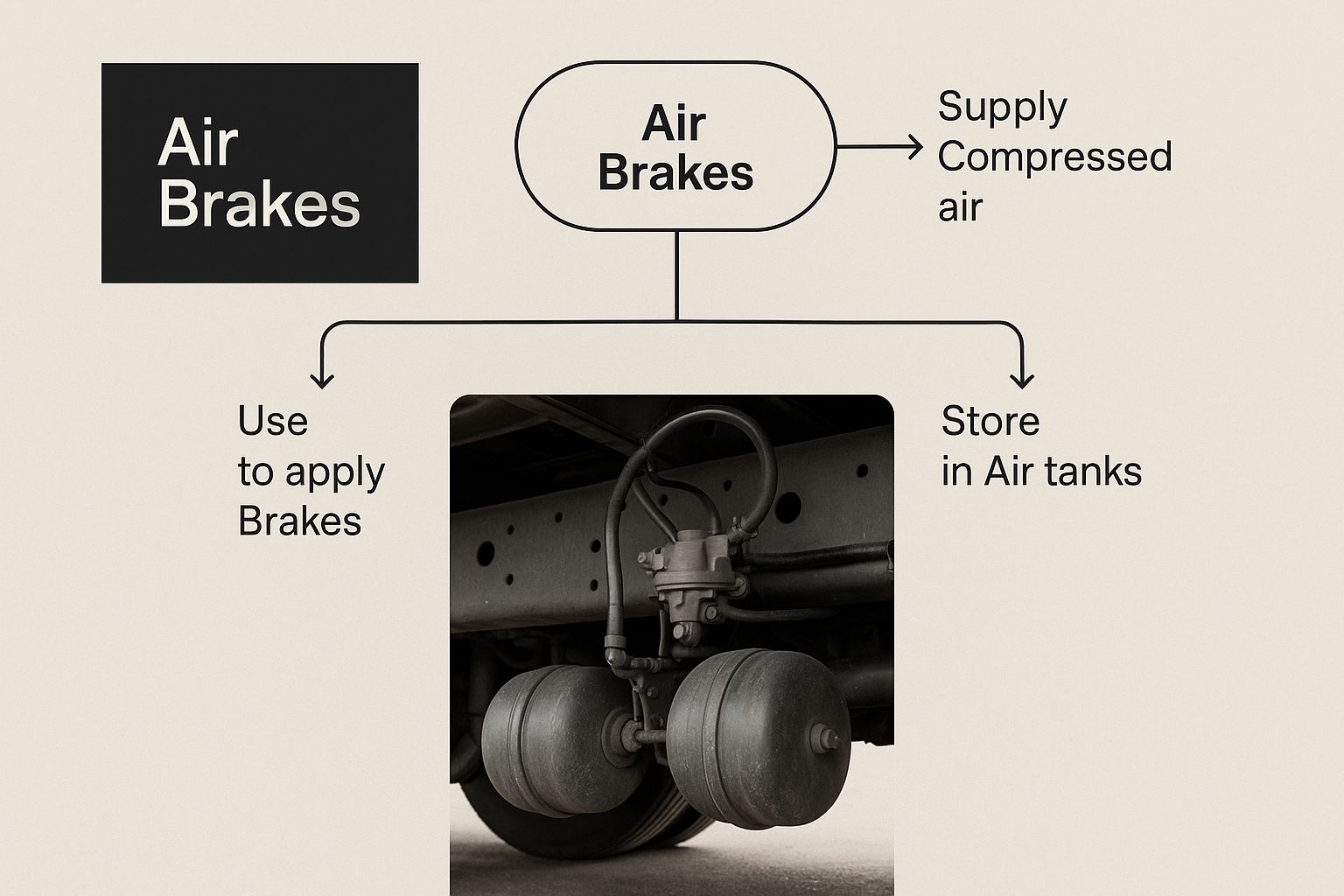
Seeing how the brake chamber, slack adjuster, and s-cam all work in unison helps you understand how simple air pressure is turned into the massive mechanical force needed to stop a truck.
The whole process starts with an engine-driven air compressor, which fills up the storage tanks. When you press the foot pedal (the service brake), that air gets sent out to the brake chambers on each wheel. Getting a mental picture of this flow is crucial for troubleshooting problems down the road.
The pre-trip air brake inspection is something you'll do every single day, and it’s a huge part of your skills test. You'll have to prove you can check for leaks and test all the warning systems. It boils down to a three-part check:
- Applied Leakage Test: With the engine off and the brakes held down, your system can't lose more than 4 psi in one minute for a combination vehicle. Any more than that, and you have a leak.
- Low-Pressure Warning Test: Next, you'll pump the brake pedal to bleed air from the system. The low-air warning light and buzzer have to come on before the pressure drops below 60 psi.
- Spring Brake Pop-Out Test: Keep pumping down the air, and the red and yellow knobs on your dash (the tractor and trailer protection valves) must pop out somewhere between 20 and 45 psi. This automatically engages the spring brakes as a final failsafe.
Nailing these checks shows the examiner you know how to make sure your truck's most important safety system is 100% ready for the highway.
Acing Your Pre-Trip Inspection Test
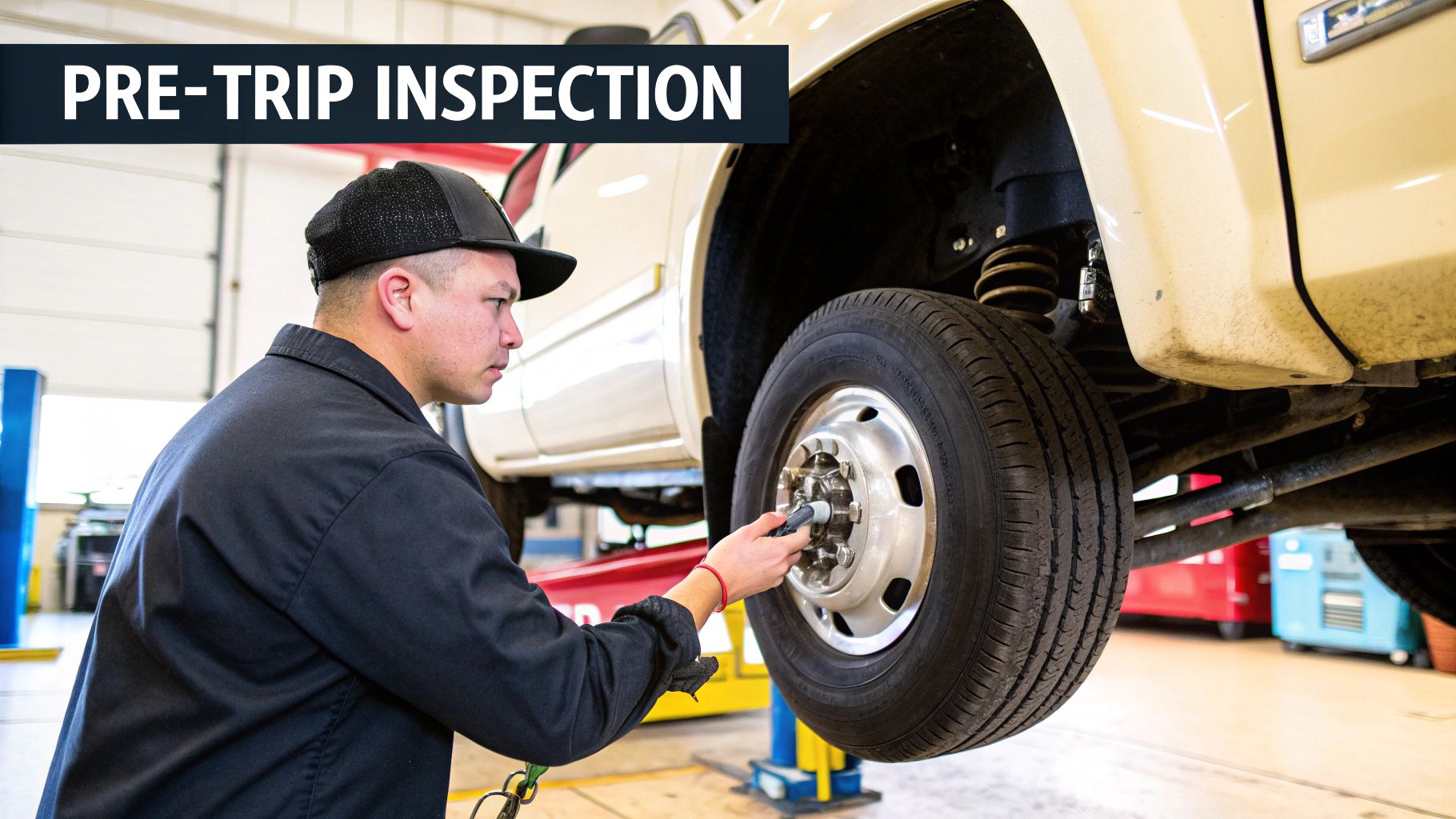
Let's be honest: the pre-trip inspection is usually the part of the CDL skills test that makes people sweat the most. It’s not a quick walk-around. You have to systematically check your entire rig from top to bottom, all while explaining every single step out loud to the examiner.
The best way to think about it isn't as a test, but as a daily safety ritual you need to have down cold. This inspection is your first line of defense out there. Federal regulations require it for good reason—finding a small problem like a frayed belt or a minor leak in the yard can save you from a catastrophic failure on the interstate. Showing the examiner you can do a thorough check proves you're a professional who takes safety seriously.
Breaking Down the Inspection into Zones
Feeling overwhelmed? That's normal. Trying to memorize a checklist of over 100 items is a recipe for failure. The secret is to break the truck down into manageable zones and follow a simple, repeatable pattern every single time. This turns a monumental task into second nature.
A proven, logical approach is to split the inspection into three core areas:
- The Engine Compartment: Pop the hood and start here. You'll be checking all the critical fluids and parts that make the truck go.
- The In-Cab Inspection: Next, you’ll climb inside to perform your safe start procedure and run through the all-important air brake checks.
- The Full Walk-Around: This is the big one. You’ll methodically circle the entire rig, inspecting every component from the front bumper of the tractor to the very back doors of the trailer.
This "zonal" method is your roadmap. It ensures you don't forget a single step. You start under the hood, move to the driver's seat, and then make a full circle. Easy.
Mastering the Engine Compartment
When you open the hood, you need to know what you’re looking at and, just as importantly, what to say. Don't just point at a part. You need to explain what you're checking for and why it matters. You're hunting for any signs of trouble and making sure everything is properly secured.
Here are some of the key checks under the hood:
- Fluid Levels: Check your engine oil, coolant, and power steering fluid. Are they all at their proper operating levels?
- Belts and Hoses: Look over every belt for cracks, frays, or glazing. Check the tension—it should have no more than 3/4 inch of play. Inspect all hoses for leaks, cuts, or bulges.
- Air Compressor: Make sure it's securely mounted and not leaking any fluids. You’ll need it for your brakes.
Your narration to the examiner needs to be clear and confident. For instance, when you get to a hose, say something like: "I'm checking this coolant hose. It's securely mounted at both ends. It's not cracked, cut, or leaking, and I don't see any abrasions or bulges." This proves you understand the why behind the check, not just the what.
For a complete script you can practice, check out our detailed guide on the pre-trip inspection.
Perfecting the In-Cab and Walk-Around Routine
Once you get in the cab, your focus shifts to the controls and safety systems. You’ll do a safe start, check all your gauges, test your lights and horns, and then perform the three-part air brake test. Let me be clear: you have to nail the air brake check. It's non-negotiable.
The final piece of the puzzle is the full walk-around. Start at the driver’s side steer tire and work your way around the vehicle in a consistent pattern. You'll be inspecting tires for proper inflation and tread depth, checking brake components like slack adjusters and brake chambers, and making sure all suspension parts are intact.
When you reach the coupling system, you must confirm a secure connection. Check that the fifth wheel is greased, the locking jaws are closed tight around the kingpin, and there’s no gap between the fifth wheel and the trailer apron. This part of your cdl class a permit study guide is absolutely vital. From there, continue your inspection to the rear of the trailer, checking lights, tires, and doors before completing your circle. Following this same path every time builds the muscle memory and confidence you need to impress any examiner.
Prepping for Your CDL Endorsements
Think of your Class A CDL as your all-access pass to the world of professional driving. But the endorsements? Those are your VIP tickets. They unlock the specialized, more challenging, and often higher-paying gigs that most drivers are after. Your license gets you in the door; endorsements prove you’ve mastered a specific skill.
These aren't just extra letters stamped on your plastic card—they represent entirely new career paths. A driver with endorsements is more versatile and, frankly, more valuable to a company. You don't have to collect them all at once, but knowing what each one involves is key. It helps you focus your study time on the kind of trucking career you actually want.
The Tanker Endorsement (N)
If you plan on hauling any kind of liquid—from milk to fuel—in a tank larger than 119 gallons, you'll need the Tanker (N) endorsement. The whole exam is built around one major challenge: liquid surge.
Imagine a giant wave sloshing around inside your trailer every time you speed up or slow down. That’s surge. It can shove your truck into an intersection when you're trying to stop or push you sideways in a turn. The test really hammers home how to manage these forces, covering things like:
- Surge Control: You'll learn why smooth braking and gentle acceleration are non-negotiable.
- High Center of Gravity: Tankers are notoriously top-heavy and far more likely to roll over than a standard dry van.
- Tanker-Specific Equipment: You need to know what baffles and bulkheads are and how they help (or don't help) control the liquid's movement.
The Doubles and Triples Endorsement (T)
Ready to pull more than one trailer? The Doubles/Triples (T) endorsement is your ticket. This lets you operate what the industry calls a Longer Combination Vehicle (LCV), and the test is all about the tricky physics and coupling procedures involved.
You'll have to master the proper way to assemble your train, always putting the heaviest trailer first, right behind the tractor. A huge part of this is understanding how to prevent the dangerous "crack-the-whip" effect. One sharp turn or quick lane change can send that last trailer swinging wildly, causing a devastating rollover.
The T endorsement demands a whole new level of precision. It’s about constantly thinking ahead and respecting the amplified risks that come with managing multiple pivot points behind you.
The Hazardous Materials Endorsement (H)
Often just called "HazMat," the Hazardous Materials (H) endorsement is one of the toughest to get, but it also opens the door to some of the best pay in the industry. This endorsement is required to transport anything classified as flammable, explosive, corrosive, or otherwise dangerous. Be prepared for an intensive study process and a full TSA background check.
The entire HazMat test is built on a foundation of safety and communication. You absolutely have to know:
- The Placard System: How to identify different classes of hazardous materials and display the correct diamond-shaped placards on all four sides of your vehicle.
- Loading and Security Rules: There are strict federal rules for securing HazMat loads, parking, and attending to your vehicle.
- Emergency Response: You must know exactly what to do if an accident happens to protect yourself, the public, and first responders.
Choosing the right endorsements can be a huge motivator. For instance, many of the best-paying jobs in the retail supply chain require drivers with these special qualifications. To get a better sense of pay and industry demand, you can read the full research about CDL driver demographics. It's also smart to be aware of any restrictions on your license; for example, there are straightforward courses available to help you get an E restriction removal and open up more job opportunities.
Common CDL Class A Endorsements Comparison
To help you decide which path is right for you, here’s a quick breakdown of the most common endorsements you'll encounter. Think about the kind of work you want to do and which of these qualifications will get you there.
| Endorsement (Code) | Allows Transport Of | Key Study Topics |
|---|---|---|
| Tanker (N) | Liquids or liquefied gases in tanks over 119 gal. | Liquid surge, high center of gravity, vehicle handling, rollover prevention, tank inspection, and specialized equipment like baffles. |
| Doubles/Triples (T) | A tractor pulling two or three trailers. | Coupling/uncoupling procedures, "crack-the-whip" effect, managing multiple pivot points, vehicle dynamics, and specific inspection routines. |
| Hazardous Materials (H) | Materials classified as hazardous by the DOT. | Placarding rules, loading/unloading regulations, security threat assessment, emergency response, and the Hazardous Materials Table. |
| HazMat & Tanker (X) | Hazardous materials in a tanker. | A combination of knowledge from both the H and N endorsements, focusing on the unique risks of transporting volatile liquids. |
Each endorsement requires passing a separate written knowledge test. Getting one or two of these can significantly boost your career prospects right from the start.
Common Questions About the CDL Permit Test
Getting your Commercial Learner's Permit (CLP) is the first big step, and naturally, you probably have a few questions. That's a good thing. Knowing what to expect clears up a lot of the anxiety and helps you focus on what really matters: learning the material.
Let's walk through some of the most common things people ask on their way to getting that permit. Think of it as a quick chat with someone who's seen it all before.
How Long Should I Really Study for the Permit Test?
There's no magic number here, but I can tell you what works. Most people who pass on the first try put in 20 to 40 hours of solid study time. The secret isn't cramming all night—that's a recipe for forgetting everything the next day. It’s about consistency.
A much better approach is to break it down. Spend an hour or two each day over a few weeks. Focus on one major section at a time, like General Knowledge, and don't move on until you feel you've got it down. Use the practice tests in your cdl class a permit study guide to check your understanding. When you're consistently hitting 90% or higher, you’re probably ready for the real deal.
Think of studying like you're already on the job. It requires professional commitment. That focused, steady effort is what will get you a first-time pass and build the knowledge you'll actually use on the road.
What Paperwork Do I Need to Bring for My Permit Test?
Nothing is more frustrating than getting to the DMV and being turned away because you're missing a piece of paper. You can avoid that headache with a little prep. Always, always check your state's DMV website for their exact list first, as it can vary slightly.
Still, there’s a standard set of documents you’ll almost certainly need. Get them all together in a folder ahead of time so you can just hand them over. It makes the whole process go a lot smoother.
- Proof of Identity and Age: Your current driver’s license or an original birth certificate.
- Proof of U.S. Citizenship or Lawful Residency: A U.S. Passport or permanent resident card usually does the trick.
- Social Security Card: They'll want to see the original card, not a copy.
- Proof of State Residency: You’ll need two forms of proof. Recent utility bills, bank statements, or a lease agreement with your name and address are perfect.
- DOT Medical Examiner's Certificate: This is your "Med Card"—the official proof that you're medically cleared to drive a commercial vehicle.
What Happens If I Fail a Section of the Test?
First off, don't panic. It happens more often than you think, and it’s not the end of the road. Failing a section is just a sign that you need a bit more review on that topic. It's a learning opportunity, not a failure.
The good news is that most states let you retake just the section you failed. You won't have to sit through the entire test again. There's usually a short waiting period, which is the perfect time to hit the books. Zero in on the material that tripped you up and take practice quizzes on just that section until it clicks. Plenty of veteran drivers didn't ace every single part on their first go, so just be persistent.
Ready to stop studying and start driving? At Patriot CDL, we provide the hands-on training and expert guidance you need to ace your exams and launch your trucking career in as little as three weeks. Learn more and enroll today.