


Emergency equipment is easy to overlook because a driver hopes never to use it. That is why it needs a deliberate place in the pre-trip inspection. A fire extinguisher hidden behind cargo, an empty triangle case, or a loose mounting bracket can turn a manageable problem into a rushed roadside decision. The goal is not to memorize a few nouns for a test. It is to confirm that the equipment required for the power unit is present, usable, accessible, and suited to the operation before the truck moves.
This guide uses the federal rules current on November 7, 2026, together with Pennsylvania CDL inspection guidance. It also explains an important update: since April 20, 2026, the Federal Motor Carrier Safety Regulations no longer require a spare fuse of each type and size, and the federal warning-device rule no longer lists liquid-burning flares as an alternative. Older study materials may still show the previous wording. Students should learn the current rule, use the current testing material supplied for their appointment, and follow any carrier policy that is more restrictive.
Start with the current rule baseline
applies emergency-equipment requirements to each truck, truck tractor, and bus, except a unit being towed in a driveaway-towaway operation. The current section addresses fire extinguishers and warning devices for stopped vehicles. Separately, says a commercial motor vehicle may not be driven unless the driver is satisfied that listed equipment, including emergency equipment, is in good working order.
Those provisions create two different but connected questions. Section 393.95 answers what qualifying equipment the power unit must carry. Section 392.7 places the pre-driving decision on the driver: is that equipment actually ready for use? Counting equipment without checking its condition is incomplete. Checking condition without verifying the required type and quantity is also incomplete.
Federal minimum, test procedure, and carrier policy are different layers
The federal rule is the legal baseline for covered interstate operation. A CDL test procedure governs that examination, while a carrier may add inspection or replacement standards. When they differ, follow the current law, the examiner's current instructions, the vehicle manufacturer, and applicable carrier policy.
PennDOT's modernized CDL skills-test page explains that the vehicle inspection test focuses on the applicant's knowledge of the vehicle's features. That makes a repeatable location-condition-purpose explanation useful. Name the component, show where it is, describe what you inspect, and state why a defect matters.
Inspect the fire extinguisher
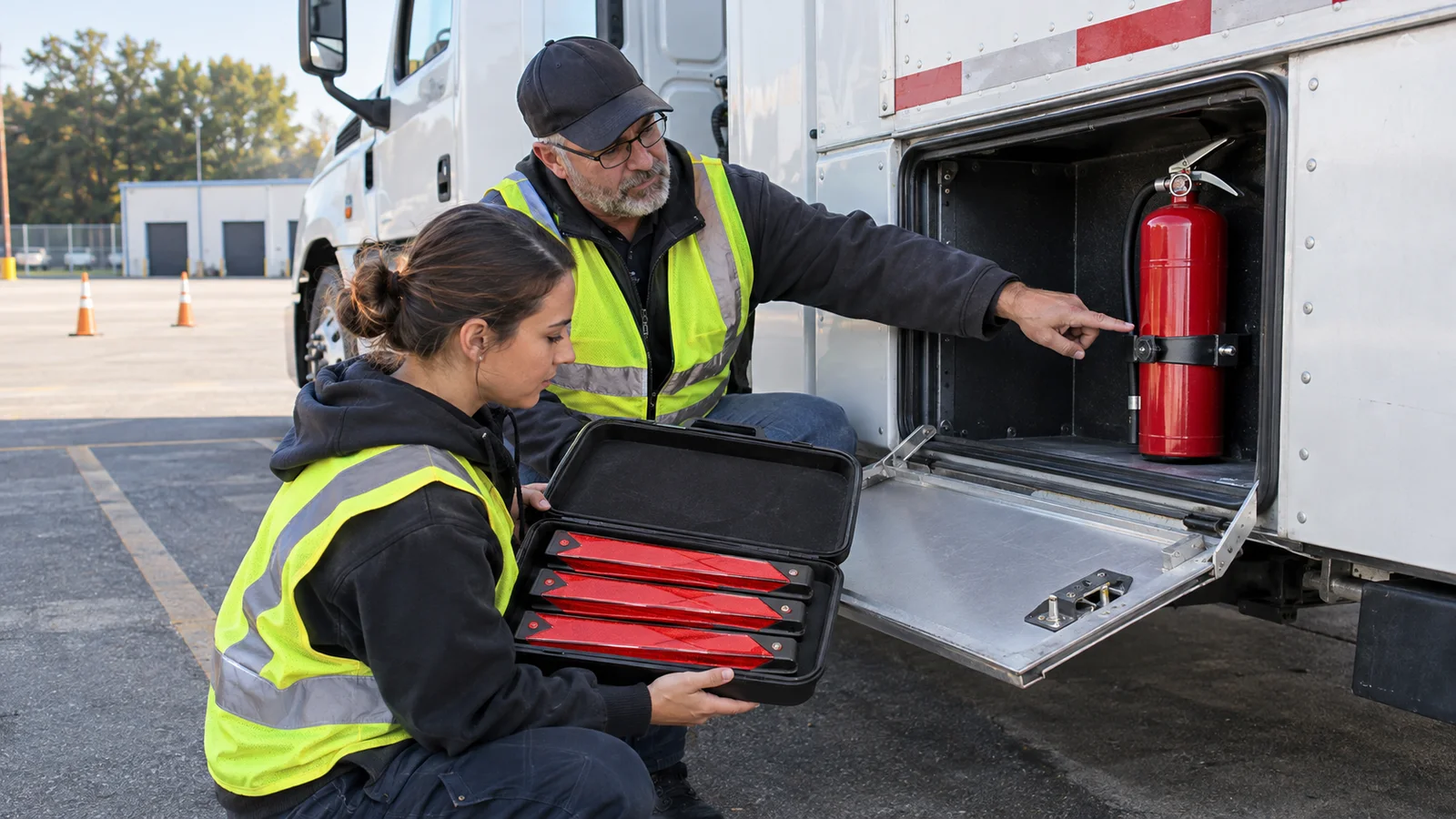
A fire extinguisher check should answer five questions: Is the required rating present? Is the manufacturer's rating visible? Can charge status be determined? Is the unit filled and accessible? Is it securely mounted? A cylinder lying loose in a side box does not satisfy the mounting requirement merely because it is on the vehicle.
Verify the minimum rating for the operation
For a power unit not used to transport placardable hazardous materials, the federal rule requires either one extinguisher rated at least 5 B:C or two extinguishers each rated at least 4 B:C. A power unit used to transport hazardous materials in a quantity requiring placarding must carry an extinguisher rated at least 10 B:C. The required extinguisher must bear the manufacturer's Underwriters' Laboratories rating. Do not guess from cylinder size or color; read the marking.
The B:C rating concerns flammable-liquid and energized-electrical-equipment fires. It is not a promise that every fire can be safely attacked. Use an extinguisher only within training and company procedure, with a safe escape plan. If approach is unsafe, prioritize people, emergency notification, and distance.
Check charge indication and physical condition
Section 393.95 requires the extinguisher to permit visual determination of whether it is fully charged. On a unit with a gauge, confirm the indicator is in its acceptable range. Also inspect the cylinder, hose or nozzle, handle, safety pin, tamper seal, label, and bracket as applicable. Look for severe corrosion, dents, leakage, a blocked nozzle, missing hardware, or evidence that the unit has discharged. Follow the manufacturer and carrier schedule for service dates and maintenance; the pre-trip is a condition check, not a substitute for required servicing.
Confirm accessibility and secure mounting
The extinguisher must be filled, readily accessible, and securely mounted so it cannot slide, roll, or move vertically relative to the vehicle. Test the bracket with a controlled hand check. The path to the extinguisher should not be blocked by tools, chains, straps, or personal gear.
If reaching the extinguisher requires moving unrelated equipment or searching several boxes, correct the storage problem before departure.
Inspect stopped-vehicle warning devices
The current federal rule provides two alternatives for most covered power units: three bidirectional emergency reflective triangles conforming to Federal Motor Vehicle Safety Standard No. 125, or at least six fusees plus as many additional fusees as needed to meet the stopped-vehicle placement requirements in 49 CFR 392.22. Many training vehicles use reflective triangles because they are reusable and do not produce flame.
Count the complete set
Open the case rather than shaking it. Confirm that it contains three separate triangles, not two triangles and a loose base. Each device needs its support or base so it can stand as designed. A correct count is important because roadside placement uses multiple positions to give approaching traffic advance warning. For the placement sequence after a stop, see the detailed CDL roadside warning-device plan.
Inspect condition, visibility, and deployment
Look for cracked reflectors, separated panels, contaminated reflective surfaces, bent supports, missing feet, and a case that will not close. Practice unfolding and standing a training device in a controlled area so you understand the hinges and base, but do not place devices in an active traffic lane for casual practice. Clean them according to the manufacturer and return the full set to its assigned location.
Other warning devices may supplement the required devices if they do not reduce their effectiveness. Identify the federally qualifying set first and optional equipment separately.
Know the restriction on flame-producing devices
Fusees and other flame-produced signals may not be carried on certain vehicles, including commercial vehicles transporting specified explosive materials, cargo tank vehicles used to transport certain flammable gases or liquids whether loaded or empty, and commercial vehicles using compressed gas as motor fuel. A student should not attempt to decide a hazardous-material exception from memory during a real dispatch. Verify the cargo, vehicle, and company procedure with qualified supervision.
Understand the 2026 federal changes
Two federal final rules effective April 20, 2026 changed the wording that many drivers learned from older manuals. FMCSA removed the federal requirement to carry at least one spare fuse for each type and size needed to operate required parts and accessories. FMCSA also removed liquid-burning flares from the federal warning-device alternatives. The current eCFR reflects both changes: paragraphs (b) through (e) of section 393.95 are reserved, and paragraph (f) lists triangles or fusees.
Spare fuses are optional federally, but defects still matter
The spare-fuse final rule states that removing the carrying mandate does not permit operation with required electrical equipment out of service. A carrier may still choose to stock correct spare fuses, and a local or company rule may address them. Drivers should not replace a repeatedly opening fuse with a higher rating or perform electrical repairs outside their training and authorization. A blown fuse can be evidence of a fault that needs diagnosis.
Liquid-burning flares are no longer a federal alternative
FMCSA's liquid-burning-flares final rule summary explains that the references were removed as outdated. The change did not remove reflective triangles or fusees from the current rule. If an older checklist says “three liquid-burning flares,” do not silently treat that wording as current federal law. Mark the study source's date, compare it with the current eCFR, and ask the school or testing authority which current examination material governs.
How to study when a manual lags a rule change
Keep a correction note with the old wording, current rule, and source date. Use the latest instructions for the scheduled test and learn the current operational rule for real driving. PennDOT's posted manual still includes earlier language about spare fuses and liquid-burning flares, while the current eCFR has been amended.
Use a compartment-to-cab inspection routine
A consistent sequence prevents the equipment check from becoming a quick glance. Begin with the vehicle secured and the assigned compartment identified. Open it fully, control the door, and examine the storage area before touching the equipment. Water intrusion, oil contamination, loose tools, or a failed latch can damage emergency gear even if each item looked acceptable on the prior trip.
Step 1: identify what qualifies
Point to the fire extinguisher and read its rating. Identify the warning-device case, open it, and count the complete qualifying set. If the vehicle carries fusees instead of triangles, verify their type, quantity, condition, and whether flame-producing devices are prohibited for the operation. Separate optional lights, flags, a first-aid kit, and a crash packet from the items that satisfy section 393.95.
Step 2: inspect condition and retention
Check the extinguisher's charge indication, seal, nozzle, label, cylinder, and mounting bracket. Check each triangle's reflective faces, hinges, supports, and base. Return equipment to a clean, dry, assigned position. Confirm the bracket and case do not move freely, the compartment closes, and nothing can fall out when the door opens.
Step 3: make a go, correct, or hold decision
Classify the result. “Go” means the required items are complete and serviceable. “Correct before departure” means a simple authorized correction—such as removing an obstruction or securing the case in its designed holder—restores readiness. “Hold and report” applies when equipment is missing, discharged, damaged, incorrectly rated, insecurely mounted, unsuitable for the operation, or beyond the driver's authority to correct. Document the issue through the carrier's process and verify the correction rather than assuming someone handled it.
This same decision discipline supports the safe-start and secure-shutdown routine. The engine starting successfully does not cancel a defect found in required emergency equipment.
Emergency-equipment action table
| Observation | What it means | Driver action before departure |
|---|---|---|
| One non-hazmat extinguisher marked 5 B:C or higher, charged, accessible, and securely mounted | Matches the basic federal rating option, subject to vehicle and carrier requirements | Record the check and continue the inspection |
| Extinguisher present but loose on the compartment floor | Fails the secure-mounting condition | Hold the vehicle until correctly mounted and rechecked |
| Gauge or visual indicator does not show a full charge | Readiness cannot be confirmed | Report and replace or service through an authorized process |
| Triangle case contains only two complete devices | The three-triangle option is incomplete | Obtain a complete qualifying set before driving |
| Three triangles present, but one base is broken | Quantity is correct but the device may not stand or perform as designed | Replace the defective device or set before departure |
| No spare fuse kit on a vehicle with fuses | Not a federal section 393.95 violation after April 20, 2026; company policy may differ | Check applicable policy; never ignore an inoperative required electrical item |
| Older checklist lists liquid-burning flares | The material reflects prior federal wording | Use current eCFR and current testing instructions; do not count outdated equipment automatically |
Worked training scenario
A student is preparing a non-hazmat tractor for a supervised road lesson. She opens the emergency-equipment compartment and finds one extinguisher labeled 5 B:C. Its gauge is in the acceptable range and the pin and seal are present, but the bottom of the cylinder can move several inches because the bracket strap is not latched. The triangle case contains two complete triangles and a third reflective panel with no base. A small box of assorted fuses is also present.
First decision: do not let “present” replace “ready”
The extinguisher rating fits the non-hazmat federal option, but its unsecured mounting fails the condition requirement. The warning-device set is incomplete because the third panel cannot stand as designed. The fuse box does not compensate for either defect. The student tells the instructor that the truck should be held before departure.
Second decision: correct through the proper channel
The instructor confirms that the bracket is undamaged and latches it using the designed retention strap. The school replaces the incomplete triangle case with a sealed case containing three complete compliant triangles. The student reopens both storage locations, checks the bracket by hand, opens the replacement case, counts three devices, and inspects their bases and reflectors. She then closes and secures the compartment.
Third decision: explain the current fuse rule accurately
When asked about the fuse box, the student explains that carrying spare fuses is no longer required by current 49 CFR 393.95, effective April 20, 2026, but the school may keep them as optional supplies. She also states that a fuse-related failure affecting required equipment still requires a safe operating decision and proper repair. That answer separates current law from good optional preparation without treating a box of parts as permission for unauthorized repair.
Connect readiness to a roadside stop
Pre-trip readiness and roadside placement are separate skills. The pre-trip confirms that qualifying devices are available and usable. If a truck stops on the traveled portion or shoulder of a highway for a reason other than necessary traffic stops, 49 CFR 392.22 governs activation of hazard flashers and placement of warning devices. Road geometry, divided highways, hills, curves, and visibility affect the placement pattern.
Do not step into traffic simply because a timer is running. Secure the vehicle, evaluate fire and traffic hazards, wear high-visibility equipment when available, exit away from traffic when possible, and contact emergency services when conditions require. A driver who cannot deploy devices without unacceptable risk should not manufacture exposure. Follow emergency instructions and carrier procedure.
After any use, count the devices before departure and inspect them again. A triangle struck by traffic, contaminated by mud, or left behind makes the next pre-trip incomplete. Record equipment used, damaged, or replaced during the post-trip inspection and handoff.
Avoid common inspection mistakes
Reciting an old list without checking its date
Regulations and testing publications do not always update on the same day. Saying “fuses, flares, and an extinguisher” from memory can miss the current federal text. Put a date beside every rule note and verify current eCFR language before treating a study phrase as law.
Counting a closed case by its label
A case can be empty, incomplete, or filled with mismatched parts. Open it in a safe inspection area. Count three complete triangles and inspect the stands. Then return them so the case closes correctly.
Checking the extinguisher gauge but not the bracket
Charge is only one part of the requirement. Read the rating, inspect physical condition, confirm accessibility, and test secure mounting. The best verbal inspection follows the same order every time.
Treating optional equipment as a substitute
A flashlight, LED beacon, high-visibility vest, first-aid kit, or optional fuse assortment can support preparedness, but it does not replace the qualifying extinguisher or warning-device set. Identify extras as extras. This prevents a crowded compartment from creating false confidence.
Fixing electrical faults by guesswork
Never install a higher-amperage fuse to keep a circuit alive or repeatedly replace a fuse that opens. Those actions can defeat circuit protection and hide a defect. If required lights, warning indicators, or other safety equipment are inoperative, apply the appropriate hold-and-report process. The battery and electrical inspection plan provides a broader visual routine without encouraging unauthorized repair.
Practical emergency-equipment checklist
- Secure the vehicle and identify the assigned emergency-equipment storage location.
- Open the compartment safely and inspect for water, contamination, loose cargo, or a failed latch.
- Read the extinguisher's marked rating; do not infer rating from color or size.
- Confirm the rating suits the operation: non-hazmat or placardable hazardous materials.
- Verify the charge indicator can be read and shows a serviceable condition.
- Inspect the extinguisher cylinder, hose or nozzle, handle, pin, seal, and label.
- Confirm the extinguisher is filled, readily accessible, and securely mounted.
- Open the warning-device case and count three complete reflective triangles when using that option.
- Inspect each triangle's reflective surfaces, hinges, supports, and base.
- Confirm the devices are clean, dry, and stored where they can be reached.
- If fusees are used, verify quantity, condition, and flame-device restrictions for the operation.
- Do not count optional lights, flags, fuse kits, or other supplies as substitutes.
- Check current eCFR language rather than relying on an undated checklist.
- Know the carrier's additional equipment, inspection, and documentation policy.
- Classify every defect as go, correct before departure, or hold and report.
- After correction, repeat the relevant inspection instead of assuming completion.
- Close and secure the compartment before moving the truck.
- After roadside use, recount, inspect, document, and replenish equipment.
Official sources and study strategy
Use the current eCFR text for the federal requirement, FMCSA's final-rule pages to understand 2026 changes, and PennDOT's Commercial Driver's Manual page for the version currently provided to Pennsylvania applicants. Record the access date. If a manual and the current regulation differ, do not conceal the difference; identify it and confirm the applicable test instructions with the testing authority.
For training, use a three-pass method. First, study the rule and write a one-sentence summary. Second, locate and inspect the actual equipment with an instructor. Third, practice explaining a defect and making a no-go decision. That sequence builds legal awareness, physical recognition, and judgment instead of short-term memorization.
Patriot CDL students can practice a structured inspection routine with an instructor at 7800 Bristol Pike, Levittown, PA 19057. Call to discuss CDL training and supervised vehicle-inspection practice.
Frequently asked questions
How many reflective triangles must a commercial truck carry?
Under current 49 CFR 393.95, the reflective-triangle option requires three bidirectional emergency reflective triangles that conform to Federal Motor Vehicle Safety Standard No. 125. The rule also permits at least six qualifying fusees, subject to additional quantity and flame-device restrictions. Many training vehicles use the three-triangle option.
What fire-extinguisher rating does a non-hazmat commercial truck need?
A power unit not used to transport hazardous materials in a quantity requiring placarding must have either one fire extinguisher rated at least 5 B:C or two extinguishers each rated at least 4 B:C. The rating must be marked by the manufacturer, and the extinguisher must also be charged, accessible, and securely mounted.
Where should a commercial-truck fire extinguisher be stored?
Federal rules do not name one universal compartment. They require the extinguisher to be filled, readily accessible for use, and securely mounted so it cannot slide, roll, or move vertically relative to the vehicle. Use the vehicle's designed location and applicable carrier procedure.
Does a truck with circuit breakers still need spare fuses?
No federal spare-fuse carrying requirement remains in 49 CFR 393.95. FMCSA removed paragraph (b), effective April 20, 2026, for vehicles with fuses as well as vehicles with circuit breakers. A carrier may still stock fuses or impose a policy, and inoperative required electrical equipment must still be addressed before operation.