


A truck can have clean lights and a normal-looking dashboard while a battery is shifting in its tray, a cable is rubbing against metal, or a battery-box cover is not fully latched. Those conditions belong in a disciplined vehicle inspection because the starting, charging, lighting, control, and safety systems depend on secure electrical components. The driver's job is not to diagnose internal battery chemistry. It is to find visible conditions early, describe them accurately, and keep an unresolved electrical hazard out of service until the approved process clears it.
Map the battery and electrical system
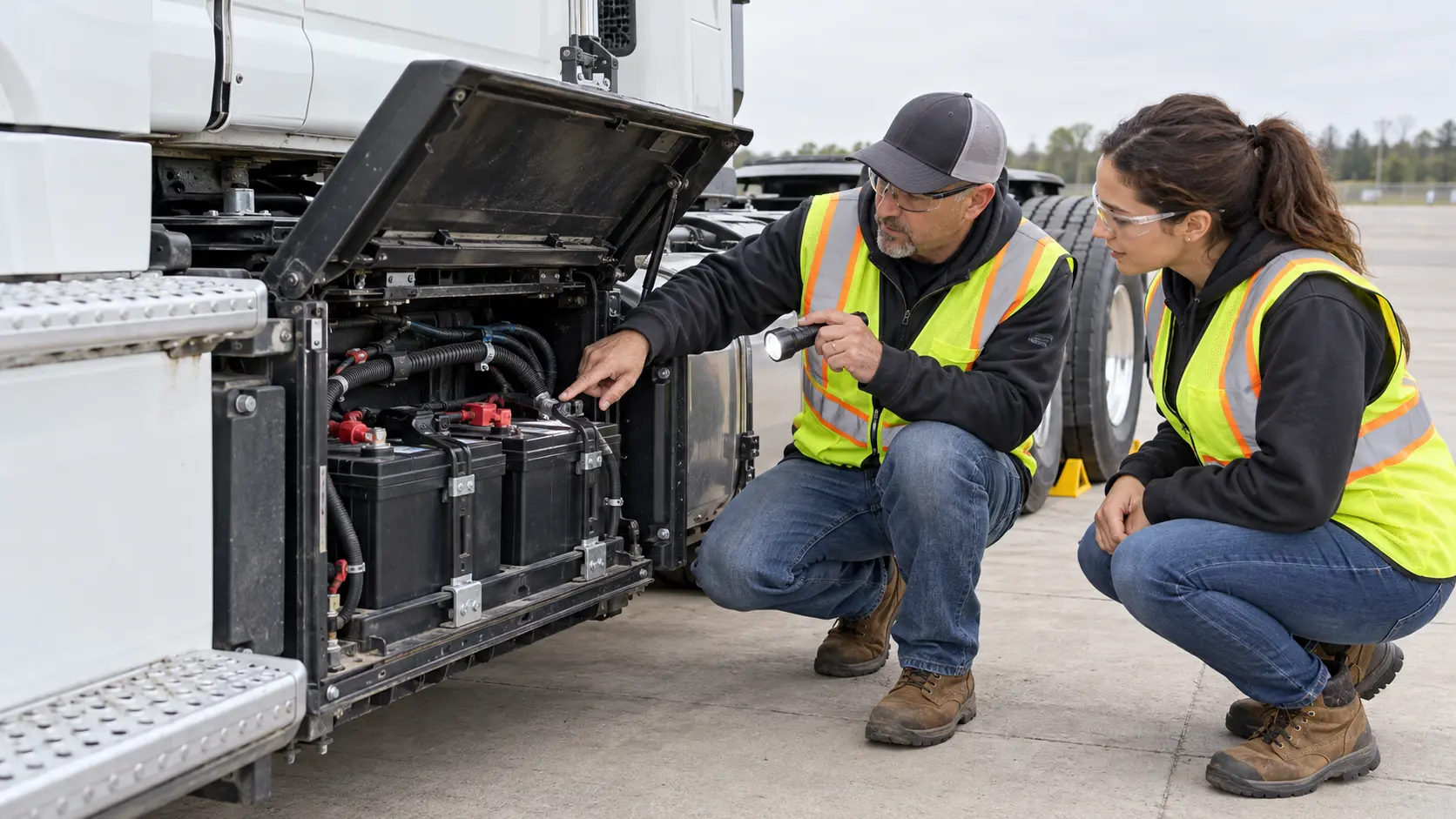
Begin by learning where the batteries are located on the specific vehicle. A truck may use a side box beneath the cab, an engine-compartment location, a chassis-mounted enclosure, or another manufacturer-designed position. Some compartments are immediately visible; others are behind a cover that the driver may or may not be authorized to open during the test or walkaround. Ask before operating unfamiliar latches.
Identify the inspection boundaries
The battery inspection includes the case or cases you can see, hold-downs, tray, box, cover or door, terminal connections, and visible cables. The broader electrical inspection includes supported wiring, protective loom or conduit, pass-through points, junctions, trailer electrical cables, and any obvious damage near heat, sharp edges, or moving parts. Do not confuse an accessible view with permission to disassemble.
Separate visual inspection from electrical testing
A student can identify a loose-looking hold-down, cracked case, wet residue, excessive corrosion, open cover, worn insulation, missing grommet, or unsupported cable. A visual check cannot prove state of charge, battery capacity, charging output, cable resistance, or an intermittent short. Those questions require approved test equipment and qualified procedures. Use the observable condition as the report, not as a shortcut to a diagnosis.
Know the federal and Pennsylvania baseline
49 CFR 393.28: wiring systems
The current federal wiring rule requires commercial-vehicle electrical wiring to be installed and maintained in conformity with the incorporated SAE J1292 standard, subject to stated exceptions. A CDL driver is not expected to reproduce that engineering standard during a walkaround. The practical duty is to notice wiring that is visibly damaged, unsupported, abraded, overheated, poorly protected, or placed where contact could occur, then refer it through the carrier's maintenance system. The operative rule is .
49 CFR 393.30: battery installation
For a storage battery outside the engine compartment, the federal rule requires protection by a fixed part of the vehicle or by a substantial removable cover or enclosure that is securely fastened. It also addresses corrosion-resistant coating on the battery compartment and nearby metal, openings for ventilation and drainage, insulation where the starting-motor cable passes through a metal compartment, and separation when a battery and fuel tank share an under-seat location. Read the full installation language at .
PennDOT's modernized test language
PennDOT Section 10M tells applicants to inspect visible batteries for securement, visible connections for tightness and excessive corrosion, electrical cables and lines for secure routing and cracks or wear, and the battery box, cover, or door for securement. If the batteries are not visible or accessible, the applicant should tell the examiner. The current manual is linked from PennDOT's , with test resources on the .
Prepare for a safe visual inspection
Control the vehicle and ignition state
Park on a level, approved surface, apply the parking brake, place the transmission as directed, and chock wheels when required. Follow the vehicle-specific sequence for ignition and master electrical switches. Remove jewelry or conductive objects before any authorized close work, and keep tools, flashlights with exposed metal, and loose hardware away from terminals. A routine driver inspection does not require bridging, probing, or disconnecting anything.
Look for immediate stop signs
Do not open a compartment if you see smoke, active arcing, a strong burning odor, a badly swollen case, significant fresh liquid, a hot or melted cable, or a damaged enclosure that could expose energized components. Keep people clear, shut down the vehicle if that can be done safely under the procedure, and contact the instructor, dispatcher, or maintenance team. Do not use water, tools, or bare hands to investigate an electrical event.
Use light without creating a path to ground
A nonconductive or properly protected flashlight can improve the view, but keep it outside the compartment unless the approved method permits otherwise. View from more than one angle. Never rest a light, phone, clipboard, fastener, or tool across the battery top. A dropped metal object can connect conductive points even when the vehicle appears shut down.
Inspect batteries and hold-downs
Confirm the batteries remain in position
Look at the hold-down bars, brackets, straps, trays, and visible fasteners. The batteries should sit squarely in their intended positions and should not appear shifted, tilted, or able to contact sharp metal. Look for a missing hold-down, broken bracket, loose fastener, damaged tray, or polished movement mark. Do not push or rock the battery unless the exact inspection procedure authorizes that action.
Inspect the visible battery cases
Check for cracks, bulging, deformation, heat damage, wetness, and residue. Distinguish a dusty surface from fresh liquid by describing what you actually see rather than touching or smelling it closely. If serviceable batteries have removable caps, do not remove them during the normal walkaround. Case style and maintenance requirements vary, so follow the manufacturer and fleet procedure.
Consider motion and contact
A secure battery must remain separated from terminals, covers, cable edges, and other components as the vehicle moves. Check for witness marks on the lid, rubbed insulation near a hold-down, or a cable pulled tight because a battery shifted. One condition can create several hazards, so report the relationship: “rear battery shifted left; positive cable is taut against the box edge,” not merely “battery issue.”
Check the box, cover, ventilation, and drainage
The cover must protect and stay secured
Inspect the box, lid, hinges, latch, retaining straps, and mounting hardware. A cover that is present but cannot latch is not equivalent to a secured enclosure. Check that it does not press on terminals or cables when closed. If the battery is protected by a fixed vehicle structure rather than a separate lid, identify that design and inspect the accessible protection.
Ventilation and drainage cannot be blocked
Federal battery-installation language calls for openings that provide ventilation and drainage. Inspect visible vents and drains for mud, debris, paint, cargo, or aftermarket material that blocks them. Do not insert a tool to clear a hidden passage. Report the obstruction and allow maintenance to clean and evaluate the compartment safely.
Look at the compartment metal
Inspect the tray, walls, and adjacent metal for heavy corrosion, coating failure, holes, deformation, or residue spreading beyond the box. The federal rule specifically addresses acid-resistant protection where leakage could corrode the compartment. A driver need not identify the coating chemistry. The useful observation is whether the protective surface is intact and whether damage or leakage is visible.
Review terminals and visible connections
Check seating without touching
From a safe view, inspect terminal clamps, cable lugs, inter-battery connections, boots, and protective covers. Look for a clamp sitting crooked, a visible gap, missing hardware, a cable lug that has shifted, or a terminal boot that no longer covers the conductive area. Do not twist a cable or test a connection by hand during a visual inspection.
Describe corrosion precisely
Corrosion may appear as powdery or crusted material around a post, clamp, cable end, or tray. PennDOT's test language focuses on excessive corrosion at visible connections. Record the location, color, spread, and whether the material reaches nearby cables or hold-downs. Avoid statements about voltage loss or internal battery condition unless a qualified test actually measured them.
Keep conductive protection in place
Missing terminal boots, cracked insulating covers, or an enclosure component that could touch a terminal deserve immediate attention. A cover should protect the battery without trapping or pinching cables. Do not substitute tape, cardboard, or an unsecured object as a temporary terminal guard unless the carrier's qualified repair procedure specifically provides it.
Trace cables and wiring protection
Follow the visible cable route
Trace each accessible battery cable from the terminal toward the starter, disconnect, frame ground, junction, or harness. Look for secure supports, reasonable slack, intact loom, and separation from hot exhaust parts, sharp edges, moving components, and road splash exposure. A cable should not hang, rub, or pull against its connection as the cab, engine, or suspension moves.
Inspect pass-through points
Where a starting cable passes through a metal compartment, 49 CFR 393.30 calls for protection against grounding by an acid- and waterproof insulating bushing. From the driver's view, look for a present, seated protective grommet or bushing and insulation that is not cut, flattened, or exposing conductor. If the pass-through is hidden, report that it was not visible rather than certifying it.
Extend the check beyond the battery box
Inspect accessible harnesses along the frame and at the rear of the cab, lights, sensors, and trailer connection. Look for cracked conduit, exposed conductor, unsupported loops, crushed sections, heat damage, or improvised splices. Connect this check to the lights and reflectors inspection plan: an inoperative lamp may be the symptom, while damaged wiring may be the underlying condition that maintenance must diagnose.
Use functional clues without guessing
Observe before and during start-up
Follow the normal start sequence and observe whether the starter turns as expected, the dashboard powers normally, warning lamps complete their required checks, and electrical accessories behave consistently. A slow crank, repeated clicking, flickering display, unexpected reset, or warning message is useful information. It is not proof that the battery itself is defective; cables, connections, switches, charging components, and other systems can produce similar symptoms.
Connect symptoms to the walkaround
If the engine cranks slowly, return only to safe, authorized visual checks. Look for a shifted cable, loose-looking connection, heavy corrosion, damaged box, or recent service note. Do not repeatedly crank the engine to reproduce the symptom. Repeated attempts can change conditions and complicate the report.
Report warning patterns, not theories
A useful handoff states when the symptom occurred and what else was operating: “dash powered normally, starter clicked once, then display reset; rear battery negative cable shows rubbed insulation at the hold-down.” That description gives maintenance a starting point without declaring that an alternator, starter, or battery has failed.
Include recent service and auxiliary equipment
Review the last repair or battery change
After battery, starter, cable, or charging-system work, confirm the repair order identifies the vehicle and affected components. Visually check that covers, hold-downs, cable supports, and protective boots were restored. A new battery does not make a loose enclosure or misrouted cable acceptable. If a required follow-up or testing record is unclear, resolve it before departure.
Account for added electrical loads
Inverters, auxiliary power units, liftgates, cameras, telematics, and other equipment can add cables, fuses, disconnects, and mounting points. Inspect only what is accessible and within the driver procedure. Look for secure, protected routing and professional connections. An unfamiliar cable is not automatically wrong, but an unsupported or damaged installation should be documented and reviewed.
Do not improvise a jump-start
Commercial vehicles can use different battery arrangements and system configurations. Jump-starting requires the correct equipment, connection order, grounding point, and manufacturer or carrier procedure. Never guess voltage, bridge terminals, or use visibly damaged cables. Arrange the authorized response and record the original symptoms before anyone changes the battery state.
Turn observations into safe actions
| Observation | Useful report language | Safe next action |
|---|---|---|
| Battery shifted against the box | “Rear battery is displaced toward the outer wall; hold-down bar sits above the case edge.” | Do not operate; keep the compartment undisturbed and request securement inspection. |
| Cover will not latch | “Battery-box lid closes but the forward latch does not engage; lid can rise at that corner.” | Do not substitute a temporary strap; obtain approved enclosure repair. |
| Heavy corrosion at a connection | “White-green crust covers the left positive clamp and extends onto the cable lug.” | Report for qualified cleaning, connection inspection, and electrical testing. |
| Cable insulation worn at metal edge | “Starter cable has a rubbed flat spot where it passes the rear box opening; conductor is not visibly exposed.” | Prevent movement and request cable, bushing, and routing evaluation before release. |
| Fresh liquid in the tray | “Clear wet residue is present beneath the front battery and along the tray drain area.” | Keep clear, avoid contact, and have maintenance identify the source and correct disposal method. |
| Slow crank plus dashboard reset | “Starter turned slowly, dashboard reset once, and the right terminal boot is displaced.” | Stop repeated start attempts and refer the combined symptoms for diagnosis. |
| Batteries not accessible during test | “Batteries are behind a non-accessible enclosure; visible box, latch, and exterior cables inspected.” | Inform the examiner and continue only as directed. |
Worked scenario: slow crank and a rubbing cable
A student performs the morning inspection on a tractor that completed starter service two days earlier. The repair order is closed, and the truck operated normally the previous afternoon. During the first start attempt, the starter turns slowly and the dashboard briefly resets. The engine does not start.
Step 1: stop changing the condition
The student does not try repeatedly, connect a booster, or move cables. Following the instructor's direction, the ignition is returned to the approved off position. The truck remains secured and the key status is controlled.
Step 2: inspect the visible installation
At the side battery box, the lid and hold-downs appear secure. Terminal boots are present, and no fresh liquid or heavy corrosion is visible. The student then follows the accessible starter cable route and sees a section pulled tightly across a metal opening. The protective bushing is displaced, and the outer insulation has a shiny rubbed area. No conductor is visible.
Step 3: make a factual handoff
The report states: “First morning start after recent starter service: starter cranked slowly and dashboard reset; no repeat attempt. Batteries and hold-downs appear secured from accessible view. Starter cable is taut at rear battery-box pass-through, protective bushing is displaced, and insulation has a polished wear mark with no conductor visible.” Maintenance isolates and evaluates the system before the tractor returns to training. The student did not diagnose a short or bad battery; the student preserved evidence and reported the visible risk.
Practical battery and electrical checklist
- Secure the truck, control the ignition state, and chock wheels when required.
- Review recent battery, starter, charging-system, cable, or auxiliary-equipment service.
- Locate every battery compartment and state when batteries are not visible or accessible.
- Inspect visible batteries for secure position, case damage, deformation, wetness, and residue.
- Check hold-downs, trays, brackets, straps, and visible fasteners.
- Inspect the box, fixed protection, cover, hinges, latches, and mounting hardware.
- Confirm visible ventilation and drainage openings are not blocked.
- Check compartment coating and adjacent metal for corrosion, holes, or leakage damage.
- Inspect visible terminal clamps, cable lugs, boots, and protective covers without touching them.
- Describe corrosion by location and extent; do not infer voltage or capacity.
- Trace accessible cables for secure support, intact insulation, reasonable slack, and separation from heat, edges, and moving parts.
- Inspect metal pass-throughs for seated protective bushings or grommets.
- Look at frame harnesses and trailer electrical connections for cracks, wear, unsupported loops, or exposed conductor.
- Observe start-up behavior once under the approved sequence; avoid repeated attempts after an abnormal result.
- Report smoke, arcing, melting, strong burning odor, large leaks, or swollen cases immediately and keep people clear.
- Never bridge terminals, remove caps, tighten connections, or improvise a jump-start during a routine inspection.
- Record the component, side, location, visible condition, symptom, and recent service context.
Common inspection mistakes
Calling a starting symptom a battery diagnosis
A slow crank may involve batteries, cables, connections, a starter, control circuits, temperature, or other factors. Report the symptom and visible conditions. Let qualified testing identify the cause.
Touching a connection to see whether it is tight
Hand pressure does not verify the specified connection and may move a damaged part or expose the person to energized conductors. PennDOT asks for visible securement and connection condition during the test; it does not turn the student into an electrical technician.
Inspecting only the battery tops
The important defect may be at the tray, hold-down, pass-through, cable support, or outside of the box. Use a complete path from battery case to enclosure and accessible cable route. If access ends, say so clearly.
Closing the lid without checking the latch
A cover can appear closed while a latch is broken or a cable is trapped. Confirm the closure using the approved method and inspect for pinching. Connect the result to the broader frame and cab inspection plan, because the box and cable supports attach to vehicle structure.
Frequently asked questions
Should a CDL student touch battery terminals during a vehicle inspection?
A normal CDL walkaround is primarily visual. Do not touch terminals, remove covers, or place tools near conductors unless an instructor or approved maintenance procedure specifically authorizes the task and the electrical system has been controlled. Identify visible connections, securement, corrosion, cable condition, and enclosure condition from a safe position.
Does corrosion on a truck battery connection automatically make the vehicle unsafe?
Visible corrosion is a condition to describe and report, but appearance alone does not establish electrical resistance, remaining battery capacity, or serviceability. PennDOT directs applicants to check that visible connections are tight and do not show excessive corrosion. Qualified maintenance should decide cleaning, testing, repair, and release.
Can a driver jump-start a commercial truck during a pre-trip inspection?
Only under the carrier's approved procedure with the correct equipment, connection sequence, vehicle information, and trained personnel. A driver should never improvise with damaged cables, uncertain voltage, or exposed conductors. If the truck will not start normally, report the symptoms and protect the scene while the authorized process is arranged.
What should a Pennsylvania CDL applicant say if the batteries are not visible or accessible?
PennDOT's modernized inspection guidance says to inform the examiner when the batteries are not visible or accessible. The applicant should still identify and inspect any visible battery box, cover or door, nearby cables, and other accessible electrical-system components as directed by the examiner.