Getting your Commercial Driver's License is a huge step, but the real money and better job opportunities often come from adding endorsements. To pass those specialized exams for things like HazMat, Tanker, or School Bus, your best bet is to use CDL endorsement practice tests.
Think of them as a dry run. They give you a real taste of the questions you'll see on exam day and are specifically built to connect what you've read in the manual to what you'll actually be tested on.
Why Practice Tests Are Your Secret Weapon
Just reading the official CDL manual is a solid start, but let's be honest—it’s not enough to walk in and ace the test. The real test is applying that knowledge when the clock is ticking, and that’s where practice tests really shine. They shift you from passively reading to actively learning, which is a proven way to make information stick.
This process of actively recalling information is crucial for locking in complex rules. For example, you can read about the specific placarding rules for hazardous materials a dozen times, but trying to recall those details for a practice question is what really cements it in your memory. Same goes for understanding the tricky surge dynamics in a tanker.
Walk in Confident, Not Stressed
We've all been there. Walking into a testing center can be nerve-wracking. The pressure to pass can make even the most prepared person start to doubt themselves. This is another huge reason to make practice tests a regular part of your study routine.
When you simulate the exam experience over and over, you get comfortable with the types of questions and the timing. Each practice test is like a dress rehearsal, taking the "fear of the unknown" out of the equation. This builds the kind of genuine confidence you need to stay calm and do your best when it matters.
The goal isn't just to memorize the material; it's to get comfortable and fast at applying it. Consistent practice gets rid of the element of surprise, so you can focus on the questions, not the pressure.
Find and Fix Your Weak Spots
It’s tough to know what you don't know just from reading. A good practice test works like a diagnostic tool, instantly showing you which topics need more of your attention. Whether you’re getting tripped up by air brake systems or passenger safety rules, the results give you a clear "to-do" list for your study time.
This approach saves you a ton of time. Instead of just rereading the whole manual hoping for the best, you can zero in on the areas that will make the biggest difference to your score. For instance, if you keep missing questions about pre-trip inspections, you know exactly which section to review in our deep dive on the general knowledge test.
For those wanting to cast a wider net, there are many resources for free drivers training online that include practice tests which can help you sharpen your skills even further.
Understanding the Different CDL Endorsements
Before you even think about practice tests, you need a clear picture of where you want to go in your career. Each CDL endorsement opens the door to a different kind of driving job, and the tests for each are laser-focused on the specific knowledge that job demands. You can't just wing it with a general study guide; your preparation has to be targeted.
Think about it this way: prepping for a Passenger (P) endorsement is a completely different ballgame than studying for Hazardous Materials (H). One is all about keeping riders safe and managing people, while the other requires you to know chemical classifications and emergency protocols inside and out.
The Most Common Endorsements and What to Expect
Let's break down the big ones. Knowing the unique challenges of each endorsement is the secret to picking the right practice tests and spending your study time wisely.
Here’s a quick look at the most common endorsements you'll encounter and the core knowledge you'll need to master for each one.
Common CDL Endorsements and Key Focus Areas
| Endorsement Code | Full Name | Primary Focus of Study |
|---|---|---|
| H | Hazardous Materials | Placarding rules, safety regulations, loading/unloading procedures, and emergency response. |
| N | Tank Vehicles | Managing liquid surge, vehicle dynamics, braking techniques, and inspection protocols for tankers. |
| T | Double/Triple Trailers | Coupling/uncoupling, controlling the "crack-the-whip" effect, and multi-trailer inspections. |
| P | Passenger Transport | General rider safety, pre-trip inspections for passenger vehicles, and proper loading/unloading procedures. |
| S | School Bus | Student safety, specific rules for railroad crossings, loading/unloading children, and managing behavior. |
| X | Tanker/Hazmat Combo | A combination of H and N endorsement knowledge, covering both hazardous material safety and tanker dynamics. |
This table really highlights why you can't take a one-size-fits-all approach. Each endorsement tests a specialized skill set.
Here's a closer look at what that means in practice:
- H Endorsement (Hazardous Materials): This one is all about safety and compliance. The test questions are notoriously detailed, grilling you on placarding, proper loading and unloading, and exactly what to do if something goes wrong. You need to have those federal regulations down cold.
- N Endorsement (Tank Vehicles): The real beast here is the "surge." You have to understand how that shifting liquid affects your truck's handling. Practice tests for the N endorsement will be heavy on questions about safe driving speeds, proper braking, and the specific inspections unique to tankers.
- T Endorsement (Double/Triple Trailers): If you're a Class A driver looking to pull more than one trailer, this is your ticket. The test will focus on managing multiple pivot points, including correct coupling procedures and how to prevent the dangerous "crack-the-whip" effect.
This infographic does a great job of showing how targeted practice builds the confidence you need on test day.
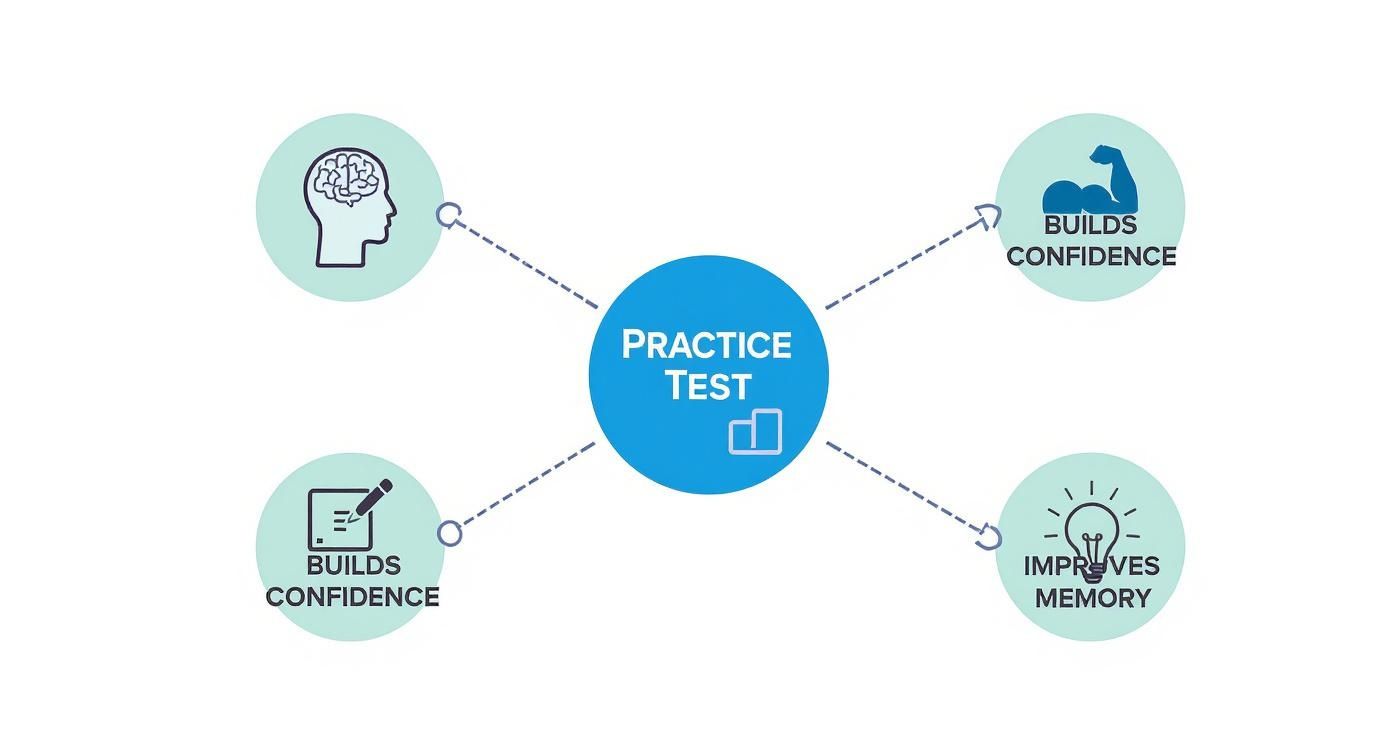
As you can see, consistent practice does more than just help you memorize answers; it reduces test anxiety and sharpens your recall when you're under pressure.
The Difference Between Passenger and School Bus Endorsements
At first glance, the P and S endorsements seem similar, but there are critical distinctions. The P endorsement covers any vehicle designed to carry 16 or more passengers, focusing on general rider safety. The S endorsement, however, is a highly specialized add-on just for school bus drivers.
The rules for an S endorsement are much more stringent. For instance, in Pennsylvania, the CDL School Bus test has 20 questions, and you need to get at least 16 correct (an 80% passing grade). The questions dive deep into specific procedures for safely loading and unloading kids, handling student behavior, and navigating railroad crossings—things you wouldn't find on a standard P endorsement exam.
Ultimately, using the right CDL endorsement practice tests isn't just about passing. It's about proving you have the specific skills to do the job safely and professionally, whether you're hauling people or hazardous freight.
It's also a good idea to think about how your training vehicle might affect your license. Testing in a truck with an automatic transmission, for example, will put an E restriction on your CDL. If you want the flexibility to drive any rig, checking out an E restriction removal course is a smart move for your career.
A Smarter Way to Use Practice Tests
Getting your CDL endorsements is more about working smart than just working hard. Instead of grinding through the CDL manual from cover to cover, you can use practice tests to find and fix your weak spots fast. The secret is a simple but powerful cycle: Test, Review, Study, and Retest.
Following this loop turns a simple quiz into a diagnostic tool. You stop just guessing and start hunting for the gaps in your knowledge. This approach makes sure every minute you spend studying is focused on what will actually get you a passing score on the real exam.
Your First Test Is Your Baseline
Don't wait until you feel perfectly prepared to take your first practice test. Dive right in. That first attempt is just a baseline—a snapshot of where you're starting from. The score itself doesn't matter nearly as much as the data it gives you.
This initial test will instantly show you which endorsement topics are tripping you up. Maybe you're solid on tanker surge dynamics but keep getting questions wrong about hazmat placarding. That's fantastic information to have.
By finding these problem areas on day one, you can build a study plan that actually works. You’ll know exactly which chapters in the CDL manual deserve your attention, so you won't waste time rereading sections you already know cold. It’s the first and most important step to studying efficiently.
From Wrong Answers to Real Knowledge
The most important part of any cdl endorsement practice test isn’t the questions—it's the answer explanations. Just seeing a red 'X' next to your answer doesn’t help you learn. You need to understand why you got it wrong.
Dig into the explanations for every single question you miss. A high-quality practice test will break down the specific regulation or concept behind the correct answer. Once you read the explanation, pull out your state’s official CDL manual and find that same topic. Reading it in the official source material cements the knowledge.
Think of each wrong answer as a signpost pointing directly to an area where you can make significant improvement. By focusing on these areas, you systematically turn your weaknesses into strengths before test day.
This review process is where the real learning kicks in. It’s what separates guessing on a practice quiz from having the confidence to nail the answer when you’re sitting in the official testing center. To get access to a full suite of these materials, you'll want to sign up for comprehensive CDL training.
Schedule Your Study and Retest
Now that you know what to work on, it's time to hit the books with a clear plan. Forget about cramming all night. A much better approach is spaced repetition, which helps lock information into your long-term memory.
Here’s a practical way to do it:
- Day 1: Deep dive into a tough topic, like air brake systems.
- Day 2: Do a quick 15-minute review of the same material.
- Day 4: Review it again, focusing on anything you’re still fuzzy on.
- Day 7: Give it one last look.
After about a week of this focused studying, take another full-length practice test. This is your retest. The goal is to see a big jump in your score in the areas you studied, and it will also show you if any other weak spots have popped up. Then, you just repeat the cycle.
Recreating the Real Exam Experience
Knowing the material for your CDL endorsements is one thing, but performing under pressure is a whole different ball game. The best way I’ve found to get over test-day jitters is to make your practice runs feel just like the real thing. It’s all about desensitizing yourself to the stress of a timed test long before you ever set foot in the testing center.
When you treat your CDL endorsement practice tests with that level of seriousness, they stop being simple quizzes and become powerful training tools. The idea is to make the official exam environment feel so familiar that your brain can focus entirely on the questions, not the ticking clock or the strange room.

Honestly, this is less about memorizing facts and more about building mental toughness. When the big day feels like just another practice session, your anxiety plummets, and your score almost always goes up.
Set the Stage for Success
Where you study matters. A lot. Taking a practice test on the couch with the TV blaring in the background is a recipe for failure. You need to find a quiet spot where you can lock in and focus without interruptions.
Try to mirror the official testing center conditions as closely as you can:
- Go Minimal: Clear everything off your desk. The only thing in front of you should be your computer or the practice test. No phone, no notes, no CDL manual.
- Kill Distractions: Silence your phone and, even better, put it in another room. Close out all those extra browser tabs.
- Set Boundaries: Give your family or roommates a heads-up that you need a specific chunk of time—say, 45 minutes—of complete, uninterrupted quiet.
This isn't about being overly dramatic; it's about conditioning. You're training your brain to snap into "test mode" the second you sit down in that space.
By making your practice sessions feel real, you ensure the real exam feels like just another practice session. That’s where the confidence comes from.
Make the Clock Your Ally
Taking an untimed practice test can give you a dangerously false sense of security. The real CDL endorsement exams are timed, and you absolutely have to get comfortable answering questions both correctly and efficiently. Pacing is a skill, and like any other skill, it only improves with practice.
So, the next time you sit down with a practice exam, like this great air brakes test, set a timer. Don't just answer the questions; answer them against the clock. This forces you to be decisive and quickly highlights which question types are eating up too much of your time. Soon enough, you'll develop an internal rhythm that keeps you on pace without inducing panic.
When you’ve successfully beaten the clock dozens of times at home, the timer at the DMV just becomes background noise. You’ll walk in already knowing you can finish on time because you've proven it to yourself again and again.
How to Analyze Your Results for a Higher Score
Finishing a practice test feels good, but it’s really just the starting line. The real work—the kind that actually gets you a higher score—begins when you dig into your results. It's about looking past that overall percentage and finding the patterns in what you got wrong. That’s how you turn a decent study session into a great one.
A score of 75% doesn't just mean you missed a quarter of the questions. Think of it as a detailed map pointing directly to your blind spots. Your job is to follow that map. This is how you make sure your next study session is laser-focused on the exact topics that will push your score up.

This is what separates the drivers who barely scrape by from those who walk into the exam room feeling confident. It’s a smart strategy that saves a ton of time and, frankly, gets much better results.
Categorize Your Incorrect Answers
First things first, you need to sort your wrong answers into groups. Don’t just see them as a random pile of mistakes. Instead, start asking why you missed them to find the real patterns.
Try to figure out the source of each error:
- Conceptual Gaps: These are the topics you genuinely just don't get yet. Are you constantly fumbling questions about air brake systems or hazardous material placards? Those are your new top priorities.
- Reading Errors: Sometimes, you know the material, but you just didn't read the question carefully. Did you miss a key word like "except" or "not"? It happens to everyone, but you need to catch it.
- Second-Guessing: This one is painful. Did you have the right answer at first but talked yourself out of it? That usually means you lack confidence in that subject, even if you have a basic grasp of it.
By bucketing your mistakes like this, you can build a much more effective plan. You’ll know whether you need to go back to the CDL manual for a specific chapter or just take a deep breath and slow down on the next test.
Build a Targeted Study Plan
Once you know why you're making mistakes, you can build a study plan that attacks those weaknesses head-on. If your results show a clear struggle with Tanker (N) endorsement questions, then your next two study sessions should be dedicated to nothing but that section of the manual.
This focused approach is incredibly effective. In fact, online platforms have found that users who complete at least five full-length practice tests—each with around 50 questions—before the real deal have a first-time pass rate approaching 90%. That’s a huge jump from the national average of just 50–60% for people who only read the manual.
The key takeaway is simple: repetition combined with analysis is the fastest way to a passing score. Each test-and-review cycle systematically patches up your weak spots until you have a rock-solid foundation of knowledge.
Your plan doesn’t need to be fancy. It can be as simple as writing down: "This week, I will master the three subsections of the HazMat chapter where I scored the lowest." It's that kind of specific, actionable goal that turns your CDL endorsement practice tests from a simple quiz into a powerful training tool for guaranteed improvement.
Your CDL Practice Test Questions Answered
If you're gearing up for your CDL endorsements, you've probably got some questions about practice tests. And that's a good thing. Knowing how to use these tools effectively is what separates the drivers who walk in confident from those who walk in hoping for the best.
Let’s clear up some of the most common questions I hear from students all the time.
Are Practice Tests the Same as the Real Exam?
This is the big one, and the straight answer is no—but that's actually a good thing. You aren't looking for a cheat sheet. What you need is a realistic preview of what's coming.
The best practice tests are built to mirror the real exam in every important way. They pull questions directly from the concepts in the official CDL manual, use the same multiple-choice format, and present you with the same kinds of tricky scenarios you'll face at the DMV. It's about making the real thing feel familiar, not surprising.
For instance, a solid practice test for the Combination Vehicles endorsement will throw questions at you about the "crack-the-whip" effect or the right way to couple your trailers. It’s designed to feel just like the test you’ll have to pass. You can see exactly what I mean by looking over a quality Combination Vehicles practice test to get a feel for the format and depth.
How Many Practice Tests Should I Take?
There isn't a magic number, but here's a rule of thumb from my experience: keep taking them until you're consistently hitting 90% or higher. That’s the benchmark for true readiness.
Why not just a passing score? Because on test day, nerves can knock a few points off your performance. A 90% buffer means you've mastered the material, not just memorized it. We’ve seen that drivers who run through at least five full practice tests tend to have a much easier time passing on their first try.
Don't just aim to pass your practice runs; aim to dominate them. A score of 90% or more proves you can apply what you know, even when the pressure is on.
What if I Keep Failing Practice Tests?
First off, don't get discouraged. A failed practice test isn't a failure—it's a roadmap showing you exactly where to focus your energy. It’s one of the most valuable study tools you have.
Look at the results. Is it the air brakes section that’s giving you trouble? Are questions about tanker slosh tripping you up? Whatever the weak spot is, that’s your next study session.
Crack open the official CDL manual and focus only on that topic. Read the chapter again, take notes, and then find another practice quiz on that specific subject. The goal is to understand the why behind the answers, not just remember the correct letter.
Can I Pass by Only Using Practice Tests?
While they are a game-changer, practice tests alone aren't enough. They're a supplement to your core learning, not a replacement for it. The official CDL manual is the ultimate source of truth—it's what both the real test and the practice tests are based on.
Here’s the most effective strategy I’ve seen work time and time again:
- Study a section in the manual first.
- Then, take a practice test on that specific topic.
This one-two punch of learning the material and then immediately testing your recall is the fastest way to build lasting knowledge and confidence.
Ready to stop practicing and start your professional driving career? Patriot CDL offers expert, hands-on training to get you on the road in as little as three weeks. Learn more and enroll today at https://patriotcdl.com.