
If you've been eyeing a Hazmat endorsement, you know it can open doors to higher pay and better routes. But the thought of another test can be daunting. The good news? Passing the Hazmat test is more straightforward than you might think, especially when you have a solid study plan. It's all about knowing the rules of the road for sensitive materials, and this guide will get you there.
Your Roadmap To Passing The Hazmat Endorsement Test
Think of getting your Hazmat endorsement like prepping for a big haul. You wouldn't hit the road without checking your route, your rig, and the weather, right? This guide is your trip ticket for the Hazmat exam. We're going to break down everything you need to know, piece by piece, so you can walk into that test with total confidence.
Forget trying to cram a bunch of dry facts. Our goal is to give you a real-world understanding of how to transport hazardous materials safely. We'll turn complex regulations into simple, practical knowledge.
What This Guide Covers
We’ve structured this guide to cover every key area of the Hazmat test, starting with the basics and building up from there. You won't just be memorizing answers; you'll be learning the "why" behind the rules.
Here’s a quick look at what we'll cover:
- The Nine Classes of Hazardous Materials: Get to know the different types of cargo, from explosives and gases to corrosives.
- Placards and Shipping Papers: We’ll break down the paperwork and signage, which is the universal language of Hazmat safety.
- Loading and Transport Rules: You'll learn the specific procedures for securing and hauling different materials.
- Emergency and Security Protocols: Know exactly what to do if things go wrong and how to prevent security threats.
Getting this endorsement is a smart move. The Federal Motor Carrier Safety Administration (FMCSA) notes that about 14% of all CDL holders have a Hazmat endorsement, showing a clear demand for skilled drivers.
Why The Hazmat Endorsement Matters
There's a reason the rules for hauling hazardous materials are so strict—it's all about safety. One small mistake can have massive consequences for the public and the environment. This endorsement is your proof that you’re a professional who can be trusted with that responsibility.
By the time you finish this guide, you’ll have a clear path forward. The information here isn't just for passing a test; it's the foundation for a safer, more successful career on the road. It also helps to have a firm grasp of the general CDL requirements before tackling specialized endorsements. With a bit of focused effort, you'll be ready to ace your exam and take your driving career to the next level.
Understanding The Nine Classes Of Hazardous Materials
At the very heart of the CDL Hazmat exam are the nine classes of hazardous materials. You have to know them inside and out. Think of these classes as a universal language for danger—a system that tells anyone, from the dockworker loading your trailer to the firefighter at an accident scene, exactly what kind of threat they're dealing with.
Getting a handle on these classes isn't just about rote memorization. It's about building a mental framework for safety. A good mechanic instinctively knows the difference between an engine block and a transmission; a professional hazmat driver must have that same instant recognition for the difference between a corrosive and an oxidizer. This knowledge is your first and best line of defense on the road.
The Core Hazard Categories
The Department of Transportation (DOT) sorts every hazardous material into one of nine classes based on its primary danger. Some of these classes are broken down even further into divisions to get more specific about the risk. Let's walk through each one.
Class 1: Explosives
Picture a spring coiled so tight it's about to burst, releasing a massive amount of energy in an instant. That’s the core idea behind Class 1 materials. This isn’t just dynamite and military munitions; it also includes things you see every day, like certain types of fireworks and ammunition. The danger here is a sudden, violent release of pressure and heat.
Class 2: Gases
This class covers anything that's a gas at a normal temperature and pressure. These materials are tricky because they're hard to contain and can pose several different threats at once. They’re split into three divisions:
- Division 2.1 Flammable Gases: Think propane or acetylene. All it takes is a small spark, and you've got a serious fire.
- Division 2.2 Non-Flammable, Non-Toxic Gases: These sound harmless, but they can be silent killers. Materials like nitrogen or helium can displace oxygen in a confined space and cause suffocation without any warning.
- Division 2.3 Toxic Gases: This is the nasty stuff. Materials like chlorine are poisonous if inhaled and can be lethal.
Class 3: Flammable and Combustible Liquids
This is probably the most common class you'll haul. We’re talking about everyday liquids like gasoline, diesel fuel, and alcohol. Their main danger comes from the flammable vapors they produce, which can easily be ignited by a spark. The key term here is flashpoint—the lowest temperature where a liquid gives off enough vapor to ignite. The lower the flashpoint, the more dangerous it is.
Materials That React Or Self-Destruct
Now we get into materials that are dangerous because they're inherently unstable or react violently with their environment. These require a whole other level of caution when you're loading, securing, and transporting them.
The most critical part of hauling hazmat is having a deep respect for the material. You have to understand that a solid or liquid that looks perfectly stable can become incredibly dangerous under the right—or wrong—conditions. That understanding is what prevents incidents on the road.
Class 4: Flammable Solids
This class is a bit of a grab-bag because it’s not just about things that can catch fire; it’s about how they catch fire.
- Division 4.1 Flammable Solids: These are solids that are easy to ignite with friction or a spark, like magnesium shavings or safety matches.
- Division 4.2 Spontaneously Combustible: This is stuff that can literally catch fire all by itself. Oily rags piled up in a corner are a classic example—they can generate their own heat and ignite without any external spark.
- Division 4.3 Dangerous When Wet: Just like the name says, these materials either become flammable or release toxic gas when they get wet. Think of substances like sodium or calcium carbide.
Class 5: Oxidizers and Organic Peroxides
Think of these materials as "fire-helpers." An oxidizer, like ammonium nitrate, might not burn on its own, but it produces oxygen, which acts like an accelerant and makes other materials burn much hotter and faster. Organic peroxides are often chemically unstable and can react dangerously to heat, shock, or friction.
Hidden Dangers And Corrosives
The last few classes cover hazards that might not be as dramatic as an explosion but are every bit as deadly. These materials can harm you through invisible radiation, poison, or direct chemical burns.
Class 6: Toxic and Infectious Substances
This class is all about poisons. Division 6.1 covers toxic substances like arsenic or pesticides that can cause serious injury or death if swallowed, inhaled, or absorbed through the skin. Division 6.2 is for infectious substances, like medical waste or lab cultures containing live viruses.
Class 7: Radioactive Materials
These materials give off invisible energy that can damage living tissue. It’s a constant, silent danger. Examples range from medical isotopes used in hospitals to nuclear fuel. Hauling this stuff requires highly specialized training, procedures, and equipment.
Class 8: Corrosives
A corrosive is any substance that can literally eat away at other materials, whether it's steel plating or human skin. Common examples are battery acid (sulfuric acid) and powerful drain cleaners (sodium hydroxide). Their danger is straightforward: they cause severe chemical burns and can destroy equipment and property.
Class 9: Miscellaneous Hazardous Materials
This is the catch-all category for anything that poses a real hazard during transport but doesn't neatly fit into the other eight classes. This is where you’ll find things like lithium batteries, dry ice, and asbestos. Just because they’re called "miscellaneous" doesn’t mean their risks aren’t serious—they just have to be managed in their own specific ways.
How To Master Placards And Shipping Papers
Think of placards and shipping papers as the universal language for hauling hazardous materials. A driver with a load of gasoline in Ohio needs to communicate the danger just as clearly to a first responder in California as they do to a dockworker back in Texas. This part of your study guide will help you speak that language fluently.
Getting this system down isn't just about passing your Hazmat test; it’s about keeping yourself, the public, and emergency crews safe. Those placards on the side of a truck are the first and most obvious warning of what's inside, giving immediate info that can save lives if something goes wrong. The shipping papers fill in all the critical details.
Decoding The Diamond Placards
Placards are those diamond-shaped signs you see on all four sides of a trailer hauling hazmat. Every color, symbol, and number tells a specific story about the cargo. Learning to read these visual cues is a core skill for any driver with a Hazmat endorsement.
The design is anything but random—it's a highly organized system. The background color gives you a quick read on the main hazard. For instance, red means flammable, yellow means oxidizer, and white means poison. The symbol at the top, like a flame or a skull and crossbones, drives that warning home.
This infographic gives you a quick visual cheat sheet for the first three Hazmat classes and their placard icons.
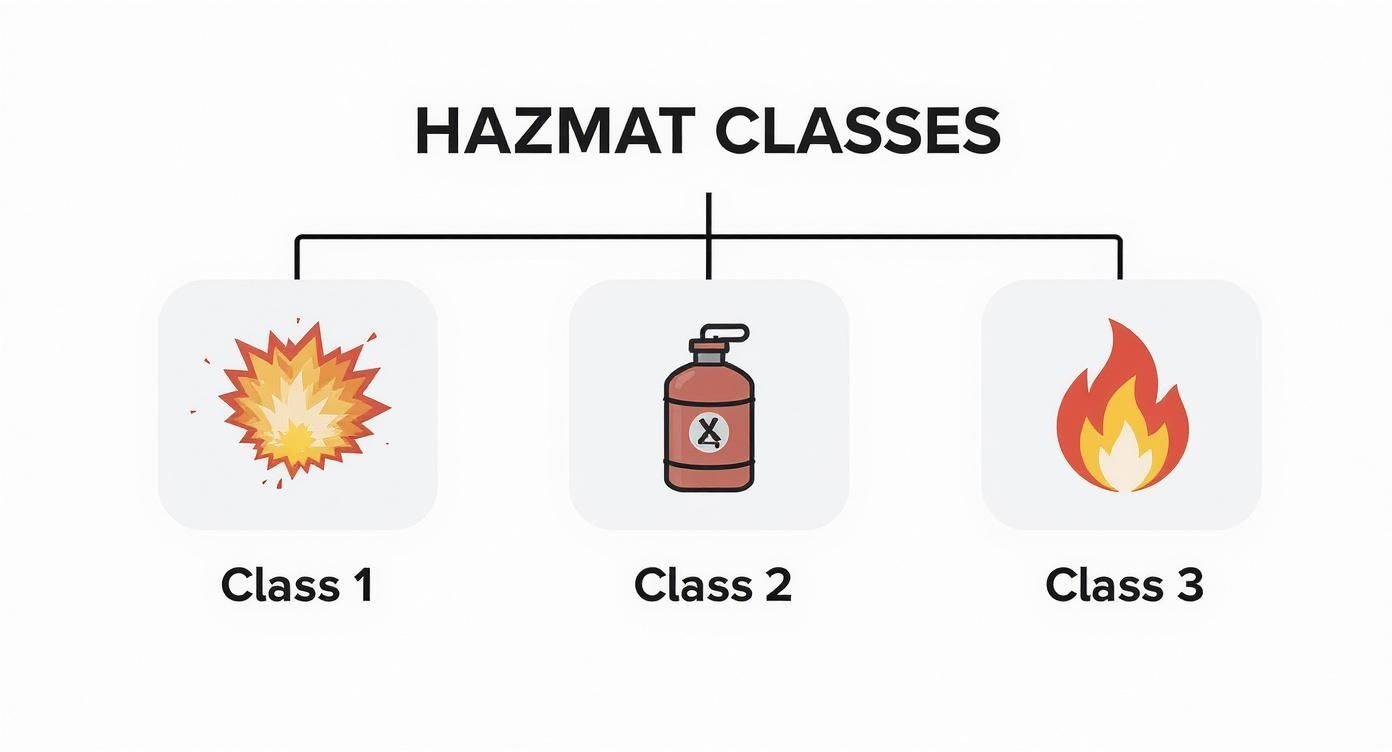
As you can see, a simple icon instantly communicates a complex danger, from the explosive burst of Class 1 materials to the contained pressure of Class 2 gases.
Your Responsibility: The Driver's Role
The shipper is required to give you the correct placards, but it is the driver's responsibility to ensure they are displayed correctly and are the right ones for the load you're hauling. Before you even think about pulling away from the dock, you have to verify that the placards match the shipping papers and are securely placed on all four sides of your vehicle.
A missing or incorrect placard is a serious violation. It forces emergency responders into a dangerous guessing game. Never just assume the shipper got it right—always check the information yourself before you start your trip.
This isn't just good advice; it's a non-negotiable part of your pre-trip inspection. You are the final checkpoint for safety and compliance out on the road.
This quick reference table can help you connect the visual placards with their corresponding hazard classes.
Hazmat Placard Quick Reference Guide
| Hazard Class | Class Name | Primary Placard Color | Primary Hazard Example |
|---|---|---|---|
| 1 | Explosives | Orange | Dynamite, Ammunition |
| 2 | Gases | Red, Green, Yellow, White | Propane, Oxygen |
| 3 | Flammable Liquids | Red | Gasoline, Diesel Fuel |
| 4 | Flammable Solids | Red/White, Blue, White | Matches, Sodium |
| 5 | Oxidizers | Yellow | Ammonium Nitrate |
| 6 | Poisons/Toxic | White | Pesticides, Arsenic |
| 7 | Radioactive | Yellow/White | Uranium, Plutonium |
| 8 | Corrosives | Black/White | Battery Acid, Hydrochloric Acid |
| 9 | Miscellaneous | Black/White Stripes | Lithium-ion Batteries |
Getting familiar with this table is a great way to build the instant recognition you'll need for both the test and your career.
Dissecting The Shipping Papers
If the placards are the book's cover, then the shipping papers are the story inside. This document is your go-to source for every detail about the hazardous materials you're hauling. It must be within your immediate reach anytime you are behind the wheel.
The most important information on the shipping paper is the basic description, which has to appear in a very specific order. The Hazmat test loves to ask questions about this sequence. The correct order is:
- ID Number: This is the United Nations (UN) or North American (NA) ID number for the specific material.
- Proper Shipping Name: The official name for the material, as determined by the DOT.
- Hazard Class or Division: The number that represents the material's main danger (e.g., Class 3 for a flammable liquid).
- Packing Group: A Roman numeral (I, II, or III) that indicates the degree of danger. Packing Group I signals the highest level of danger.
For example, a correct entry for a load of gasoline would look like this: UN1203, Gasoline, 3, PG II. If these items are out of order, the shipping paper is wrong, and you cannot legally transport that load.
Common Errors And How To Spot Them
Your job as a driver is to be a critical reviewer of the shipping papers. You need to be able to spot mistakes before they become a serious problem on the highway.
Keep an eye out for these common slip-ups:
- Incorrect Sequence: The basic description isn't in the proper order of ID number, name, class, and packing group.
- Missing Information: Key data is missing, like the total quantity or an emergency contact number.
- Illegible Entries: The information is handwritten so poorly you can't read it clearly.
- Placard Mismatch: The hazard class listed on the papers doesn't match the placards on the trailer.
Catching these issues while you're still at the shipper's dock will save you from big fines, long delays, and potentially dangerous situations. Always review the paperwork carefully, ask questions if something doesn't look right, and refuse any load with incorrect or incomplete documentation. Your CDL and your safety depend on it.
Key Rules For Loading, Unloading, And Transport
Knowing the nine hazard classes and how to fill out the paperwork is just the beginning. The real test of a hazmat driver’s skill comes down to the hands-on work of loading, unloading, and moving the cargo down the road. This is where your knowledge becomes action, ensuring everything stays secure from the first mile to the last.
Think of it this way: a single mistake during loading can set the stage for a disaster hours later. It’s like building a house with a shaky foundation. If the cargo isn't properly loaded, braced, and segregated, the entire haul is at risk.
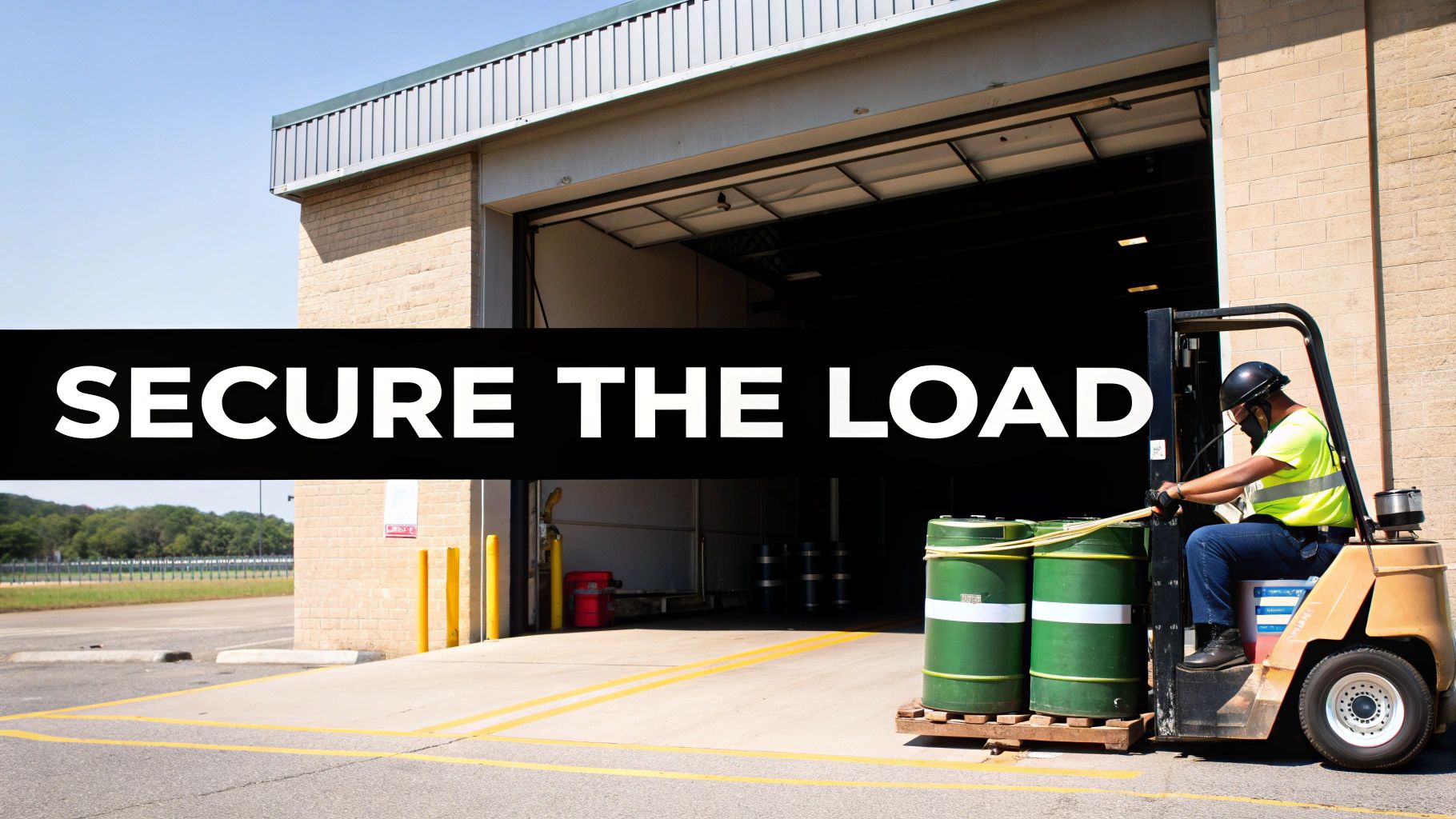
Segregation And Compatibility: Keeping Dangers Apart
One of the most important concepts you'll master is segregation. It’s a simple idea with huge implications: some types of hazardous materials just can’t be loaded next to each other. It’s like keeping bullies apart on the playground—put the wrong ones together, and you're asking for trouble.
For instance, you’d never load Class 3 flammable liquids next to Class 5 oxidizers. Why? Because the oxidizer actively produces oxygen, which would feed a fire and turn a bad situation into an uncontrollable inferno. The DOT provides a detailed Segregation Table for this very reason, and it’s your responsibility to know these rules or at least know how to use the table to make sure your load is compliant.
Proper Cargo Securement
Once you’ve got your materials separated correctly, the next job is locking them down for the trip. Hazmat cargo absolutely cannot be allowed to shift, slide, or fall. Any movement risks damaging the packaging, and damaged packaging can lead to leaks and spills.
There are a few core techniques you’ll use to keep everything in place:
- Blocking: This involves using lumber or other sturdy materials to build a barrier around the cargo, preventing any forward, backward, or sideways movement.
- Bracing: This reinforces the blocking and also stops the cargo from moving upward. It keeps everything stable.
- Tiedowns: Using straps or chains is the final step to anchor the load securely to the trailer itself.
These skills are vital for any type of freight, but for hazmat, they are non-negotiable. A final, thorough check of your securement is just as critical as any other part of your routine. Everyone involved in the process shares this responsibility, which is a key part of the transport chain of responsibility.
Special Rules For Parking And Attendance
The safety rules don't end when you park the truck. Where you stop a placarded vehicle is tightly regulated to keep the public safe.
Never forget that a placarded vehicle is a rolling hazard. You are responsible for its security and safety 24/7, whether you are driving down the highway or stopped for a break.
As a rule, you can't park a placarded vehicle within 300 feet of an open fire, a public gathering spot like a restaurant or bridge, or someone's home. You have to find a designated safe area. For high-risk loads like explosives or radioactive materials, the rules get even stricter with attendance requirements. This means the vehicle must be attended at all times unless it's parked in a certified "safe haven."
So, what does "attending" the vehicle mean? It means you are physically within 25 feet of it with a clear line of sight, or you are awake inside the sleeper berth. These strict regulations exist for a reason—to prevent theft or sabotage of materials that could be used to cause serious harm.
This level of commitment is precisely why drivers with a Hazmat endorsement are so highly valued. Of course, the financial incentive doesn't hurt. Industry data shows that truck drivers with a Hazmat endorsement can earn 20-25% more than those without one. The median salary for an endorsed driver is around $62,471, and for those who hold both Hazmat and Tanker endorsements, that number can climb past $71,000 a year.
Emergency Response And Security Best Practices
No one wants an emergency, and the goal is always a smooth, uneventful run. But when you’re hauling hazardous materials, you have to be ready for the worst-case scenario. Your ability to react quickly and correctly isn't just part of the job—it's a massive responsibility for public safety.
Think of yourself as the first line of defense out on the road. If a leak, spill, or fire happens, your immediate actions can be the difference between a small incident and a full-blown disaster. The absolute first priority is your own safety. From there, it's about protecting the public and giving first responders the exact information they need.
Your First Steps In A Hazmat Emergency
If you're in an accident or spot a leak, those first few minutes are everything. The most important thing you can do is stay calm and methodically work through your training.
Here are your immediate priorities:
- Assess the situation: Get a quick read on what's happening. Is it a leak? Is there a fire? Is anyone hurt?
- Secure the area: If you can, move your truck to a safe spot, away from traffic and people. Shut off the engine and hit the emergency flashers.
- Communicate: Your phone is your most critical tool. Call for help immediately.
When you make that call, being clear and concise is crucial. This is where your shipping papers become your lifeline.
Using The Emergency Response Guidebook
That little orange book in your cab, the Emergency Response Guidebook (ERG), is one of the most powerful tools you have. It’s designed to help you and first responders instantly identify the specific dangers of the materials you’re hauling. It gives you the critical details on fire, explosion, and health risks, plus initial isolation and evacuation distances.
When you call 911, you need to be ready to rattle off this information straight from your shipping papers:
- Your name and a number they can call you back on.
- Your exact location.
- The proper shipping name and the UN/NA identification number of the Hazmat.
- How much of the material you're carrying.
- A simple description of what's happening (e.g., "my trailer is leaking a yellow liquid," or "there's a fire near my rear axles").
Knowing your way around the ERG and being able to relay this info clearly can shave precious minutes off the response time and make the emergency crews far more effective. You're the bridge between the incident happening and professional help taking control.
Security Threats And Prevention
It’s not just about accidental spills. You also have to be on guard against security threats. Hazardous materials can be a target for thieves or terrorists, which means your security duties are just as vital as your safety procedures. For certain high-risk materials, the DOT mandates that carriers have a formal security plan.
As the driver, you are the eyes and ears of that plan. That means recognizing and reporting anything that seems off. Be aware of anyone showing an unusual interest in your cargo, asking probing questions, or trying to get near your vehicle.
A key security concept you need to know is the safe haven. This is a designated, pre-approved, and secure parking area where you can leave a placarded vehicle unattended. If a safe haven isn't an option, you are required to "attend" your truck. This means you must stay within 25 feet of it and keep it in your line of sight at all times. This constant vigilance is a non-negotiable part of the job.
Mastering these responsibilities takes solid training, and any good CDL school will offer a comprehensive program for new drivers that drills down on these critical topics. Your attention to detail on security doesn't just protect your load—it protects your community and the country.
Your Final Exam Preparation Strategy
Alright, you've put in the work and have a solid foundation of Hazmat knowledge. Now it's time to shift gears from learning new stuff to mastering what you've already learned. This final push is all about strategy and walking into the test with confidence.
Let's move from just reading the material to actively recalling it. Don't just skim your notes or the manual again. You need to force your brain to pull that information out of storage. That's what builds the strong memory connections you'll rely on when the clock is ticking.
Nailing Down the Tough Stuff
Let's be honest, some parts of the Hazmat test are notorious for tripping people up. You'll want to spend some extra time locking these down.
- Placarding Tables: Don't just stare at the charts until your eyes glaze over. Get active with it. Scribble down a few mock loads with different materials and figure out the placarding yourself. It sticks better when you actually do it.
- Shipping Paper Sequence: That basic description order is a make-or-break detail: ID Number, Proper Shipping Name, Hazard Class, and Packing Group. A simple memory trick like "I Prefer Healthy Paychecks" can be a lifesaver.
- Segregation Rules: Flashcards are your best friend here. Focus on the big no-nos, like keeping oxidizers and flammables far apart. Drill them until it's second nature.
Your final review isn't about cramming. It's about building the confidence that comes from knowing you've done the work and can handle any question they throw at you. A calm, prepared mind is your greatest asset on test day.
Simulating the real thing is also huge. Take as many timed practice tests as you can. This gets you comfortable with the pace, helps you learn to manage your time, and shines a spotlight on any areas where you're still a bit shaky. You’ll find that the attention to detail needed for Hazmat really sharpens what you learned for the general knowledge test, as they both demand precision.
In the end, it all comes down to consistent, focused effort. By hammering on those difficult topics and using practice tests to sharpen your skills, you're putting yourself in the best possible position to pass. Walk into that testing center knowing you've earned it.
Frequently Asked Questions About Hazmat Endorsements
Getting your Hazmat endorsement is more than just passing the test. You've also got to navigate the rules that come with it. Let's break down some of the most common questions drivers have about what happens after you pass the exam.
Think of this as the practical side of things—knowing these details will keep you compliant and confident on the road long after you've earned that H on your license.
How Long Is A Hazmat Endorsement Good For?
Your Hazmat endorsement isn't a lifetime pass. Its validity is directly linked to the Security Threat Assessment (STA) you have to pass with the Transportation Security Administration (TSA).
In most cases, your Hazmat endorsement is valid for up to five years. When it's time to renew, you'll have to go through the whole STA process again, which includes a background check and new fingerprints. Don't wait until the last minute—start the renewal process early so there's no gap where you can't haul Hazmat loads.
Can I Get A Hazmat Endorsement With A Felony?
This is a big one, and the answer is: it depends. The TSA has a specific list of disqualifying criminal offenses that can prevent you from getting or keeping a Hazmat endorsement, either temporarily or for good.
The crimes on that list are serious—things like terrorism, treason, murder, and major immigration violations. If your felony isn't on that specific TSA list, it might not automatically disqualify you. Your best bet is to check the official TSA guidelines yourself to see where you stand.
What’s The Difference Between The H And X Endorsements?
It's easy to get these two mixed up since they're so closely related, but they serve two distinct purposes.
Here’s the simple breakdown:
- The H Endorsement is your standard permit to transport any placarded hazardous materials.
- The X Endorsement is a combination endorsement. It bundles your Hazmat (H) and Tanker (N) endorsements together.
So, if you plan on hauling something like gasoline in a tanker truck, you'll need the X endorsement. Getting the X is a smart move for many drivers because it opens up more job opportunities, and often, better pay. For drivers looking to expand their skillset even further, specialized training like an E restriction removal course can also add to your qualifications by certifying you to operate a manual transmission.
At Patriot CDL, we're all about giving you the hands-on training and expert support to ace your exams and start a great career. To get on the road faster, check us out at https://patriotcdl.com.