Your journey to getting a Commercial Driver's License all starts with one crucial hurdle: the CDL knowledge test. This isn't just another quiz. It’s the official written exam that proves you’ve mastered the essential rules and safety practices for operating a commercial vehicle. Passing this test is your ticket to getting a Commercial Learner's Permit (CLP).
Your Roadmap to a Commercial Driving Career
A successful career as a professional driver is built on a solid foundation of knowledge. Before you can even think about climbing into the cab for hands-on training, you have to prove you understand the ins and outs of vehicle systems, safety regulations, and proper cargo handling.
This guide is here to cut through the confusion. We'll turn what feels like a daunting exam into a clear, achievable goal, giving you a roadmap that takes you from day one of studying right up to the moment you walk into the DMV with confidence.
What This Guide Covers
We’re breaking down everything you need to know for the CDL knowledge test and what comes after. Our focus is on equipping you with a real understanding of the rules, not just the ability to memorize answers. Inside, you'll find practical advice on:
- Core Test Topics: We'll dive deep into the must-know sections: General Knowledge, Air Brakes, and Combination Vehicles.
- A Proven Study Schedule: Follow our multi-week plan to keep your learning organized and avoid that last-minute cram session.
- Effective Practice Strategies: Learn how to use practice tests to pinpoint your weak spots and build the confidence you need for the real thing.
- Navigating the Paperwork: Get clear guidance on getting your DOT medical card and making sure you meet all your state's specific permit requirements.
Setting the Stage for Success
Think of the CDL knowledge test as your first professional checkpoint. The information you're learning isn't just for the exam; it directly applies to the situations you'll face on the road every single day. Knowing how to properly inspect your rig, manage your space in traffic, and secure a load—these aren't just test questions. They are the core skills of a safe, reliable driver.
Success on this test isn't about memorizing facts. It’s about truly understanding the principles of safe commercial driving. That's the mindset that separates someone who just has a permit from a true professional.
When you approach your prep with a solid strategy, you're doing more than just studying for a test. You’re building the foundation for a long and successful career. Before jumping in, it's also a good idea to review the complete list of CDL requirements, which covers everything from age and residency to medical fitness. With the right plan, you're already on the path to reaching your goal.
Breaking Down the Core CDL Knowledge Tests
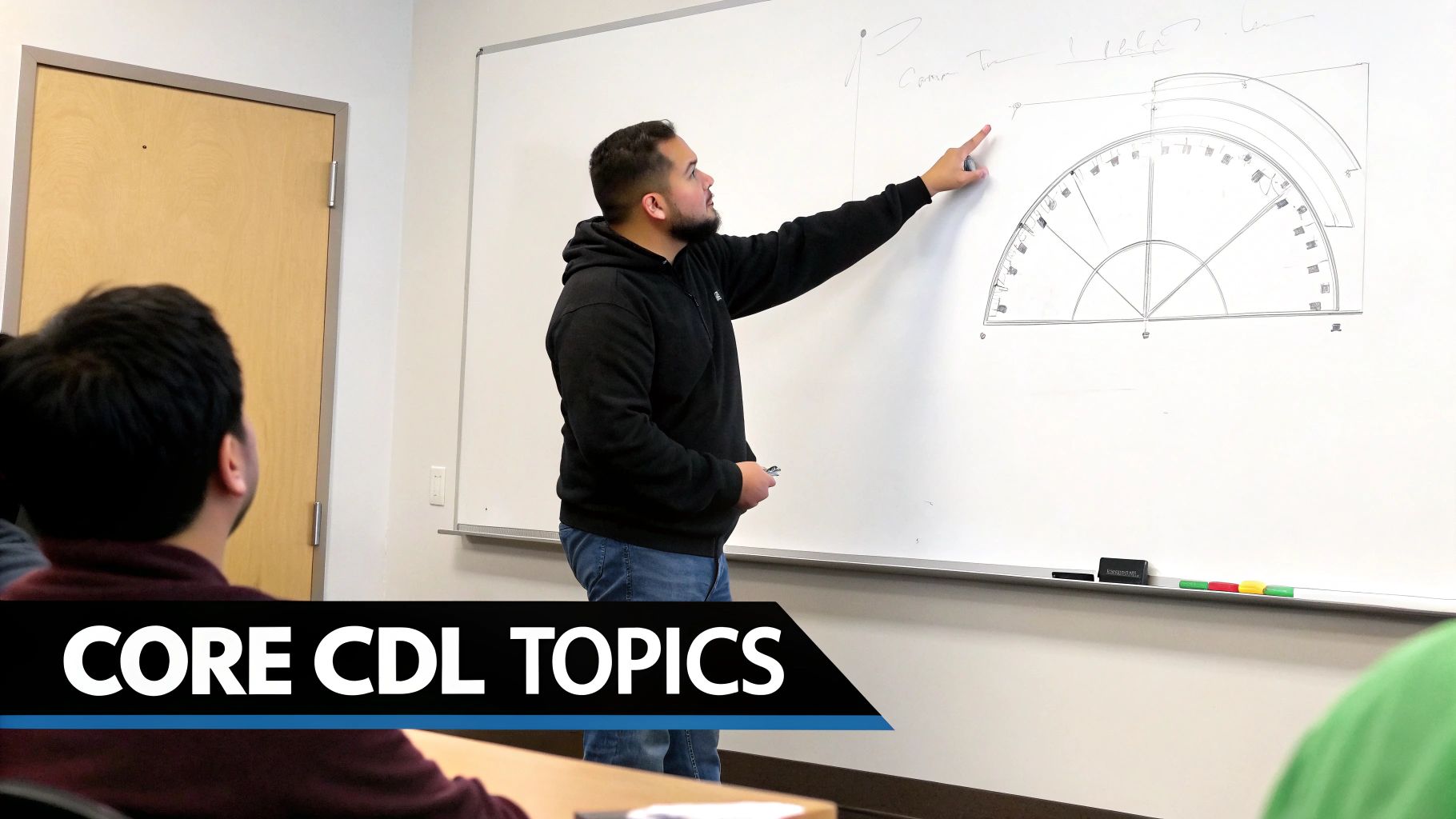
Before you can even think about getting behind the wheel, you've got to conquer the written knowledge test. It helps to know exactly what you're up against. This isn't one giant exam; it's a series of specific tests. Your journey starts with mastering the "big three": General Knowledge, Combination Vehicles, and Air Brakes.
Passing these isn't just about memorizing facts to pass a test. It's about building the foundational knowledge you'll rely on every single day out on the road. Let's break down what's inside each of these crucial sections.
The Foundation: Your General Knowledge Test
Think of the General Knowledge test as the bedrock of your entire CDL career. You have to pass this one first, before you can even move on to most of the other endorsement tests. It casts the widest net, covering topics every single commercial driver needs to know inside and out, no matter what they're driving.
This test is all about real-world application. You won't just be asked to recite a rule; you'll have to apply it to a situation you could actually face. For instance, a question might describe a slick, downhill grade and ask you to choose the safest way to manage your speed. It forces you to think like a pro from the get-go. For a deeper dive, check out our complete guide to the General Knowledge Test.
You can expect to be tested on:
- Vehicle Inspection: This is way more than kicking the tires. You need to know the proper pre-trip, in-trip, and post-trip inspection process cold. More importantly, you have to know which defects are critical enough to take a vehicle out of service.
- Basic Vehicle Control: We're talking about the fundamentals—accelerating, steering, and braking smoothly. Questions will hit on managing the space around your rig, using your mirrors effectively, and taking corners without incident.
- Hazard Perception: A huge part of being a professional driver is spotting trouble before it finds you. This means knowing how to scan ahead, identify drivers who aren't paying attention, and anticipate dangers at intersections or through work zones.
- Emergency Procedures: When things go wrong, you have to react correctly. You’ll need to know exactly what to do for a tire blowout, brake failure, or a nasty skid.
CDL Knowledge Test Core Sections at a Glance
To give you a clearer picture, the core written tests follow a standard format across most states. Here’s a quick summary of what to expect for the main sections.
| Test Section | Typical Number of Questions | Passing Score Required |
|---|---|---|
| General Knowledge | 50 Questions | 80% (40 Correct) |
| Combination Vehicles | 20 Questions | 80% (16 Correct) |
| Air Brakes | 25 Questions | 80% (20 Correct) |
Remember, these are the national minimums. Your state might have a slightly different number of questions, but that 80% passing score is the universal standard you need to hit.
Mastering Combination Vehicles
If a Class A license is your goal, the Combination Vehicles test is non-negotiable. This exam zeroes in on the unique physics and challenges that come with driving a tractor-trailer. These rigs handle completely differently than a straight truck, and this test makes sure you understand why.
One of the biggest concepts you'll have to master is offtracking. This is where your trailer's wheels take a shorter path than your tractor's wheels in a turn. A classic question will show you a diagram of a right-hand turn and ask you to pick the path that avoids taking out a street sign or climbing the curb.
The "crack-the-whip" effect is another concept they'll test you on. It describes how a sudden jerk of the steering wheel can cause the back of your trailer to swing out violently, which is a major cause of rollovers. Knowing this is absolutely critical for making safe lane changes.
Understanding the Air Brakes System
For nearly all Class A and Class B drivers, the Air Brakes test is a must-pass. Air brake systems are far more complicated than the hydraulic brakes in your personal car, and knowing how to operate and inspect them is a life-or-death skill.
This section gets technical. You’ll need to know what all the different components do—the air compressor, the governor, the storage tanks, the brake chambers, all of it.
A huge chunk of the test focuses on the proper air brake inspection procedure. You must have the multi-step process for checking for leaks and verifying that your low-pressure warning alarm and emergency brakes activate at the right PSI memorized. Nail this down now, because you'll be doing it every single day of your career.
An Actionable Three Week Study Plan
Let's be honest: passing the CDL knowledge test isn't about pulling an all-nighter with a gallon of coffee. That’s a recipe for failure. Real success comes from a smart, consistent plan that builds your knowledge day by day. This three-week schedule is designed to do just that, breaking down the massive CDL manual into manageable, daily goals.
Forget the guesswork. This structured approach ensures you cover every critical topic without getting overwhelmed. You’ll build a solid foundation of knowledge that will get you through test day and stick with you on the road.
Week One: Focus on General Knowledge
Your first week is all about one thing: General Knowledge. This is the biggest, most important part of the written exam. Give it a full week of your undivided attention. Trying to swallow the entire manual in one sitting will only lead to burnout.
Instead, slice the General Knowledge section into five smaller, digestible daily readings. The goal here is real comprehension, not just skimming the pages. If you're looking for ways to make the information stick, there are proven techniques like active recall.
Here’s a practical way to break down Week One:
- Day 1: Vehicle Inspection and Basic Vehicle Control
- Day 2: Shifting Gears and Seeing (Visual Search)
- Day 3: Communication and Space Management
- Day 4: Controlling Speed and Hazard Perception
- Day 5: Emergency Maneuvers and Skid Control
Right after you finish each day's reading, take a 15-20 question practice quiz on only the topics you just studied. This immediate feedback is one of the best ways to lock that information into your memory.
Week Two: Master the Technical Endorsements
Now that you have a solid General Knowledge base, Week Two dives into the more technical stuff: Air Brakes and Combination Vehicles. These sections are shorter, but they’re dense. You can’t just breeze through them.
Split the week in two. Dedicate the first three days entirely to Air Brakes. You'll need to know the system components by heart, memorize the PSI ranges for cut-in and cut-out, and master the step-by-step process for the full air brake system check.
Pro Tip: Don't just read about the air brake check—visualize it. Seriously. Find videos of drivers actually performing the check and say the steps out loud as you follow along. It’s a game-changer compared to just staring at the manual.
For the second half of the week, turn your attention to Combination Vehicles. The big concepts here are offtracking, the infamous "crack-the-whip" effect, and the exact procedures for coupling and uncoupling. These topics are all about the physics of a rig in motion, so pay close attention to any diagrams you see.
Week Three: Reinforce and Simulate
The final week is all about building rock-solid confidence and kicking test-day nerves to the curb. Stop learning new material. Your mission now is to reinforce what you already know and get used to the real test environment.
Your new best friend this week? Full-length, timed practice exams. They should cover all three core areas—General Knowledge, Air Brakes, and Combination Vehicles—just like the official test. This is how you master your pacing and get comfortable with the pressure of the clock ticking down.
- Analyze Every Mistake: Don't just glance at your score and move on. For every single question you get wrong, go back to the manual and find the exact paragraph that explains the right answer. Figure out why you missed it.
- Identify Your Weak Spots: After taking two or three practice exams, you’ll start to see patterns. Are you always fumbling questions about axle weights? Or maybe the specifics of the air brake check are still fuzzy? Hammer those specific topics with extra study time.
This final week is what separates hoping you'll pass from knowing you will. Of course, for those who want a fully guided experience from start to finish, a structured CDL training program builds this kind of preparation right into the curriculum. By the time you walk into that testing center, you won't be guessing—you'll be ready.
Using Practice Tests to Guarantee a First-Try Pass
Let's be blunt: practice tests are the key to acing your CDL knowledge exam. But there’s a right way and a wrong way to use them. Just blazing through a quiz, glancing at your score, and moving on won't cut it. To really nail this, you need to treat every practice session like a diagnostic tool, figuring out exactly where you’re strong and, more importantly, where you’re weak.
This isn’t about just memorizing answers. It’s about understanding the why behind them. When you get this down, you can walk into the DMV with the confidence that you're not just ready—you're over-prepared. A first-try pass won't be a hope; it'll be the expected outcome.
A structured plan is your best friend here. Breaking down your prep over a few weeks makes the whole process feel less overwhelming and much more manageable.
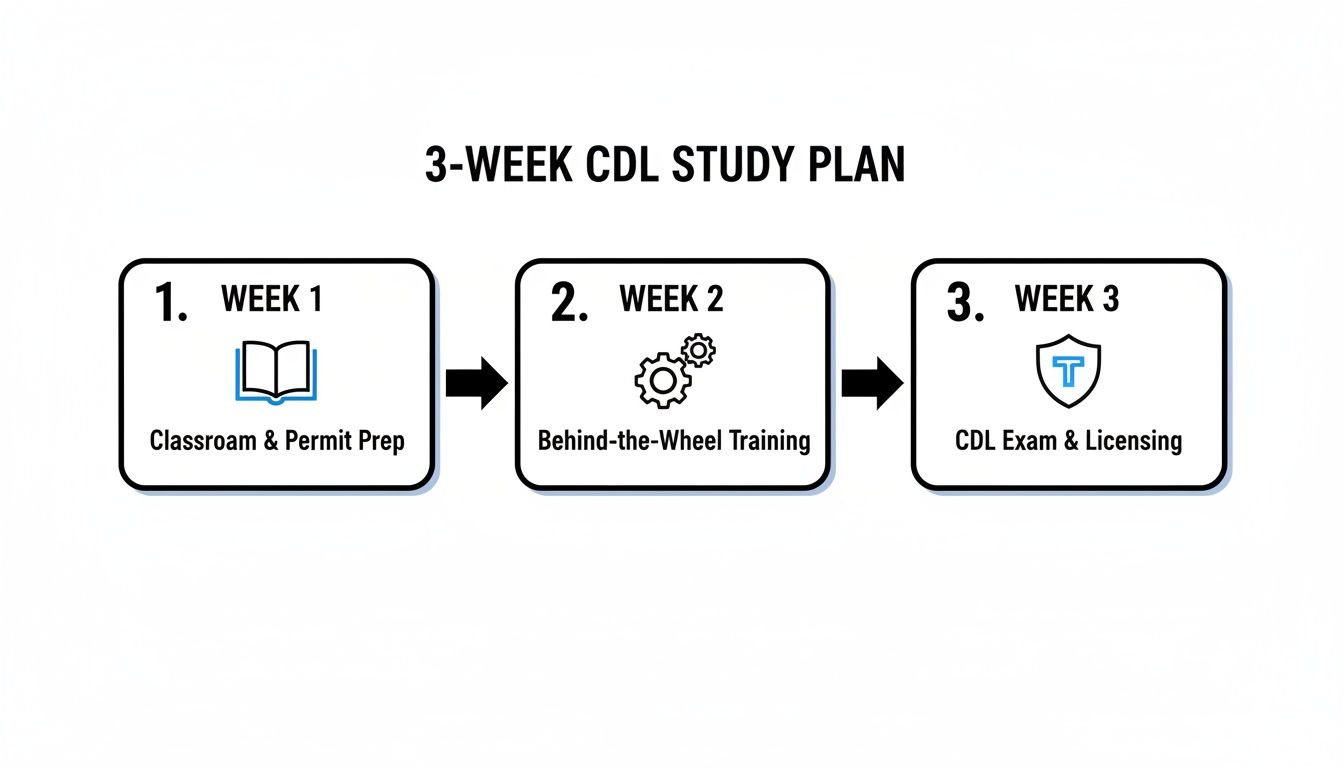
This kind of methodical approach—focusing on core knowledge first, then endorsements, then full-on exam simulation—builds a solid foundation for test day.
Start With Untimed Foundational Tests
When you're just starting out, forget the clock. Your only goals should be accuracy and understanding. Begin with untimed practice tests that drill down into specific sections of the CDL manual, like Air Brakes or Combination Vehicles. This takes the pressure off and lets you focus purely on the material.
Keep your CDL manual open and handy while you do these. If you hit a question and you're not 100% sure, look it up. The point isn't to guess your way to a good score; it's to actively learn and burn the information into your brain. For instance, if a question asks about the low-air warning PSI, don't just pick the number that feels right. Flip to the air brakes section and read exactly what it says. That small action makes the information stick.
Analyze Your Results Like a Pro
Alright, you finished a practice test. Now the real work begins. Don't just scan for the red X's. Go back and review every single question, even the ones you got right. Ask yourself: "Was I absolutely certain, or did I just get lucky with that guess?"
For every question you missed, you need to do a post-mortem:
- Pinpoint the Topic: Was it about inspections, shifting, or maybe hazmat placards?
- Hunt Down the Source: Grab your CDL manual and find the exact paragraph that covers that topic.
- Understand the 'Why': Read the text around the answer. Why is that option correct? Just as important, why are the others wrong?
This is how you find your knowledge gaps. You might discover you’re a rockstar on pre-trip inspections but shaky on skid control. That tells you exactly where to focus your study time. To really hammer down those tough spots, find quizzes that focus on them. For something as complex as the air brake system, a dedicated practice test can be a game-changer.
Transition to Timed Exam Simulations
Once you're consistently hitting 90% or higher on those untimed, section-specific quizzes, it’s time to turn up the heat. Switch over to full-length, timed practice exams. This is where you get a feel for the real deal, learning to manage the clock and handle the pressure.
Your new goal is to finish the entire test with a few minutes left on the clock. That extra time is gold, allowing you to go back and double-check any questions you flagged. Timed tests quickly show you if you're spending too much time on certain types of questions, helping you become faster and more decisive.
A school's first-time pass rate is a huge deal. Top-tier programs see rates from 70% to over 90%. Think about it: for every 100 students, jumping from a 60% to an 80% pass rate means 20 more drivers get on the road right away instead of getting stuck in retest limbo.
Dissecting Trap Questions and Tricky Phrasing
The official CDL test is known for being tricky. The questions are often written to catch you off guard if you've only memorized facts without truly understanding the rules. Practice tests are your best defense against these "gotcha" questions.
Keep an eye out for absolute words like "always," "never," or "except." They can completely flip the meaning of a question. Another classic trap is a scenario question where a few of the answers might seem correct, but you have to pick the "best" or "most important" action.
Working through these tricky questions during practice builds your instinct. You'll learn to spot the key detail they're really asking about, making sure you don't get tripped up when it counts.
Navigating State Requirements and Paperwork
Passing the CDL knowledge test is a huge milestone, but honestly, it's only half the battle. Before you can even sit for the exam, you've got to conquer a mountain of paperwork.
Think of it as the pre-trip inspection for your career. Showing up to the DMV unprepared is like trying to start a haul with a flat tire—you're just not going anywhere. Let’s get you a clear checklist so you can walk in with confidence, knowing you have every single document squared away.
Your DMV Document Checklist
Every state's DMV has its own little quirks, but the core documents you'll need for a Commercial Learner’s Permit (CLP) are pretty universal. Showing up with an incomplete file is probably the number one reason I see aspiring drivers get turned away. Don't let that be you.
Before you head to your appointment, get these things together:
- Proof of Identity and Age: A valid U.S. passport or an original birth certificate is your best bet.
- Social Security Card: They need the actual, original card. Memorizing the number isn't enough.
- Proof of Residency: Plan on bringing two. Utility bills, bank statements, or a lease agreement with your current name and address usually do the trick.
- Current Driver's License: You must have a valid, non-commercial license from the state where you're applying.
The DOT Medical Exam and Your Medical Card
No one gets behind the wheel of a commercial truck without a valid DOT Medical Examiner's Certificate, or "med card" as we all call it. This is completely non-negotiable.
You have to pass a physical exam, and it can only be done by a certified medical professional listed on the FMCSA National Registry. The examiner will check your vision, hearing, blood pressure, and run a urinalysis to screen for conditions like diabetes. Be straight with them about any health issues or medications you're taking—it just makes the whole process smoother.
Understanding Federal ELDT Mandates
One of the biggest changes to the CDL process in recent years is the federal Entry-Level Driver Training (ELDT) requirement. Gone are the days of just reading the manual and winging the test. Now, you must complete a certified theory curriculum from a provider on the FMCSA's Training Provider Registry.
The federal ELDT rules became official on February 7, 2022, and they completely changed the game. They set a new national standard for training, ensuring every new driver gets a consistent, solid foundation before they can even take their road test. This impacts tens of thousands of applicants every year.
This rule makes sure all new drivers learn the essentials, from vehicle systems to crucial non-driving skills like hours-of-service regulations. A good training school takes care of all the certification and submits your completion to the federal database, which is what makes you eligible to test.
If you're planning to drive in a specific area, it pays to know the local rules, too. You can look into the specific CDL requirements in California to see how state-level details fit in with the federal mandates.
What to Do If You Need to Retest
So, you didn't pass. It feels like a gut punch, I know. But before you let frustration take over, understand this: plenty of top-tier professional drivers didn't ace their knowledge test on the first try. This isn't the end of your journey; it's just a detour.
The most important thing to do right now is to walk away. Seriously. Don't immediately jump back into the study guide or get angry with yourself. Take a day, clear your head, and reset. Trying to study when you're frustrated is like trying to drive with a fogged-up windshield—you won't get very far.
Pinpoint What Went Wrong
Once you've had a chance to decompress, it's time to put on your detective hat. The testing center should give you a score report, and that little piece of paper is your roadmap to success. It breaks down your performance by section.
Don't just glance at the final score. Dig into the details. Did the air brakes section trip you up? Were the questions about hazardous materials a problem? Maybe it was the specifics of combination vehicle coupling that got you. Identifying exactly where you struggled is the key to creating a smarter, more targeted study plan.
Think of it this way: a retest is a second chance to master the material. Your score report just told you exactly which areas need the most work.
Instead of just re-reading the entire manual from cover to cover, you can now zero in on the chapters that gave you the most trouble. This is about working smarter, not just harder.
Most states will make you wait a bit before you can try again—anywhere from a day to a full week. Use that time productively. Also, be ready for another fee; retests are rarely free. With a focused strategy and a bit of persistence, you’ll turn this setback into a comeback.
Your Top Questions About the CDL Knowledge Test, Answered
If you're getting ready for your CDL knowledge test, you've probably got some questions buzzing around your head. It's totally normal. Let's cut through the noise and get you some straight answers from folks who've been there.
What Happens if I Don't Pass? How Many Retakes Do I Get?
First off, take a deep breath. Failing a test attempt isn't the end of your driving career—not by a long shot. Every state handles it a bit differently, but you can absolutely retake the test.
Most states make you wait a little while before your next shot, usually anywhere from one to seven days. This isn't a punishment; it's a built-in "cool down" period designed to get you to hit the books on the sections you struggled with instead of just trying to guess your way through. The main thing to remember is that you'll likely have to pay the test fee again for each attempt, so it pays (literally) to be prepared.
Seriously, How Hard Is This Test?
I won't sugarcoat it: the CDL knowledge test is challenging. It has to be. It's the gatekeeper that ensures everyone sharing the road with an 80,000-pound vehicle knows their stuff, from safety rules to complex vehicle systems.
But "challenging" doesn't mean "impossible." Where most people trip up is trying to memorize answers instead of actually understanding the concepts. You can memorize the steps of an air brake test, but if you don't know why you're doing them, a scenario-based question will throw you for a loop. If you focus on the "why" behind the rules—why you need a certain following distance, why you check your tires a specific way—the questions start to feel a lot more like common sense.
Passing isn't about rote memorization. It’s about proving you have the fundamental knowledge to be a safe, responsible professional driver.
What's the Fastest Way to Get Ready and Pass?
Everyone wants the magic bullet, the "fastest" way to study. The truth is, the quickest path to a passing score is a smart one, not a rushed one. Pulling an all-nighter with the manual the day before the test is probably the slowest path to actually getting your permit.
The most efficient method that we see work time and time again boils down to two things:
- Your State's CDL Manual: This isn't just a suggestion; it's the source code for the entire test. Every single question you'll face originates from this book.
- High-Quality Practice Tests: Reading the manual gives you the knowledge. Taking practice tests teaches you how to apply it, shows you where you're weak, and gets you comfortable with the question formats.
Forget cramming. A steady, disciplined approach of reading a chapter and then immediately taking a practice quiz on that topic will get you ready faster and more effectively than any last-minute panic session.
Ready to stop worrying and start preparing with a proven plan? At Patriot CDL, we provide the structured training and expert guidance you need to pass your CDL knowledge test with confidence. Learn more about Patriot CDL training.