Think of CDL passenger endorsement practice tests as your secret weapon for acing the real exam. They’re the most straightforward way to get a feel for the actual questions and topics you'll encounter at the DMV. By simulating the test environment, you can quickly pinpoint any weak spots in your knowledge, whether it's vehicle inspections, passenger safety rules, or emergency procedures. Nail these practice runs, and you'll walk into your test with the confidence you need.
Understanding the CDL Passenger Endorsement Exam
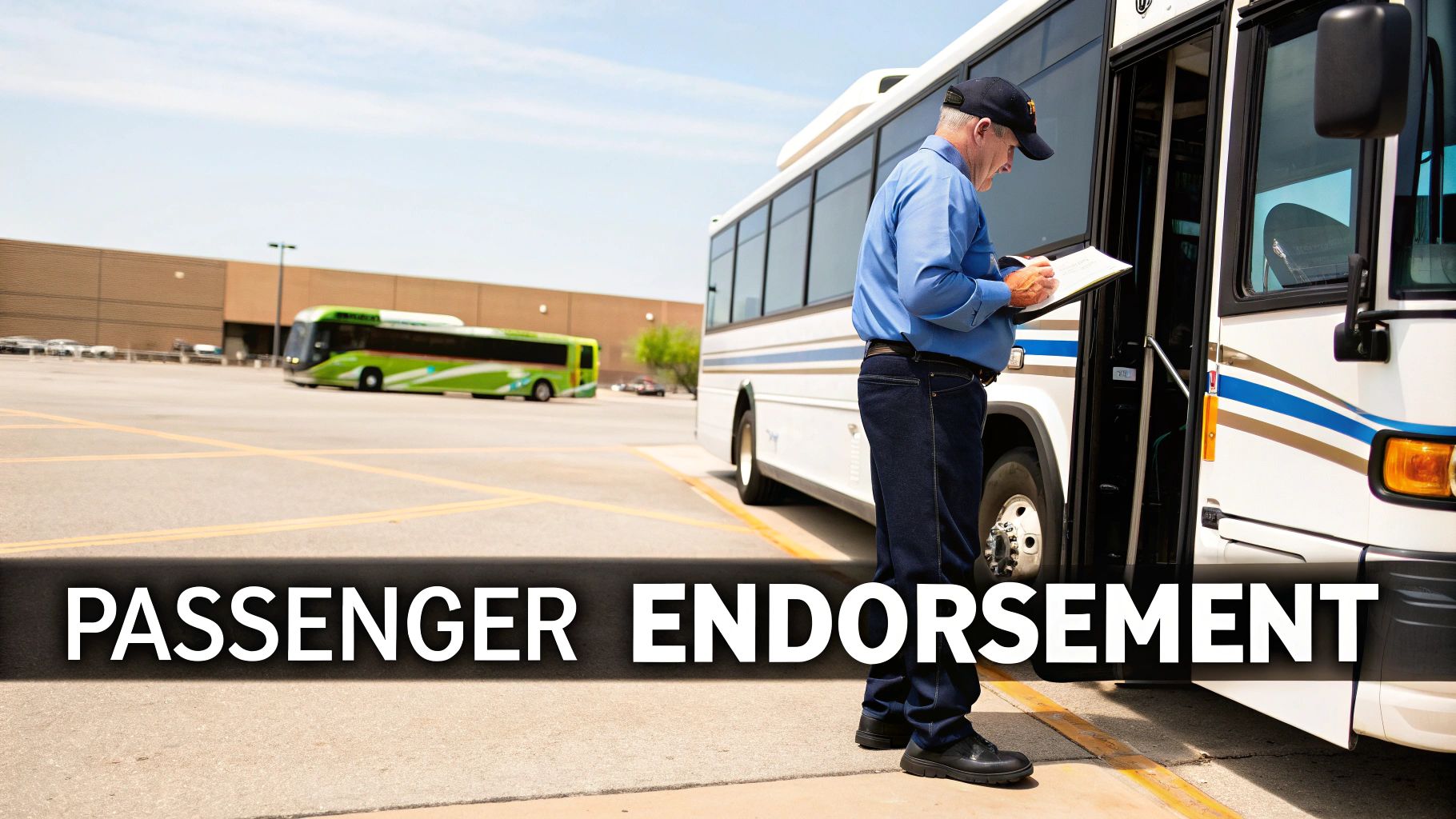
Before you can start a career moving people, you’ll need the Passenger (P) Endorsement on your Commercial Driver's License. This isn't just a suggestion; it's a federal mandate for anyone driving a vehicle built to carry 16 or more passengers, yourself included. Think of it less as a hoop to jump through and more as proof that you have the specialized skills to keep every single person on your vehicle safe.
The exam is a written knowledge test, but it goes far beyond basic road signs. It focuses on the unique scenarios and regulations that come with transporting people. The whole point is to distinguish passenger transport from hauling freight—it’s about managing the human element. The test confirms you're ready for the huge responsibility of carrying people, not just cargo.
Core Knowledge Areas on the Test
To pass, you'll need to master several key areas. The questions aren't just about general driving rules; they're designed to test your response in specific, high-stakes situations you'll face on the job.
Here’s what you should expect to be tested on:
- Vehicle Inspections: This is more than a standard pre-trip. You'll need to demonstrate knowledge of inspecting emergency exits, passenger seats, PA systems, and other equipment found only on buses or large passenger vans.
- Loading and Unloading Procedures: The test will cover the right way to board and de-board passengers safely. This includes the rules for designated stops and how to manage the flow of people getting on and off.
- Passenger Management: Get ready for questions on handling difficult passengers, addressing people's needs, and maintaining order and safety inside the vehicle.
- Emergency Situations: You must know the correct procedures for evacuating the vehicle, dealing with medical emergencies on board, and responding to an accident.
- Special Safety Considerations: Expect to see questions about navigating railroad-highway grade crossings, handling drawbridges, and knowing what’s strictly forbidden, like fueling with passengers on board.
Why This Endorsement Matters
Picture yourself behind the wheel of a city bus, guiding dozens of people to their destinations safely. The CDL passenger endorsement is what makes that career possible. It’s a key that unlocks your role in our country's transportation system. Recent labor stats show there are over 1,356,501 CDL drivers employed in the U.S., and while trucking gets a lot of attention, a huge number of them hold the P endorsement.
This endorsement opens doors to jobs in public transit, school bus driving, private charter services, and the tour industry. It's a solid investment in a stable and fulfilling career where safety is everything.
Passing this exam comes down to having a great study plan. First, you need to be sure you understand all the specific CDL requirements in your state. From there, using CDL passenger endorsement practice tests is hands-down the best way to transform the dense rules in the CDL manual into practical knowledge you can actually use on test day.
Finding Practice Tests That Mirror the Real Exam
When you're gearing up for your passenger endorsement test, finding the right study materials can feel like a hunt. Let's be clear: not all practice tests are created equal. You need resources that do more than just ask questions; you need them to simulate the real deal you'll face at the DMV. Think of a good practice test as a full-dress rehearsal—it builds the confidence and muscle memory you need to walk in and ace it.
The whole point of the CDL passenger endorsement is to ensure drivers can safely transport millions of people every day. That's why the feds have standardized the testing process. In fact, a 2015 FMCSA report found that updates made back in 2014 had already significantly improved testing consistency across all 50 states. This is exactly why practicing with up-to-date, accurate materials that reflect these high standards is a non-negotiable part of your prep.
Official Manuals vs. Third-Party Resources
Your state's official CDL manual is the bible. It's the source document for every single question on the exam, so you have to start there. But let's be honest, reading it cover-to-cover is a surefire way to fall asleep. It gives you the information, but it doesn't give you the interactive feedback of a real test.
That's where quality third-party resources come in. They take all that dense, dry information from the manual and package it into an active learning tool. The best ones have a massive bank of questions, so you're constantly seeing new scenarios instead of memorizing the same handful of answers.
Key Takeaway: The winning strategy is to use both. Treat the official manual as your textbook and high-quality practice tests as your workbook. One gives you the knowledge, the other helps you apply it.
What to Look for in a Quality Practice Test
An effective practice test isn't just a quiz; it’s a diagnostic tool. It should pinpoint your weaknesses, help you learn from your mistakes, and build genuine confidence for test day.
Here are the features you should absolutely insist on:
- Detailed Answer Explanations: A simple "correct" or "incorrect" is useless. You need a platform that explains why an answer is right, ideally pointing back to the specific rule in the CDL manual. Every mistake becomes a lesson.
- Realistic Question Formatting: The questions should feel like they were pulled straight from the DMV exam. The wording, the structure, the scenarios—it all needs to match up to avoid any surprises.
- A Massive Question Bank: A large pool of questions is critical. It guarantees you'll be tested on everything from pre-trip vehicle inspections and loading procedures to handling difficult passengers and emergency situations.
- Timed Test Simulations: Once you feel like you have a decent grasp of the material, timed tests are your best friend. They train you to work efficiently under pressure and build the focus you'll need to stay sharp for the entire exam.
Weaving Practice Tests into Your Study Plan
Kick off your prep with untimed practice tests. In the beginning, speed is not the goal—understanding is. Use these first few sessions to figure out where your knowledge gaps are. If you keep stumbling on questions about railroad crossings or prohibited practices, you know exactly which chapter of the manual needs your attention.
Once your scores start climbing, switch over to timed simulations. This is a crucial step for sharpening your test-taking instincts and making sure you can answer every question accurately before the clock runs out. And don't forget, the P endorsement test assumes you already know the basics. Before you get too deep in the weeds, make sure your core CDL knowledge is rock-solid by reviewing the material in our guide to the general knowledge test. It’s all about building a strong foundation first.
A Strategic Study Plan Centered on Practice Tests
Jumping into a stack of practice tests without a real plan is like trying to drive a new route without a GPS. You might get there eventually, but you'll waste a lot of time and fuel. A smart, structured approach, on the other hand, turns those cdl passenger endorsement practice tests from simple quizzes into your best study tool.
The key is using them to diagnose your weaknesses from the very beginning.
Find Your Starting Point
Before you even crack open the CDL manual, take a full-length practice test. Don't sweat the score—this isn't about passing just yet. Think of it as a baseline assessment. It gives you a raw, honest look at what you already know and, more importantly, what you don't.
Maybe you're a natural with passenger management rules but draw a blank when it comes to pre-trip inspections on buses. That first test result becomes your personalized roadmap, pointing you directly to the sections that need the most attention.
From Diagnosis to Targeted Study
Once you've got your results, the real work begins. Don't just glance at the score. You need to dig into every single question you got wrong. A good practice test will always explain why an answer is correct, and that feedback is pure gold.
Instead of trying to memorize the entire manual from cover to cover, use your test results to focus your energy. Missed three questions about emergency procedures? That’s your signal to find and master that specific section. This targeted approach saves a ton of time and stops you from getting bogged down reviewing things you've already got handled.
To make the information really stick, try integrating some proven study note-taking strategies. Sometimes, just physically writing down a rule you're struggling with is enough to lock it in.
This simple workflow is the core of an effective study strategy.
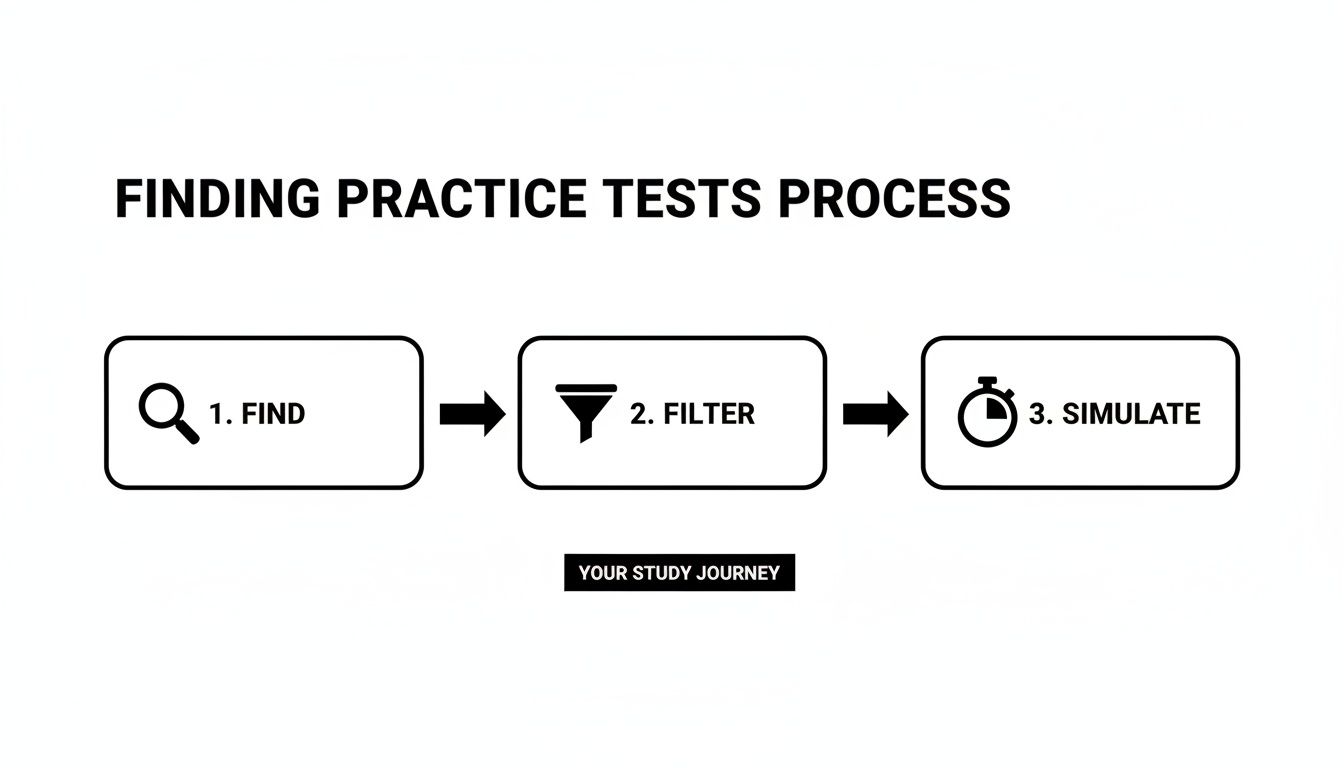
This Find, Filter, and Simulate cycle turns practice tests from a passive review into an active learning system that adapts as you improve.
Building Your Study Schedule
How much time you have will obviously shape your study plan. Whether you have two weeks or six, the core idea is the same: diagnose your weak spots, focus your efforts there, and repeat the process. A solid training school will help you build this kind of structure. Seeing how a full CDL training program is laid out can give you great ideas for putting together your own schedule.
To get you started, here's a sample four-week plan you can adjust to fit your life.
Your 4-Week Passenger Endorsement Study Plan
This schedule is designed to move you from identifying weaknesses to building speed and confidence for the real exam.
| Week | Focus Area | Practice Test Goal | Study Activity |
|---|---|---|---|
| Week 1 | Diagnostic & Foundation | Take one untimed diagnostic test to identify your weakest 2-3 areas. | Focus exclusively on your weak areas in the CDL manual. Take notes on key rules and regulations you missed. |
| Week 2 | Reinforcement | Take two untimed practice tests, aiming for an 80% score or better. | Review incorrect answers from each test immediately. Reread the corresponding manual sections. |
| Week 3 | Speed & Accuracy | Begin taking timed practice tests. Aim to finish with 5-10 minutes to spare. | Simulate real test conditions. Put away your phone and notes. Focus on answering accurately under pressure. |
| Week 4 | Final Polish | Take one timed practice test every other day. Consistently score 90% or higher. | Review all notes and flagged questions from previous weeks. Get a good night's sleep before the exam. |
By following this cycle—test, analyze, study, repeat—you'll build the deep knowledge and confidence you need to walk into the DMV and pass.
Key Takeaway: Every wrong answer on a practice test is a cheap lesson. It’s your chance to fix a blind spot now, not when it counts. Embrace those mistakes; they're the most valuable part of the entire process.
A Look at Some Sample Passenger Endorsement Questions
The best way to see how well you know the CDL manual is to see the rules applied in real-world questions. Getting familiar with cdl passenger endorsement practice tests is what separates the people who pass on the first try from those who don't. It’s one thing to read a rule; it’s a completely different ballgame to pick the right answer when a few options look plausible.
Let's walk through a few examples that mirror what you'll see on the actual P Endorsement exam. I'll break down the "why" behind each correct answer so you can see the logic, not just memorize facts.
Question 1: Passenger Safety
When is it acceptable to fuel your bus?
A) When passengers are on board, as long as the engine is off.
B) In a closed building with passengers on board.
C) With passengers on board, but only at a designated truck stop.
D) Never with passengers on board.
Correct Answer: D
Explanation: This is one of those black-and-white safety rules you just have to know. There are absolutely no exceptions—you must never fuel your vehicle with passengers on board. The risk of fire is just too high. The proper procedure is to have everyone off the bus and at a safe distance before you even think about touching the fuel pump.
Question 2: Vehicle Inspection
During your pre-trip inspection, you must check for which of the following emergency equipment?
A) A fire extinguisher, spare electrical fuses, and a first-aid kit.
B) A fire extinguisher, emergency reflectors, and spare electrical fuses (unless the vehicle has circuit breakers).
C) A tool kit, a fire extinguisher, and a spare tire.
D) Emergency reflectors, a first-aid kit, and a set of tire chains.
Correct Answer: B
Explanation: Federal law is very specific about the emergency gear required on a commercial passenger vehicle. The big three are a properly charged fire extinguisher, a set of three red reflective triangles, and spare electrical fuses (if your bus uses them instead of circuit breakers). While having a first-aid kit is always a smart move, it's not a federally mandated item like the others. You can find a complete rundown in our guide to mastering the CDL pre-trip inspection.
Question 3: Prohibited Practices
Which of the following activities is strictly prohibited while you are driving a bus?
A) Talking to passengers about the route.
B) Adjusting the radio or climate controls.
C) Engaging in distracting conversation with any passenger.
D) Drinking a bottled water.
Correct Answer: C
Explanation: This one gets a lot of people. Of course, you have to talk to passengers sometimes. But federal rules draw a hard line at any conversation that becomes a distraction. Your focus has to be 100% on the road. The other actions, like a quick radio adjustment or taking a sip of water, are generally permissible as long as they don't take your attention away from driving. Unnecessary chatter, however, is explicitly forbidden.
Question 4: Loading and Unloading
When must you announce the location, reason, and duration of a stop?
A) Only at designated bus stops.
B) At every stop, no matter where it is.
C) Only when a passenger asks.
D) Only during long-distance charter trips.
Correct Answer: B
Explanation: Clear communication is a cornerstone of being a professional driver. You are required to announce every single stop. Tell your passengers where you are, why you're stopping, and how long it will be. This simple act prevents confusion and keeps passengers feeling safe and informed, which is especially important during an unexpected delay or at a stop that isn't on the regular route.
Question 5: Handling Onboard Situations
If a disruptive passenger is causing a problem on your bus, what is the best course of action?
A) Stop the bus and order the passenger to get off immediately.
B) Ignore the passenger to avoid escalating the situation.
C) Wait until the next scheduled stop to address the issue.
D) Pull over in a safe location and contact your dispatcher or the police.
Correct Answer: D
Explanation: Your number one job is keeping everyone safe—including yourself. Trying to play hero and handle a seriously disruptive person on your own is a recipe for disaster. The correct and safest protocol is to pull over to a secure, well-lit spot as soon as you can and radio your dispatcher for instructions or call the police if the situation warrants it. Don't engage and don't escalate.
Your Game Plan for Test Day and Beyond
After all the hours you've put in with those cdl passenger endorsement practice tests, this is the final sprint. But being truly prepared isn't just about knowing the material cold—it's about having a rock-solid plan for test day and knowing what comes next. A calm, methodical approach can be the deciding factor between passing and failing.
This is where you execute. Let’s make sure your logistics are buttoned up, your mind is clear, and you have a plan no matter how the test goes.
The Ultimate Test Day Checklist
There's nothing worse than walking into the DMV flustered. That kind of last-minute stress can sabotage your performance before you even see the first question. The key is to get everything ready the night before.
Here’s what your pre-exam checklist should look like:
- Your Paperwork: Don't guess. Double-check your state's exact DMV requirements online. You'll absolutely need your valid driver's license, Social Security card, and proof of residency. Keep them all together in one folder.
- Medical Certificate: Grab your current DOT Medical Examiner's Certificate. Take a second to confirm it hasn't expired.
- Fees & Confirmation: Have any appointment paperwork with you and be ready to pay the testing fees. It's smart to know the exact amount ahead of time.
- Fuel Your Brain: Seriously, get a full night's sleep. Late-night cramming is far less effective than a rested mind. On the morning of, eat a decent meal so a rumbling stomach doesn't break your focus.
Get to the DMV at least 15-20 minutes early. This buffer gives you time to park, check in, find the restroom, and just take a deep breath. Rushing breeds anxiety, and anxiety is the enemy of a good test score.
What If You Don’t Pass the First Time?
Look, nobody likes to think about failing, but having a backup plan isn't pessimism—it's professionalism. If you don't pass on your first go, don't spiral. Think of it as a diagnostic report that tells you exactly where you need to focus.
Your score report is pure gold. It breaks down the sections where you missed points. This is your new study guide.
Let's say you stumbled on the questions about emergency procedures. Your next study session should be dedicated only to that chapter in the CDL manual and those specific practice questions. If vehicle inspection was your weak spot, drill those questions until you can't get them wrong. This targeted repair work is way more effective than just taking the same general practice tests again. Most states make you wait a bit before you can retest, so use that time to turn your weaknesses into strengths.
Life After Earning Your P Endorsement
Passing the test is a huge milestone, but it's not the finish line—it's the starting gate. Having that P Endorsement on your CDL instantly makes you a more valuable, versatile driver in the job market.
A whole new set of doors just opened for you. With your P Endorsement, you can start looking at careers in:
- Public Transit: Driving city buses.
- School Transportation: Becoming a school bus driver.
- Private Charter/Tours: Operating motorcoaches for tour companies or even sports teams.
- Shuttle Services: Driving shuttles for airports, hotels, and university campuses.
You’ve proven you have the specialized skills to be responsible for the safety of dozens of passengers. That's a big deal. Now, it's time to leverage that new credential into a long and rewarding career.
Answering Your P Endorsement Test Questions
Even with the best study plan, you're going to have questions. That's completely normal. Getting ready for any CDL endorsement test is a deep dive into specifics, and it’s easy to feel a little lost in the details.
Let's clear things up. Here are some no-nonsense answers to the questions I hear most often from drivers getting ready for their P Endorsement exam.
How Many Questions Are on the CDL Passenger Endorsement Test?
This can change a bit from state to state, but you should plan on facing 20 to 30 multiple-choice questions. The critical number to remember is the passing score, which is almost always 80% or higher. That doesn't leave you much wiggle room.
These aren't just simple true/false questions, either. They're designed to cover everything you'd be responsible for as a passenger vehicle operator. Expect to see questions on detailed pre-trip and post-trip inspections, proper loading procedures, how to manage passengers, and what to do in an emergency. This is exactly why using CDL passenger endorsement practice tests is so crucial—it prepares you for that wide range of topics.
Are Online Practice Tests Actually Good for the Real Exam?
Yes, absolutely—as long as you’re using high-quality ones. A well-designed online practice test is probably the most effective study tool you can get your hands on. They don’t just quiz you; they train you to recognize the specific format and tricky wording you'll encounter at the DMV.
The single most important feature to look for? Detailed answer explanations. It does you no good to just see you got a question wrong. You have to know why it was wrong. That’s how you turn a mistake into a lesson and truly master the material, not just memorize a bunch of answers. Stick to practice tests from trusted sources that are based on your state's official CDL manual.
Pro Tip: Avoid taking the same practice test over and over. You’ll just end up memorizing the answers for that specific test, not learning the concepts. Look for platforms with a big bank of questions so you're always being challenged with new scenarios.
What Are the Most Common Mistakes People Make?
Over the years, I've seen aspiring drivers stumble on the same few things. If you know what they are, you can sidestep them completely.
- Skipping the Manual: You'd be surprised how many people try to get by on practice tests alone without ever cracking open their state's official CDL manual. The manual is the source for every single test question. Don't skip it.
- Fuzzy on Prohibited Practices: Some rules are non-negotiable, like never fueling with passengers on board or avoiding distracting chatter. Drivers often get tripped up on the finer points of these regulations.
- Glazing Over Inspection Details: The pre-trip inspection for a bus has unique checks, like making sure emergency exits and PA systems work. Forgetting these specific passenger-vehicle steps is a surefire way to lose points.
How Long Is a Passenger Endorsement Valid?
Your Passenger (P) Endorsement is linked directly to your Commercial Driver's License. It stays valid for as long as your CDL does, which usually means renewing it every 4 to 8 years, depending on your state.
But renewing the license itself isn't the whole story. You also have to keep a valid DOT medical card on you at all times. On top of that, some jobs—especially driving a school bus—will require you to pass regular background checks and complete extra training to stay qualified. For more tips on keeping up with the rules of the road, check out the articles on our Patriot CDL blog. Always double-check with your local DMV to be sure you know the exact renewal requirements where you live.
Ready to move from studying to a hands-on career? The expert instructors at Patriot CDL can guide you through every step of earning your CDL and its endorsements. We don't just prepare you for the test—we prepare you for the job.
Find out more about our hands-on training programs at https://patriotcdl.com.