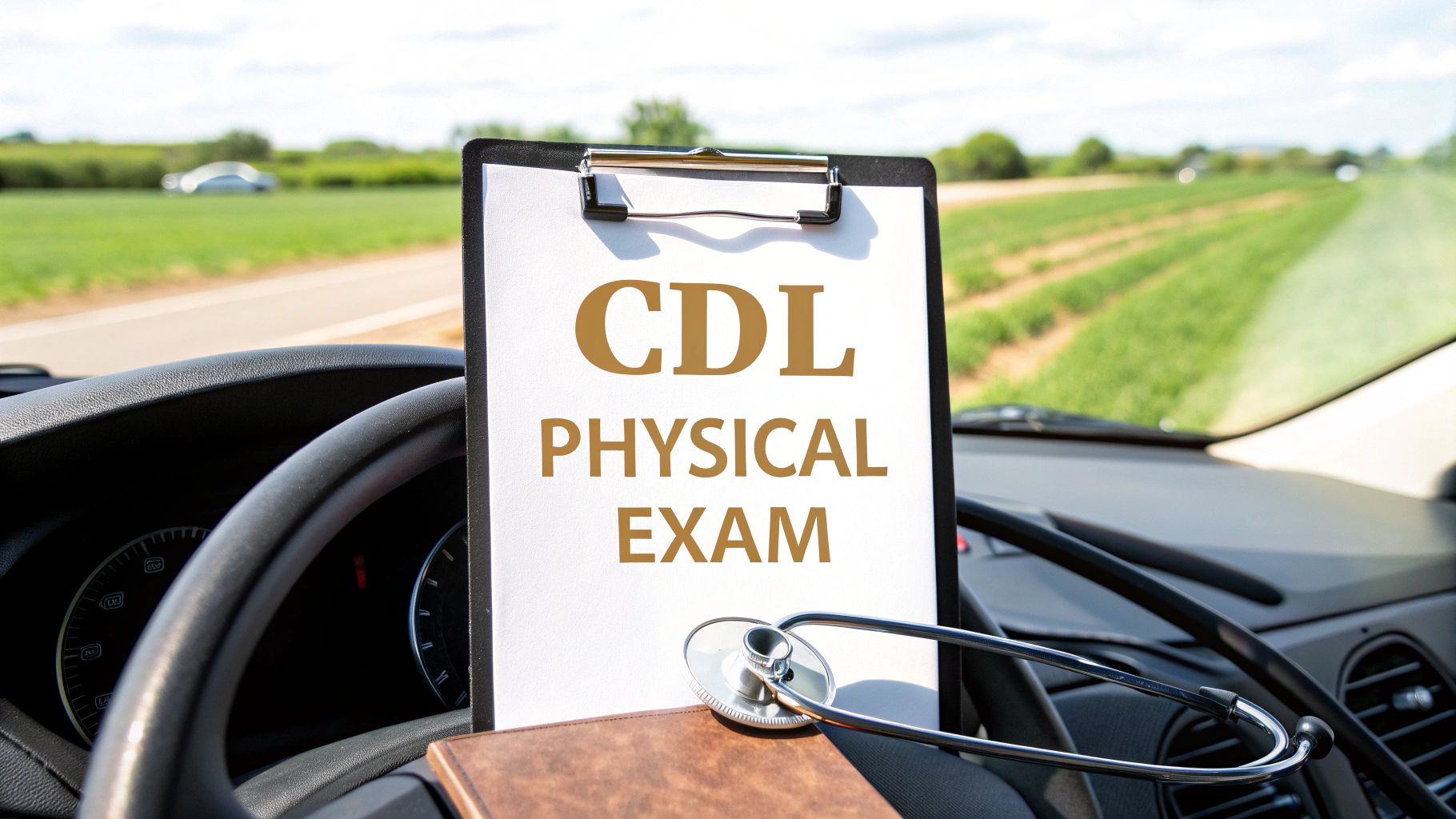
So, you’re ready to get your Commercial Driver’s License and hit the road. One of the very first steps on that journey is the CDL physical, which is officially called the Department of Transportation (DOT) medical exam.
This isn't just another doctor's appointment. It’s a required health screening to make sure you’re physically and mentally up to the challenge of safely handling a commercial truck. Think of it less as a test to pass and more as a safety check for yourself and everyone else on the road.
What Is a CDL Physical Exam and Why It Matters
You can think of the CDL physical as being a lot like a pilot's pre-flight check. Before a pilot ever steps into the cockpit, the plane goes through a detailed inspection. In the same way, the DOT wants to make sure every professional driver is medically fit for the huge responsibility of operating a commercial vehicle.
The whole point is simple: to confirm you have the health and stamina to drive safely, day in and day out, without putting yourself or the public at risk. This is a foundational part of your career, proving you can handle long hours and tough conditions. It's about more than just getting a certificate; it's about protecting your career and keeping the roads safe for all of us.
The Goal of the Exam
The exam isn't designed to be a roadblock or to disqualify people left and right. Its real purpose is preventative. A certified medical examiner will look at key health indicators to catch any potential issues before they can become a serious problem on the highway.
They’ll focus on a few key areas:
- Vision and Hearing: Can you clearly see road signs from a distance and hear sirens or other warning signals?
- Blood Pressure and Heart Health: They're checking for conditions that could potentially cause a sudden medical emergency while you're driving.
- Overall Physical Ability: You need the basic strength and mobility to handle the job, which is just as vital as knowing how to inspect your truck. In fact, learning more about the CDL pre-trip inspection helps you see why being physically prepared is so important.
Ultimately, the exam is a system of checks and balances. It ensures that the men and women driving our nation's trucks are in good health, making the highways safer for everyone.
Once you understand what the exam is all about, you can walk into your appointment with confidence. In the next sections, we'll break down the specific medical standards, how to get ready for the big day, and what to do if you have a pre-existing medical condition. It’s the first real step toward becoming a qualified, professional driver.
What the DOT Medical Exam Actually Looks For
Getting through the CDL physical isn't about being in peak physical condition like an Olympian. It's about meeting very specific health benchmarks laid out by the Federal Motor Carrier Safety Administration (FMCSA). These aren't arbitrary rules; they exist to make sure every driver on the road can safely manage the physical and mental demands of driving a big rig.
Let's break down what these standards really mean for you.
Think of it this way: each requirement is a non-negotiable safety feature. Sharp vision helps you spot a deer on the shoulder from a distance. Stable blood pressure ensures you don't have a medical emergency while navigating a tight curve. Good hearing lets you pick up on the sound of an ambulance siren long before you see it.
This diagram hits on the big three areas the medical examiner will focus on.
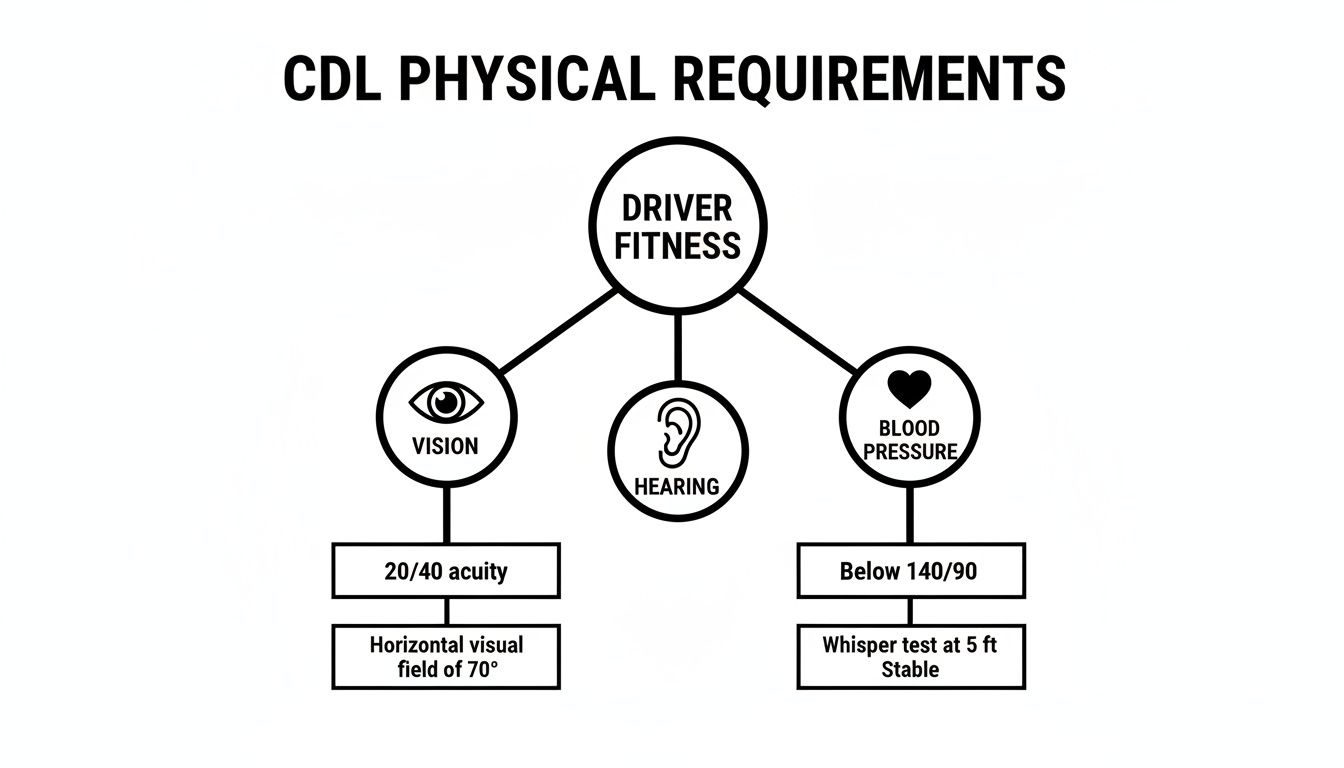
As you can see, the exam is built around the fundamentals—your vision, hearing, and heart health. These form the bedrock of your ability to safely operate a commercial vehicle.
H3: Vision and Hearing Requirements
On the road, your eyes and ears are your most important tools. The FMCSA has clear, firm lines on what's acceptable to ensure you can see and hear everything you need to.
- Vision Acuity: You need to have at least 20/40 vision in each eye and when using both eyes together. It doesn’t matter if you need glasses or contacts to get there. You also have to prove a horizontal field of vision of at least 70 degrees in each eye.
- Color Recognition: This one is simple but critical. You must be able to tell the difference between red, green, and amber—the colors of a traffic light.
- Hearing Standard: The test is pretty straightforward. You must be able to hear a "forced whisper" from five feet away in at least one ear. If you use a hearing aid, that's perfectly fine. If you can't pass this initial test, the examiner might send you for a formal audiometry test to get a more precise reading.
H3: Blood Pressure and Cardiovascular Health
Your heart health is a huge part of the DOT physical. The main goal here is to prevent a sudden medical crisis, like a heart attack or stroke, when you're in control of an 80,000-pound truck. The examiner will take your blood pressure and check your pulse to spot any red flags.
High blood pressure is the single most common reason drivers run into issues with their medical certification. But having hypertension doesn't mean you're automatically out. It just means you have to prove your condition is under control.
How long your medical certificate is valid for is directly tied to your blood pressure reading. To get the full two-year certification, your numbers need to be below 140/90 mmHg. If your readings are higher, you'll get a shorter certification, which is the FMCSA's way of ensuring you're staying on top of your health. The official CDL requirements for medical fitness are designed to be tough but fair.
While the system is designed to catch serious risks, it hasn't always been perfect. It’s shocking, but before the National Registry of Certified Medical Examiners was fully implemented, data showed that examiners were certifying 93.3% of drivers with Stage 3 hypertension (readings of 180/110 mmHg or higher)—a level that should have been an automatic disqualification. What's more, 42% of drivers with Stage 2 hypertension were given certifications longer than the mandated three-month temporary card.
This table shows exactly how your blood pressure numbers can affect your medical card.
DOT Blood Pressure Guidelines and Certification
| Blood Pressure Reading | Stage | Certification Length | Required Action |
|---|---|---|---|
| Under 140/90 mmHg | Normal | 2 Years | No immediate action needed. Continue routine health management. |
| 140-159 / 90-99 mmHg | Stage 1 Hypertension | 1 Year | Requires annual recertification to ensure the condition is managed. |
| 160-179 / 100-109 mmHg | Stage 2 Hypertension | 3 Months (One-Time) | Must lower blood pressure below 140/90 within 3 months to be recertified for 1 year. |
| 180/110 mmHg or Higher | Stage 3 Hypertension | Disqualified | You cannot be certified until your blood pressure is lowered to 140/90 or less. |
These guidelines are strict, but they're in place for everyone's safety on the road.
H3: Other Key Medical Evaluations
Beyond the big three, the examiner will check for a few other conditions that could affect your ability to drive safely.
- Diabetes: You can absolutely get certified if you have insulin-treated diabetes. You’ll just need to show that your condition is stable and well-managed, usually with a form or letter from the doctor who treats your diabetes.
- Sleep Apnea: Because fatigue is a massive safety risk, obstructive sleep apnea is taken very seriously. If you've been diagnosed, you'll likely need to bring data from your CPAP machine showing you use it regularly and that it's working effectively.
- Urinalysis: You'll provide a urine sample, but it’s not a drug test. This screening is simply to check for underlying health issues like kidney problems or untreated diabetes. Your employer will require a separate drug test.
Common Disqualifiers and How to Manage Them
It’s easy to worry that a health condition might stop your truck driving career before it even gets started. And while the CDL physical exam has firm standards, think of a tricky diagnosis as more of a checkpoint than a dead end. The real secret is being proactive and understanding what the examiner needs to see.
Instead of just listing problems, let's talk about solutions. Many of the most common disqualifiers can be handled with the right paperwork and a clear treatment plan, turning a potential roadblock into a manageable part of your health journey.
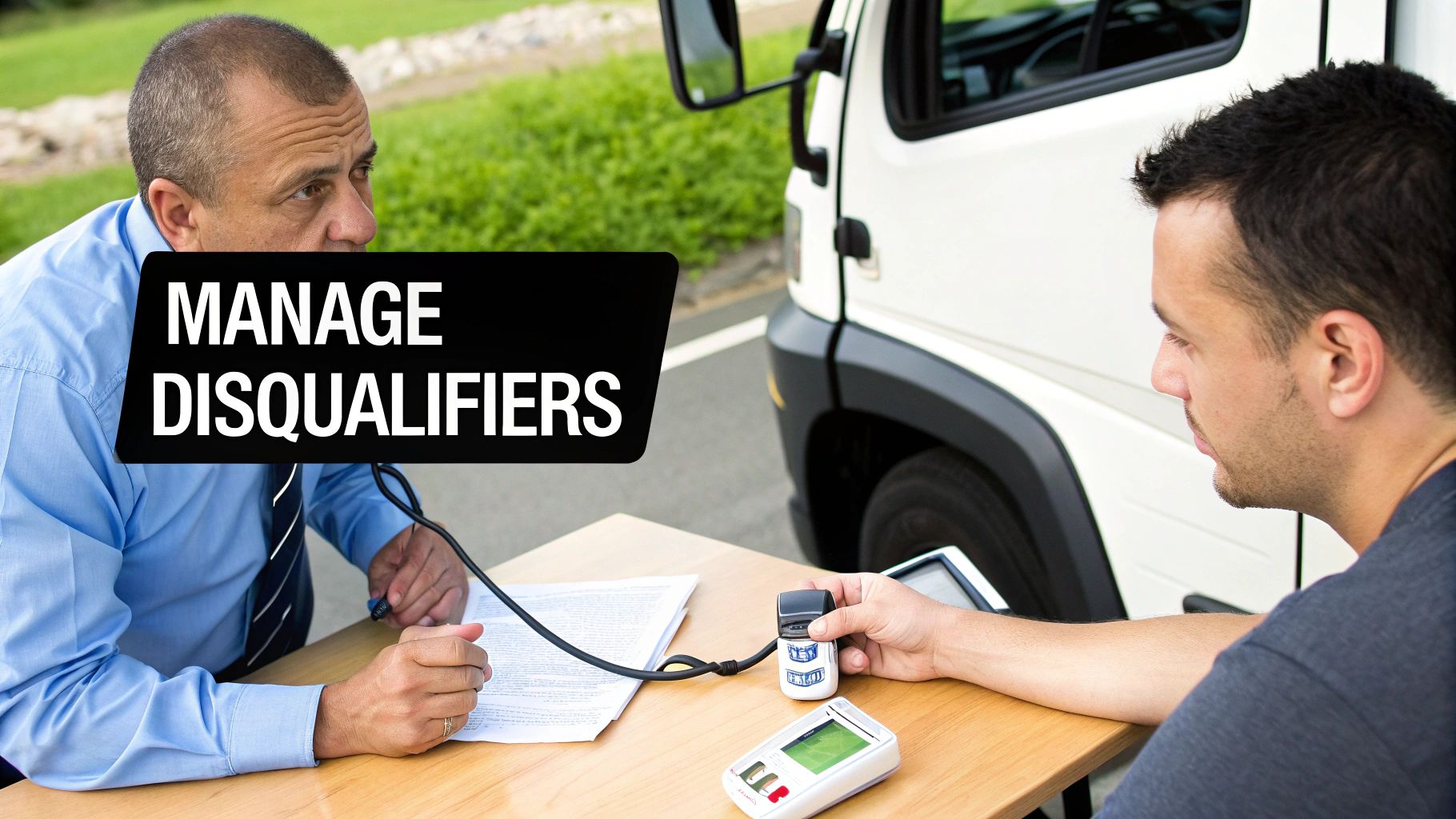
Uncontrolled High Blood Pressure
As we've covered, consistently high blood pressure is a top reason for getting disqualified or receiving a short-term medical card. But the key word here is uncontrolled. The FMCSA isn't looking for a perfect bill of health; they want to see that you and your doctor have things safely under control.
If you have hypertension, showing up with a documented treatment plan from your regular doctor changes everything. It shows the medical examiner you're responsible and actively maintaining your fitness to drive. For drivers who want to keep an eye on their numbers, an automatic digital blood pressure monitor can be a great tool for tracking at home.
Vision or Hearing Deficiencies
The standards for sight and hearing are non-negotiable. You’ve got to have 20/40 acuity in each eye (with or without glasses/contacts) and be able to hear a "forced whisper" from a set distance.
Failing to meet these standards is a definite disqualifier, but it’s also one of the easiest to fix ahead of time.
- For Vision: If you have any doubt at all about your eyesight, see an optometrist before your physical. A new prescription for your glasses or contacts can solve the problem on the spot.
- For Hearing: If you have trouble hearing, don't worry—hearing aids are perfectly acceptable. A quick visit to an audiologist will tell you if a device can help you meet the standard.
Poorly Managed Diabetes
Getting diagnosed with diabetes, even if you need insulin, doesn't automatically mean you can't drive. The medical examiner’s primary concern is simple: preventing a low blood sugar (hypoglycemic) event while you're on the road.
To get your medical card, you'll need to bring documents showing your condition is stable and well-managed. This usually means bringing in your blood sugar logs or having your endocrinologist fill out a specific form (like the MCSA-5870). It’s all about proving you’re on top of it. For instance, if you're interested in driving vehicles that previously had an automatic transmission restriction, you might find our guide on the E restriction removal course helpful in understanding how specific skills and certifications work.
Certain Heart Conditions
A history of heart problems—like a heart attack, angina, or cardiac surgery—will naturally lead to a closer look from the examiner. You will almost certainly need to get a clearance letter from your cardiologist.
This letter needs to state clearly that your condition is stable and you aren't at risk of sudden collapse. The examiner will also likely want to see recent stress test results to confirm your heart is strong enough for the physical demands of the job.
Substance Use and Other Automatic Disqualifiers
Some issues are simply non-negotiable. A current diagnosis of alcoholism or any use of illegal drugs will prevent you from being certified. Period.
On top of that, some prescription medications can be disqualifying if their side effects impair your ability to drive safely, such as heavy sedatives. It is absolutely critical to be upfront about every single medication you take.
The rise of chronic health issues has made the CDL physical exam a critical screening point. A landmark study of over 88,000 driver medical exams found that 53.3% of drivers were obese and 26.6% were morbidly obese. These drivers were far more likely to report conditions like hypertension, diabetes, and heart disease, and less likely to receive a full two-year medical card.
By understanding these common hurdles and talking with your doctor beforehand, you can walk into your exam with confidence. Preparation is truly your best asset.
Your Step-by-Step Guide to Exam Day Success
Knowing the medical standards is half the battle, but walking into your appointment prepared is what gets you across the finish line. Let’s break down exactly what you need to do to make exam day a success, from finding the right doctor to knowing what to bring. This is your game plan for a stress-free experience.
First things first, you can't just go to your family doctor. This exam has to be done by a healthcare professional who is officially listed on the Federal Motor Carrier Safety Administration's (FMCSA) National Registry of Certified Medical Examiners. These examiners are specially trained in DOT regulations and know precisely what it takes to safely operate a commercial vehicle.
What to Bring to Your Appointment
Showing up prepared is the easiest way to make sure the exam goes off without a hitch. Think of it like a pre-trip inspection for your own health—having all your gear in order prevents delays and the headache of a return visit. For a good overview of general prep, this guide on how to prepare for a physical exam is a helpful resource.
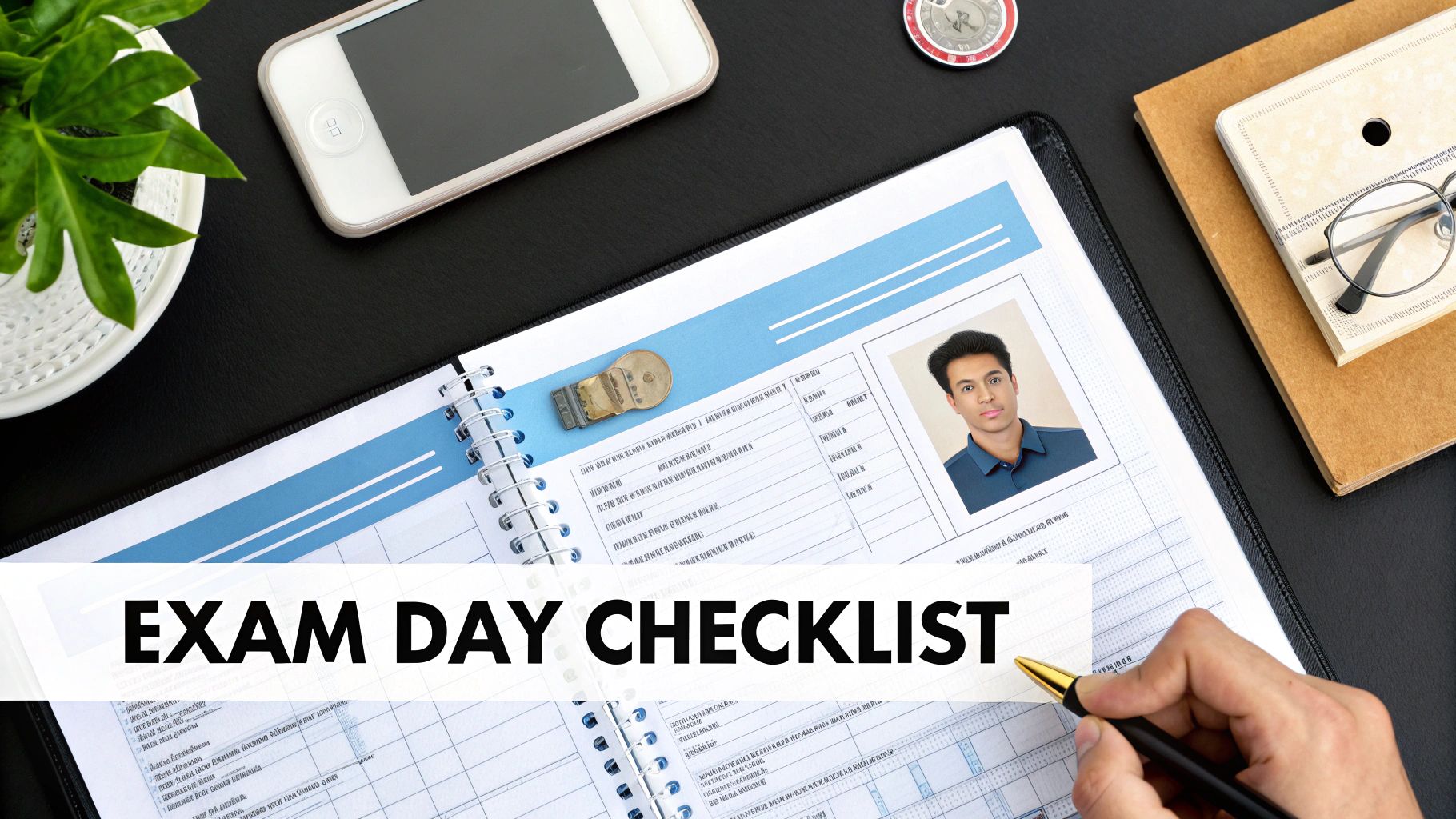
To make things simple, we've put together a checklist of what you'll need on exam day.
CDL Physical Exam Day Checklist
| Item/Information Category | What to Bring | Why It's Important |
|---|---|---|
| Identification | Valid photo ID (e.g., driver's license) | The examiner must verify your identity before starting the exam. |
| Corrective Lenses | Your eyeglasses or contact lenses | You'll be tested on your vision, and you must meet the 20/40 standard with or without correction. |
| Hearing Aids | Your hearing aids, if you use them | If you need them to pass the hearing test, you must wear them during that portion of the exam. |
| Medication List | A complete, detailed list of ALL medications | Include names, dosages, and prescribing doctor info for both prescriptions and over-the-counter drugs. |
| Medical Records | Specific documentation for any conditions | This is for conditions like heart problems, sleep apnea, diabetes, or neurological issues. |
| Payment | Cash or card for the exam fee | Most clinics require payment upfront, as insurance typically doesn't cover this exam. |
Having these items organized and ready to go will make the entire process smoother for both you and the examiner.
Special Documentation for Medical Conditions
This is a big one. If you have a known medical condition, you absolutely must bring the right paperwork. This documentation isn't optional; it's proof that your condition is under control and won't interfere with your ability to drive safely.
For example, a driver with sleep apnea will need to bring recent data from their CPAP machine. Someone with a heart condition will need a letter from their cardiologist.
Key Insight: The examiner's role isn't to diagnose you. Their job is to verify that you are medically fit to drive based on the evidence you provide. Clear, organized documentation makes their decision easy.
Forgetting this paperwork is one of the most common reasons for a delayed or denied medical card. If you're wondering how to get all this in order, contact the Patriot CDL team. We guide our students through this process every day.
The Typical Flow of the CDL Physical Exam
Knowing what to expect can take a lot of the anxiety out of the appointment. The whole thing is pretty straightforward and usually follows a consistent pattern.
- Paperwork First: You'll start by filling out the Medical Examination Report Form (MCSA-5875). This is where you'll list your medical history, so take your time and be honest.
- Health Screening: Next, a nurse or medical assistant will check your basics: height, weight, blood pressure, and pulse. They'll also perform the vision and hearing tests.
- Urine Sample: You'll be asked for a urine sample. It’s important to remember this is not a drug test. It’s a simple urinalysis to check for signs of underlying conditions like diabetes by looking for sugar or protein.
- Physical Assessment: Finally, the certified examiner will conduct the hands-on exam. They'll listen to your heart and lungs, check your reflexes, and assess your general physical ability to ensure you meet all the required DOT standards.
Budgeting for Your Exam
The cost for a CDL physical exam usually falls somewhere between $50 and $150, depending on where you live and which clinic you visit. Since most health insurance plans don’t cover it, you should plan on paying for this out of pocket. It's always a good idea to ask your trucking school or potential employer if they cover or reimburse the cost.
Don't underestimate how critical this medical card is. In a recent large-scale enforcement blitz, inspectors conducted 48,761 inspections. In the U.S., they issued 2,619 driver out-of-service violations. The third most common reason? Driving without a valid medical card, which accounted for 304 of those violations—a full 11.6% of the total. It's a simple piece of paper that can make or break your ability to work.
How Patriot CDL Prepares You for Your Medical Exam
Trying to figure out all the rules for the CDL physical exam can feel like a full-time job. Here at Patriot CDL, we know that top-notch driver training means more than just teaching you how to handle a big rig. We’re your partners in this, and we’re here to walk you through every single step—especially the critical medical certification.
Our whole support system is designed to take the mystery out of the exam so you don't run into any surprises. We don't just teach you how to drive; we get you ready to be a fully compliant professional from the moment you hit the road. It's this hands-on approach that lets you walk into your appointment with confidence instead of confusion.
Comprehensive Guidance and Support
Right from the day you enroll, our instructors give you clear, practical advice on the whole medical exam process. We help you understand what the FMCSA standards actually mean for you and your personal health history.
We take the time to:
- Explain the Requirements: We’ll break down all the official standards for vision, hearing, and blood pressure into plain English.
- Identify Potential Red Flags Early: Our team can help you look at your medical history and spot things that might need extra documentation before you ever get to the examiner’s office.
- Advise on Documentation: We’ll give you a clear roadmap for getting the right paperwork together, whether that’s a note from your heart doctor or the compliance report from your CPAP machine.
This kind of detailed preparation is a huge part of what we do. We've seen it time and time again: a prepared student is a successful student.
A Partnership for Your Career
Picking a CDL school isn't just about getting hours behind the wheel. It's about finding a team that's genuinely invested in your future. At Patriot CDL, our job is to make getting your commercial license as simple and stress-free as possible. Our goal is to make sure you’re not just a good driver, but also a fully prepared professional who’s ready to launch a great career.
Your success is our success. We provide the structure and support needed to handle every requirement, from the written permit test to the final skills exam and the DOT physical.
By partnering with you on these crucial steps, we help clear away the common hurdles that can slow down or even stop a new driver’s career before it starts. We give you the know-how to handle your CDL physical exam proactively, making sure you’re ready for the road ahead.
Our all-in approach is built to get you from the classroom to a rewarding career with no wasted time. To see how our training is structured, you can learn more about the Patriot CDL program and discover the path that fits you best.
Got Questions About the CDL Physical? We've Got Answers.
It's completely normal to have a few lingering questions as you get ready for your CDL physical exam. Getting a straight answer can be the difference between walking in stressed and walking in confident. We've compiled the most common questions we hear from aspiring drivers to clear things up once and for all.
Let's tackle these practical concerns head-on, from how long your medical card is good for to what happens if you don't pass the first time around. Our goal is to get these details sorted so you can focus on the big picture: launching your new career.
How Long Is a DOT Medical Card Valid For?
This is easily one of the most common questions out there. For a driver who meets all the health standards without a hitch, a DOT medical card is typically valid for a full two years. Think of this as the gold standard—it means the examiner is confident in your fitness to drive for the maximum period allowed.
But it’s not always a two-year ticket. A Certified Medical Examiner (CME) can issue a card for a shorter time if they spot a condition that needs a closer eye.
For instance, if you have Stage 1 high blood pressure, you'll likely walk out with a one-year certification. This isn't a penalty; it's a safety measure to ensure your condition stays well-managed. In some cases, an examiner might even issue a temporary three-month card to give you time to resolve a specific issue before you can get a longer-term certificate.
Your medical card's expiration date is a direct reflection of your current health. A two-year card signals a clean bill of health, while a shorter one is just the examiner's way of making sure you and everyone else on the road stays safe.
Basically, the examiner creates a personalized safety timeline based on your health. It’s all about keeping you safely behind the wheel.
What Happens If I Fail My CDL Physical?
Hearing you "failed" the CDL physical can feel like a major blow, but it's almost never the end of your driving career. If you don't meet the FMCSA standards during the exam, the examiner simply won't issue your Medical Examiner's Certificate right then and there. This is usually just a temporary roadblock, not a dead end.
The examiner will tell you exactly why you didn't pass, whether it was blood pressure that was a bit too high or vision that didn't quite hit the 20/40 mark.
What you do next depends entirely on the reason for the failure:
- Manageable Conditions: For something like high blood pressure, the next step is a visit to your regular doctor. They'll help you get it under control, often with medication or lifestyle adjustments. Once it's consistently below the 140/90 mmHg threshold, you can go back for a re-evaluation.
- Missing Paperwork: Sometimes, the issue is as simple as not having the right documents. You might need a clearance letter from a specialist or a printout from your CPAP machine. Once you have the paperwork, you just reschedule.
- Vision or Hearing: Failing the vision test often just means a trip to the optometrist for a new prescription. Likewise, if your hearing is the issue, an audiologist can see if hearing aids will get you back in the game.
Failing the exam usually just gives you a new to-do list. Address the specific medical issue, and you'll almost certainly be able to get certified on your next try.
Can I Take My CDL Physical With My Own Doctor?
This is a common point of confusion. It would be convenient to just go to your family doctor, but you can only do that if they've gone through specific training and are officially certified. The CDL physical exam must be done by a healthcare professional who is a Certified Medical Examiner (CME) and is listed on the FMCSA's National Registry.
Not every doctor, nurse, or physician's assistant has this credential. Examiners on the registry have been trained on the specific physical and mental demands of commercial driving. They know the FMCSA rulebook inside and out.
So, before you book anything, you have to confirm your provider is on the registry. The FMCSA has an online search tool where you can easily find a certified examiner near you. Using it ensures your exam is valid and will be accepted when you go to get your license.
Do I Need to Take a Drug Test During My DOT Physical?
Here’s another area where two separate requirements get tangled up. The urinalysis you do during the DOT physical is not a drug test. That urine sample is only screened for medical markers like sugar or protein, which can point to underlying issues like diabetes or kidney problems. It's strictly a medical screen.
However, you will be required to take a separate DOT drug test. This is almost always part of a pre-employment screening required by your trucking school or future employer. It’s a completely different federal program.
So, let's be crystal clear:
- The CDL Physical Exam: Includes a urinalysis to check your health. It is not looking for drugs.
- The DOT Drug Test: A separate, five-panel drug screen required by employers to test for controlled substances.
While both are necessary to become a commercial driver, they are two different tests for two different reasons. You’ll give a urine sample at your physical, but its purpose is to check on your health, not your habits.
At Patriot CDL, we believe a prepared student is a successful one. We’re here to guide you through every step of becoming a professional driver, from making sense of medical rules to mastering the skills you'll need on the road. If you're ready for a rewarding career with a school that's invested in you, learn more about our programs today.