
Before you can even think about getting behind the wheel of a big rig, you have to prove you know your stuff. That's where a cdl practice knowledge test comes in. It's your single best tool for getting ready for the official written exams you need to pass to become a commercial truck driver.
Think of it as a full-on dress rehearsal. It mirrors the real test, letting you get comfortable with the material and walk into the DMV with confidence. Nailing this part is the first real milestone on your path to getting a Commercial Learner's Permit (CLP).
Why the CDL Knowledge Test Is Your First Big Hurdle
Long before you're in the driver's seat of an 80,000-pound machine, you have to show you've mastered the rules that keep it operating safely. The Commercial Driver's License (CDL) knowledge test isn't just a box to check—it's the foundation of your entire career in trucking. Passing this exam is how you secure your Commercial Learner's Permit (CLP), which is the non-negotiable first step toward earning a full CDL.
It’s a lot like becoming a pilot. No one gets into a cockpit without first proving they have a rock-solid understanding of aerodynamics, navigation, and emergency protocols. In the same way, the CDL knowledge test confirms you have the critical concepts down cold before you're trusted on the road.
The Gateway to Your CLP
The CLP is your golden ticket to start your hands-on, behind-the-wheel training. To get it, you have to pass a series of written tests at your local DMV. For most people starting out, this means passing three mandatory tests: General Knowledge, Air Brakes, and Combination Vehicles. Each one zeroes in on specific areas of knowledge essential for operating large trucks safely and legally.
The General Knowledge test is the big one. It covers a wide range of topics, from basic vehicle control and pre-trip inspections to communicating with other drivers and what to do in an emergency. It’s the core of everything else you'll learn.
Understanding the Different CDL Classes
The exact tests you'll face depend on which class of CDL you're going for. While many of the core CDL requirements are the same, the type of vehicle you plan to drive will shape your study plan.
- Class A CDL: This is for combination vehicles like tractor-trailers. It's the most common license and gives you the most flexibility in your career.
- Class B CDL: This is for single vehicles like dump trucks, box trucks, and school buses.
- Class C CDL: This license covers vehicles that don't fall into Class A or B, such as smaller passenger vans or vehicles that transport certain hazardous materials.
Your journey to a CDL starts by digging into the official CDL manual. From there, a cdl practice knowledge test becomes your secret weapon—it helps you find your weak spots, lock in what you've learned, and make sure you're truly ready for the real deal.
Ultimately, clearing this first hurdle is all about proving you're responsible. It shows you have the book smarts to handle the complex situations that pop up on the road, which is crucial for protecting yourself and everyone else out there.
Mastering the Three Core CDL Knowledge Tests
Before you can even think about getting behind the wheel with a Commercial Learner's Permit (CLP), you first have to prove your knowledge by passing three critical written exams. These aren't just formalities; they’re the foundation for a safe and successful career on the road.
Think of them as the three essential pillars that will support everything you do as a professional driver. To ace your cdl practice knowledge test, you need a solid grasp of what each exam expects from you. Let's dig into the General Knowledge, Air Brakes, and Combination Vehicles tests to see what they're all about.
The General Knowledge Test: Your Driver's Operating System
The General Knowledge test is the big one—it's the most comprehensive exam you'll face. You can think of it as the core operating system for your career, covering the universal rules, safety procedures, and on-the-road knowledge that apply to almost every commercial driver.
This test is incredibly broad. It dives into everything from conducting meticulous pre-trip inspections to maintaining control of your rig in nasty weather. You'll also need to know how to handle emergencies, navigate specific traffic laws for commercial vehicles, and master critical safety skills like managing speed, maintaining proper following distance, and spotting hazards before they turn into accidents.
Because it covers so much ground, this section is absolutely essential to master. For a much deeper dive into what to expect, check out our complete guide on the General Knowledge test to start your prep on the right foot.
The Air Brakes Test: The Lifeline of Your Vehicle
Next up is the Air Brakes test, which focuses on arguably the single most important safety system on any large truck. This exam is about more than just naming parts; it's about deeply understanding the principles that prevent catastrophic brake failure. Getting this wrong isn't an option when you're responsible for 80,000 pounds rolling down the highway.
You'll be tested on identifying all the components of an air brake system, knowing how to properly inspect them for wear and tear, and using them correctly in real-world scenarios. Key topics include understanding brake lag, applying proper braking techniques on steep downgrades, and instantly recognizing warning signs like low air pressure alarms. The goal here is to make sure you can confidently and safely manage the incredible stopping power of a heavy vehicle.
"The Air Brakes test isn't just about knowing parts like the compressor or brake chambers. It's about respecting the physics involved and knowing how to prevent a potential disaster with routine checks and proper technique."
The Combination Vehicles Test: Taming the Trailer
If you’re aiming for a Class A CDL, the Combination Vehicles test is a requirement. This exam zeroes in on the unique and often tricky challenges that come with pulling a trailer. It’s a completely different ballgame; you have to learn how to manage a vehicle that bends in the middle and doesn't always follow you perfectly.
This test covers the physics of turning, backing up, and—most importantly—preventing dangerous situations that only happen with combination rigs. You'll learn about the terrifying "crack-the-whip" effect, where a sudden swerve can send your trailer swinging violently into another lane. Other key topics include proper coupling and uncoupling procedures, inspecting air and electrical lines between the tractor and trailer, and accounting for the trailer's "off-tracking" during turns.
These three tests are the backbone of your CLP exam. Knowing what to expect is half the battle, so let’s summarize what you’ll be facing.
Here is a quick look at the core knowledge tests you'll need to pass to get your Commercial Learner's Permit.
Overview of Core CDL Knowledge Tests
| Test Name | Primary Topics Covered | Typical Number of Questions |
|---|---|---|
| General Knowledge | Vehicle control, inspections, hazard perception, traffic laws, and basic driving rules. | 50 questions |
| Air Brakes | System components, inspection procedures, and proper use of air brakes. | 25 questions |
| Combination Vehicles | Coupling/uncoupling, turning, backing, and managing articulated vehicles. | 20 questions |
As you can see, each test has a distinct focus, but they all work together to ensure you have the foundational knowledge needed for safe operation.
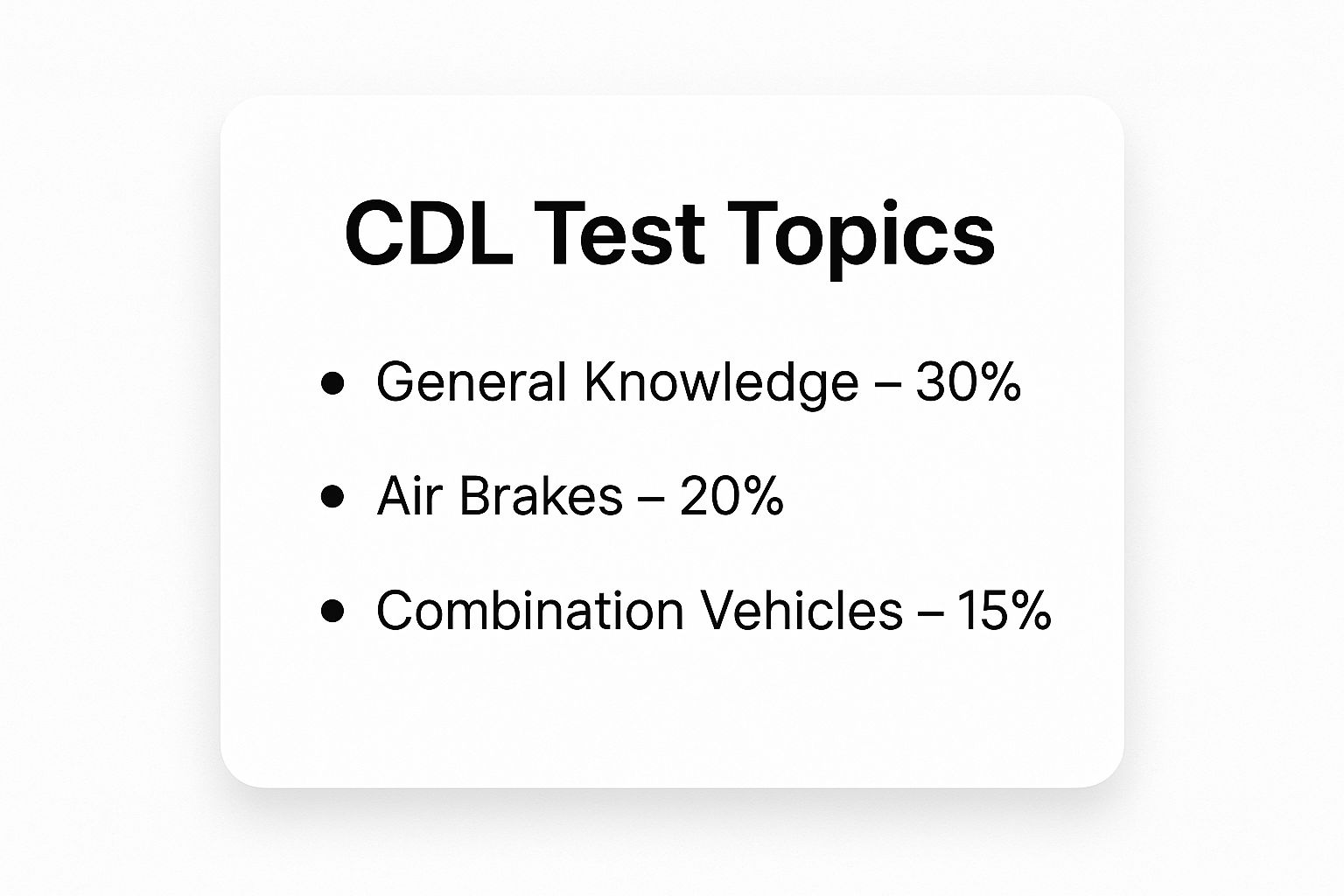
This visual really drives home how significant the General Knowledge section is. It makes up a huge portion of the core exam, so you’ll want to dedicate plenty of your study time to it.
Choosing Endorsements to Boost Your Career

Passing those initial knowledge tests to get your Commercial Learner's Permit is a huge first step, but it’s really just the starting line. The endorsements are what will put your career into overdrive. They unlock better jobs, higher paychecks, and the chance to get behind the wheel of more specialized rigs.
Think of it this way: your basic CDL is like a general high school diploma. Endorsements are the special certifications—the trade school degrees—that make you a sought-after professional in a specific field.
These extra qualifications prove you’ve got the know-how to handle specific types of cargo or vehicles. Want to haul gasoline? You'll need an endorsement for that. Plan on driving a double or triple trailer rig? You have to pass a test showing you can manage that kind of complexity.
Each endorsement comes with its own knowledge test, and this is exactly where a good CDL practice knowledge test becomes your best friend. Prepping for these exams isn't just about passing a test; it's a direct investment in your future earning potential.
Understanding High-Value Endorsements
When it comes to job opportunities, not all endorsements carry the same weight. Some are niche, while others throw the doors wide open to entire industries. As you start planning your career, here are a few of the most valuable ones to get on your radar.
H Endorsement (Hazmat): This is your ticket to transporting hazardous materials, everything from industrial chemicals to flammable liquids. The test is all about safety—recognizing placards, knowing containment rules, and being prepared for emergencies. Drivers with a Hazmat endorsement are always in demand and typically earn more because of the extra responsibility.
N Endorsement (Tanker): If you see yourself hauling liquids—whether it's milk, fuel, or water—you'll need this endorsement. The practice tests for the Tanker endorsement really focus on the unique physics of liquid cargo. You have to master how to handle the "slosh effect," a dangerous surge that can throw a truck off balance in a turn or a sudden stop.
S Endorsement (School Bus): Driving a school bus requires a special set of skills, and this test covers them all. It's laser-focused on the safety protocols for transporting children, from managing loading zones and using stop-arm signals to performing mandatory post-trip checks to make sure no child is ever left behind.
Choosing the right endorsements is like picking the right tools for a job. A driver with Hazmat and Tanker endorsements can take on far more assignments than one without, significantly boosting their income and job security.
Aligning Endorsements with Your Career Goals
Your endorsement strategy should be a conscious business decision. Think about the kind of career you want.
Do you prefer being home every night? The School Bus (S) or Passenger (P) endorsements could be a perfect fit for local routes. Or are you chasing the highest earning potential on long-haul trips? Combining the Hazmat (H), Tanker (N), and Doubles/Triples (T) endorsements will make you one of the most versatile and valuable drivers on the road.
Sometimes, drivers find their options limited by a restriction on their license. A common one is the E restriction for those who tested in an automatic truck, which bars them from operating a manual. The good news is, you can take an e restriction removal course to open up those opportunities.
By using practice tests to nail the material for each endorsement, you’re not just adding letters to your license. You’re building a powerful, customized CDL that is perfectly tuned to your professional goals.
How Practice Tests Build Real-World Confidence
Studying the CDL manual is essential—it gives you all the raw facts you need. But just knowing the material is only half the battle. The real test isn't just a friendly quiz; it's a timed, high-stakes situation where pressure can make even the most prepared person start to second-guess themselves.
This is exactly where a cdl practice knowledge test becomes your secret weapon. It’s the bridge that takes you from simply knowing the theory to having genuine, unshakable confidence behind the wheel and in the testing room.
Think of it like a pilot using a flight simulator. A pilot doesn't just read books about how to fly a plane. They spend countless hours in a simulated cockpit, dealing with turbulence, handling emergencies, and mastering the controls until it becomes second nature. They get to make mistakes and learn from them in a place where the stakes are zero.
For aspiring truck drivers, practice tests serve the exact same purpose. They are your simulator for the DMV exam room.
From Memorization to Mastery
Let's be honest, just reading the manual over and over often leads to basic memorization. You might be able to pick the right answer out of a lineup, but do you truly understand the why behind the rule?
Practice tests force you to actively pull that information out of your brain and apply it to specific, real-world scenarios, just like the actual exam will. This active recall is what moves knowledge from your short-term "cram session" memory into your long-term memory. You stop just remembering a rule and start understanding its purpose on the road.
That deeper level of comprehension is what separates someone who just passes a test from someone who becomes a safe, competent professional driver.
By repeatedly tackling exam-style questions, you are training your brain not just to know the answers, but to think like a professional truck driver. This mental conditioning is the key to walking into the DMV feeling prepared and in control.
Taming Test Anxiety and Time Pressure
One of the biggest hurdles on test day isn't the questions themselves—it's anxiety. That clock ticking down can create a sense of panic, causing you to make simple mistakes on questions you absolutely know the answer to. A good practice test helps you get ahead of this by throwing you into the fire before the real thing.
It replicates the exact conditions of the exam, taking the surprise out of the experience.
- Timed Modes: These train you to manage your time effectively. You learn to find a steady pace so you don't feel rushed but also don't run out of time.
- Randomized Questions: This is crucial. It stops you from just memorizing the order of the answers and forces you to actually learn the material inside and out.
- Instant Feedback: Seeing which questions you missed—and more importantly, why you missed them—is how you find and fill your knowledge gaps on the spot.
By simulating the pressure of the real test again and again, you basically desensitize yourself to the stress. When test day finally arrives, the format, the timing, and the pressure will all feel familiar. It's just another Tuesday. This allows you to focus all your mental energy on the questions in front of you.
You can start building this essential test-taking muscle when you sign up for our practice test resources. This kind of preparation turns a daunting exam into just another practice run, giving you the confidence you need to pass with flying colors.
A Smarter Way to Study for Your CDL Test

Just reading the CDL manual from front to back isn't a real strategy—it’s just the starting line. If you really want to pass, you need a smarter plan that turns your cdl practice knowledge test into more than just a quiz. It should be your secret weapon for finding exactly what you need to work on.
This is all about studying smarter, not just harder. A focused, methodical approach builds a deep understanding that you’ll carry with you on test day and for your entire career on the road. Forget cramming; this is about building true mastery.
Everything you need to know starts and ends with your state’s official CDL manual. Think of it as the ultimate source of truth. Every single question on the actual exam comes directly from those pages, so treat it like your primary textbook.
Building Your Foundation
Before you even think about taking a practice test, set aside some serious time to read through the relevant sections of the manual. Really dig into the topics that feel a bit tricky, like the specifics of air brake systems or the rules for hauling hazardous materials. The goal here is just to get a solid baseline of knowledge.
Once you feel like you have a decent handle on the material, it’s time to take your first practice test. Don’t get hung up on the score. See this first attempt as a diagnostic tool, like a mechanic plugging into a truck’s computer to find the source of a problem. Its only job is to put a spotlight on your weak spots.
Analyze, Don't Just Memorize
After you finish a practice test, the real work begins. Your results are a roadmap, showing you which topics you’ve got down cold and where you need to put in more time. This is the point where you switch from studying everything to targeting your problem areas.
For instance, if you keep getting questions wrong about air brake inspection procedures, that's your signal to dive back into that specific chapter of the CDL manual. You can also find great resources to help you drill down, like a dedicated air brakes practice test that lets you focus solely on that topic.
The most effective learners don't just see wrong answers; they see patterns. Try keeping a 'mistake journal'—a simple notebook where you write down every question you miss and why. This forces you to understand your errors instead of just repeating them.
Reinforce and Simulate
Once you’ve identified your weak areas, you can use some proven learning techniques to make sure the information sticks. Two of the best methods out there are spaced repetition and exam simulation.
- Spaced Repetition: Instead of trying to cram a topic for hours on end, review it in short, focused sessions over several days. This is a scientifically proven way to move information from your short-term memory into your long-term memory.
- Exam Simulation: As your test day gets closer, it's time to change how you practice. Start using timed tests to get used to the pressure of the real thing. Turn off your phone, find a quiet spot, and treat every practice test like you’re at the DMV. This builds the focus and time management skills you’ll need to succeed.
Following this simple cycle—study, diagnose, analyze, and reinforce—is way more effective than mindlessly taking practice tests over and over. It's a much smarter way to prepare that builds real confidence and makes sure you're ready for whatever the exam throws at you.
Answering Your Top Questions About the CDL Knowledge Test
When you're gearing up to take your CDL knowledge tests, it's natural for questions and a bit of uncertainty to creep in. Let's be honest, the process can feel overwhelming. The good news is that most aspiring drivers share the same concerns, and getting straight answers can make a world of difference.
Think of this section as a quick FAQ from someone who's been there. We'll cut through the noise and give you the practical details you need to walk into the DMV with confidence.
How Many Questions Are on the General Knowledge Test?
The General Knowledge test is the big one. You can typically expect to see 50 multiple-choice questions on this exam, though the exact number can sometimes differ slightly depending on your state.
The magic number to pass is almost always an 80%. That means you need to get at least 40 questions right. My best advice? Double-check your state's official CDL manual—it’s the ultimate source of truth for the number of questions and the passing score you'll need to hit.
Can I Take the Official CDL Test Online?
This is a big one, so let’s be crystal clear: no. You absolutely cannot take the official CDL knowledge test online.
While a cdl practice knowledge test is a fantastic online study tool, the real deal for your Commercial Learner's Permit (CLP) has to be done in person. You'll need to head down to an official DMV or another state-approved testing center. This rule is all about maintaining the security and fairness of the testing process for everyone.
Think of practice tests as your sparring sessions. They get you ready for the championship bout, but the main event always takes place in the ring—in this case, an official testing center.
What Happens If I Fail a CDL Knowledge Test?
First off, don't panic. Failing a test feels like a major setback, but it’s just a bump in the road, not a dead end. Every state will let you retake it.
Usually, you'll have to wait a short period—sometimes just 24 hours—before you can give it another shot, and yes, you'll likely have to pay the test fee again. The smart move here is to treat that first attempt as a diagnostic. Your score report is a goldmine of information, showing you exactly which topics you're weak on. Use it to zero in on those sections in the CDL manual before you go back for round two.
Are Practice Tests Enough to Pass the Real Exam?
Practice tests are an incredibly valuable part of your study plan, but they shouldn't be the only part. Relying on them alone is a common mistake. They work best when paired with the official CDL manual, not as a substitute for it.
The manual is the playbook; it contains every rule, regulation, and piece of information that the test questions are based on. A winning strategy looks like this:
- Step 1: Really dig into the official CDL manual. Don't just skim it—read it to truly understand the material inside and out.
- Step 2: Then, hit the practice tests. Use them to lock in what you've learned, pinpoint any remaining weak spots, and get used to the feel and timing of the actual exam.
Combining deep study of the manual with repeated practice testing is, without a doubt, the surest way to pass on your first try.
Ready to stop worrying and start preparing? At Patriot CDL, we provide the hands-on training and expert guidance you need to ace your knowledge tests and get on the road to a successful career. Learn more about our CDL programs.