If you're looking to take a CDL tanker endorsement practice test, you’re already on the right track to a better-paying, more specialized career in trucking. This add-on to your license, officially called the N endorsement, is your key to hauling liquid cargo and a seriously smart move for your future.
Why a Tanker Endorsement Is Your Ticket to Higher Pay
Getting your tanker (N) endorsement is one of the best career decisions any professional driver can make. It’s not just another piece of paper to add to your CDL; it’s a direct line into a niche part of the industry with high demand and, frankly, much better pay.
This endorsement clears you to haul the liquid goods that our entire economy depends on. Just think about what moves in tankers:
- Gasoline and diesel for every gas station
- Milk and other food-grade liquids for grocery stores
- Industrial chemicals that are the backbone of manufacturing
- Water for farms and cities
Because this kind of cargo demands more skill and a higher level of responsibility to haul safely, companies pay a premium for drivers who can handle it. We’re not talking about a small bump in pay, either. It’s a significant jump that can really change your financial picture.
The Financial Advantage of an N Endorsement
Let’s get straight to the point: the pay difference between a standard freight hauler and a tanker driver is huge. With that N endorsement, you're looking at some of the best-paying jobs in the industry. Most experts put the salary range for tanker drivers between $75,000 and $106,250 a year. That’s a massive leap from the typical $50,000 to $60,000 you might see pulling a dry van.
So, why the big difference? It all comes down to the unique challenges of the job. Tankers carry liquids that slosh around, creating what we call liquid surge. This constant movement can raise the vehicle's center of gravity and make rollovers a very real danger. A driver who knows how to manage that is worth their weight in gold. Of course, before you even think about endorsements, make sure you meet the baseline CDL requirements in your state.
Beyond the Paycheck: Stability and Opportunity
While the money is definitely a big motivator, the benefits don’t stop there. The tanker industry offers a kind of job stability that’s tough to find elsewhere. The products you’re hauling are essential, which means the demand for your skills stays strong, even when the economy gets a little shaky.
Getting your N endorsement isn't just about passing a test. It's a strategic investment in your career that shows you’re serious about safety and specialized skills, putting you at the top of the list for the best jobs out there.
This specialization also opens doors that would otherwise be shut. Many of the most reputable and stable trucking companies only deal in liquid bulk transport. Earning your N endorsement makes you exactly who these top-tier employers are looking for, paving the way for a more secure and rewarding career on the road.
What The Tanker Endorsement Test Actually Covers
To pass the N endorsement exam, you need to start thinking like a seasoned tanker driver, not just someone memorizing a handbook. The test isn't about trivia; it’s a practical check to ensure you understand the real-world physics and safety protocols of hauling liquid cargo.
This is where we get into the nuts and bolts of what you'll face. We'll break down the powerful force of liquid surge, see how baffles and bulkheads try to tame it, and cover the specific driving skills that separate tanker haulers from everyone else on the road. It's not just about what’s in the tank—it's about how that load changes everything you do behind the wheel.
The Physics of Liquid Surge and Vehicle Control
If there's one concept that defines tanker driving, it's liquid surge. Get this, and you're halfway there.
Picture thousands of gallons of milk, fuel, or whatever you're hauling sloshing forward when you brake. That massive weight shift can literally push your rig right into an intersection. Then, as you accelerate, it all sloshes back, fighting your momentum. The test is built around confirming you can anticipate and manage these forces before they get you into trouble. This is a core part of mastering the assessment of competence for this specific skill.
You'll need to know:
- Surge Control: Expect questions on the importance of smooth, gentle braking and acceleration. A sudden stop can create a wave powerful enough to be a real hazard.
- High Center of Gravity: Tankers are notoriously top-heavy, especially if they aren't full. The exam will test your knowledge of safe speeds for curves and ramps to prevent a rollover.
- Tanker Guts (Baffles & Bulkheads): You must know the difference. Baffles are dividers with holes that slow the surge down. Bulkheads are solid walls that create separate compartments. A "smooth bore" tanker has neither, making it the most challenging to handle.
As the infographic shows, getting this endorsement is a direct route to better pay and more specialized work.
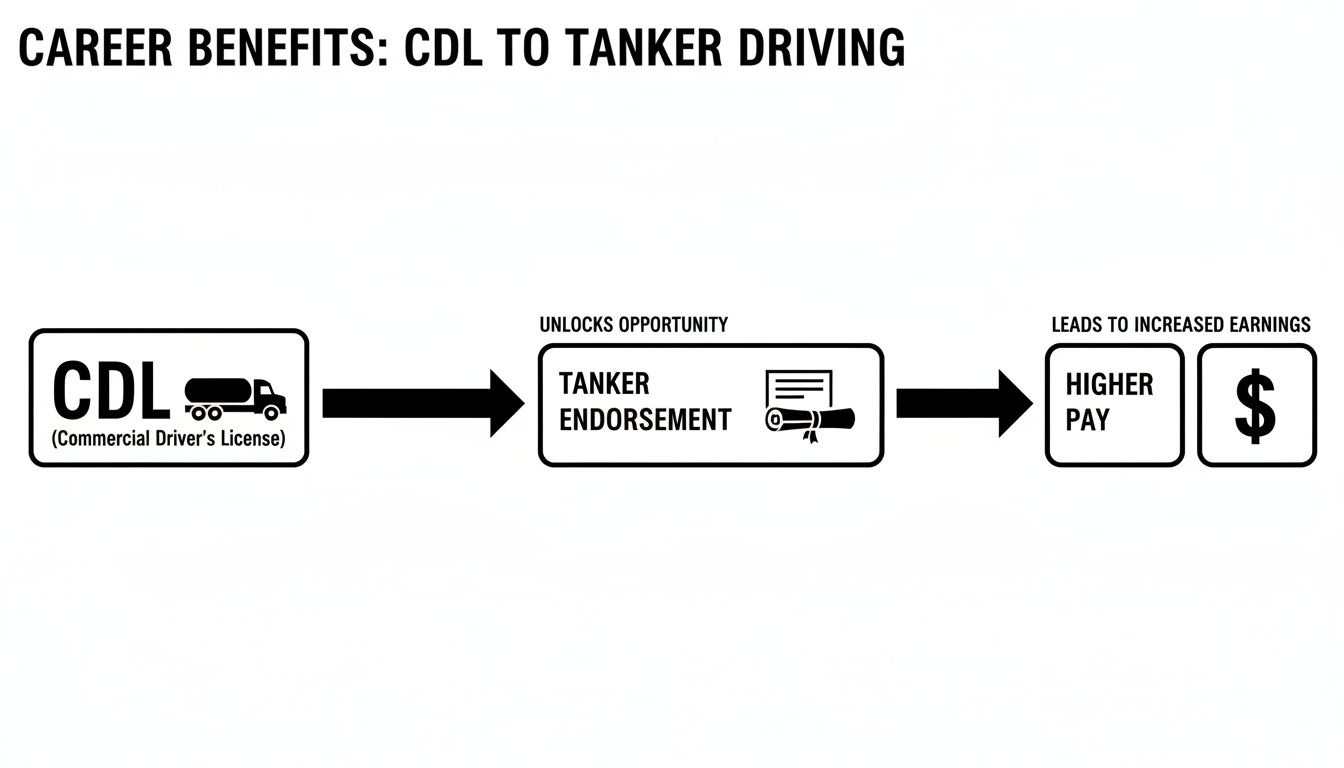
This isn't just another stamp on your license; it’s a key that unlocks a higher tier of driving jobs.
Key Topics On The CDL Tanker Endorsement Test
The written test zeroes in on a few critical areas where a lack of knowledge can have serious consequences. Here’s a quick breakdown of the topics you absolutely have to nail.
| Knowledge Area | Why It's Critical for Safety | Example Test Concept |
|---|---|---|
| Liquid Surge Dynamics | Uncontrolled surge can cause loss of control, jackknifing, or push the vehicle into cross-traffic. | How braking distance is affected by a partially filled, unbaffled tank. |
| High Center of Gravity | Tankers are prone to rollovers on curves, ramps, or uneven surfaces if speed isn't properly managed. | Calculating the safe speed for a sharp highway exit ramp. |
| Tank Inspection | Leaks, especially of hazardous materials, pose a direct threat to the public and the environment. | Identifying the correct procedure for checking valves and manhole covers during a pre-trip inspection. |
| Expansion and "Outage" | Liquids expand with heat. Without enough room (outage), pressure can build and rupture the tank. | Why you never fill a tank to 100% capacity. |
| Tank Vehicle Definitions | Knowing what legally constitutes a "tank vehicle" prevents unqualified drivers from handling liquid loads. | Understanding that multiple large liquid totes on a flatbed can require an N endorsement. |
Mastering these concepts isn't just about passing a test; it's about being a safe and competent professional on the road.
Unique Inspection and Driving Procedures
Your standard pre-trip inspection gets an upgrade for tankers. The endorsement exam will ask questions specifically about inspecting the tank itself. You’ll need to know how to check for leaks around hatches and valves, make sure vents are clear, and confirm the tank is securely mounted to the frame.
Driving a tanker also demands a different mindset. You need to leave much more following distance than you would with a dry van. Why? Because the surge from a hard brake will dramatically increase your true stopping distance. You'll also need to understand "outage"—the empty space you must leave in a tank to allow for liquid expansion when it gets warmer.
Understanding The FMCSA Definition of a Tanker
The official definition of a "tanker" is probably broader than you think, and the test will absolutely cover this. A significant FMCSA rule change redefined what qualifies, and it catches a lot of drivers by surprise.
The rule requires an N endorsement for hauling any liquid or liquefied gas in a tank or tanks with a combined capacity of more than 119 gallons and an aggregate gross weight of over 1,000 pounds.
This means a dry van or reefer driver hauling a few large liquid totes could legally need a tanker endorsement. The test makes sure drivers know this rule to keep unqualified operators from handling potentially hazardous liquid cargo.
Put Your Knowledge to the Test: A Simulated CDL Tanker Endorsement Practice Exam

Reading the manual is one thing. Facing the real test under pressure is another beast entirely. This is your chance to step into the ring and see how you do.
We’ve put together a 20-question practice test that’s designed to feel just like the one you’ll take at the DMV. It covers the same topics with the same kind of tricky wording you can expect.
Don’t just fly through it. For every question, you'll find the correct answer and, more importantly, a detailed explanation breaking down why it's the right choice. This is where the real learning happens. Use this to find your weak spots and walk into the testing center with confidence.
N Endorsement Practice Questions
1. The FMCSA has a specific definition for a tanker, but which of these vehicles would also require you to have an N endorsement?
A) A flatbed truck carrying a single 150-gallon liquid tote.
B) A dry van carrying multiple portable tanks totaling 1,000 gallons.
C) A pickup truck with a 100-gallon fuel tank in the bed.
D) A straight truck carrying two 50-gallon drums of oil.
Answer B) A dry van carrying multiple portable tanks totaling 1,000 gallons.
Explanation This is a classic "gotcha" question. The key isn't the size of any single tank but the aggregate (or total) rated capacity. Once the combined capacity of all portable tanks hits 1,000 gallons, a tanker endorsement is mandatory.
2. When you're loading a tanker that has bulkheads (solid walls separating compartments), what’s the correct procedure?
A) From the front to the back.
B) From the bottom to the top.
C) Into the middle compartments first.
D) Evenly across all compartments.
Answer B) From the bottom to the top.
Explanation Safety first. Loading from the bottom is crucial because it minimizes splashing. Less splashing means less static electricity buildup, which is a major explosion hazard when you’re hauling flammable liquids.
3. What is the real job of baffles inside a tanker?
A) To completely stop the forward-and-back surge of liquid.
B) To separate different types of liquids within the same tank.
C) To slow down the movement of liquid and reduce the intensity of the surge.
D) To strengthen the tank's structure.
Answer C) To slow down the movement of liquid and reduce the intensity of the surge.
Explanation Baffles are partitions with holes in them, so they can't stop the liquid. Their purpose is to disrupt the flow and act like a shock absorber, taming the violent surge you'd get otherwise. This makes the truck far more stable.
4. Why is leaving "outage" (empty space) at the top of the tank so important?
A) To make the vehicle lighter.
B) To allow room for the liquid to expand when it gets warmer.
C) To reduce the effects of liquid surge.
D) To prevent the tank from being overfilled at the loading dock.
Answer B) To allow room for the liquid to expand when it gets warmer.
Explanation Liquids expand with heat. If you fill a tank to the brim on a cool morning, the sun can heat it up and cause the liquid to expand. Without that outage space, the pressure could build to dangerous levels and even rupture the tank.
Understanding Liquid Dynamics
5. You're driving a smooth bore (unbaffled) tanker that's about half full. Which of these moves is the most dangerous?
A) Driving up a steep hill.
B) Making a sudden stop at an intersection.
C) Accelerating quickly from a stoplight.
D) Driving on a straight, level highway at a constant speed.
Answer B) Making a sudden stop at an intersection.
Explanation A sudden stop in a half-full smooth bore creates a massive, uncontrolled wave that slams into the front of the tank. That forward surge can be powerful enough to physically push your truck right through an intersection, even with your brakes locked up.
6. A tanker's high center of gravity makes it especially prone to what kind of accident?
A) Jackknife.
B) Rear-end collision.
C) Rollover.
D) Head-on collision.
Answer C) Rollover.
Explanation All that heavy liquid is carried high off the ground. This high center of gravity makes the vehicle top-heavy and dangerously unstable in curves, on-ramps, or during any quick steering maneuver. It doesn't take much to tip it over.
7. Why do you need to leave a much bigger following distance when driving a tanker?
A) The truck is heavier and harder to steer.
B) The surge of liquid can significantly increase your effective stopping distance.
C) Tanker brakes are less effective than standard truck brakes.
D) You need more time to see road hazards.
Answer B) The surge of liquid can significantly increase your effective stopping distance.
Explanation When you hit the brakes, the entire load surges forward, adding its momentum to the truck. This "push" means you need a lot more asphalt to come to a complete and safe stop compared to a truck hauling a solid, static load.
8. Which type of tanker is the most challenging to drive because of uncontrolled surge?
A) A baffled tank.
B) A tank with bulkheads.
C) A smooth bore tank.
D) A compartmentalized tank.
Answer C) A smooth bore tank.
Explanation Smooth bore means there is absolutely nothing inside to slow the liquid down. The surge is completely unchecked, making it feel like you're wrestling a giant wave. It's the most unstable and difficult type of tanker to handle.
Inspection and Emergency Procedures
9. During your pre-trip inspection, what is one critical check specific to a tanker that you wouldn't do on a dry van?
A) Tire pressure.
B) Brake lights.
C) Tank mounting and for leaks around valves and hatches.
D) Kingpin security.
Answer C) Tank mounting and for leaks around valves and hatches.
Explanation A leaking tanker is a huge hazard. You have to physically check that the tank is securely bolted to the frame and that every single valve, pipe, and manhole cover is sealed tight with no drips. This is a non-negotiable part of the pre-trip.
10. If you have to make an emergency stop in a baffled tanker, what's the proper braking technique?
A) Pump the brakes to avoid locking the wheels.
B) Use controlled or stab braking.
C) Brake as hard as you can without locking the wheels.
D) Use only the trailer brakes.
Answer B) Use controlled or stab braking.
Explanation The official technique is controlled braking: applying firm, steady pressure right to the edge of lockup. If the wheels do lock, you switch to stab braking: release the pedal to regain steering, then immediately reapply the brakes.
11. The amount of liquid you can legally load is determined by…
A) The amount of liquid you are hauling and its weight.
B) The legal weight limit for the vehicle.
C) The liquid's density and the need for outage.
D) All of the above.
Answer D) All of the above.
Explanation It's a balancing act. You have to know the weight of your product to stay under legal gross vehicle weight, but you also have to account for its density and leave enough room for thermal expansion (outage). All three factors play a role in a safe and legal load.
12. When should the internal valve on a tanker be closed?
A) Only during loading and unloading.
B) Whenever you are driving.
C) Only when parked for more than an hour.
D) When driving on rough roads.
Answer B) Whenever you are driving.
Explanation Think of it as a master safety switch. The internal valve is inside the tank itself. Keeping it closed while in motion ensures that even if an accident rips off the external piping, your load will stay contained inside the tank.
Safe Driving Practices
13. How should you handle a turn in a tanker?
A) Enter the turn at the posted speed limit.
B) Slow down to a safe speed before entering the turn, then accelerate slightly through it.
C) Brake lightly throughout the turn to maintain control.
D) Take the turn as sharply as possible to clear the intersection quickly.
Answer B) Slow down to a safe speed before entering the turn, then accelerate slightly through it.
Explanation This is tanker driving 101. All your braking must be done in a straight line before you start turning. Once you're in the curve, a little bit of power helps stabilize the truck. Braking in a turn is a recipe for a rollover.
14. What exactly is "liquid surge"?
A) The expansion of liquid due to heat.
B) The movement of liquid inside the tank.
C) A leak from a valve or fitting.
D) The sound the liquid makes while driving.
Answer B) The movement of liquid inside the tank.
Explanation Surge is the dynamic force created by the liquid shifting around as you speed up, slow down, or turn. Learning to anticipate and manage that movement is the single most important skill for a tanker driver.
15. You're driving on a slick, wet road. What move is especially dangerous in a tanker?
A) Driving with a full load.
B) Making a quick lane change.
C) Downshifting too early.
D) Using your engine brake.
Answer B) Making a quick lane change.
Explanation On a low-traction surface, a sudden steering input can cause the liquid to surge sideways. This sudden shift in weight can easily break traction or, even worse, start a rollover. All steering inputs must be smooth and deliberate.
16. What's the number one way to prevent a rollover?
A) Keep the tank as full as possible.
B) Drive slightly below the speed limit at all times.
C) Keep the cargo close to the ground by managing speed in curves and on ramps.
D) Use a truck with a wide wheelbase.
Answer C) Keep the cargo close to the ground by managing speed in curves and on ramps.
Explanation It all comes down to physics. Speed creates centrifugal force that wants to push your high center of gravity outwards. The only way to fight that force and keep the truck planted is to slow way down before you get into any curve or ramp.
Final Knowledge Check
17. Which tank shape is more likely to roll over?
A) A tank trailer with a round cross-section.
B) A tank trailer with an elliptical cross-section.
C) They are equally as likely to roll over.
D) Only used for non-hazardous materials.
Answer B) More likely to roll over than a tank with an elliptical cross-section.
Wait, that doesn't seem right. Let's re-read the question and common knowledge. A round tank has a higher center of gravity. Correct Answer is A) A tank trailer with a round cross-section.
Explanation A round tank has a higher center of gravity compared to an elliptical (oval) tank, which is designed to keep the load lower to the ground. That higher center of gravity makes the round tank less stable and more susceptible to rolling over.
18. When unloading a compartmentalized tanker, what's the best practice?
A) Unload the front and rear compartments first.
B) Unload the middle compartments first.
C) Unload all compartments at the same time.
D) Unload the compartments from front to back.
Answer A) Unload the front and rear compartments first.
Explanation By emptying the compartments at the front and back first, you keep the remaining weight concentrated over the vehicle's axles. This maintains the best possible balance and traction throughout the unloading process.
19. A smooth bore tanker is most dangerous to drive when it is:
A) Completely full.
B) Completely empty.
C) About half full.
D) More than three-quarters full.
Answer C) About half full.
Explanation This is the "sweet spot" for dangerous surge. A full tank has almost no room for the liquid to slosh around, and an empty tank has no surge at all. A partially filled tank gives the liquid the maximum room to gain momentum and cause problems.
20. If you're hauling a flammable liquid, what piece of safety equipment must you have and know how to operate?
A) A fire extinguisher.
B) Roadside flares.
C) A special communication device.
D) All of the above.
Answer A) A fire extinguisher.
Explanation While all safety gear is important, federal regulations are very specific about fire extinguishers. When hauling flammables, you must carry the correct type and size of extinguisher and be properly trained on how to use it effectively.
Common Mistakes To Avoid On Your Tanker Test
Knowing the material is one thing, but acing the tanker test is all about sidestepping the common traps that snag even experienced drivers. This isn't just about memorizing facts; it's about applying what you know when the pressure is on. You'll find many questions are designed to test if you're really reading them carefully.
Little things, like misreading a question about "outage" or just skimming a detail about weight distribution, can be the difference between passing and failing. These aren't really knowledge gaps—they're test-taking mistakes. Let's walk through the most common pitfalls so you can see them coming a mile away.
Underestimating the Physics of Liquid Surge
The single biggest mistake I see is a failure to truly respect the power of liquid surge. Many drivers get the basic idea but don't connect it to real-world scenarios on the test. You might know what surge is, but do you grasp how it can dangerously increase your stopping distance or make a rollover almost inevitable on a sharp curve?
Keep these points front and center:
- A half-full tank is the most dangerous. This gives the liquid maximum room to build up momentum and slam against the bulkheads.
- Surge messes with everything. It affects how you brake, accelerate, and turn. Test questions will definitely connect surge to everyday driving decisions.
- Baffles only slow the surge down. They don't stop it. A classic trick question implies that baffles make a tanker handle like a dry van. They don’t.
Getting a firm handle on these dynamics is non-negotiable. A mistake here can have a domino effect, as surge is a core safety concept you'll see woven throughout the entire exam.
Misreading Questions and Rushing Your Answers
When you're up against the clock, it's easy to rush. That's when you miss critical words like "not," "except," or "always." Tanker questions can be tricky, often giving you a scenario and asking for the best possible action. This means more than one answer might look correct at first glance.
Take a breath before you begin. Read every single question twice. A great habit is to use the process of elimination—mentally (or on scrap paper) cross out the answers you know are wrong. This keeps you from second-guessing yourself and falling for a well-worded distraction.
This slow-and-steady approach is your best friend. It helps with time management, too, preventing you from getting bogged down on one tough question and then having to fly through the rest.
Forgetting About State-Specific Rules and Mental Prep
While federal rules are the foundation, some states have their own little quirks or areas they emphasize. Don't just assume the general CDL manual is all you need. Do a quick search for your state's commercial driving handbook to avoid any last-minute surprises.
Beyond the books, your mindset is a huge factor. Walking into the test stressed or exhausted is a recipe for careless errors. A calm, focused attitude is one of your most powerful tools.
Think about the big picture: this endorsement is a major career step. As we head through 2025, the demand for specialized tanker drivers is through the roof, with a nationwide shortage of over 60,000. Passing this test puts you in a very select, in-demand group of professionals.
Your prep work goes beyond just studying—it’s about having all your ducks in a row, just like you would for a meticulous pre-trip inspection. Get a good night's sleep, eat a solid breakfast, and show up to the test center a little early. Giving yourself that buffer can make all the difference.
Your Final Checklist For Test Day Success
Feeling confident on test day isn’t just about knowing the material—it's about being organized and mentally ready to go. Having a solid game plan for the final few days can eliminate that last-minute scramble and let you focus completely on acing the test.
Think of this as your pre-mission brief. By handling all the logistics ahead of time, you clear your head of any potential distractions and can walk into the DMV ready to pass.
The Week Before Your Test
This is where you shift from learning new things to fine-tuning what you already know. The goal is to polish, not cram.
- Drill Down on Weak Spots: Take a hard look at your practice test results. Don't just glance at the wrong answers. Look for patterns. Are you consistently tripping up on questions about surge dynamics? Or maybe it's the inspection procedures? This is your chance to zero in on those specific areas and turn a weakness into a strength.
- Get Your Paperwork in Order: There's nothing worse than that sinking feeling of not having the right document. Get a folder and put everything in it now: your driver's license, Social Security card, and any proof of residency your state DMV requires.
- Check Your Permit: Make absolutely sure your Commercial Learner's Permit (CLP) is still valid. An expired permit is a non-starter. This is your ticket in the door, and you can get all the details on getting or renewing one in our complete guide to the CDL permit.
The Day Before The Exam
Today is all about getting your head in the game, and that means resting. Seriously. Last-minute cramming sessions usually just create more anxiety and can actually hurt your performance.
Do a quick, light review of your notes in the morning if you feel you need to, but then put the study materials away. Confirm your appointment time and figure out your route to the testing center, adding some buffer time for traffic. Lay out your clothes and make sure your document folder is by the door, ready to go.
The single most important thing you can do the night before is get a good night's sleep. A well-rested brain is a sharp brain. It makes a huge difference in your ability to recall information and think clearly under pressure.
The Morning Of The Test
It’s go-time. Wake up early enough so you aren't rushing around.
Eat a decent breakfast—something that will give you steady energy, not a sugar crash. Give your document folder one last check before you head out. Leave with plenty of time to spare; arriving a little early and relaxed is way better than screeching into the parking lot stressed out.
Once you’re there, just take a few deep breaths. Stay positive and trust the work you've put in. You're ready for this.
Ultimate Tanker Test Day Checklist
Here’s a quick-glance table to make sure you've got all your bases covered in the days leading up to your exam.
| Timeline | Action Item | Purpose |
|---|---|---|
| 5-7 Days Before | Review practice test results; focus on weak areas. | To turn problem topics into strengths. |
| 3-4 Days Before | Gather all required documents into one folder. | To eliminate last-minute panic and ensure a smooth check-in process. |
| 2 Days Before | Confirm your test appointment time and location. | To avoid any scheduling surprises or location mix-ups. |
| The Day Before | Plan your route, lay out clothes, and relax. | To minimize stress and promote a calm mindset. |
| The Night Before | Get 7-8 hours of quality sleep. | To ensure your brain is rested, sharp, and ready for the exam. |
| The Morning Of | Eat a balanced breakfast and leave early. | To provide sustained energy and avoid the stress of being late. |
| Right Before | Do a final document check and take a few deep breaths. | To walk in calm, confident, and prepared to pass. |
Following these simple steps will help you walk into the testing center feeling prepared, focused, and in control. Good luck
How Patriot CDL Turns Your Endorsement Into a Career
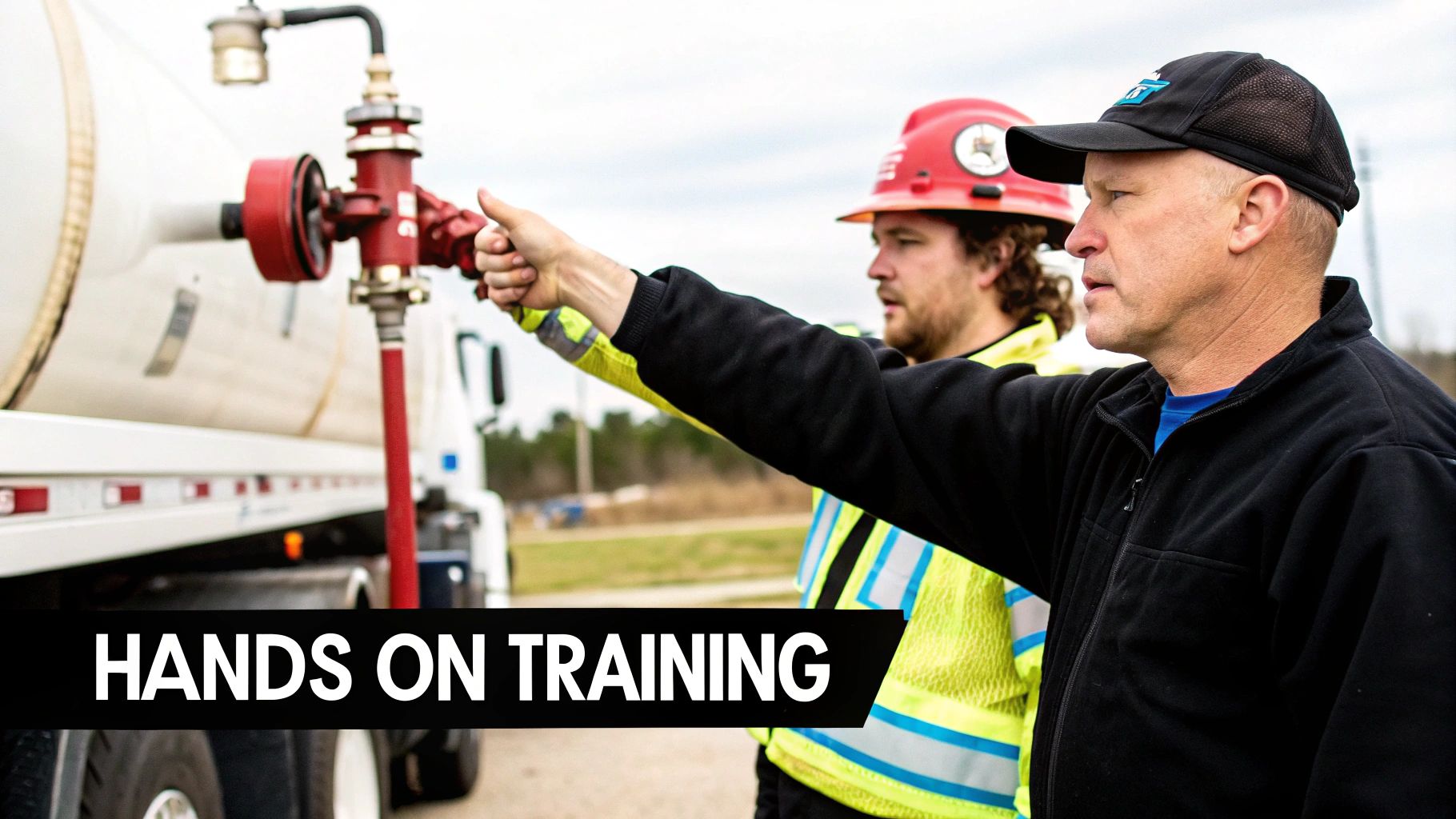
Passing the written exam is a big deal—it’s the key that opens the door. But a real, long-lasting career is built on the road, not in the testing center. This guide and our cdl tanker endorsement practice test get you started with the book smarts, but Patriot CDL is where you get the hands-on skill to turn that knowledge into a seriously good paycheck.
Our whole approach is about closing the gap between what you read in a manual and what you actually feel behind the wheel. We get you out of the classroom and into the driver's seat, where you can physically feel the slosh of a liquid load and learn the finesse it takes to control it.
From Test-Ready to Job-Ready
At Patriot CDL, we don't just teach you to pass a test; we train you to do the job. You're building real skills and muscle memory, not just memorizing answers for an exam. Our instructors have been there and done that, and they're right beside you, showing you what really matters out on the road.
- Feel the Surge: Forget just reading about it. You’ll get firsthand experience with how a half-empty tank pushes and pulls on the rig during stops, turns, and takeoffs—all with an expert guiding you.
- Handle the Gear: We’ll walk you through all the specialized equipment, from the valves and hoses to the emergency shut-off systems you absolutely need to know how to use.
- Master the Moves: Our training gets you comfortable with the tricky maneuvers needed to handle a vehicle with a high center of gravity, whether you're in city traffic or on a winding back road.
Think of Patriot CDL as more than just a school. We're your partner in launching a stable, high-paying career. Our accelerated training is designed to get you skilled, licensed, and earning as fast as possible.
Your Fast Track to a Better Paycheck
We get it. Many of our students are looking for a solid career change or a way to break into an industry with great earning potential. That’s why our programs are built to be fast, efficient, and effective. We give you the kind of real-world confidence and skill that the best companies are looking for when they hire tanker drivers.
Ready to take that test score and turn it into a career? Take a look at our hands-on CDL training program and see how we help drivers just like you get ahead. We provide the practical training you need to not only ace the endorsement test but to hit the ground running from day one on the job.
Your Top Tanker Endorsement Questions Answered
As you gear up for the test, a few questions are bound to come up. Getting these details sorted out now means you can walk into the DMV with total confidence. Let’s clear up some of the most common things drivers ask.
How Many Questions Are On The Tanker Test?
You can expect to see somewhere between 20 and 30 multiple-choice questions on the official N endorsement test. The exam isn't designed to trick you; it's there to make sure you've got the essential safety principles down cold.
To get a passing grade, you'll need to score at least an 80%. That's the standard in most places, but it's always smart to double-check with your local DMV just in case their requirements are slightly different.
How Long Is The Endorsement Valid For?
Good news here—the tanker endorsement doesn't have its own expiration date. It's tied directly to your Commercial Driver's License.
As long as your CDL is active and in good standing, so is your N endorsement. You don't have to worry about a separate renewal process. Just keep your main license current, and the endorsement automatically stays with it.
The N endorsement is a permanent upgrade to a valid CDL, not a separate certificate you have to track or renew. Once you earn it, it's yours.
Can I Get A Tanker Endorsement With A Class B CDL?
Absolutely. The N endorsement is available for both Class A and Class B CDL holders, which is great because it opens up a ton of different job opportunities.
A lot of people picture massive Class A tractor-trailers when they think of tankers, but many tanker jobs are actually for Class B straight trucks. These are the trucks doing essential work like local fuel delivery, propane hauling, or transporting food-grade liquids. Adding that N to your Class B license is a fantastic way to boost your career options and pay.
Ready to turn that endorsement into a great career? Getting the right training is the first step. At Patriot CDL, we provide the hands-on experience you need to get the job done right. Check out our programs by visiting our site at https://patriotcdl.com.