A CDL training program isn't just a class—it's your direct on-ramp to a career as a professional truck driver. These specialized courses mix essential classroom learning with critical, hands-on experience behind the wheel, all designed to get you ready to ace your Commercial Driver's License (CDL) exam.
Think of it as the most direct path to a stable, always-in-demand profession.
Why a CDL Training Program Is Your Career Launchpad
Starting a career on the open road begins with solid, structured training. While learning from a buddy might sound tempting, a formal CDL training program gives you a massive advantage. It provides the rock-solid framework for safety, compliance, and real success in an industry that’s hungry for skilled pros. This guide is your co-pilot, here to help you navigate the journey from student to licensed driver.
The importance of formal driver education is recognized worldwide. The driving school market was already valued at an estimated $19.4 billion back in 2019, and it's only getting bigger. That number shows just how vital structured training is for keeping our roads safe and meeting official standards. A professional program makes sure you learn everything the right way, right from the start.
Building a Foundation for Success
Look at this training as more than just a way to pass a test. It’s about building the foundation of your entire professional career. You'll go far beyond basic driving, learning the specific skills needed to handle a massive vehicle safely and efficiently. A quality program pulls back the curtain on the whole process, showing you just how much stability and opportunity earning your license can bring.
This structured environment is set up to build your skills one step at a time. The core areas you'll master usually include:
- Vehicle Inspection: Learning the right way to perform thorough pre-trip inspections to make sure your rig is safe and road-ready.
- Basic Control: Getting a feel for the fundamentals like shifting, turning, and managing your speed in a safe, controlled setting.
- Advanced Maneuvers: Practicing the tricky stuff—backing, docking, and coupling trailers—until it becomes second nature.
- Defensive Driving: Developing the instincts to spot and react to potential hazards on the road before they become problems.
Enrolling in a formal program is a true investment in yourself. It gives you the confidence and competence to handle the immense responsibilities of a professional driver, setting you up for a rewarding and long-lasting career.
Ready to shift gears and get started? You can sign up to begin your journey toward a new career and hit the road to success.
Meeting the Core Requirements for CDL Training
Before you can even think about climbing into the cab of a big rig for training, you've got to clear a few hurdles first. Think of these as the gatekeepers to your new career—they ensure you're ready and able to handle the responsibilities of a professional driver.
The first thing schools look at is your age. If you plan on driving only within your state (intrastate driving), you generally need to be at least 18. But if you want to cross state lines and run long-haul routes (interstate driving), federal law bumps that minimum age up to 21.
Next up is your driving record. You’ll need a valid, standard driver's license, of course, but schools and future employers will also be looking for a clean history. A speeding ticket from five years ago probably won't be an issue, but major red flags like DUIs, reckless driving convictions, or a suspended license can definitely stop you in your tracks.
Medical Fitness and Documentation
Being a professional driver is physically demanding, so you’ll have to prove you’re up for the job. This is done through a Department of Transportation (DOT) physical. A certified medical examiner will check everything from your vision and hearing to your blood pressure to make sure you're healthy enough to operate a massive vehicle safely.
Passing the DOT physical and a drug screening isn't just about checking a box. These are serious safety measures that protect you, your truck, and every other driver on the road. They are absolutely non-negotiable.
Finally, getting your paperwork in order beforehand will save you a ton of headaches during enrollment.
Here’s what you’ll need to have ready:
- Proof of Residency: A utility bill or state ID showing you live in the state you're applying in.
- Social Security Card: Needed for identity verification.
- Valid Driver's License: Your current, standard license must be active and in good standing.
Getting these pieces in place ahead of time makes everything smoother. For a deeper dive, you can learn more about specific CDL requirements to make sure all your bases are covered. Having all your ducks in a row is the best way to kickstart your journey into the trucking industry.
What You'll Actually Learn in a CDL Program
A top-notch CDL training program goes way beyond just teaching you how to steer a massive truck. It's a comprehensive curriculum designed to build you into a professional driver from the ground up. The best programs seamlessly blend critical classroom theory with the hands-on, real-world practice you need to be safe, confident, and competent behind the wheel.
Your journey starts not in a truck, but at a desk. This is where you build the mental framework for your entire career, learning the "language" of professional trucking and understanding that it's a world apart from driving your personal car.
Building Your Foundation in the Classroom
Before you even think about turning the key, you have to know the rules of the road—and there are a lot of them. The classroom portion of your training dives deep into the complex web of federal and state regulations that every professional driver must live by. You'll get a handle on critical topics like hours-of-service rules, proper logbook maintenance, and how to manage your trip and cargo documents.
A huge piece of this is learning about safety and compliance. One of the single most important habits you'll form is conducting a thorough vehicle inspection. For a detailed breakdown of this vital routine, check out our guide to the CDL pre-trip inspection—it's a non-negotiable part of every trucker's day.
Think of the classroom work as the bedrock of your career. It’s not just about passing the written permit test. This knowledge provides the professional framework that guides every decision you make on the road, ensuring you operate legally, safely, and efficiently.
Getting Hands-On Driving Experience
Once you’ve got the theory down, it’s time for the part everyone looks forward to: the behind-the-wheel instruction. This is where all that classroom knowledge comes to life. But don't worry, they won't just toss you the keys and point you toward the nearest interstate. Your training progresses in careful, deliberate stages.
It all starts in a controlled, off-road training yard. This is your sandbox, a place to get a feel for the truck's immense size and unique handling without the pressure of other traffic. Here, your instructors will guide you through the fundamental maneuvers that are the bread and butter of this job.
- Straight-Line Backing: Sounds simple, but getting a 53-foot trailer to go exactly where you want it is a real skill.
- Offset Backing: You'll learn to back the trailer into a space that isn't directly behind you, mimicking a common loading dock scenario.
- Alley Docking: This is a true test of precision—backing your trailer perfectly into a tight spot, often between two other rigs.
- Coupling and Uncoupling: You'll master the exact, safety-first procedure for connecting and disconnecting your tractor and trailer.
As your skills sharpen and your confidence grows, you’ll graduate from the yard to the open road. With an experienced instructor right beside you, you'll tackle real-world driving. You'll navigate everything from city streets with tight corners to busy intersections and multi-lane highways. This steady progression ensures you have the competence to handle whatever the road throws your way, cementing your path to becoming a true professional driver.
Navigating Program Costs and Financial Aid
Let's talk about the investment. Getting your CDL is a huge step toward a rewarding career, but it's natural to wonder about the cost. A quality CDL training program can run anywhere from $3,000 to over $10,000. That price tag depends on a few things, like the school's reputation, its location, and how comprehensive the training is.
But what does that tuition actually buy you? It's not just for time behind the wheel. That cost almost always covers your classroom hours, access to the school's trucks for practice and your final road test, and priceless one-on-one time with seasoned instructors. It’s an all-in-one package to get you road-ready.
The good news is, you don’t have to shoulder that cost alone. There are plenty of ways to fund your training, making this career path open to anyone with the determination to succeed.
Exploring Your Funding Options
One of the most popular ways to get started is through company-sponsored training. Here’s how it works: a trucking company pays for your entire education upfront. The trade-off? You commit to driving for them for a set period of time, usually about a year. It's a fantastic way to get your license with zero out-of-pocket expense.
Don't forget to ask about scholarships, either. Many schools have specific awards for new drivers, and they might be based on financial need, your background, or other criteria. Always check with an admissions advisor—you never know what you might qualify for.
For veterans, there's a powerful resource available.
Many accredited CDL schools are approved to accept GI Bill® benefits. This can cover a huge chunk of your tuition, and in some cases, all of it. It’s a benefit you’ve earned, and it’s a perfect bridge into a high-demand civilian career.
Other Financial Aid Avenues
Beyond the big ones, there are other paths to explore. Some schools offer their own payment plans, letting you break up the tuition into more manageable monthly payments. Federal grants and loans are less common for short-term vocational programs, but it’s still worth checking, depending on the school's accreditation.
And if you're already a driver just looking to upgrade, specialized courses like an E-restriction removal might have their own unique funding opportunities.
Figuring out how to pay for your CDL training is a big part of the journey. To help you weigh your options, here’s a quick breakdown of the most common methods.
CDL Training Program Funding Options
| Funding Method | How It Works | Key Benefits | Considerations |
|---|---|---|---|
| Company Sponsorship | A trucking company pays for your training in exchange for a work commitment (usually 1 year). | No upfront cost; a guaranteed job after graduation. | You are locked into a contract with one company. |
| Scholarships/Grants | Schools or organizations offer financial awards based on need, merit, or background. | Free money you don't have to pay back; reduces tuition costs. | Can be competitive; you may not qualify for all of them. |
| GI Bill® Benefits | Veterans use their educational benefits to cover tuition and sometimes housing. | Can cover the full cost of training; a well-earned benefit for service. | Only available to eligible veterans and service members. |
| In-House Financing | The school allows you to pay your tuition in installments over a set period. | Makes the cost more manageable; no need for an outside lender. | You will still be responsible for the full tuition amount. |
Choosing the right funding path really just depends on your personal situation. Each one offers a clear route to getting your license and starting your career.
The infographic below breaks down the simple, three-step process you'll follow to earn that CDL once you've got the funding sorted out.
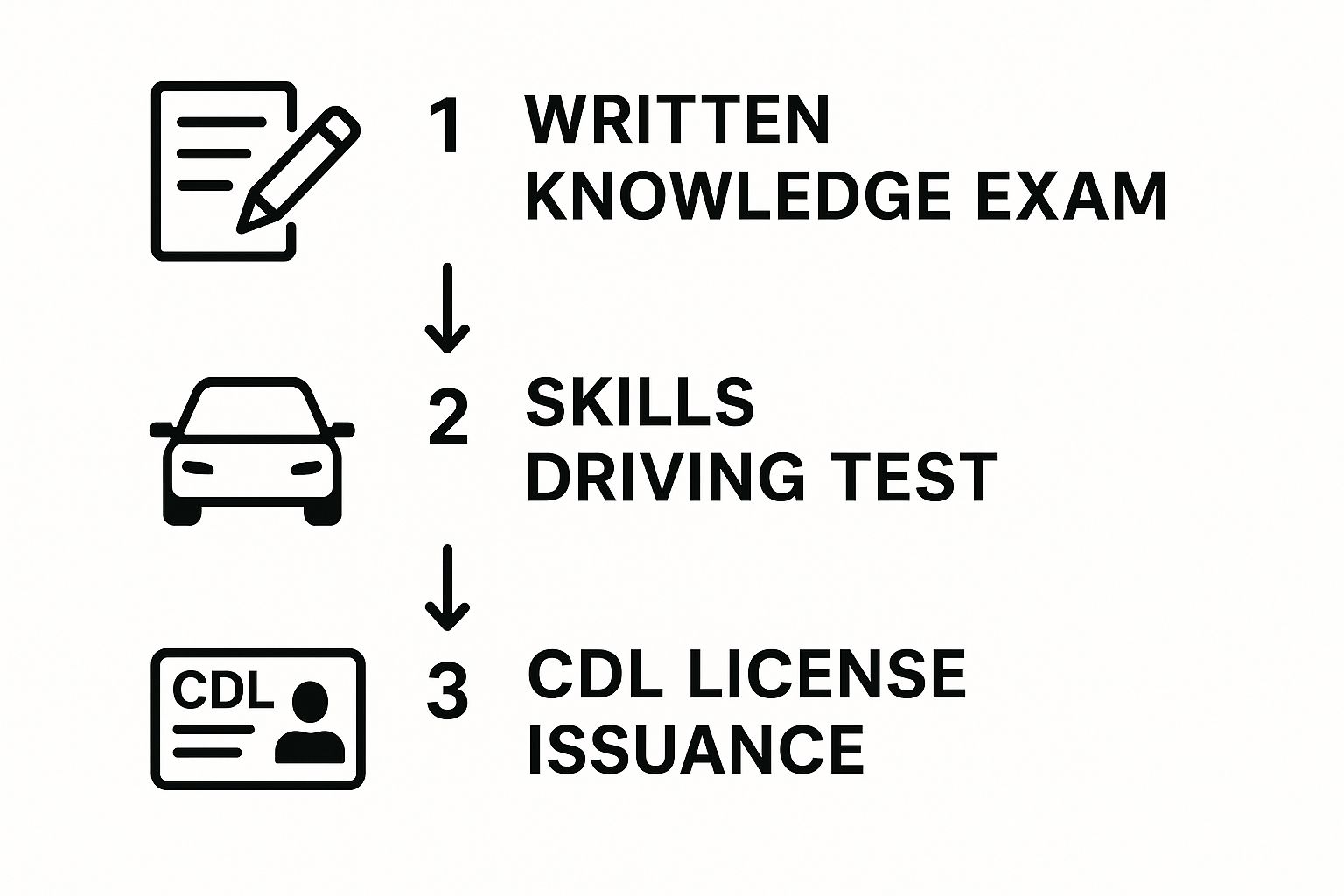
As you can see, once the financial piece is in place, the path forward is a clear progression from learning the rules to mastering the road. By digging into these financial aid options, you can fund your CDL training program without the stress and focus on what really matters: building the skills for your new career.
How to Choose the Right CDL Training Program

With so many schools vying for your attention, picking the right CDL training program can feel overwhelming. But this is the single most important decision you'll make for your new career, so taking your time to do the research really pays off. A great school isn't just focused on helping you pass a test; it's committed to shaping you into a safe, confident, and employable professional driver.
Think of it like choosing a skilled tradesperson to build the foundation of a house. You wouldn't just pick the cheapest option. You’d look for proven experience, quality tools, and a reputation for solid work. Your career is that foundation—it's worth investing in the best.
Look for Signs of Quality
Your first checkpoint should be the school's accreditation. An accredited institution has been vetted and proven to meet high industry standards for its curriculum, instructors, and equipment. It’s a clear signal that you’re dealing with a legitimate training center, not a "license mill."
Next, dig into the student-to-instructor ratio. You're paying for time behind the wheel, not time waiting in line. Smaller class sizes mean you get more direct instruction and one-on-one guidance from your instructor, which is absolutely critical when you're learning to handle an 80,000-pound vehicle.
The condition of the training trucks tells you a lot about a school's commitment to quality. Modern, well-maintained equipment means they're serious about providing a safe, realistic learning environment that prepares you for the rigs you'll be driving on the road.
Focus on Job Placement Assistance
Here's one of the biggest differentiators between an average school and a great one: job placement assistance. This is a huge advantage. Schools with dedicated placement teams have spent years building relationships with trucking companies, and they can connect you with carriers actively looking to hire their graduates.
A high job placement rate, often over 80% at top schools, is a powerful sign. It tells you that local and national companies trust the quality of that school's training. As you review the CDL training program details, pay close attention to the kind of career support they offer once you've earned your license.
Questions to Ask Admissions Staff
When you talk to an admissions advisor, don't be shy. You're the customer, and this is your chance to make sure the program is the right fit. Go in with a list of questions ready.
- How many hours of actual behind-the-wheel training does each student receive?
- Are all the instructors former professional drivers with real-world experience?
- What are your school's graduation and job placement rates?
- Can I come in for a tour to see the facility and the trucks?
- Which specific trucking companies hire your graduates?
Getting straight, confident answers to these questions will help you see which schools are truly invested in their students' success. A program that’s transparent and proud of its results is the kind of partner you want as you start your journey into professional trucking.
Exploring Career Paths After Graduation
https://www.youtube.com/embed/kuG2CIkpCaw
Getting your CDL isn't just about passing a test; it's about opening the door to a whole world of different career paths. Think of your new license as a master key. Now you just have to decide which doors you want to open in an industry that keeps America moving.
The path most new drivers take right out of school is over-the-road (OTR) trucking. This is the long-haul life you see in the movies—crossing state lines, seeing the country, and being out for weeks at a time. It’s a great fit if you're independent and love the open road, and it often pays the most for new drivers.
But if being away from home for that long doesn’t appeal to you, don’t worry. There are plenty of other great gigs out there.
Finding Your Ideal Driving Niche
A lot of drivers find their sweet spot in regional routes. This keeps you in a specific cluster of states, so you’re still putting in serious miles but you're usually home every weekend. It's a fantastic balance between good pay and having a home life.
Then there are local jobs, which are perfect for folks who want to be home every single night. These are your daily delivery routes, construction hauling, or dump truck jobs.
Want to really boost your paycheck and career options? Go for endorsements. Each one you add to your license opens up specialized, often higher-paying, jobs.
- Hazmat (H): This lets you haul hazardous materials. It comes with more responsibility, but the pay reflects that.
- Tanker (N): If you want to haul liquids—anything from milk to fuel—you'll need the tanker endorsement.
- Doubles/Triples (T): This certification allows you to pull two or three trailers at once, a skill that certain major freight companies always need.
The best part? Good drivers are always in demand. Right now, the industry is facing a major driver shortage, with some estimates pointing to a need for up to 78,000 drivers.
This isn't just a number—it means real job security and strong, competitive wages for you. A brand new driver can expect to start somewhere between $50,000 and $65,000 a year, and that's just the beginning.
Once you find a path that fits your lifestyle and start adding specialized endorsements, your CDL becomes more than just a license. It’s your ticket to a stable, well-paying career with plenty of room to grow.
Got Questions About CDL Training? Let's Get Them Answered.
Thinking about getting your CDL is a big step, and it’s smart to have questions. Getting the details straight is the first move toward feeling confident behind the wheel. Let’s tackle some of the most common things people ask before they sign up.
How Long Does It Really Take?
Most people are surprised by how fast you can get trained. A lot of full-time programs are built for speed. You could be looking at earning your CDL Class A license in just three to four weeks. Think about that—in less than a month, you could be fully licensed and ready to start your new career.
Is the CDL Test Really That Hard?
This is a big one. The test has two main parts: a written exam and a hands-on skills test. A good school won’t just teach you to drive; they'll teach you how to pass this test. With solid classroom instruction and plenty of time practicing maneuvers in the truck, it's absolutely a challenge you can meet.
What Happens If I Don't Pass on the First Try?
It happens. Don't let the thought of failing stop you. This isn't a one-and-done situation. Most states let you retake the test, and a quality school will stick with you. They'll offer extra practice to sharpen the skills you need to work on, ensuring you’re ready for round two.
Every single professional driver you see on the highway has been through this process. Your instructors were once new students, too, and they get it.
Will I Have a Job Waiting for Me When I Graduate?
While no school can legally guarantee you a job, the best ones come incredibly close. Top-tier schools have strong job placement programs and deep connections with trucking companies that are eager to hire their graduates. Their high placement rates are a testament to the quality of their training and their industry relationships. This gives you a massive leg up when it's time to find work.
Ready to stop asking questions and start your engine? Patriot CDL provides the training and support you need to launch your career in trucking. Find out more on the Patriot CDL website.