


Winter driving is not one skill. It is a chain of decisions that begins before the engine starts and continues every time the surface, visibility, traffic, or forecast changes. For a new commercial driver, the difficult part is rarely recognizing heavy snow. It is noticing the earlier clues—falling temperature, spray disappearing from other tires, slush collecting between lanes, a bridge deck that looks darker than the approach—and adjusting before the truck needs a sudden correction.
This guide turns official winter-driving rules into a practical CDL routine. It explains how to prepare the vehicle, evaluate a route, use smooth controls, protect visibility, and make a defensible stop-or-go decision. It is a training framework, not a substitute for the law, the Pennsylvania Commercial Driver's Manual, the vehicle manufacturer's instructions, or a motor carrier's procedures.
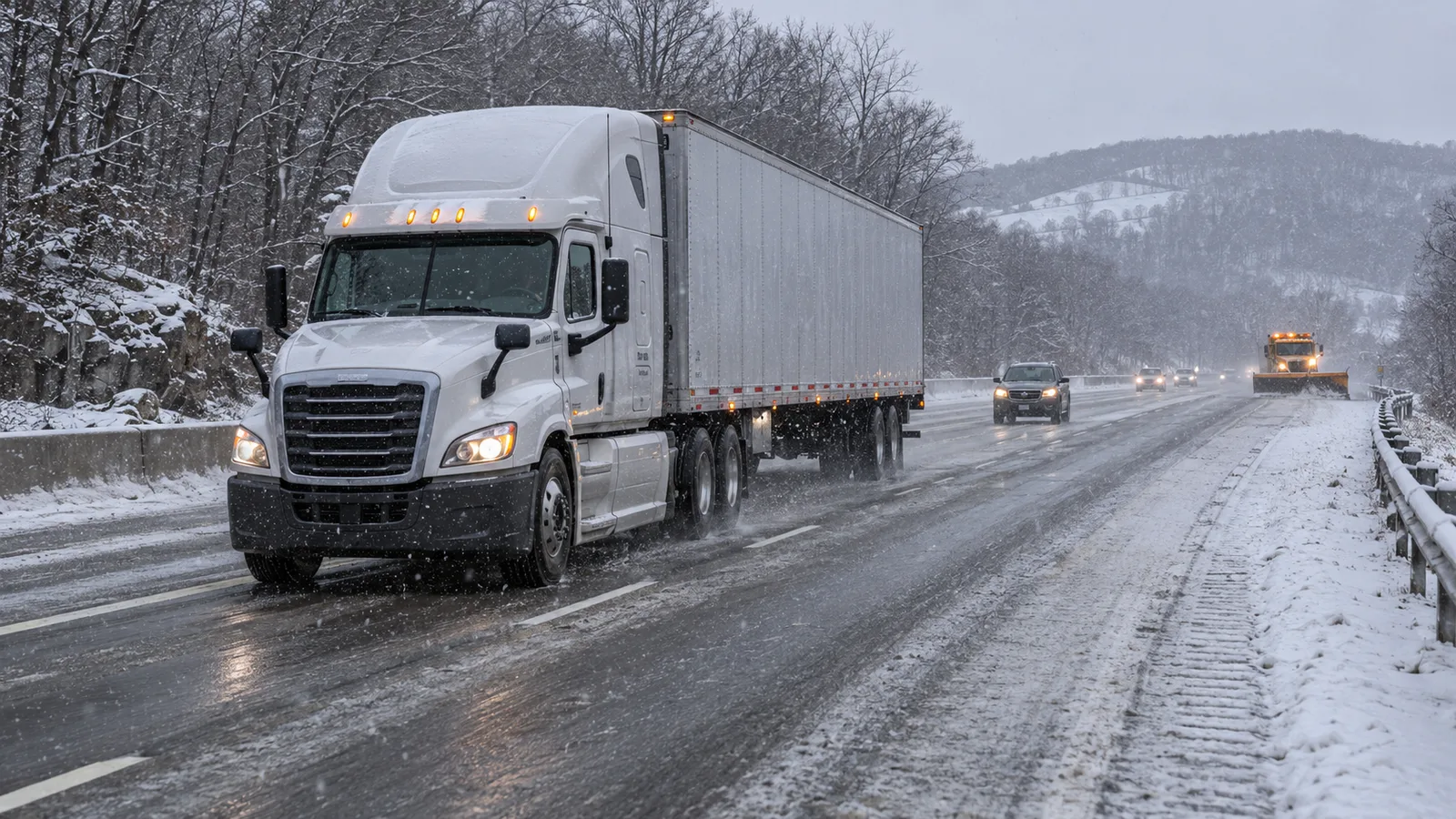
1. Start with the rule and a disciplined stop-or-go decision
is the federal baseline. When snow, ice, sleet, fog, mist, rain, dust, or smoke adversely affects visibility or traction, a commercial driver must exercise extreme caution and reduce speed. If conditions become sufficiently dangerous, CMV operation must be discontinued and cannot resume until the vehicle can be operated safely. That is a performance rule: it does not provide one universal winter speed or one visibility measurement that fits every truck and road.
Separate legal requirements from good operating practice
The regulation supplies the obligation. Good practice supplies a repeatable way to meet it. A driver can ask four questions at every change in conditions:
- Can I see far enough ahead to identify a hazard and make a gradual stop?
- Does the truck respond predictably to gentle steering, throttle, and braking?
- Can I maintain enough space without being forced into abrupt actions?
- Is there a safer place to stop before the next grade, interchange, squall, or restriction?
A “no” does not automatically mean continuing more slowly is acceptable. It is a signal to reassess the entire situation. Reducing speed is required when visibility or traction is adversely affected, but slowing is not permission to keep moving after the conditions become sufficiently dangerous.
Choose a stopping place before you need it
A stop-or-go plan works only if it includes safe places to stop. Identify truck parking, a service plaza, terminal, approved customer location, or other lawful area that can accommodate the combination. Avoid improvising on a narrow shoulder, ramp gore, curve, bridge, grade, or live lane. If the immediate location makes stopping more dangerous, continue only as needed to reach the nearest safer point, while following the applicable rule and carrier direction. Communicate early with dispatch; do not wait until the road is nearly impassable to report the change.
2. Build a winter-ready truck before departure
The , calls for a regular pre-trip with extra attention to winter equipment. A normal inspection remains the foundation, but winter makes small defects more consequential. A weak wiper, dirty reflector, marginal tread, or leaking exhaust connection can remove the margin a driver needs when snow begins.
Visibility and cab systems
Confirm that the heater and defrosters work and that you know their controls. Inspect wiper condition and pressure against the windshield, verify the washer system operates, and use washer fluid suitable for freezing temperatures. Clear the windshield, side windows, mirrors, lights, and reflectors before moving. Snow left on a lamp or mirror can quickly undo an otherwise careful inspection. The detailed windshield and wiper inspection plan and lights and reflectors plan are useful companion routines.
Also clear handholds, steps, and deck plates. A driver who slips while entering the cab or connecting lines may be injured before the trip begins. Remove snow and ice from surfaces that could shed onto the road, following Pennsylvania requirements and carrier procedures.
Tires, brakes, and the surfaces that create control
Use a gauge and follow the vehicle or tire manufacturer's cold-inflation guidance and the carrier's maintenance process. Inspect tread, cuts, exposed material, valve stems, dual spacing, and any other condition in the normal pre-trip. The Pennsylvania CDL manual lists at least 4/32 inch tread depth in every major groove on front tires and at least 2/32 inch on other tires, while emphasizing that additional tread is valuable in winter. A legal minimum does not prove a tire is suitable for the present snow, load, or route. Review the commercial truck tire inspection plan for the full walkaround sequence.
Inspect the brake system as required, drain air tanks when and as the vehicle and carrier procedure require, and report defects. Do not try to compensate for a brake, tire, or steering defect by driving more slowly. Winter conditions demand a serviceable vehicle.
Coolant, exhaust, and traction equipment
Check coolant level and freeze protection through the approved maintenance process. Inspect the exhaust system carefully because closed windows and reduced ventilation increase the importance of keeping exhaust gases out of the cab. Verify that the tailpipe is unobstructed before running the engine while parked in accumulating snow.
If chains or other approved traction devices may be required, confirm the correct type, quantity, fit, condition, and storage before departure. Learn installation in a controlled setting, not for the first time on a storm shoulder. Chain and traction-device requirements can vary by road, restriction tier, vehicle, and event, so use current official notices, carrier instructions, and manufacturer guidance rather than a remembered rule from another state.
3. Plan the route around weather, restrictions, and safe exits
FMCSA advises truck and bus drivers to research weather, road conditions, roadwork, and detours before a trip. A commercial route plan should also account for height, weight, hazardous-material, and other CMV restrictions; a consumer navigation app may not contain them. In Pennsylvania, provides current road-condition layers, traffic, closures, cameras, truck parking, speed restrictions, and weather-event vehicle restrictions.
Create decision checkpoints, not just an ETA
Mark several points where you will reassess: before leaving the terminal, before entering a higher elevation, before a long grade, at a major interchange, and before passing the last known truck-parking option. Record the forecast window and expected temperature trend, but treat the forecast as planning information rather than proof of what the pavement will do. Conditions can differ across a single route.
For each checkpoint, name an action: continue, reduce speed and expand space, take an approved alternate route, or stop. This prevents the schedule from becoming the default decision. If a restriction prohibits the vehicle or requires equipment you do not have, do not enter the affected segment.
Coordinate without surrendering the driving decision
Tell dispatch or the appropriate supervisor what you observe: route, mile marker, precipitation, road coverage, visibility, traffic speed, and the safe location you intend to use. Concrete observations are more useful than “the weather is bad.” A carrier can help with routing and parking, but the driver must still operate within the safety rule. Document the communication according to company procedure.
4. Use smooth control when traction is reduced
Winter control is built from small, early inputs. Abrupt acceleration can spin drive wheels; abrupt steering can exceed the available lateral grip; abrupt braking can turn a manageable speed into a skid. The Pennsylvania CDL manual directs drivers to start gently, drive slowly and smoothly, make gentle turns, avoid unnecessary hard braking, and enter curves slowly enough that braking in the curve is not required.
Start, steer, and change speed gradually
Begin with the wheels as straight as practical and apply power gently. Look far ahead so you can release the accelerator early instead of making a late brake application. Complete most speed reduction while traveling straight and before a curve, lane change, ramp, or downgrade. If traffic forces frequent sharp adjustments, increase the space or leave the roadway at the next safe option.
Turn off cruise control on snow-covered or slippery roads. specifically warns against its use on snow-covered roads. Direct accelerator control helps the driver respond to changing grip, but it does not create traction; the primary tools are lower speed, more space, and smooth inputs.
Understand retarders, ABS, and vehicle-specific instructions
The Pennsylvania CDL manual warns that an engine brake or speed retarder can cause drive wheels to skid on slippery surfaces. Follow the vehicle manufacturer's instructions and carrier policy for disabling or using the system in winter. Do not assume that one truck's controls behave like another's.
Anti-lock brakes help prevent wheel lock during hard braking, but they do not make ice dry or shorten every stop. Keep the vehicle straight, look toward a safe path, and use the braking method specified for the vehicle. Training should include identifying the ABS indicator and understanding the operator manual before bad weather arrives.
5. Protect visibility and a usable space cushion
A driver needs enough visible road to recognize a problem, decide, and act gradually. Snowfall, spray, fogged glass, dirty lamps, and glare can reduce that distance long before the road feels slippery. If the wipers, washers, defroster, or lights cannot maintain a clear view, stop safely and correct the problem. Do not keep moving by looking through a small cleared patch.
Use light and clean surfaces to be seen
Use the lighting required by law and the conditions, and follow PennDOT guidance to use low beams in heavy or blowing snow. High beams can reflect from snow or fog and reduce the driver's useful view. At safe stops, recheck lamps, mirrors, windows, wipers, and reflectors because road treatment and slush can coat them quickly.
Give plows room. Do not pass or drive between trucks operating in a plow line. Their working area may include thrown snow, treatment material, and pavement that has not yet been cleared. A plow's visible path is not an invitation to follow closely.
Expand space before the truck needs it
The correct winter following gap depends on speed, surface, visibility, traffic, grade, and vehicle condition. There is no single extra-second formula that makes every icy road safe. Build more space than in dry conditions and preserve an escape path whenever possible. The following-distance and space-cushion guide explains how to count a gap and reset it as speed or traffic changes.
Watch the rear and sides as well as the lane ahead. Another vehicle may be following too closely or drifting beside the trailer. Signal early, avoid unnecessary lane changes, and do not let a faster driver's impatience pull the truck above a safe speed.
6. Read traction cues before grip disappears
Winter roads often provide warnings. Bridges and overpasses can freeze before nearby pavement. Tire spray from other vehicles may diminish when liquid water becomes ice. Ice on mirrors or wiper arms can indicate freezing conditions. Shiny areas, slush ridges, shaded curves, ramp surfaces, and changes in steering feel deserve an immediate speed and space reassessment.
Make a gentle, low-risk traction check
The CDL manual advises drivers to get the feel of the road when first starting and not to hurry. That does not mean making a hard brake test in traffic. In a safe, open, low-speed area, start gently and observe whether the drive wheels, steering, and normal light braking respond predictably. If the surface cannot support smooth control, do not enter faster traffic to “see if it improves.” Stop at the first safe place or use an approved alternative.
Respond to a skid by removing the cause, not adding inputs
Skid recovery depends on the vehicle and the type of skid, so it must be practiced with a qualified instructor and learned from the official manual. The general prevention lesson is simpler: look far ahead, keep speed down, make one smooth input at a time, and avoid braking while turning. If drive-wheel spin begins under power, ease off rather than adding throttle. If the trailer begins to move out of line or steering response is lost, focus on regaining control without a sudden competing input and reach a safe stopping place for reassessment.
7. Worked scenario: a rain-to-snow transition before a grade
A student driver and instructor are preparing a loaded tractor-trailer for a daylight training route. The terminal is wet, the temperature is just above freezing, and 511PA shows snow coverage at higher elevation. The route includes a long climb, a downhill segment, and a service plaza before the grade.
Before departure
They complete the normal pre-trip, then verify defrosters, heater, winter washer fluid, wiper contact, clean lights, tread condition, mirrors, steps, coolant, and exhaust. The instructor confirms the truck's retarder procedure and the carrier's traction-device plan. They identify the service plaza as the primary reassessment point and a terminal-approved alternate as the fallback. Dispatch receives the route and planned checkpoint.
During the route
Rain becomes wet snow. The student turns off cruise control, reduces speed smoothly, increases the following gap, and avoids an unnecessary lane change. Near an overpass, spray from vehicles ahead disappears and snow begins collecting between lanes. Steering still responds predictably, but visibility is shortening and the temperature display is falling.
At the service-plaza exit, they reassess instead of committing to the grade. A fresh 511PA check shows worsening coverage and a planned commercial-vehicle restriction farther ahead. The instructor can no longer see enough road to guarantee gradual responses at the existing traffic speed. They enter the plaza, park in a lawful truck space, notify dispatch with their observations, and wait for conditions and restrictions to improve. The decision is not based on fear or schedule pressure; it follows the preselected checkpoint and the federal requirement to discontinue operation when conditions become sufficiently dangerous.
What made the decision effective
The key actions happened early: the vehicle was prepared, a stopping option was identified, changes were observed before the grade, and communication occurred from a safe location. Continuing past the plaza would have removed options. The same framework applies when the correct choice is to continue at a reduced speed: the driver must still keep monitoring visibility, traction, traffic, and the next safe exit.
8. Winter driving action table
| Observation | Immediate action | Next decision |
|---|---|---|
| Snow begins but the road remains wet and visible | Reduce speed smoothly, increase space, turn off cruise control, and recheck mirrors and lights | Continue only while the vehicle remains predictable and the next checkpoint is reachable safely |
| Spray disappears near a bridge or shaded area | Treat the surface as potentially icy; avoid abrupt throttle, steering, or braking | Reassess traction at low speed in a safe area and consider the nearest safe stop |
| Wipers or defroster cannot maintain a clear view | Reduce speed and move to a lawful safe stopping location | Correct the visibility problem before resuming |
| Slush ridges or packed snow affect lane position | Hold a steady path, avoid unnecessary lane changes, and make gradual inputs | Stop if the truck cannot stay predictably within the lane |
| A restriction applies to the vehicle or required equipment is missing | Do not enter the restricted segment | Use an approved alternate or wait at a safe location |
| Visibility or traction becomes sufficiently dangerous | Discontinue operation under 49 CFR §392.14 | Resume only when the CMV can be operated safely |
9. Practical CDL winter-driving checklist
Before moving
- Complete the normal pre-trip and resolve safety defects.
- Verify heater, defrosters, wipers, washers, and freeze-resistant washer fluid.
- Clear snow and ice from windows, mirrors, lights, reflectors, steps, handholds, and vehicle surfaces.
- Inspect tires, tread, inflation, brakes, steering, coolant, battery connections, and exhaust.
- Confirm the correct traction equipment, fit, condition, and applicable restrictions.
- Review official weather, 511PA conditions, restrictions, grades, truck parking, and alternates.
- Choose reassessment points and safe stopping locations before departure.
While driving
- Wear the seat belt and keep both attention and controls ready for changing grip.
- Turn off cruise control on snow-covered or slippery roads.
- Reduce speed, expand space, and make throttle, steering, and braking inputs smoothly.
- Watch bridges, overpasses, shaded areas, tire spray, mirrors, and wipers for ice cues.
- Enter curves slowly; avoid unnecessary braking or lane changes within them.
- Recheck lights, mirrors, windows, and wipers at safe stops.
- Communicate specific observations and decisions through the carrier's procedure.
- Stop at the first safe place when conditions are too slippery or sufficiently dangerous.
10. Frequently asked questions
When must a commercial driver slow down for snow or ice?
Federal rule 49 CFR §392.14 requires speed to be reduced when hazardous conditions such as snow, ice, sleet, fog, mist, or rain adversely affect visibility or traction. The safe speed depends on the actual road, traffic, grade, visibility, vehicle, and load. A posted limit is a maximum; it does not guarantee that the limit is safe in winter weather.
When should a CDL driver stop driving in dangerous winter conditions?
Under 49 CFR §392.14, operation must be discontinued when conditions become sufficiently dangerous and may not resume until the vehicle can be operated safely. Plan safe stopping options early, communicate with the carrier, and avoid stopping in a live lane or another location that creates a greater hazard.
Should a truck driver use cruise control on snow or ice?
No. PennDOT advises drivers not to use cruise control on snow-covered roads and warns against cruise control on slippery surfaces. Keep direct control of the accelerator, follow the vehicle manufacturer's instructions and carrier policy, and make smooth speed changes.
How should a CDL driver test traction in winter?
The Pennsylvania CDL manual says to get the feel of the road when starting and not to hurry. In a safe, low-speed area away from traffic, begin gently and observe steering and drive-wheel response without an abrupt brake or throttle input. If the vehicle slips or conditions are very slick, reduce speed further or stop at the first safe place.
Build the decision process in supervised training
Winter safety improves when the routine is practiced before the weather forces a quick choice. Review the manual, name the vehicle-specific controls, plan checkpoints, and discuss real stop-or-go scenarios with a qualified instructor. The broader CDL training guide can help you compare a complete training plan.
Ready to discuss CDL training? Contact Patriot CDL at or visit 7800 Bristol Pike, Levittown, PA 19057.
Official sources
- , Section 2.13, Driving in Winter