


Following distance is not just empty pavement. For a commercial driver, it is decision time: time to recognize brake lights, understand why traffic is changing, reduce speed smoothly, and preserve an escape option. A passenger car may fit into a short gap and still stop much faster than a loaded truck. That is why a CDL student should learn to measure space with a repeatable time interval rather than trust a visual guess.
This guide turns the Pennsylvania Commercial Driver's Manual timing method into a practical training routine. It explains how vehicle length and speed establish a starting interval, how to count that interval using a fixed landmark, and when conditions require substantially more room. It also distinguishes a study formula from the driver's legal and operational duty to obey local laws, reduce speed for hazards, and choose a margin that fits the actual vehicle and roadway.
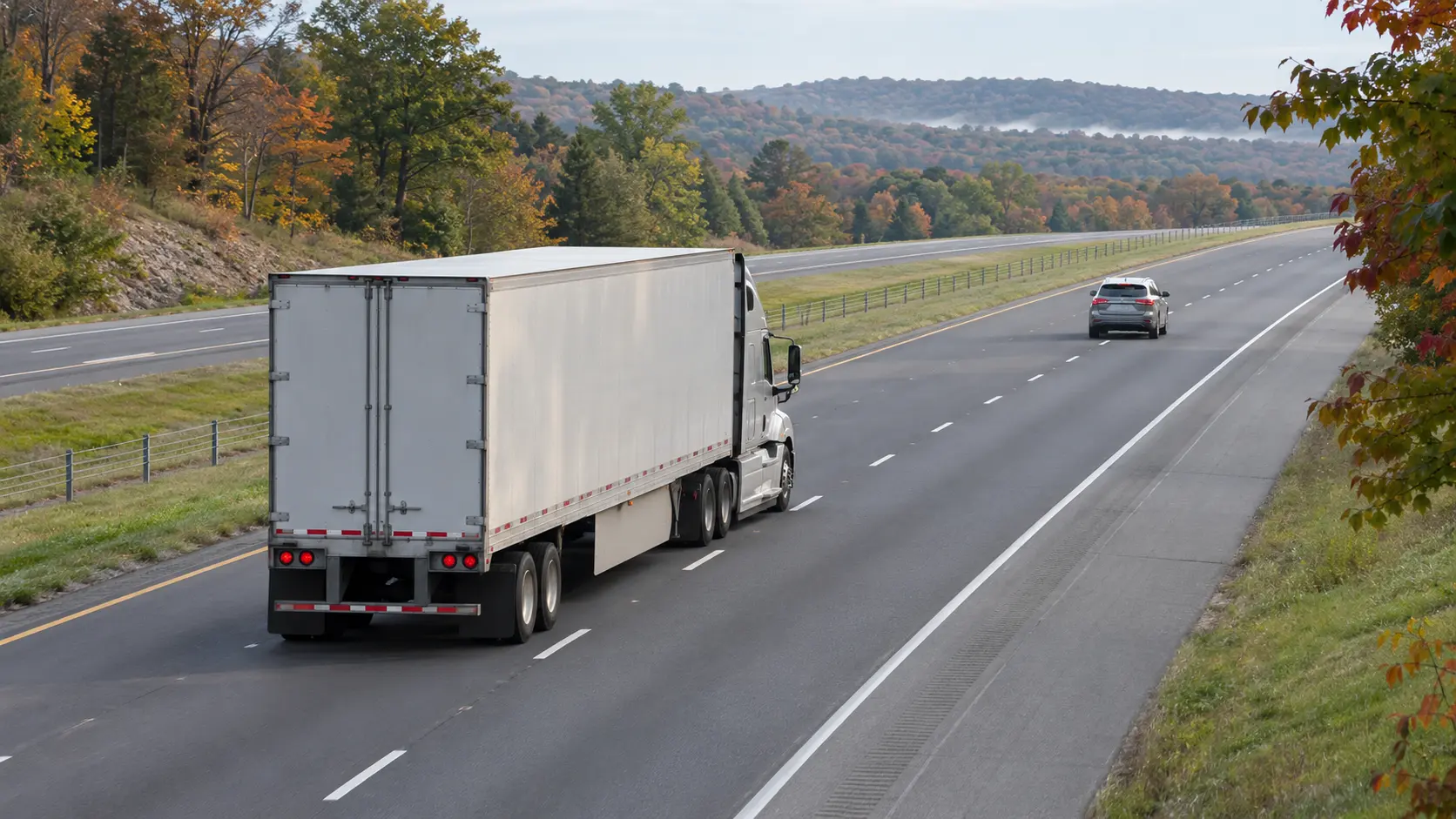
Why commercial drivers need time ahead
A following gap must cover more than braking distance. The driver first has to see a change, interpret it, decide what to do, and begin a controlled response. The truck then needs room to slow. A well-managed interval also lets the driver look beyond the vehicle directly ahead, see lanes and shoulders, and avoid getting trapped in a pattern of repeated acceleration and hard braking.
FMCSA's emphasizes that additional space gives large vehicles time for safe braking and unexpected actions. PennDOT's CDL manual similarly warns that the smaller vehicle ahead may stop faster than the truck or bus behind it. The practical lesson is simple: a gap that feels comfortable in a car may be inadequate in a commercial vehicle.
A safety margin, not a target to consume
The counted interval is a minimum planning margin under the conditions used for the count. It is not an invitation to drive exactly that close. If a driver counts more time than the baseline, that extra space is useful. If traffic repeatedly enters the gap, the solution is not to defend it by accelerating. Ease off smoothly, recreate the interval, and continue scanning for the next change.
Space supports steering choices too
Stopping may not be the only safe response to a developing hazard. A clear shoulder or adjacent lane can sometimes become an escape option, but only when the driver has already checked mirrors and understands surrounding traffic. Space ahead gives time to evaluate rather than make a sudden lane movement. It works together with the mirror and clearance habits discussed in the truck turn planning and trailer-clearance guide.
Build a baseline from vehicle length and speed
The Pennsylvania Commercial Driver's Manual presents a useful timed-interval rule for heavy vehicles: below 40 mph, allow at least one second for each 10 feet of vehicle length; above 40 mph, add one additional second. FMCSA repeats the same approach in its driver guidance. The formula converts a truck's approximate overall length into a count a driver can practice without estimating feet on moving pavement.
| Approximate vehicle length | Below 40 mph | Above 40 mph | Training interpretation |
|---|---|---|---|
| 30 feet | At least 3 seconds | At least 4 seconds | Starting point only; add time for hazards |
| 40 feet | At least 4 seconds | At least 5 seconds | Matches PennDOT's 40-foot example |
| 50 feet | At least 5 seconds | At least 6 seconds | Measure the entire vehicle, not just the tractor |
| 60 feet | At least 6 seconds | At least 7 seconds | Matches PennDOT's combination-vehicle example |
| 70 feet | At least 7 seconds | At least 8 seconds | Confirm actual configuration and operating policy |
Know the combination you are driving
A tractor with a short training trailer is not the same length as a highway combination with a longer trailer. A straight truck, motorcoach, school bus, doubles combination, or vehicle towing equipment may require a different baseline. Learn the approximate total length of the current configuration and recalculate when equipment changes. Do not reuse a memorized “four seconds” for every commercial vehicle.
The formula is not a legal safe harbor
Under , a commercial motor vehicle must be operated according to the laws, ordinances, and regulations of the jurisdiction where it is being driven, unless an FMCSA rule imposes a higher standard of care. State rules and enforcement facts can differ. Meeting a study formula does not excuse following too closely when traffic, weather, sight distance, load, or road design requires more room.
Measure the interval with a fixed landmark
Distance in feet is difficult to judge while both vehicles are moving. Time is more practical. Choose a fixed point ahead—a shadow across the pavement, bridge joint, signpost, lane marking, or another stationary landmark. The moment the rear of the vehicle ahead passes that point, begin a steady count. Stop when the front of your truck reaches the same point.
- Select a fixed landmark that will be easy to recognize without staring at it.
- When the lead vehicle's rear clears the landmark, start counting: “one-thousand-one, one-thousand-two,” and continue evenly.
- Stop the count when the front of the truck reaches that landmark.
- Compare the count with the baseline for the truck's length and speed.
- If the interval is short, release the accelerator early and rebuild the gap smoothly.
- Count again after speed, lane, traffic, grade, or weather changes.
Count without losing the traffic picture
The count is a brief reference, not a reason to fixate on the pavement. Keep the eyes moving near and far, check mirrors, and watch brake lights several vehicles ahead when sight lines allow. PennDOT recommends looking roughly 12 to 15 seconds ahead, while still shifting attention to closer hazards. A following-distance count protects the immediate gap; a longer visual lead helps explain what may happen inside that gap.
Recheck instead of assuming
At a constant speed, the gap can shrink quietly when the lead vehicle slows slightly. A downgrade can increase the truck's speed. A lane change can replace a distant lead vehicle with a much closer one. Count again after the situation changes. The skill is not producing one correct number at the start of the trip; it is noticing when the number is no longer correct.
Add room for real driving conditions
The baseline assumes that the current conditions support it. FMCSA advises drivers to adjust following distance for weather, road conditions, visibility, and traffic, and its training guidance recommends doubling the interval in adverse conditions. That is a useful planning direction, not permission to keep driving whenever a doubled gap can be found.
requires extreme caution when snow, ice, sleet, fog, mist, rain, dust, smoke, or similar conditions adversely affect visibility or traction. Speed must be reduced; if conditions become sufficiently dangerous, CMV operation must be discontinued until the vehicle can again be operated safely. A driver therefore manages speed, following distance, and the continue-or-stop decision together.
Rain, snow, ice, and loose surfaces
Less traction increases the room needed to slow and makes abrupt steering or braking more risky. Increase the time interval before the pavement becomes obviously slippery, reduce speed, and avoid cruise control when the vehicle or employer guidance says conditions make it inappropriate. Bridge decks, shaded sections, standing water, leaves, gravel, and polished intersections can change traction within a short distance. If the safe margin cannot be maintained, the operating plan must change.
Fog, darkness, glare, dust, and smoke
A long gap is not enough if the driver cannot see far enough to use it. Match speed to the distance visible ahead and preserve extra time for recognition. Do not use the taillights of a vehicle ahead as a guide through poor visibility; that can draw the truck into an unsafe following interval. The fog and low-visibility decision guide expands on visibility limits and the decision to discontinue travel.
Downgrades and heavy or shifting loads
Gravity can increase closing speed on a downgrade, while vehicle mass, brake condition, cargo behavior, and gear selection affect how the truck responds. Establish the safe speed and gear before descending, add space early, and avoid relying on service brakes to correct a chronically short gap. Review the separate downgrade planning guide for speed selection and braking strategy.
Blocked sight lines
When a box truck, bus, van, or another tractor-trailer blocks the view ahead, leave enough room to see more of the traffic picture without moving out of the lane. Extra distance can reveal brake lights, traffic signals, ramp activity, and lane closures sooner. Never offset the truck merely to peek around a lead vehicle when that position reduces side clearance or places the truck in another lane.
Manage space behind and beside the truck
A driver controls the space ahead more directly than the space behind. If a tailgater follows the truck, do not speed up, flash brake lights, or use a sudden maneuver to “teach” the other driver. PennDOT recommends avoiding quick changes, signaling early, reducing speed gradually, and increasing space ahead so the truck is less likely to need an abrupt response. Stay right when appropriate and let the other vehicle pass when it can do so safely.
Preserve side space and an escape path
Lane position should leave the greatest practical clearance from vehicles, barriers, workers, parked cars, and roadside hazards. Avoid driving beside another vehicle for long periods, especially where a lane ends or an entrance ramp feeds traffic into the truck's blind area. If both sides become constrained, reduce speed and create more room ahead; extra time can replace a missing lateral option.
Leave room for vehicles that need to merge
Scan entrance ramps early. When permitted and safe, a lane change can create space for entering traffic. Otherwise, adjust speed gradually to avoid arriving beside a merging vehicle at the same point. Do not make a last-second lane change without confirming mirrors, signals, blind areas, and trailer clearance.
Handle cut-ins, queues, and changing traffic
When another vehicle enters the gap
A car entering the space ahead has changed the measured interval. First stabilize the truck: keep steering smooth, release the accelerator as needed, and avoid retaliatory acceleration. Rebuild the correct time interval behind the new lead vehicle. Brake more firmly only when the traffic situation requires it. The gap exists to absorb exactly this type of uncertainty.
When brake lights appear far ahead
Respond to the traffic pattern, not only the bumper directly in front. A wave of brake lights, a queue at a signal, a lane closure, or vehicles bunching near an interchange is a reason to come off the accelerator early. Early speed reduction keeps the interval from collapsing and gives following traffic more notice. In work zones, expect shortened lanes, construction vehicles, flaggers, and sudden queues; use the commercial-driver work-zone plan as a complementary routine.
When the lead vehicle behaves unpredictably
Repeated speed changes, drifting, delayed signals, or blocked rear windows justify more room, not closer monitoring. Increase the interval and avoid spending unnecessary time beside the vehicle. If a driver is aggressive, do not engage. Preserve a route out, let the vehicle move away, and follow applicable company procedures if a serious hazard must be reported.
Following-distance action table
| Situation | What changes | Practical response |
|---|---|---|
| Dry road, steady traffic, clear view | Baseline conditions | Use the length-and-speed interval, then retain any additional space available |
| Speed rises above 40 mph | Higher closing speed | Add the extra second in the PennDOT formula and count again |
| Rain, snow, ice, fog, dust, or smoke | Traction or visibility worsens | Reduce speed, substantially increase time, and stop if safe operation is no longer possible |
| Long downgrade | Gravity can shrink the gap | Select speed and gear early, add room before descent, and monitor closing speed |
| Car cuts into the gap | New lead vehicle and shorter interval | Release the accelerator, stay smooth, and recreate the margin without retaliation |
| Lead vehicle blocks the view | Less information ahead | Increase the interval so more roadway and traffic signals become visible |
| Tailgater behind the truck | Less rear space | Increase room ahead, signal early, avoid abrupt changes, and allow a safe pass |
| Work-zone or exit queue | Sudden or hidden stops likely | Come off the accelerator early and avoid driving into a closing gap |
Worked highway scenario: the seven-second gap changes
Jordan is driving a 60-foot tractor-trailer at 55 mph on a dry divided highway during supervised training. Using the PennDOT formula, the starting interval is seven seconds: six seconds for the approximate 60-foot length plus one additional second because the speed is above 40 mph. Jordan selects a signpost, begins counting when the car ahead passes it, and reaches the post at “one-thousand-eight.” The truck has more than the baseline, so Jordan keeps the margin rather than accelerating to consume it.
Two miles later, an SUV passes and moves into the gap. The new interval is only about four seconds. Jordan does not flash the lights or move left immediately. Jordan checks mirrors, releases the accelerator, keeps the lane, and allows the combination to slow gradually. When the SUV passes another fixed marker, the recount reaches seven seconds. The required margin has been rebuilt without a hard brake application.
Light rain then begins, and spray reduces contrast. Jordan reduces speed, increases the interval beyond the dry-road baseline, confirms that the longer gap can be maintained, and watches traffic farther ahead. A queue forms near a work-zone sign. Because the truck is not close to the SUV, Jordan can begin a steady slowdown early and communicate the change to traffic behind through normal brake-light use.
The teaching point is not that seven seconds solves every situation. Seven seconds was the dry-road starting calculation for that vehicle and speed. The cut-in required a fresh measurement; the rain and work-zone queue required more time and lower speed. The driver kept updating the plan instead of treating the first count as permanent.
A repeatable training drill
Practice first as a verbal exercise while another qualified person drives or during a supervised lesson. Identify vehicle length, state the baseline at the current speed, choose a landmark, and call out the count. Then name the factor that would require more time. The instructor should emphasize smooth corrections and continuous scanning, not an exact bumper-to-bumper target.
Use three short practice rounds
- Stable interval: count on a dry, low-traffic road and compare the result with the calculated baseline.
- Changed lead vehicle: after a safe lane change or natural cut-in, identify the new lead vehicle and rebuild the interval.
- Changed condition: discuss how darkness, rain, a downgrade, a blocked view, or a queue changes speed and space decisions.
Do not turn the drill into repeated speed changes that disrupt traffic. If the roadway is too busy for a calm count, keep the conservative gap and practice later in a suitable location. The instructor remains responsible for choosing a safe lesson environment and directing the student.
Practical following-distance checklist
- Know the approximate total length of the current truck or combination.
- Below 40 mph, start with at least one second for each 10 feet of vehicle length.
- Above 40 mph, add one more second to that starting calculation.
- Use a fixed landmark and a steady verbal count; do not estimate moving feet.
- Keep any extra space rather than accelerating to the minimum.
- Look 12 to 15 seconds ahead while monitoring the immediate lead vehicle.
- Recount after speed, lane, grade, lead vehicle, traffic, visibility, or traction changes.
- Increase time substantially for adverse weather, poor surfaces, blocked views, and heavy traffic.
- Reduce speed when visibility or traction is affected.
- Discontinue operation when conditions no longer permit safe CMV operation.
- Release the accelerator and rebuild the gap when another vehicle cuts in.
- Respond early to brake lights, queues, lane closures, and ramp traffic.
- Do not defend the gap, retaliate, or use abrupt braking against a tailgater.
- Signal early and slow gradually when another vehicle follows too closely.
- Avoid lingering beside vehicles; preserve side clearance and an escape option.
- Follow state and local laws, carrier policy, and instructor direction.
Common mistakes to correct
Using one number for every truck. The PennDOT baseline changes with total vehicle length and with speeds above 40 mph.
Counting from a moving reference. Another vehicle or its shadow is not a fixed point. Use a stationary roadside or pavement landmark.
Staring at the landmark. The count must fit inside a continuing scan of mirrors, traffic, lanes, and escape paths.
Accelerating when a car enters the gap. That converts a useful safety margin into a contest. Recreate the space smoothly.
Keeping normal speed in poor visibility. A larger gap does not correct a speed that outruns the visible stopping area.
Treating the formula as permission. A timed interval is a training tool. Applicable law and actual conditions still govern the safe decision.
Frequently asked questions
How many seconds should a tractor-trailer follow behind another vehicle?
PennDOT teaches at least one second for each 10 feet of vehicle length below 40 mph, plus one additional second above 40 mph. A 60-foot combination therefore starts at six seconds below 40 mph and seven seconds above 40 mph. Weather, traction, visibility, traffic, grade, and vehicle condition can require substantially more time.
Why should CDL drivers measure following distance in seconds instead of feet?
Seconds are easier to measure while both vehicles are moving. The driver watches the lead vehicle pass a fixed landmark, counts steadily, and stops counting when the truck reaches the same point. The result can be compared with the vehicle-length and speed baseline without trying to estimate moving feet.
What should I do when a car cuts into my following gap?
Keep steering smooth, check the surrounding traffic, release the accelerator as needed, and rebuild the time interval behind the new lead vehicle. Do not accelerate to defend the space, retaliate, or make an unverified lane change. Brake more firmly only when the actual traffic situation requires it.
Does the PennDOT timing formula replace state following-distance laws?
No. It is a practical CDL training method, not a legal safe harbor. A CMV driver must obey the laws of the jurisdiction and use greater care when FMCSA rules or actual conditions require it. A counted interval can still be unsafe when weather, traffic, visibility, grade, or vehicle condition demands more space.
Official sources and training next step
Use the current official materials with your training vehicle's characteristics, your instructor's direction, and the carrier's operating policy. The timing method should support judgment, not replace it.
Want to practice following-distance judgment and smooth speed control with an instructor? Contact Patriot CDL at or visit 7800 Bristol Pike, Levittown, PA 19057.