So, you're ready to get behind the wheel of a big rig. The first real step on that journey is getting your Class A CDL permit, and this guide is here to walk you through it. Think of the permit test as the written exam before the final driving test. Nailing it proves you have the book smarts, and it's the only way you can legally start your hands-on training.
With the right approach, you can walk into the DMV feeling prepared and walk out with your permit in hand.
Your Roadmap to a Class A CDL Permit
Your Class A Commercial Learner's Permit (CLP) is more than just a piece of paper—it's your official green light to start training on public roads with an instructor. You can’t legally practice driving a semi-truck without one, period. It shows you’ve mastered the essential knowledge needed to handle a combination vehicle safely.
This guide will break down the entire process, from figuring out if you're eligible to what you'll actually see on the tests. We'll turn what feels like a mountain of rules and regulations into a simple, step-by-step plan so you can move forward with confidence.
Understanding the Core Requirements
Before you can even think about scheduling your permit exam, you have to check a few boxes. Federal and state governments have set some ground rules to make sure every new driver meets a baseline for safety and professionalism.
For example, federal law is clear: you must be at least 21 years old to drive a commercial truck across state lines (interstate) or to haul hazardous materials. Some states might let you get an in-state-only CDL at 18, but many, including New York and Hawaii, stick to the 21-year-old minimum for a Class A.
These rules aren't random. They stem from the Commercial Motor Vehicle Safety Act of 1986, which was created to make sure every state holds its commercial drivers to the same high standards.
Beyond your age, you'll need a few other things squared away. You can find a complete list of what you'll need here: https://patriotcdl.com/cdl-requirements/, but here’s a quick rundown of the must-haves:
- A Valid Driver's License: You need to have a standard driver's license from the state where you live.
- Proof of Citizenship or Legal Residency: Be ready to show documents that prove you're a U.S. citizen or are legally permitted to work here.
- A Clean Driving Record: The DMV will pull your driving history. Major violations can be a deal-breaker.
- Passing a Medical Exam: You’ll have to pass a Department of Transportation (DOT) physical to confirm you're healthy enough for the job.
Mastering the General Knowledge Test
The General Knowledge test is the big one—it’s the cornerstone of your entire Class A CDL permit exam. Think of it as the foundation for everything else you'll learn. It covers the widest range of topics, and every single applicant has to pass it. Nailing this test shows you’ve got the core principles of safely handling a big rig down pat.
This guide is your toolkit for getting it done. We’ll break down all the must-know subjects, from how to conduct a meticulous vehicle inspection to controlling your truck and spotting trouble on the road before it finds you. Once you really get these concepts, you'll walk into the test feeling confident and prepared.
The Art of the Vehicle Inspection
Long before you even think about turning the key, your most critical job is making sure your truck is safe to be on the road. A thorough vehicle inspection isn't just about ticking boxes on a form; it's a non-negotiable safety habit. It protects you, your load, and every other person out there. The General Knowledge test will absolutely expect you to know this process like the back of your hand.
You need to approach it with the same level of detail a pilot uses for a pre-flight check. It’s that serious. You'll be tested on the three main types of inspections:
- Pre-Trip Inspection: This is the full, top-to-bottom check you do before starting your day. You’ll go through everything, from what's under the hood to the coupling system connecting your tractor and trailer.
- En-Route Inspection: These are the quick-check pit stops you make during your trip. You're looking for things like shifted cargo, listening for any strange new noises, and giving your tires and brakes a once-over.
- Post-Trip Inspection: When the trip's over, you do another inspection to spot any problems that might have cropped up. This makes sure the truck is either ready for the next run or flagged for maintenance.
A proper pre-trip inspection isn’t about memorizing a list of parts. It's about building a mental routine that becomes second nature, so you can spot a potential failure before it happens at 65 mph.
Essential Vehicle Control Skills
There's a world of difference between driving a car and maneuvering a fully-loaded tractor-trailer. The massive size and weight of a commercial vehicle demand a smooth, deliberate touch. The General Knowledge test is designed to see if you truly understand the physics involved in controlling that much mass.
This includes fundamental concepts like safe acceleration. You have to apply power gradually to keep your drive wheels from spinning out, especially on wet or icy roads, and to avoid putting unnecessary strain on the drivetrain. In the same way, safe stopping is absolutely critical. You need to know how your rig’s weight, your speed, and the road conditions can drastically increase the distance it takes to come to a complete stop.
You'll need to know how to calculate your total stopping distance, which is broken down into three parts:
- Perception Distance: How far the truck rolls from the moment you see a hazard to the moment your brain recognizes it's a problem.
- Reaction Distance: How far the truck travels between your brain recognizing the hazard and your foot actually hitting the brake pedal.
- Braking Distance: The distance your truck covers from the time you apply the brakes until it finally stops.
Managing Gears and Speed
If you're testing in a truck with a manual transmission, knowing how to work the gears is a make-or-break skill. This isn't like your buddy's sports car where you can skip gears for fun. In a big rig, proper shifting techniques, especially double-clutching, are essential to avoid wrecking the transmission.
Double-clutching is a two-step process: press the clutch to pull it out of gear, release the clutch, press it again, and then slide it into the next gear. It sounds complicated, but this technique is what allows you to match the engine's speed to the transmission's speed, resulting in a smooth, non-grinding shift. The test will also cover how to choose the right gear for climbing and descending hills to maintain control and prevent your brakes from overheating.
For a deeper dive into these topics, our comprehensive breakdown of the General Knowledge test can provide additional clarity and practice questions.
Developing Hazard Perception
Finally, a huge part of the test is about hazard perception. This is the skill of seeing, recognizing, and reacting to potential dangers before they turn into real emergencies. It's all about being a proactive driver, not a reactive one.
The key pieces of good hazard perception are:
- Scanning the Road: You need to look way, way ahead. In the city, that means looking 12 to 15 seconds down the road, which is about a full city block. On the open highway, you should be scanning at least a quarter of a mile ahead.
- Checking Your Mirrors: Your mirrors are your best friends. Constant checks are the only way to know what's going on all around your rig, especially in your massive blind spots.
- Managing Your Space: The single most important safety tool you have is space. You need to maintain a cushion of empty space around your truck—in front, behind, and on the sides. This space gives you the time and room you need to react to the unexpected.
The demand for qualified drivers has never been higher, which makes mastering these skills essential. The industry needs drivers who are safe and professional. The data shows that drivers under 45 are underrepresented in the industry compared to the general workforce. This gap highlights the huge opportunity for new drivers to enter a field where they are desperately needed to keep the country moving, especially behind the wheel of the tractor-trailers and truck-trailer combinations that are the backbone of our supply chain.
Understanding Air Brakes Inside and Out
If you’re going for a Class A CDL, there’s no getting around it: you have to pass the Air Brakes test. This isn't an optional endorsement; it's a mandatory requirement for operating these big rigs. So, let’s dedicate some serious time to understanding this system from the inside out. Knowing your air brakes isn't just about passing a test—it's a critical safety skill you'll rely on every single day you're behind the wheel.
It helps to think of an air brake system kind of like the circulatory system in your body. The air compressor is the heart. It’s constantly working, pumping pressurized air (the system's "lifeblood") through the lines to make sure everything is ready to go. This simple analogy makes it easier to picture how all the different parts work together to stop a truck that can weigh up to 80,000 pounds.
Core Components of an Air Brake System
To really nail this section of the test, you've got to know the key players in the system and what each one does. Once the compressor builds up air pressure, that air has to be stored somewhere and then sent to the wheels the instant you need it. That's where these main components come in.
For the permit test, you need to be able to identify and explain these parts:
- Air Compressor: This is the engine-driven pump that acts as the heart of the system, compressing air and pushing it into the storage tanks.
- Air Storage Tanks: These tanks hold the compressed air, giving you a ready supply to work the brakes, even if the compressor stumbles for a moment.
- Brake Pedal (Treadle Valve): When you step on the brake, you're really just opening a valve. This lets that stored compressed air rush from the tanks toward the brake chambers. The harder you press, the more air flows, and the more stopping power you get.
- Brake Chambers: You'll find one of these at each wheel. This is where the magic happens—air pressure gets turned into mechanical force. The air pushes on a diaphragm inside the chamber, which shoves a pushrod forward.
- Slack Adjusters and Brake Linings: That pushrod moves the slack adjuster, which in turn twists a camshaft. This final movement presses the brake shoes and their linings against the inside of the brake drum, creating the friction you need to slow down and stop.
It's all about understanding the sequence. Think of it as a chain reaction: your foot hits the pedal, air flows to the chambers, the pushrod moves the slack adjuster, and the linings hit the drum. If any link in that chain is weak, you could be looking at brake failure.
To get comfortable with these concepts, drilling practice questions is a great strategy. You can find plenty that cover these components in our complete air brakes test guide.
The Essential Air Brake System Check
The most hands-on part of acing the air brakes test is showing you can perform a full system check. This isn’t just something you memorize for the exam; it's a precise, step-by-step diagnostic you’ll run before every single trip. You need to be able to walk the examiner through this process without a hitch.
The infographic below shows how the core principles of driving—inspection, control, and awareness—all tie together.
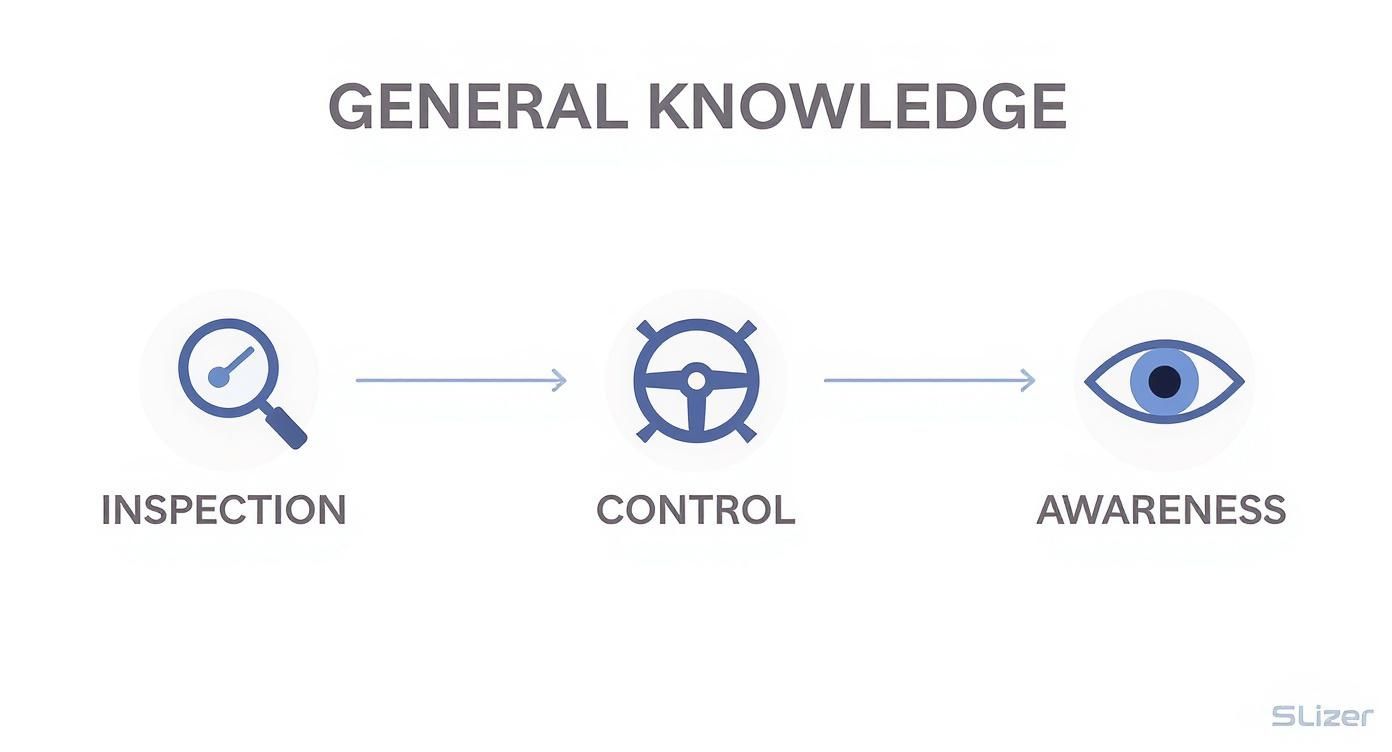
As you can see, a proper inspection, like the air brake check, is the foundation for everything else. It’s what gives you the confidence that you have control and full awareness on the road.
Your air brake check involves several specific tests to prove the system is airtight and responsive. They'll expect you to check for leaks, test the low-air warning signals, and confirm that the emergency spring brakes automatically apply when the air pressure drops to a critical level, which is typically between 20 and 45 psi.
Recognizing and Reacting to Common Problems
Finally, the permit test will quiz you on what to do when things go wrong. You need to spot the tell-tale signs of trouble, like seeing the needle on your air pressure gauge drop, hearing a constant hissing sound that signals a leak, or feeling a spongy brake pedal under your foot.
Knowing how to react is just as important. For instance, if that low-air warning light and buzzer kick on, there's only one right answer: get pulled over safely as soon as you can and figure out what's wrong. Trying to push on with low air pressure is incredibly dangerous and will get you an automatic fail on your test.
Conquering the Combination Vehicles Test
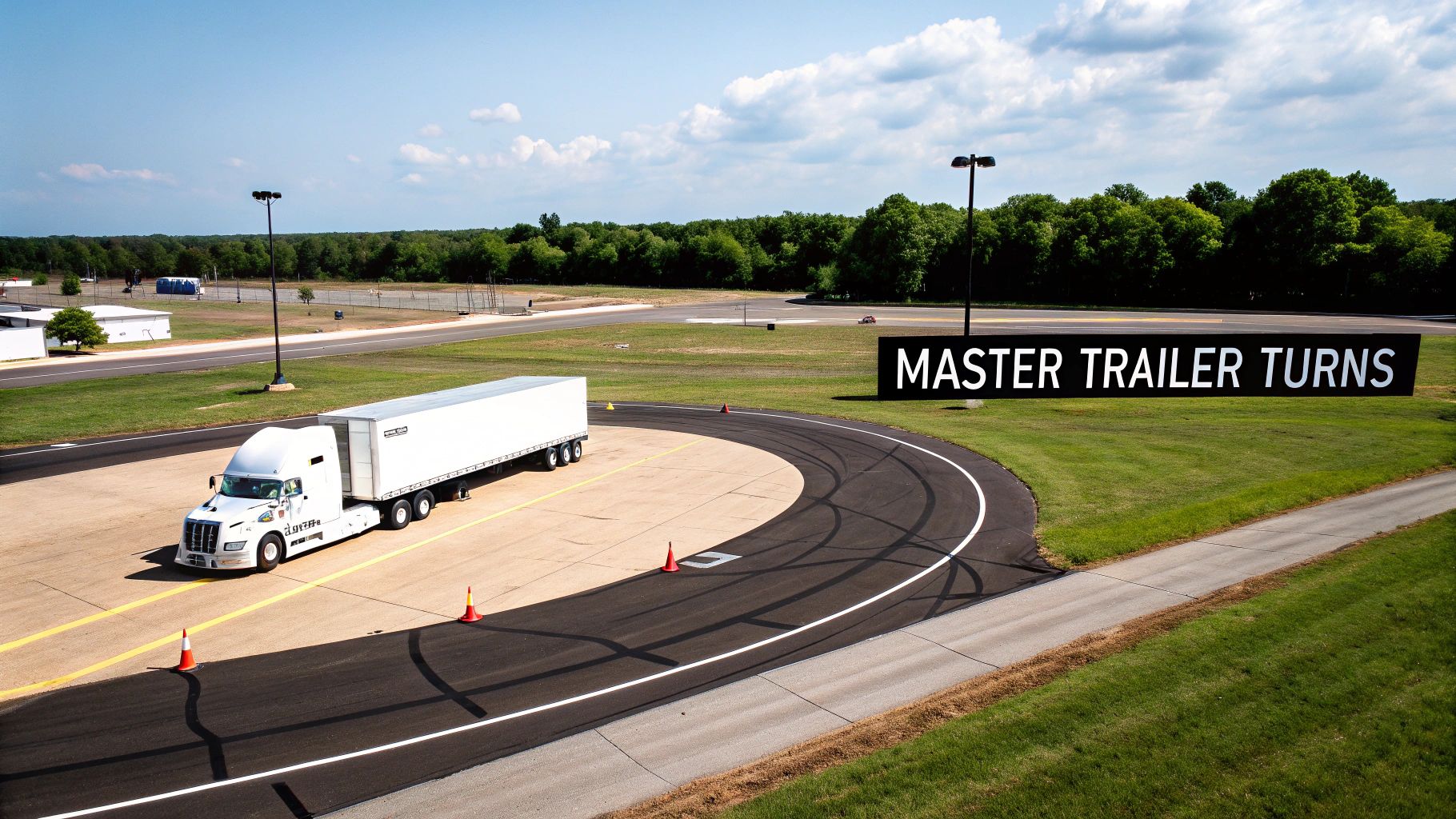
Driving a combination vehicle is what separates the pros from the rest. This section of the exam zeroes in on the unique physics of a tractor-trailer, and you need to understand how these two massive pieces of equipment operate as one single, articulated unit.
Passing this test isn't just about memorizing facts. It's about developing an instinct for how your rig will behave out on the road. From the geometry of a turn to the forces at play during braking, knowing these concepts inside and out is what will keep you—and everyone else—safe.
Safe Coupling and Uncoupling Procedures
Before you can even think about hitting the road, you have to master the meticulous process of connecting and disconnecting your tractor and trailer. This isn't something you can rush. It's a precise, step-by-step procedure where one missed check can lead to a dropped trailer—a disaster you absolutely want to avoid.
Think of it like a pilot's pre-flight checklist. Every single step matters.
- Inspect Everything First: Before you even start backing up, give the fifth wheel and the trailer's kingpin plate a thorough look-over. Check for damage and make sure the fifth wheel is properly greased.
- Back Up and Lock In: Ease the tractor back, keeping it as straight as possible. You're looking for that solid "clunk" as the fifth-wheel jaws lock around the kingpin. Then, do a gentle tug test by putting the truck in a low gear and pulling forward slightly to confirm it's secure.
- Lines and Landing Gear: Once you're locked in, it's time to connect your air and electrical lines. The final step is to raise the trailer's landing gear completely.
Uncoupling is the same process, just in reverse. You'll start by lowering the landing gear firmly to the ground and finish by pulling the tractor slowly away. For a deeper dive and some great practice questions on these steps, be sure to review our combination vehicles test guide.
Navigating Turns and Off-Tracking
One of the biggest learning curves for any new driver is handling turns. You absolutely have to understand a concept called off-tracking. This is where the rear wheels of your trailer follow a much shorter path than the front wheels of your tractor. The longer your rig, the more dramatic the off-tracking will be.
Here's a good way to picture it: think of a marching band turning a corner. The musicians on the inside corner barely have to move, while the ones on the outside have to take huge steps to keep the line straight. Your trailer's tires are like the musicians on the inside—they are always going to cut that corner.
To counteract this, you have to swing wide. This means pulling your tractor well into the intersection before you even start turning the wheel. This gives the trailer the extra room it needs to clear curbs, signs, poles, and other vehicles.
Preventing Rollovers and the Crack-the-Whip Effect
A loaded trailer has a high center of gravity, which makes any combination vehicle vulnerable to rollovers. This danger gets much worse on curves, highway on-ramps, or any time you have to make a sudden move. Speed is almost always the main factor. A ramp with a posted speed of 45 mph for a car might only be safe at 25 mph for your rig.
Another scary phenomenon is the "crack-the-whip" effect. It happens when you make a sudden lane change or swerve. That small movement at the steering wheel gets amplified down the length of the trailer, causing the rear end to swing out violently. This can easily lead to a rollover or a jackknife.
The most important thing to remember is this: slow down before the turn. Hitting the brakes while you're already in a curve is one of the worst things you can do. It can shift the load and dramatically increase your chances of rolling over. Always be smooth and deliberate with your steering and speed.
To drive a combination vehicle safely, you must be constantly aware of the unique dangers they present. The table below breaks down the biggest risks you'll face and the critical actions you need to take to stay out of trouble.
Key Risks in Combination Vehicle Operation
| Risk Type | Description | Preventive Action |
|---|---|---|
| Rollover | A high center of gravity causes the vehicle to tip over, usually from taking a curve or ramp too fast or swerving suddenly. | Dramatically reduce your speed before entering any curve or ramp. Keep your cargo as low and centered as possible. |
| Jackknife | The tractor and trailer skid into a sharp "V" shape, like a closing pocketknife. It's often caused by hard braking, especially on slick roads. | Avoid jamming on the brakes. Apply steady, controlled pressure. Never brake hard in a turn. |
| Off-Tracking | During a turn, the trailer's rear wheels follow a tighter path than the tractor's, leading to collisions with curbs, signs, or other vehicles. | Make wide turns. Pull the tractor straight into the intersection to create space for the trailer to follow safely. |
| Crack-the-Whip | A quick steering movement causes the trailer's rear to swing out with amplified force, risking a rollover or collision. | Make all steering inputs—especially lane changes—smoothly and deliberately. Avoid any sudden, jerky movements. |
Ultimately, mastering these concepts is about respecting the machine you're operating. A proactive, safety-first mindset is the most important tool you have.
Proven Study Strategies and Test Day Tips
https://www.youtube.com/embed/7NXwNwKNqfs
Knowing the rules of the road is half the battle. The other half is knowing how to study smart and walk into the test center with confidence. A solid game plan is what separates the people who pass on the first try from those who don't.
Think of it this way: you wouldn't start a long haul without checking your rig, right? You need to do the same with your study habits. Don't just stare at the official CDL manual—get your hands dirty and really engage with the material.
How to Actually Study for This Test
One of the best ways to make information stick is a technique called active recall. Instead of just re-reading the chapter on air brakes for the tenth time, close the book and try to explain the entire system out loud, as if you were teaching it to someone else. This process of pulling the information from your brain builds way stronger memories than just passively reading.
Another great trick is the Pomodoro Technique. It sounds fancy, but it's simple: study in focused 25-minute bursts, then take a 5-minute break. This keeps you from burning out and helps your brain actually absorb the complex details about coupling, uncoupling, and pre-trip inspections.
Your official state CDL manual is your bible. Practice tests are great, but the manual has the exact wording and rules you'll see on the exam. Make it your go-to resource.
If you're looking for more general study advice that works for any exam, there are plenty of proven methods out there. You can get a good overview from resources like these 5 study tips to pass any test.
Getting Ready for Game Day
The 24 hours before your test are just as critical as the weeks you spent studying. Your mission is to show up calm, rested, and ready to go.
- Get Some Sleep: This isn't the time to pull an all-nighter. A tired brain is terrible at remembering facts. Aim for a full, quality night's sleep.
- Fuel Up: Eat a decent meal before you go. Avoid anything heavy or sugary that will make you crash. A balanced breakfast gives your brain the steady energy it needs to focus.
- Keep Calm: It's totally normal to be nervous. Take a few deep breaths before you walk in. Get to the testing center a little early so you aren’t stressed about being late.
And remember why you're doing this. The trucking industry is always looking for good drivers. With nearly 1.2 million drivers on the road in the U.S. and a turnover rate that can hit 95%, the demand is huge. The average driver is 48 years old, meaning a lot of folks are heading toward retirement. Passing this test is your ticket into a field with endless opportunities.
What to Do With Those Tricky Questions
When you hit a question that makes you pause, don't panic. There's a strategy for this.
First, read the question slowly. Look for clue words like "always," "never," or "except," because they can flip the whole meaning. Then, start knocking out the answers you know are dead wrong. You can often get it down to just two choices, which gives you a much better shot at picking the right one.
Got Questions About the CDL Permit? We've Got Answers.
Getting your CDL is a big move, and it's totally normal to have a few questions before you get started. Let's clear up some of the most common ones so you can map out your journey with confidence.
How Long Is My Permit Good For? Can I Renew It?
Think of your Commercial Learner's Permit (CLP) as a temporary pass for hands-on training. Once it's issued, the clock starts ticking—it's typically valid for 180 days.
If that time is running out and you're not quite ready for your skills test, don't sweat it. Most states will let you renew it once for another 180 days. But that's usually the limit. If you let it expire after that second period, you'll have to go back to square one and retake all the knowledge tests.
What if I Fail One of the Knowledge Tests?
First off, it happens. A lot of great drivers didn't pass every test on their first try. It’s a minor setback, not a career-ender.
Every state has slightly different rules, but you can always retake the exam. You might just have to wait a day or two before giving it another shot. Use that time wisely! Go back to your study materials, hit the sections that tripped you up, and treat that first attempt like a practice run that showed you exactly where to focus.
A failed test isn't a reflection of your ability to be a great driver. It just means you weren't quite ready for that specific test on that specific day. Dust yourself off, study up, and go nail it the next time.
Do I Have to Go to a School to Get My Permit?
Nope! You don't need to be enrolled in a full-blown truck driving school just to get your permit. Anyone can study the official CDL manual and other guides on their own to pass the written knowledge tests.
But here’s the important part: the permit is just step one. It's the key that lets you get behind the wheel with an instructor. Federal regulations (known as ELDT, or Entry-Level Driver Training) require you to complete a certified training program before you can take the final CDL skills test.
So, while you can get the permit on your own, you will need professional training to get the license. To get a better feel for what the permit allows and what comes next, our guide to the commercial learner's permit lays it all out.
Ready to stop wondering and start driving? At Patriot CDL, we provide the expert, hands-on training that turns that permit in your pocket into a rewarding career. Find out more about our accelerated programs and start your journey.
https://patriotcdl.com