
Getting your combination vehicle endorsement is a huge step, and it takes more than just skimming the CDL manual. You have to genuinely understand how these big rigs handle on the road. That's where a solid combination vehicle practice test becomes your most valuable tool, closing the gap between reading a book and being ready for the real thing.
Why This Practice Test Is Your Best Study Tool
Learning the physics of a tractor-trailer isn't just about passing a test; it's about keeping yourself and everyone else safe out there. The knowledge you lock in now directly impacts how you'll handle tight spots and tricky situations on the job. A practice test simulates the pressure of the official DMV exam, building the kind of quick-thinking skills you'll need every day.
This kind of preparation is more important than ever. Back in 2018, statistics showed a 3% increase in truck accidents. Sadly, many of those incidents came down to things that good training can prevent, like poor driving decisions or missed vehicle problems. This is exactly what a rigorous CDL prep process is designed to fix.
Building Confidence and Skill
A well-designed practice exam is so much more than a simple quiz. It forces you to internalize the critical concepts you'll face behind the wheel. Think of it as a dress rehearsal that lets you find and fix your weak spots before you're sitting in the DMV testing center.
It hones in on the topics that trip up new drivers the most, including:
- Coupling and Uncoupling: Getting the sequence down for connecting air lines and locking the fifth wheel is non-negotiable.
- Air Brake Systems: You need to know how to perform a full air brake check cold and spot the early signs of a problem.
- Trailer Off-Tracking: It's essential to understand how much a long trailer will cut a corner compared to your tractor.
To give you a clearer picture, here’s a breakdown of what the official exam covers and how this practice test gets you ready.
Key Focus Areas of the Combination Vehicle Exam
| Exam Topic | Why It's Critical | Practice Test Focus |
|---|---|---|
| Coupling/Uncoupling | An improperly connected trailer is one of the most dangerous mistakes a driver can make. | Questions simulate the step-by-step process to ensure you know the correct, safe sequence. |
| Air Brakes | Combination vehicles rely entirely on their air brake systems; failure is not an option. | Scenarios test your knowledge of brake checks, lag time, and recognizing system failures. |
| Turning & Off-Tracking | Misjudging a turn can lead to hitting curbs, signs, or other vehicles. | Questions focus on right-of-way, turn radiuses, and managing the "swing out" of the trailer. |
| Rollovers & Stability | High centers of gravity make combination vehicles prone to rollovers, especially on curves or ramps. | Questions cover the dynamics of speed, road conditions, and proper braking to prevent rollovers. |
This table shows that we're not just throwing random questions at you. We're targeting the exact skills the DMV is looking for.
By running through these scenarios again and again, you stop just memorizing answers and start building real confidence. You'll understand the why behind every rule, not just the what.
This approach doesn't just prepare you for one test; it makes you a better, safer driver. Of course, this endorsement builds on the foundational knowledge from the general CDL exam. Make sure you've got that down by checking out our guide to the CDL general knowledge test. Think of this practice exam as your roadmap to passing with flying colors.
The Complete Combination Vehicle Practice Test
Alright, let's see what you've got. This is where the rubber meets the road—a full practice exam built to feel just like the real deal you'll be taking at the DMV. You’ll find 25 multiple-choice questions here that cover the whole nine yards of operating a combination vehicle.
These aren't just random trivia. Every single question is based on a real-world situation you could face on any given day out there. We're talking about everything from spotting the first sign of a trailer skid to knowing the exact sequence for hooking up your air lines. This test will really dig into your understanding of vehicle dynamics, critical safety protocols, and the regulations that keep everyone safe.
Treat this like it’s exam day. Find a quiet spot, put the phone on silent, and really think through each question. The goal here isn't just to get a passing grade; it's to pinpoint exactly where you feel confident and which areas might need a bit more time in the books.
This infographic breaks down how this practice test is designed to get you ready.
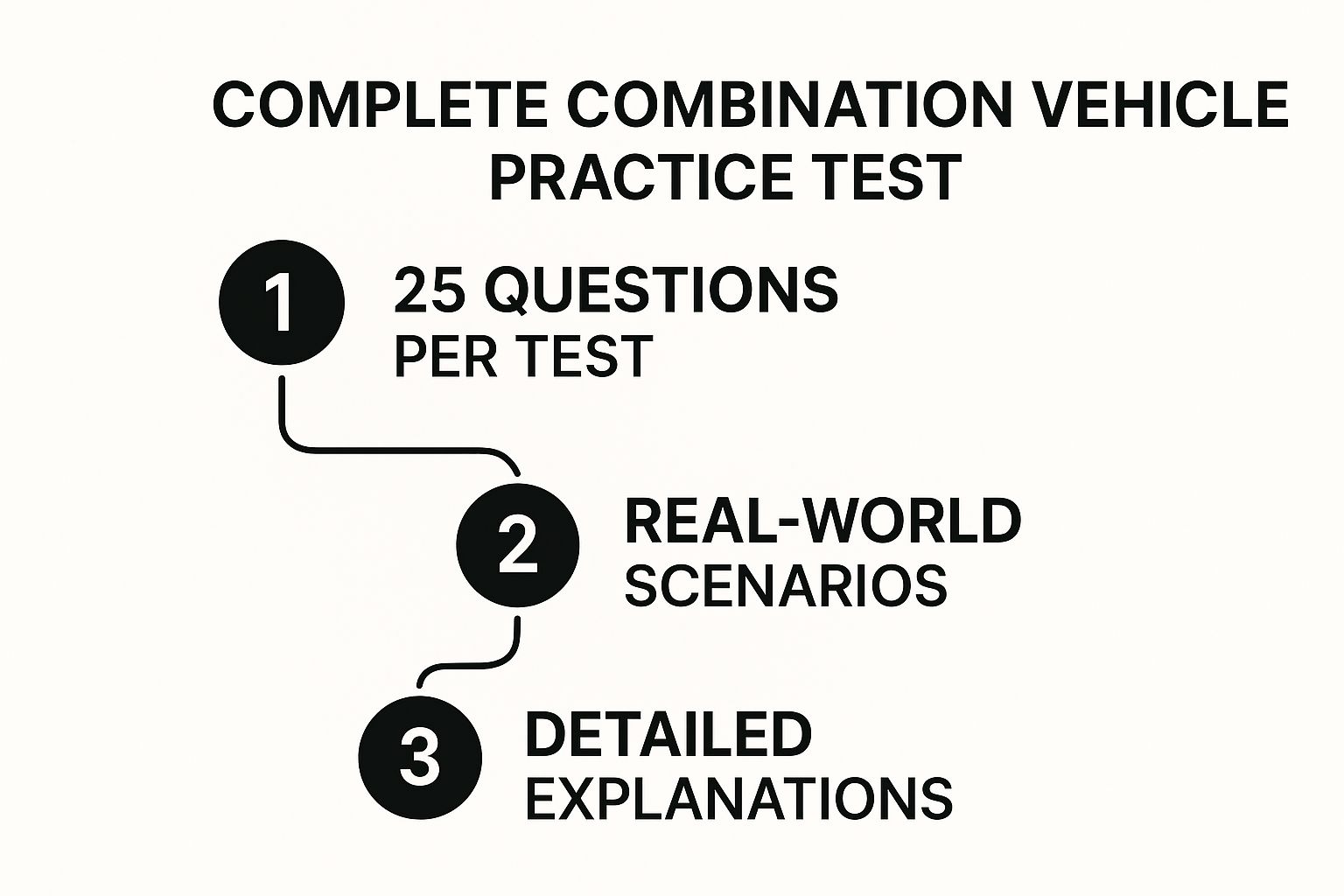
As you can see, it’s a straightforward process: we challenge you with realistic questions and then give you clear, no-nonsense explanations to make sure the knowledge sticks.
Your Practice Exam Questions
1. When coupling, the tractor protection valve should be in what position?
a) Normal
b) Emergency
c) Open
d) Closed
2. You are driving a combination vehicle when the trailer breaks away, pulling the air lines. You would expect the trailer brakes to:
a) Slowly lose pressure and disengage.
b) Lock up completely.
c) Apply and stay fully applied.
d) Be unaffected.
3. What is the main purpose of the trailer air supply control?
a) To supply the trailer with air and engage the trailer's emergency brakes.
b) To control the speed of the trailer's air compressor.
c) To apply the service brakes on the trailer only.
d) To drain water from the trailer's air tanks.
4. The "off-tracking" or "cheating" of a 53-foot trailer is most noticeable when:
a) Driving on a straight highway.
b) Backing in a straight line.
c) Making a sharp turn.
d) Accelerating from a stop.
5. To prevent a rollover, where should you place the heaviest cargo in your trailer?
a) As high as possible.
b) All the way in the nose of the trailer.
c) As low to the floor and centered as possible.
d) All the way in the tail of the trailer.
6. What are the two air lines that connect your tractor to your trailer?
a) The primary and secondary lines.
b) The service and emergency lines.
c) The input and output lines.
d) The red and green lines.
7. When you are uncoupling a loaded trailer, you should lower the landing gear until:
a) It is just off the ground.
b) It makes firm contact with the ground and relieves some pressure from the tractor.
c) It lifts the trailer completely off the fifth wheel.
d) You hear a clicking sound.
8. You should test your tractor-semitrailer connection by:
a) Visually inspecting the kingpin.
b) Pulling forward gently with the trailer brakes locked.
c) Hitting the fifth wheel with a hammer.
d) Shaking the trailer by hand.
9. The emergency air line is often colored:
a) Blue.
b) Yellow.
c) Green.
d) Red.
10. What is a trailer jackknife?
a) When the trailer pushes the tractor sideways.
b) When the trailer's wheels lock up and it swings out.
c) When the landing gear collapses.
d) When the kingpin breaks.
Key Insight: Notice how many questions focus on air brakes and coupling. These are the two most critical safety systems on a combination vehicle, and the DMV test heavily emphasizes them. Mastering these topics is non-negotiable for passing.
11. Why should you never use the trailer hand valve for parking?
a) It will damage the service brakes.
b) Air could leak out, releasing the brakes.
c) It is illegal in all 50 states.
d) It only works when the engine is running.
12. The service air line is often colored:
a) Blue.
b) Yellow.
c) Red.
d) Black.
13. A "high cube" trailer is more dangerous because:
a) It is heavier.
b) It has a higher center of gravity.
c) It is harder to see around.
d) Its brakes are less effective.
14. When should you use the trailer hand brake (trolley valve)?
a) To slow down on steep grades.
b) To park the vehicle.
c) Only to test the trailer brakes.
d) In heavy traffic.
15. If the service line disconnects while you are driving, what will happen?
a) The trailer's emergency brakes will engage.
b) Nothing, as long as the emergency line is secure.
c) The trailer's service brakes will not work.
d) A loud alarm will sound.
16. How much space should be between the upper and lower fifth wheel plates?
a) About one inch.
b) About half an inch.
c) No space at all.
d) As much as possible.
17. What is the best way to recognize that your trailer has started to skid?
a) You will feel a pull on the steering wheel.
b) You will see it in your mirrors.
c) The brake pedal will feel soft.
d) The engine RPM will suddenly increase.
18. When backing a trailer, you should turn the steering wheel:
a) In the opposite direction you want the trailer to go.
b) In the same direction you want the trailer to go.
c) Sharply to the left, then to the right.
d) It depends on the length of the trailer.
19. What does the trailer air supply control do?
a) It sends air to the trailer tanks.
b) It controls the tractor's brakes.
c) It adjusts the ride height of the trailer suspension.
d) It is used to test the air pressure.
20. If your trailer is equipped with ABS, but your tractor is not, you should:
a) Drive normally.
b) Avoid hard braking.
c) Disconnect the trailer's ABS.
d) Drive at a reduced speed at all times.
Final Questions
21. Before you back under a trailer, make sure that:
a) The trailer brakes are locked.
b) The ground is perfectly level.
c) The kingpin is greased.
d) Both a and b.
22. "Glad hands" are used to connect the:
a) Electrical lines from the tractor to the trailer.
b) Air lines from the tractor to the trailer.
c) Safety chains.
d) Hydraulic lines.
23. After you have coupled, you should raise the landing gear by:
a) Using high gear first, then low gear.
b) Using low gear first, then high gear.
c) Using only high gear.
d) Using only low gear.
24. The shut-off valves at the rear of a trailer are generally:
a) Always open.
b) Always closed.
c) Open for the last trailer and closed for others.
d) Closed for the last trailer and open for others.
25. When driving a double or triple rig, you must ensure the heaviest trailer is:
a) In the very back.
b) In the middle.
c) The one closest to the tractor.
d) It does not matter.
Answer Key and Explanations
Here are the correct answers with a quick breakdown for each one. Spend a little extra time on any you got wrong—that’s how you learn.
- a) Normal: The valve has to be in the "normal" position to charge the trailer's brake system with air.
- c) Apply and stay fully applied: This is a critical safety feature. When the air lines are ripped away, the immediate loss of pressure triggers the trailer's spring brakes, bringing it to a stop.
- a) To supply the trailer with air and engage the trailer's emergency brakes: Pushing the knob in supplies air to the trailer. Pulling it out dumps the air, which applies the emergency brakes.
- c) Making a sharp turn: Off-tracking is how much a trailer's wheels cut the corner inside the tractor's wheels. The tighter the turn, the more it "cheats" the corner.
- c) As low to the floor and centered as possible: This keeps the center of gravity down low, making the entire rig more stable and less likely to roll over.
- b) The service and emergency lines: The service line (blue) applies the brakes during normal driving, while the emergency line (red) supplies the trailer tanks and controls the emergency spring brakes.
- b) It makes firm contact with the ground and relieves some pressure from the tractor: You need the landing gear to take some of the trailer's weight. This ensures it’s stable and won't drop when you pull the tractor out from under it.
- b) Pulling forward gently with the trailer brakes locked: This is the famous "tug test." It's the only way to be 100% sure the fifth-wheel jaws are locked securely around the kingpin.
- d) Red: An easy one to remember: red always means emergency.
- b) When the trailer's wheels lock up and it swings out: This is usually caused by braking too hard, especially on a slippery road, causing the trailer to try and pass the tractor.
- b) Air could leak out, releasing the brakes: The hand valve relies on air pressure. If that air bleeds off—and it will—your brakes will release. Only the mechanical spring brakes are safe for parking.
- a) Blue: The service line is blue.
- b) It has a higher center of gravity: All that extra height raises the load's center of gravity, making it much more vulnerable to tipping in sharp turns or strong crosswinds.
- c) Only to test the trailer brakes: The trolley valve is only for testing the connection and brake application. Using it while driving is a good way to cause a skid because it brakes the trailer without braking the tractor.
- c) The trailer's service brakes will not work: The service line is what sends the signal to the trailer brakes when you step on the pedal. If it's gone, that signal can't get through.
- c) No space at all: A solid, safe connection has the tractor's fifth wheel plate sitting perfectly flush against the trailer's apron. Any gap means trouble.
- b) You will see it in your mirrors: Your mirrors are your best friend. A quick and frequent scan is the fastest way to catch a trailer starting to drift or skid before it gets out of hand.
- a) In the opposite direction you want the trailer to go: It feels backward at first, but to get the trailer to swing right, you have to turn the top of your steering wheel left.
- a) It sends air to the trailer tanks: Pushing in that red, eight-sided knob on your dash is what charges the entire trailer air system.
- a) Drive normally: The tractor and trailer brake systems operate independently. Your tractor will brake normally, and the trailer's ABS will do its job by preventing its wheels from locking up.
- d) Both a and b: You need the trailer brakes locked so the trailer doesn't roll away while you’re backing under it, and you want the ground to be level to ensure a safe and proper coupling.
- b) Air lines from the tractor to the trailer: These are the universal quick-connect fittings used for the service and emergency air lines.
- b) Using low gear first, then high gear: Low gear gives you the power to lift the heavy trailer off the ground. Once it’s up, you switch to high gear to crank it the rest of the way up much faster.
- c) Open for the last trailer and closed for others: This is for hauling doubles or triples. The valves on the lead trailer have to be open to pass air through to the rear trailer. The very last trailer's valves must be closed.
- c) The one closest to the tractor: Putting the heaviest trailer first provides the most stability and prevents the dangerous "crack-the-whip" effect, where the rear trailers swing out more dramatically.
How to Analyze Your Practice Test Results
Alright, you've finished the practice test. Good work. But don't just glance at the score and call it a day—the real learning starts now. That score isn't just a pass/fail grade; it’s a detailed map showing you exactly where you're strong and, more importantly, where you need to put in more work before the real exam.
First, let's look at the numbers. Most DMVs set the passing bar at 80% for the official endorsement test. On our 25-question practice exam, that means you need to hit at least 20 out of 25 correct. If you nailed that, you're in great shape. If you came up short, don't sweat it. Now you know precisely what to focus on.
Pinpoint Your Knowledge Gaps
Knowing you missed a few questions is one thing. Knowing why is everything. Take a moment to go back through every single question you got wrong. Don't just look at the correct answer and move on. You need to figure out where your thinking went off track.
Start grouping your incorrect answers by topic. You'll probably notice a pattern emerge. Maybe you found yourself stumbling on questions about:
- Air Brake Systems: It's common to get the service and emergency lines mixed up.
- Coupling and Uncoupling: Are you 100% solid on the sequence of events?
- Turning and Off-Tracking: It can be tough to visualize how much a long trailer will cut into a corner.
Once you spot these clusters, you've found your priority study zones. This lets you stop rereading the entire CDL manual from cover to cover and instead dedicate your time to the specific sections that are tripping you up.
Troubleshooting Your Wrong Answers
This focused review is the most efficient way to study. It’s about being smart with your time. I've put together a table to help you dissect some of the most common mistakes drivers make on the combination vehicle test.
Troubleshooting Your Wrong Answers
| Question Topic | Common Misconception | Correct Principle to Study |
|---|---|---|
| Air Brakes | Believing the trailer hand valve (trolley) is safe for parking. | The hand valve uses air pressure that can leak, releasing the brakes. Only spring brakes are for parking. |
| Coupling | Thinking a visual check of the fifth wheel is enough. | A gentle "tug test" is the only way to physically confirm the kingpin is securely locked. |
| Rollover Prevention | Assuming all cargo placement is equally safe. | High centers of gravity are a major risk. Heavy cargo must always be placed low and centered. |
| Backing | Steering in the direction you want the trailer to move. | You must turn the wheel in the opposite direction of your desired trailer movement. |
Every wrong answer is a chance to get better. By digging into your mistakes, you’re doing more than just studying for an exam—you’re building the deep-seated knowledge you need to be a safe, skilled driver out on the road.
This kind of analysis transforms a simple practice score into a personalized game plan. It’s also worth noting how your vehicle's transmission can impact your license. If you're testing in an automatic, be aware of potential restrictions. Getting informed about an E restriction removal course can ensure you’re prepared for all the opportunities that come your way. The goal is simple: walk into that DMV with the confidence that you've got every topic mastered.
Smart Study Strategies to Improve Your Score
If your practice test score wasn’t quite where you wanted it, don’t sweat it. That's exactly what these tests are for—they show you where the gaps are. Now you can build a study plan that actually works, instead of just re-reading the CDL manual until your eyes glaze over.
The key is to switch from passively reading to actively learning.
One of the best ways to do this is something called the "teach-back" technique. After you study a section, try to explain it out loud to an empty room, a pet, or another person. For example, actually get up and walk through the entire process of coupling your glad hands. Talk through each step, explaining what the service and emergency lines do and why that sequence is so important. Forcing yourself to teach it makes your brain organize the information in a way you'll remember.
Visualize the Mechanics
So much of driving a combination vehicle is about physics and mechanics, which can be tough to grasp from words on a page. This stuff is perfect for visual learning. Don’t just read about off-tracking; grab a piece of scrap paper and draw it. Sketch a simple tractor and a 53-foot trailer and show how the trailer's wheels cut the corner much tighter than the tractor's.
That simple drawing makes the whole concept of the pivot point stick in your head. The same goes for the air brake system. Trying to map out the air tanks, lines, and valves with a quick sketch can make the whole system "click" in a way that text alone never will.
When you can draw a system from memory, you truly understand it. This isn't about being an artist. It's about turning abstract rules into a physical picture you can recall when you're sitting in the test center.
These active methods feel more like doing something rather than just studying. By engaging more parts of your brain, you build stronger, more reliable memories for test day and beyond.
Focus on High-Stakes Topics
Your practice test results probably shined a spotlight on a couple of areas that need work. For a lot of new drivers, the air brake system is the big one. It's loaded with specific pressure numbers, complex parts, and is absolutely non-negotiable when it comes to safety.
If air brakes are your weak spot, you need to attack it from multiple angles. Sure, read the manual, but then find resources that let you apply that knowledge. A dedicated air brakes practice test can be a game-changer here, as it forces you to think through real-world scenarios, not just spit back definitions.
Here are a few other proven tactics:
- Create Flashcards: Get some index cards. On one side, write a term like "tractor protection valve" and on the other, write what it does in your own words.
- Use Mnemonics: Make up a silly sentence or acronym to remember the steps for an air brake check. The weirder it is, the more likely you are to remember it.
- Review Daily: Just 10-15 minutes a day flipping through your flashcards or re-drawing your diagrams will keep the information from fading.
When you engage with the material this way, you're doing more than just prepping for an exam. You're building the solid, foundational knowledge you'll depend on every single day out on the road.
Practical Test-Taking Tips for Exam Day
Knowing the material is half the battle; the other half is walking in on test day ready to perform under pressure. You can ace every combination vehicle practice test at home, but the real deal always brings a few nerves. The trick is to have a solid game plan before you even sit down at the computer.
It might sound obvious, but don't skimp on sleep the night before. A well-rested mind thinks clearer and remembers details much better. Seriously, it makes a huge difference. Also, make sure to eat a decent breakfast. The last thing you want is a growling stomach or a sugar crash distracting you from the questions.
Answering with Confidence
Once the test begins, take a breath. Don't just blaze through the questions. I always tell new drivers to read every single question at least twice. It's so easy to miss a key word like "not" or "except" when you're feeling rushed, leading you to pick an answer that seems right but doesn't actually fit the question.
If you hit a question that throws you for a loop, don't panic and don't get stuck. Your best tool is the process of elimination. You can almost always spot one or two answer choices that are just completely wrong. Cross those out mentally, and suddenly your odds get a lot better. If you’re still unsure, flag it and move on. Coming back to it with fresh eyes later can often make the correct answer pop right out.
Here's a piece of advice I've seen hold true time and time again: don't overthink it. More often than not, your first gut reaction is the right one. Trust the hours you've spent studying.
Final Preparations and Mindset
Keep in mind that this written test is just one part of getting your endorsement. Your hands-on skills, particularly the vehicle inspection, are just as important. It’s a good idea to refresh your memory by running through our complete guide on the CDL pre-trip inspection. Knowing that process inside and out builds the kind of deep confidence that helps you on every part of your CDL exams.
Finally, keep a casual eye on the clock, but don’t fixate on it. If you’ve put in the work and used practice tests to get your timing down, you’ll have more than enough time. Walk in there knowing you're prepared, and you'll walk out with a passing score.
Got Questions About the Combination Vehicle Test?
Even after studying for hours, you might still have a few questions rattling around. That's perfectly normal. Let's tackle some of the most common ones I hear from drivers so you can walk into that testing center with confidence.
How Many Questions Are on the Test?
This is probably the number one question people ask. While the exact number can shift a bit from state to state, you can pretty much count on seeing 20 to 25 questions for the combination vehicle endorsement. That’s why our practice test is designed the way it is—to give you a real sense of the exam's length and pacing.
What Score Do I Need to Pass?
Passing scores are pretty standard across the board. Most states require you to get at least an 80% to earn your endorsement. That means you can only miss a handful of questions, so every answer counts.
But what if you don't pass the first time? Don't sweat it. It happens. You can retake the test, but be aware that your state might make you wait a day or two and charge another fee.
The best advice I can give is to treat a failed attempt like a diagnostic report. The DMV usually gives you a printout showing which topics you missed, basically handing you a perfect study guide for your next shot.
What Should I Bring on Test Day?
Finally, drivers always wonder what they need to have with them. This is one area where you absolutely have to check your local DMV's website, as the rules can vary. Generally, you’ll need at least:
- Your valid driver's license
- Proof of residency (like a utility bill)
- The required testing fee
Making sure you understand all the CDL requirements ahead of time will prevent any last-minute headaches when you show up.
Ready to stop practicing and start your professional driving career? Patriot CDL provides the hands-on training you need to pass your exams and get on the road fast. Learn more at Patriot CDL.