

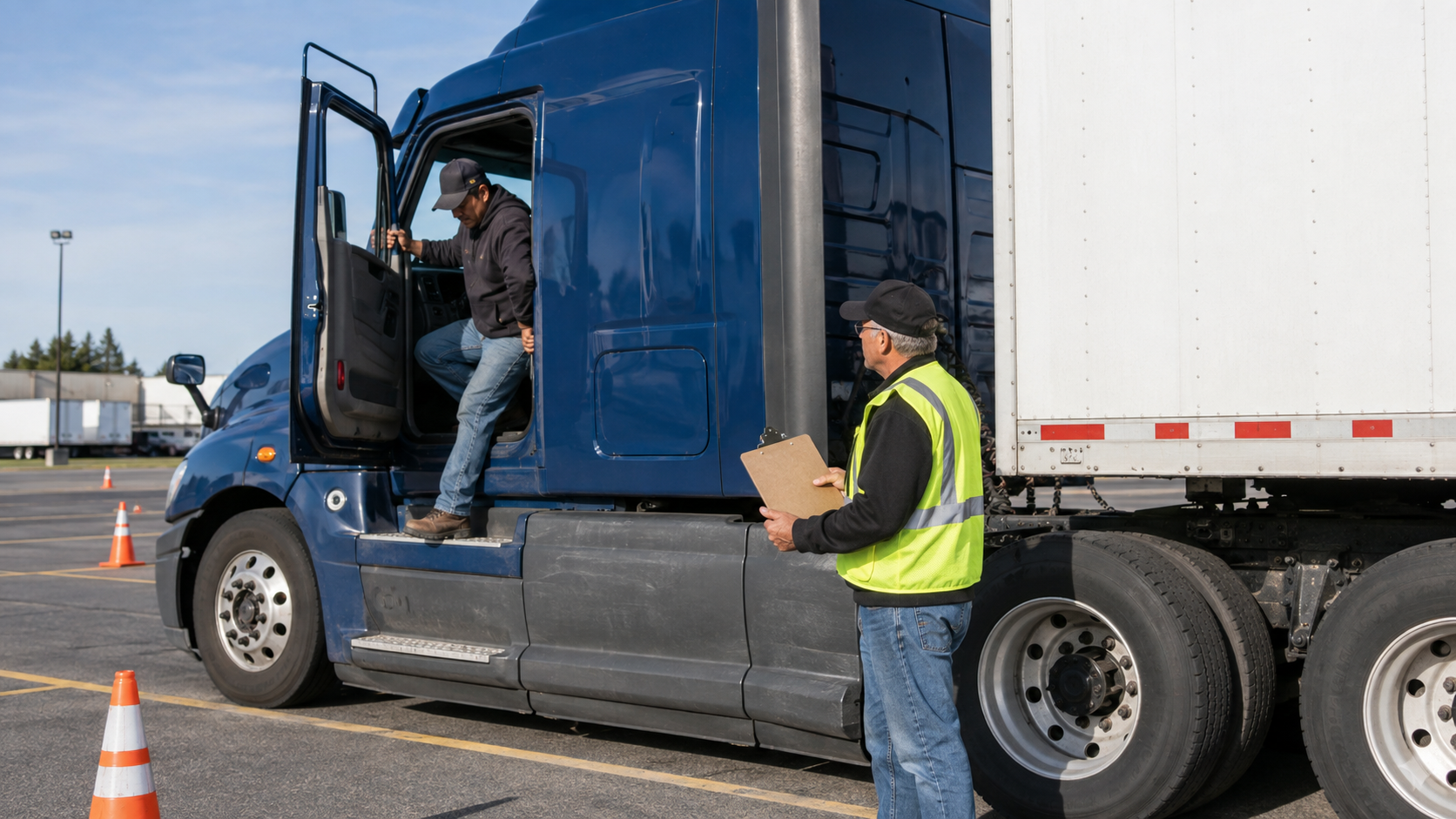
A motor carrier's road test is different from the state CDL skills test used to earn a license. Under federal driver-qualification rules, the carrier must make sure a driver can safely operate the commercial vehicle and associated equipment it intends to assign. In some cases the carrier may accept a valid CDL or a recent road-test certificate as the federal equivalent—but it may still require its own evaluation.
This guide explains who is covered by 49 CFR 391.31, the eight minimum driving operations, equipment-matching rules, examiner and documentation requirements, and when 49 CFR 391.33 allows an equivalent. It is written for CDL applicants and working drivers preparing for a carrier orientation or hiring evaluation.
Quick Answer: Does a CDL Driver Need an Employer Road Test?
generally says a person may not drive a covered commercial motor vehicle until the person successfully completes a road test and receives a certificate. The carrier or its designee administers the test in the type of vehicle the carrier intends to assign.
However, allows a carrier to accept certain documents instead: a qualifying valid CDL or a valid road-test certificate issued within the preceding three years. Acceptance is optional. Even when a document qualifies as the federal equivalent, the carrier may require a new road test or another driving-skills evaluation as a condition of employment.
State CDL Skills Test vs. Employer Road Test
The two tests can involve similar maneuvers, but they answer different questions. The state test determines whether an applicant earns a CDL class and endorsements. The Part 391 road test documents the motor carrier's driver-qualification decision for its operation and equipment.
| Comparison | State CDL skills test | FMCSA employer road test |
|---|---|---|
| Main purpose | Qualify for a state-issued CDL class or endorsement | Show the carrier that the driver can safely operate the intended assigned CMV |
| Primary rules | 49 CFR Part 383 plus state testing procedures | 49 CFR 391.31 and 391.33 |
| Administrator | State or authorized third-party CDL examiner | Motor carrier or a competent person or organization designated by it |
| Vehicle focus | Representative vehicle for the CDL class and tested restrictions | The type of vehicle and associated equipment the carrier intends to assign |
| Result | Pass supports state CDL issuance | Signed road-test form and certificate for the carrier's qualification records |
| Can the carrier require another test? | Not applicable to state issuance | Yes, even when a valid CDL or recent certificate is accepted as an equivalent |
Drivers preparing for the state exam can use our Pennsylvania CDL skills test guide. Passing that examination is an important licensing milestone, but it does not guarantee that every carrier will waive its own road evaluation.
Who Must Complete the Part 391 Road Test?
The requirement is tied to operation of a commercial motor vehicle covered by Part 391, not simply to the words “Class A” or “Class B” on a job posting. Some federally regulated CMVs do not require a CDL—for example, certain vehicles used in interstate commerce can meet the federal CMV definition by weight while remaining below the CDL threshold. A non-CDL driver in a covered operation may therefore need a Part 391 road test even though no state CDL skills test is involved.
Exceptions and alternative qualification rules can apply to specific operations, including certain multiple-employer, farm, emergency, government, or other categories. The carrier must determine the applicable rule. A driver should not claim an exception based only on vehicle appearance, local route length, or an employer's informal description.
When the evaluation normally happens
- Before a new hire is allowed to operate a covered CMV for the carrier, unless a permitted equivalent is accepted
- During orientation when the carrier verifies actual vehicle-control skills
- Before assignment to a type of equipment not supported by an accepted equivalent
- After a carrier decides that a new evaluation is needed under its safety or insurer standards
- When a driver cannot produce an acceptable recent certificate or qualifying license
The federal rule does not create a universal “one test for every future employer” card. A certificate from the preceding three years may be accepted, but the new carrier controls that decision and may test again.
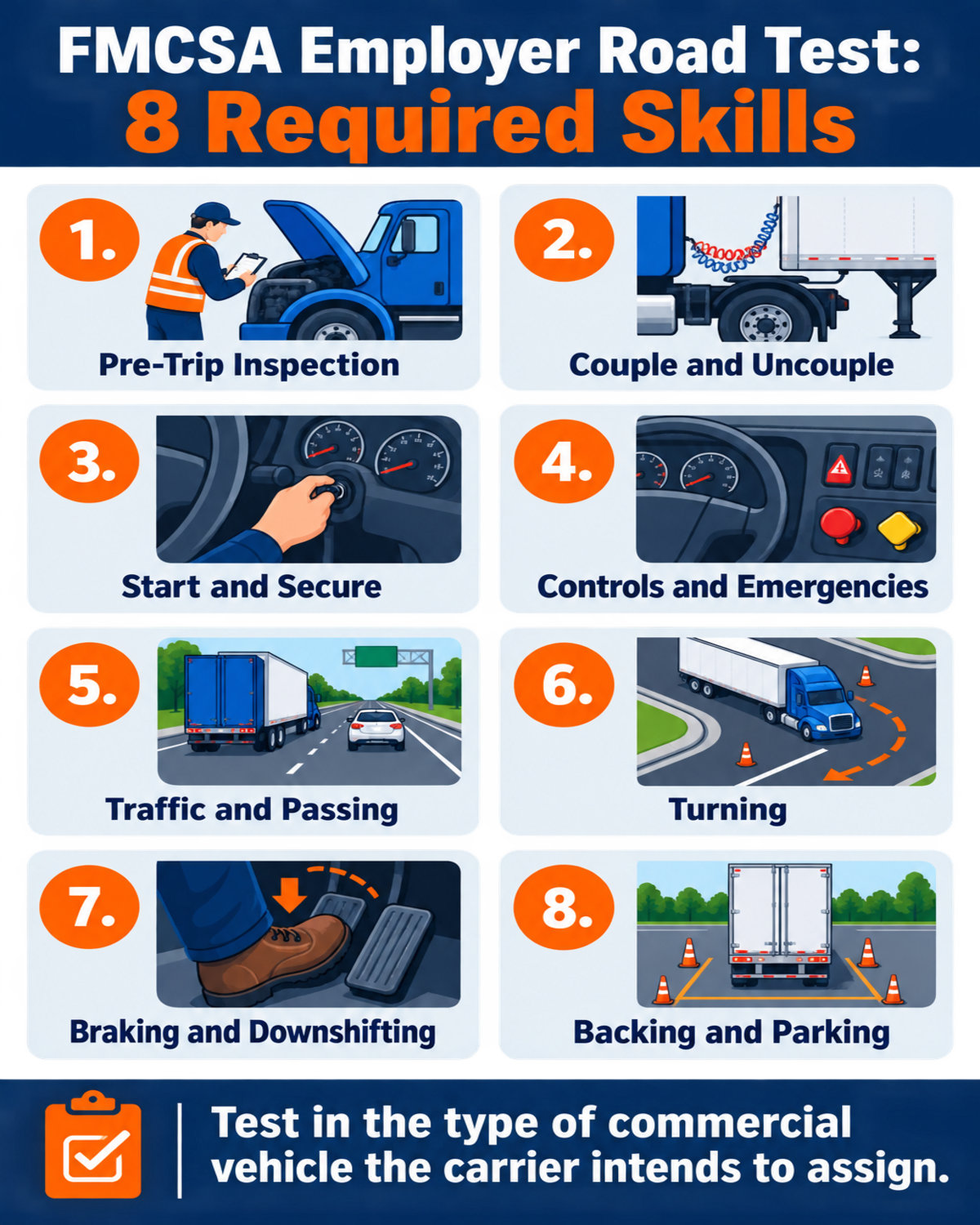
The Eight Minimum FMCSA Road-Test Skills
The road test must last long enough for the examiner to evaluate the driver's handling of the intended vehicle and associated equipment. Federal rules do not prescribe one universal mileage, minute count, route, or point system. They do require evaluation of each minimum operation below.
| Required operation | What the examiner may observe | Preparation focus |
|---|---|---|
| 1. Pre-trip inspection | Systematic inspection and recognition of unsafe conditions before operation | Use a repeatable sequence; explain critical defects without skipping components |
| 2. Coupling and uncoupling | Safe connection and separation when combination equipment will be assigned | Verify height, fifth-wheel engagement, air/electrical lines, landing gear, tug test, and visual check |
| 3. Placing the CMV in operation | Cab setup, start procedure, gauges, brake checks, gear selection, and safe movement | Set mirrors and seat before moving; confirm pressure and warning systems |
| 4. Controls and emergency equipment | Knowledge and correct use of controls, warning devices, and emergency equipment | Locate equipment before the route and understand its purpose |
| 5. Traffic and passing | Lane position, scanning, following distance, speed choice, mirror use, and safe passing | Build a visible scan pattern and communicate early with signals |
| 6. Turning | Setup, lane control, clearance, off-tracking awareness, and completion of turns | Control speed before entry and protect the trailer path without unnecessary encroachment |
| 7. Braking and slowing without brakes | Smooth braking, space management, downgrade planning, and proper use of gears or other approved methods | Choose speed and gear early; never rely on last-second braking |
| 8. Backing and parking | Setup, observation, control inputs, clearance, corrections, and safe securement | Use GOAL—Get Out And Look—when needed and stop before uncertainty becomes contact |
Pre-trip is an operating skill, not a memorized speech
The employer is evaluating whether the driver can determine that the assigned vehicle is safe to operate. A fluent script cannot compensate for ignoring a damaged tire, air leak, coupling defect, warning light, unsecured emergency equipment, or other material condition. Use the carrier's inspection process while maintaining the safety logic learned during training.
Backing is judged by control and risk management
A driver may be allowed to make corrections, but the carrier can evaluate how the driver manages uncertainty. Slow speed, frequent mirror checks, a safe setup, timely pull-ups, and getting out to look are stronger than forcing a maneuver to appear fast. Follow examiner directions and the site's pedestrian rules.
Why the Test Vehicle Must Match the Intended Assignment
Section 391.31 requires testing in the type of CMV the carrier intends to assign. The purpose is practical: operating a day-cab tractor with a 53-foot semitrailer, a tanker combination, a straight truck, a motorcoach, or a vehicle with specialized controls can demand different judgment and handling.
| Intended assignment | Skills that may need direct evaluation | Common mismatch risk |
|---|---|---|
| Tractor-semitrailer | Fifth-wheel coupling, trailer tracking, air-brake response, backing, and dock approach | Experience limited to a straight truck |
| Tanker | Surge management, smooth steering and braking, rollover awareness, and tank-specific inspection | Assuming the tank endorsement proves an on-road skills test in a tanker |
| Doubles or triples | Converter-dolly and coupling procedures, longer-combination tracking, inspection, and emergency judgment | Relying on the written endorsement alone as the road-test equivalent |
| Passenger vehicle | Passenger safety systems, stops, clearance, smooth control, and emergency equipment | Testing only in a cargo vehicle |
| Manual transmission | Gear selection, clutch control, shifting, and slowing without service brakes | Presenting experience or a credential limited to automatic equipment |
| Specialized vocational CMV | Controls, clearances, securement, PTO or body systems, and job-site movement | Testing in a vehicle that does not represent the assigned equipment |
FMCSA guidance says a carrier that intends to assign a vehicle requiring doubles/triples or tank-vehicle qualifications must not treat those endorsements alone as the road-test substitute; the carrier should evaluate the driver in a representative vehicle under 391.31. The carrier may also impose a stricter evaluation than the federal minimum.
When Can a Carrier Accept a CDL Instead of a New Road Test?
A carrier may accept a valid CDL when it licenses the driver for the specific category of CMV to be assigned and the issuing state's process licensed the driver after successful completion of a road test in that type of CMV. The rule does not treat doubles/triples or tank endorsements as proof of the required road test for those assignments.
The second possible equivalent is a copy of a valid certificate of driver's road test issued under 391.31 within the preceding three years. If the carrier accepts either document, it retains a legible copy in the driver's qualification file.
| Document or situation | May qualify as federal equivalent? | Carrier decision |
|---|---|---|
| Valid CDL for the assigned vehicle category, supported by the required state road test | Yes, subject to 391.33 conditions | May accept it or require another evaluation |
| Valid 391.31 road-test certificate issued within the preceding three years | Yes | May accept a legible copy or test again |
| Expired, suspended, downgraded, or otherwise invalid CDL | No | Driver cannot rely on an invalid credential and may not operate outside lawful privileges |
| Tank or doubles/triples endorsement without representative road testing | Not as proof of the equipment-specific road test | Carrier should administer 391.31 testing in a representative vehicle |
| Training-school completion card that is not a 391.31 certificate | Not automatically | Useful experience evidence, but carrier must satisfy the federal rule |
| Road-test certificate older than three years | No under the three-year equivalent provision | Carrier uses another permitted basis or administers a new test |
A carrier can always require a new skills evaluation
Acceptance of an equivalent is permissive, not mandatory. The carrier may test drivers because of insurer rules, company policy, unfamiliar equipment, a long break from driving, a crash history, a restriction, or the need to document job-specific competence. “I already have a CDL” is not a basis to refuse a lawful employment evaluation.
Who May Administer the Employer Road Test?
The motor carrier may give the test or designate another person or organization. The person administering it must be competent to evaluate whether the driver can operate the intended CMV and associated equipment. FMCSA guidance confirms that an outside person or organization may be designated when the examiner is competent.
A driver who is also the motor carrier cannot test and certify himself or herself. Another qualified person must administer the evaluation. The examiner needs enough knowledge of the vehicle, route, operation, and evaluation form to make a defensible safety decision.
What “competent” looks like in practice
- Understands the assigned vehicle and associated equipment
- Can identify unsafe control, inspection, braking, turning, and backing behavior
- Uses a consistent road-test form covering every required operation
- Selects a route and duration sufficient to evaluate the driver
- Can stop the evaluation when continued operation would be unsafe
- Signs the form and certificate only after personally supervising the test
Road-Test Form, Certificate, and Driver Qualification File
The carrier provides a road-test form on which the examiner rates performance for each operation included in the test. The examiner signs the completed form. After a successful test, the examiner completes a certificate identifying the driver, type of power unit, trailer or bus, test date, approximate miles, and the examiner's conclusion that the driver has sufficient skill to operate safely.
The driver receives a copy of the certificate. The carrier retains the original signed road-test form and the original or a copy of the certificate in the DQ file. If the carrier accepts a CDL or recent certificate as an equivalent, it retains a legible copy of that document instead.
These records connect directly to the broader CDL driver qualification file process. They do not replace the application, MVR inquiries, prior-employer investigation, medical qualification, Clearinghouse steps, or other applicable records.
How to Prepare for an Employer Road Test
Confirm the assigned equipment before test day
Ask what power unit, trailer, transmission, brake system, and job environment the evaluation will use. Disclose restrictions and genuine experience limits before moving the vehicle. A driver who has never coupled a converter dolly, operated a tanker, driven a bus, or shifted a particular transmission should not improvise beyond training and authorization.
Use a consistent safety sequence
Before movement, check identification and authority to operate, inspect the vehicle, set the seat and mirrors, fasten the seat belt, verify controls and warning devices, conduct the required brake checks, and confirm the area is clear. During the route, make scanning, signal timing, speed selection, and clearance management visible to the examiner.
Drive for margin, not performance theater
The objective is safe control, not speed. Leave following distance, slow before curves and turns, avoid abrupt steering, select a safe gear before a grade, communicate early, and stop when directions are unclear. During backing, use corrections and GOAL instead of gambling on clearance.
Finish with securement and documentation
Park where directed, apply parking brakes, place the transmission correctly, shut down as required, secure the vehicle, and report any defect found. Ask for your copy of the certificate after successful completion and store it securely.
Employer Road-Test Preparation Checklist
- □ My CDL, endorsements, medical status, and restrictions fit the planned operation
- □ I confirmed the power unit, trailer, transmission, and brake system used for the test
- □ I can perform a systematic pre-trip and recognize safety-critical defects
- □ I can couple and uncouple the assigned combination equipment safely
- □ I know the vehicle's controls, warning devices, and emergency equipment
- □ I use mirrors, signals, lane position, following distance, and safe speed consistently
- □ I understand off-tracking and protect clearance during turns
- □ I brake smoothly and choose gears or other slowing methods before grades
- □ I set up backing maneuvers and use GOAL when needed
- □ I stop and clarify directions rather than guessing
- □ I secure the vehicle correctly at the end of the evaluation
- □ I will obtain and retain my certificate copy after a successful test
Frequently Asked Questions
Does every CDL employer have to give a new road test?
No. A carrier may accept a qualifying valid CDL or a valid 391.31 road-test certificate issued within the preceding three years. The carrier may still require its own road test or another skills evaluation.
How long must the FMCSA employer road test be?
Federal rules do not set one mileage or time minimum. The test must be long enough for a competent examiner to evaluate all required operations in the type of CMV and associated equipment the carrier intends to assign.
Can an employer accept a tanker or doubles/triples endorsement instead of testing?
Not as proof of the equipment-specific road test. FMCSA guidance says a carrier assigning a tanker or doubles/triples vehicle must evaluate the driver under 391.31 in a representative vehicle rather than relying on the endorsement alone.
Do drivers receive a copy of the road-test certificate?
Yes. After successful completion, 49 CFR 391.31 requires a copy of the certificate to be given to the driver. The carrier keeps the signed form and certificate record in the driver's qualification file.
Educational information only, not legal advice or an employment guarantee. Operations, exemptions, carrier policies, insurer standards, and regulations can change. Official eCFR and FMCSA sources reviewed August 14, 2026; Title 49 was displayed as current through August 12, 2026.