

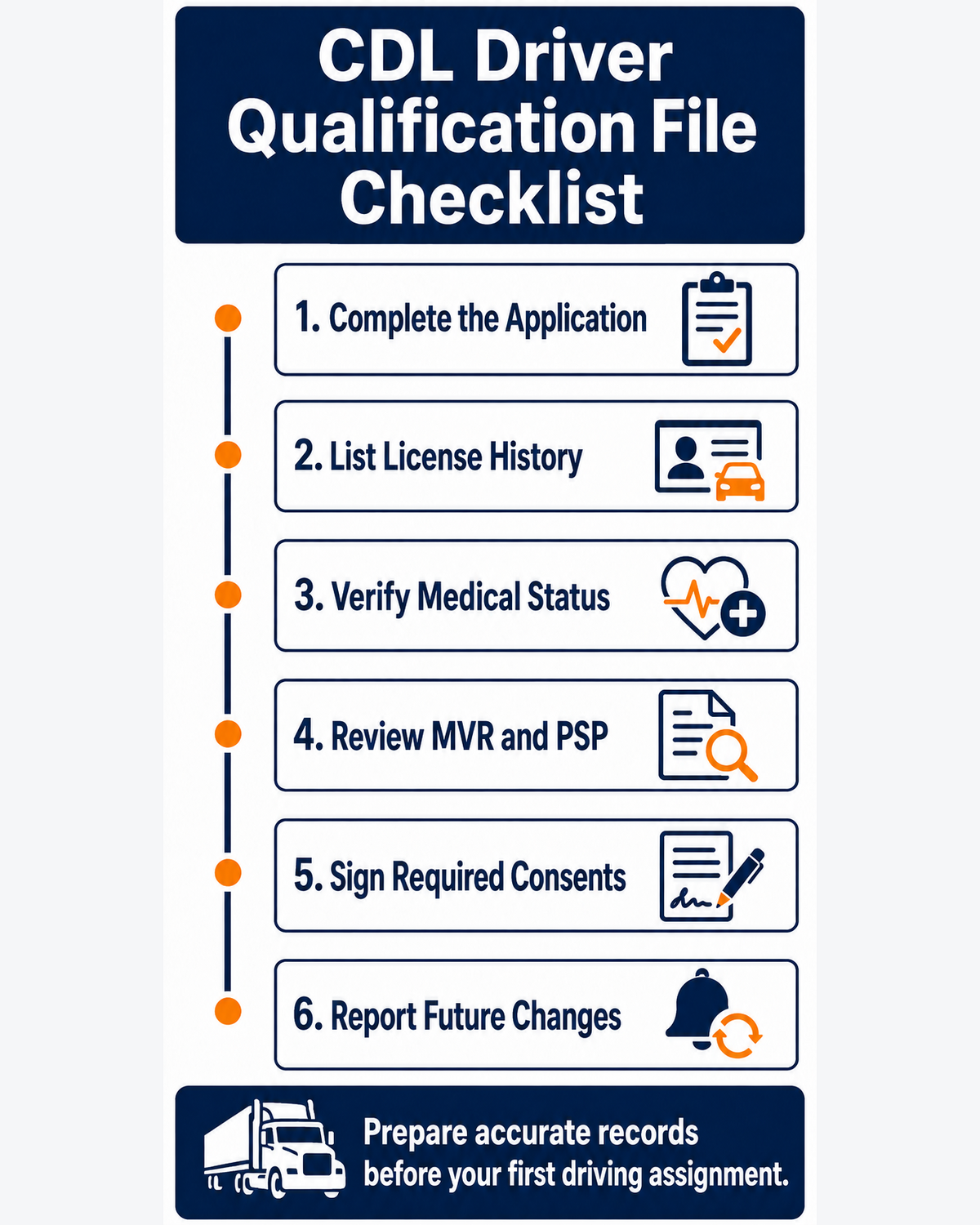
A CDL driver qualification file, often called a DQ file, is the employer-maintained record showing that a commercial driver meets federal qualification requirements. Drivers do not assemble or control the carrier's file, but they supply much of the information that starts it. Accurate applications, license history, medical status, employment details, and signed consents can prevent avoidable hiring delays.
This guide explains what motor carriers check before assigning a driver to a commercial motor vehicle, what records belong in the file, how MVR, PSP, and Clearinghouse checks differ, and what drivers can do when prior-employer information is wrong. It focuses on federal rules for interstate motor carriers; a carrier, insurer, contract, or state may impose additional lawful requirements.

Quick Answer: What Will a CDL Employer Put in Your DQ File?
Under , a motor carrier must maintain a qualification file for each driver it employs. The file generally includes the signed employment application, required motor vehicle records, road-test certificate or permitted equivalent, annual MVRs and review notes, and applicable medical qualification or variance records. Some safety-performance investigation records are kept in a separately controlled investigation history file.
The employer—not the driver—has the compliance duty to create and maintain the file. Your job is to provide truthful, complete information, sign necessary authorizations, keep your CDL and medical status current, and promptly report changes. A perfect-looking packet does not replace the carrier's independent inquiries.
What Is a CDL Driver Qualification File?
A DQ file is an employer compliance record, not a federal license, personal background report, or document a driver buys. It helps the motor carrier demonstrate that it checked the driver's qualifications under Part 391 before and during employment. The file may be combined with a personnel file, but regulated records still have specific content, access, and retention requirements.
The federal rules apply broadly to drivers of commercial motor vehicles covered by Part 391, not only to people driving tractor-trailers that require a CDL. Exceptions can apply to specific operations or driver categories. A driver should follow the carrier's instructions and avoid assuming that a CDL card alone proves every qualification.
What the file is designed to establish
- The driver completed a compliant employment application.
- The carrier checked required licensing records and safety history.
- The driver completed a road test or the carrier accepted a permitted equivalent.
- The driver's medical qualification or medical variance is documented when required.
- The carrier performs continuing MVR inquiries and reviews.
- Time-sensitive records are retained for the required period.
A DQ file should not be confused with a generic onboarding folder. Tax forms, payroll enrollment, uniform acknowledgements, and company handbooks may appear in a personnel system, but they are not substitutes for the regulated qualification documents.
What the CDL Employment Application Must Cover
requires a driver to complete and sign the motor carrier's application form before driving. The rule specifies more information than a standard resume. Applicants should gather the underlying dates and addresses before starting so entries remain consistent across the application, MVR, PSP, and prior-employer responses.
| Application section | Federal lookback or detail | Driver preparation |
|---|---|---|
| Identity and residence | Personal information plus addresses for the preceding three years | List complete addresses and month/year dates; do not leave unexplained gaps |
| Licenses and permits | Issuing authority, number, and expiration date for each unexpired CMV license or permit | Copy details directly from current credentials |
| Driving experience | Type and extent of vehicle experience, including relevant equipment | Separate tractors, trailers, buses, straight trucks, and other equipment accurately |
| Crashes | Motor vehicle accidents during the preceding three years, with date, nature, injuries, or fatalities | Use reports and employer records instead of memory alone |
| Violations | Non-parking motor vehicle convictions or bond forfeitures during the preceding three years | Compare the application with current licensing records |
| License actions | Facts about any denial, revocation, or suspension—or a statement that none occurred | Disclose the action even if privileges were later restored |
| Recent employment | Employers for the preceding three years, dates, reason for leaving, and regulated/safety-sensitive status | Confirm legal company names and compliance contacts |
| Earlier CMV employment | For applicants who will operate a Part 383 CMV, CMV-driving employers during the seven years before the recent three-year period | Prepare up to ten years of relevant CMV employment history |
Why gaps and inconsistent dates matter
A short gap is not automatically disqualifying. The problem is an unexplained or inaccurate record that prevents the carrier from determining who employed the driver or where a license was held. Use “unemployed,” “student,” “self-employed,” or another accurate status when the carrier's form asks for a complete timeline. Never invent an employer or round dates to conceal a gap.
Read the certification before signing. The required certification states that the application was completed by the applicant and that entries are true and complete to the best of the applicant's knowledge. If a recruiter prefilled information, review every field and correct it before signing.
What Records Belong in the Driver Qualification File?
| DQ file item | Who creates or obtains it | When it matters |
|---|---|---|
| Signed driver application | Driver completes; carrier supplies the form and retains it | Before operating a covered CMV |
| Pre-employment motor vehicle record | Carrier requests from each required licensing authority | Inquiry is required within 30 days after employment begins |
| Road-test certificate or permitted equivalent | Carrier or qualified examiner documents the result | Before the driver is assigned when a road test is required |
| Annual MVR | Carrier obtains from each applicable licensing authority | At least once every 12 months |
| Annual review note | Carrier's reviewer documents name and review date | At least once every 12 months |
| Medical qualification documentation | Carrier verifies required CDLIS MVR status or retains applicable records | Before dispatch and while qualification remains required |
| Medical variance or SPE documentation | Driver supplies applicable federal documents; carrier retains required copies | When the qualification depends on a variance or certificate |
The pre-employment inquiry rule in requires the carrier to request a three-year MVR from each licensing authority where the driver held a license or permit during the preceding three years. The MVR must be placed in the DQ file within 30 days after employment begins. When an authority does not return the record, the carrier must document a good-faith effort.
Safety-performance investigations are related but separately protected
The carrier also investigates safety-performance history from DOT-regulated employers during the preceding three years. Responses or documented good-faith efforts generally must be placed in a driver investigation history file within 30 days after employment begins. The distinction matters because these records have confidentiality and access rules beyond the ordinary DQ checklist.
A new entrant with no prior DOT-regulated employment is not expected to invent a history. The employer documents that no investigation was possible. Training, a new CDL, or an entry-level application can still be evaluated using the application, MVR, licensing status, medical qualification, road test, and carrier standards.
How MVR, PSP, Clearinghouse, and Prior-Employer Checks Fit Together
No single report answers every hiring question. Treat each source as a separate lane in the carrier's review.
| Source | What it helps verify | Driver action |
|---|---|---|
| State MVR / CDLIS record | License status, class, restrictions, convictions or actions, and required medical status fields | Review your Pennsylvania CDL driver record for identity and licensing errors |
| FMCSA PSP | Five-year reportable crash history and three-year roadside inspection history | Request and audit your FMCSA PSP report before applying |
| Drug and Alcohol Clearinghouse | FMCSA-regulated drug and alcohol program information and prohibited status | Maintain access and understand the Clearinghouse process for CDL drivers |
| Prior-employer safety history | Employment verification, qualifying crashes, and required safety-performance information | Provide accurate contacts, consent when required, and request review if information is wrong |
| Road test and carrier evaluation | Ability to inspect, control, and safely operate the assigned vehicle | Bring the correct credential and demonstrate the actual equipment skills claimed |
PSP is useful but does not satisfy every Part 391 inquiry. A state MVR does not replace the Clearinghouse. A clean Clearinghouse status does not prove that a CDL is valid. A carrier may also apply lawful company or insurer standards after completing the federal minimum checks.
Consent is not one universal permission
Different checks may require different notices or authorizations. For example, the prospective employer must obtain consent for specified prior-employer drug and alcohol information and must not allow a driver who refuses required consent to operate a CMV. PSP access also has its own written-consent process. Read each authorization, confirm the requesting company, and keep a copy.
Your Rights to Review and Correct Prior-Employer Information
Section 391.23 gives drivers due-process rights for safety-performance history provided by prior DOT-regulated employers. A prospective employer must notify the driver in writing of the right to review the information, ask the previous employer to correct errors, and attach a rebuttal when the parties cannot agree.
- Request review in writing. A driver with covered DOT-regulated employment in the preceding three years may request the investigative information from the prospective employer while applying or as late as 30 days after employment or notice of denial.
- Receive available information. The prospective employer generally must provide it within five business days after receiving the written request; if the information has not arrived, the clock begins when it is received.
- Send a correction request to the source. Ask the previous employer that provided the data to correct the specific error.
- Use a rebuttal if needed. If the previous employer will not correct the information, the driver can submit a rebuttal for attachment to the safety-performance history.
- Keep a clean paper trail. Save requests, delivery proof, responses, corrected records, and the rebuttal.
Focus a correction request on a verifiable fact: employment dates, identity, crash involvement, testing-program status, or another defined record. A disagreement with a carrier's lawful hiring judgment is different from an inaccurate source record. For a state MVR or PSP error, use the correction process for that system rather than asking a previous employer to change data it does not control.
Annual Reviews, Updates, and Record Retention
requires a motor carrier, at least once every 12 months, to obtain an MVR covering at least the preceding 12 months from each applicable licensing authority. The carrier must review the record to decide whether the driver continues to meet minimum safe-driving requirements or is disqualified.
The review considers accidents and evidence of violations, with great weight given to conduct such as speeding, reckless driving, or operating under the influence. The carrier maintains both the MVR and a note identifying the reviewer and review date in the DQ file.
What the driver should update without waiting for the annual review
- CDL renewal, expiration, suspension, downgrade, restriction, or disqualification
- Change in legal name, address, or licensing state
- Medical certification status, expiration, or variance changes
- Convictions, crashes, citations, or out-of-service events the law or company policy requires you to report
- Clearinghouse status or required return-to-duty information
- Any correction to application or prior-employer information
Do not assume that an agency's electronic update relieves you of every notification duty. Follow federal and state deadlines plus the carrier's written safety policy. If a credential is not valid for the assigned operation, do not drive while waiting for the file to catch up.
How long the employer keeps the file
Section 391.51 generally requires the DQ file to be kept for as long as the driver is employed and for three years afterward. Certain recurring items—such as annual MVRs, annual review notes, specified medical documentation, variances, and verification notes—may be removed three years after execution. This is an employer retention rule; it does not mean every source system erases its data after three years.
How to Prepare Before a CDL Job Application
Build one accurate master timeline
Create a private reference sheet with residences for three years, all license states, recent employers, older CMV-driving employers, equipment operated, crash dates, non-parking convictions, and license actions. Use it to complete each carrier's form consistently. Do not upload the master sheet unless requested; it may contain sensitive personal information.
Review records before the carrier does
Order the relevant state MVR and your PSP report early enough to review them. Confirm CDL status and medical certification through the proper Pennsylvania and federal channels. Resolve identity errors, duplicate events, or incorrect licensing actions with the agency that owns the record. Keep proof of a pending correction, but never represent a disputed item as already removed.
Make prior employers easy to reach
Use the legal carrier name and a current safety, compliance, or human-resources contact when possible. Owner-operators should distinguish their operating authority, leased carrier, and customer relationships accurately. If a prior company closed, provide the best documented contact and explain the situation rather than substituting another business.
Prepare for the practical evaluation
Paperwork establishes eligibility; it does not demonstrate safe vehicle control. Expect the carrier to verify experience through a road test, orientation, backing evaluation, vehicle inspection, or supervised work. Claim only the equipment and operating conditions you can safely handle.
CDL Driver Qualification Document Checklist
- □ Current CDL or commercial learner's permit details
- □ Three years of complete residential addresses
- □ License and permit history for every relevant state
- □ Three years of crash and non-parking conviction information
- □ Details of any license denial, suspension, revocation, downgrade, or disqualification
- □ Three years of all employment with correct dates and reasons for leaving
- □ Additional seven years of CMV-driving employers when the rule applies
- □ Accurate description of tractors, trailers, buses, straight trucks, and other equipment operated
- □ Current medical certification or variance information, when required
- □ Personal review of state MVR and FMCSA PSP records
- □ Login access needed for any driver Clearinghouse action
- □ Copies of signed consents and correction requests
- □ Contact information for prior DOT-regulated employers
- □ A secure folder for application copies, official records, and receipts
Frequently Asked Questions
Do CDL drivers keep their own driver qualification file?
No. The motor carrier maintains the regulated DQ file. Drivers provide the application, credential details, consents, and applicable medical or variance information. It is still smart to keep personal copies of documents you submit.
How far back does a CDL employment application go?
The federal application requires three years of general employment history. For applicants who will operate a CMV as defined by Part 383, it also requires CMV-driving employers from the seven years before that three-year period—up to ten years of relevant history.
Is a PSP report required in every driver qualification file?
No. PSP is a separate pre-employment screening tool and is not listed as a required DQ-file item in 49 CFR 391.51. It does not replace required MVR inquiries, prior-employer investigations, or Clearinghouse obligations.
Can a driver correct information supplied by a previous employer?
Yes. For covered safety-performance history, 49 CFR 391.23 gives drivers rights to review the information, request correction from the previous employer, and submit a rebuttal when the parties cannot agree.
Educational information only, not legal advice or a hiring guarantee. Carrier operations, exceptions, insurer standards, and federal or state rules can change. Official eCFR sources reviewed August 13, 2026; Title 49 was displayed as current through August 11, 2026.