
If you're serious about acing your hazardous materials endorsement exam, there’s one tool you absolutely need in your corner: a high-quality hazmat practice test. Think of it as a dry run for the real thing. These practice exams are built to feel just like the official test, helping you find your weak spots and get a handle on the types of questions you'll see. It's your study plan's secret weapon.
Why a Hazmat Practice Test Should Be Your First Move
Getting your hazmat endorsement is a big deal. It opens up better-paying gigs and specialized routes, but the test is no cakewalk. It’s known for being tough and incredibly detailed, covering everything from placard rules to what you need to do in an emergency. This isn't just about memorizing facts; it's about knowing how to apply them on the road to keep everyone safe.
That’s exactly why your study strategy matters so much. Instead of just trying to read the manual cover to cover and hope for the best, starting with a hazmat practice test gives you a huge leg up. It immediately shows you where you stand and points you directly to the topics that need your focus.
Find Your Weak Spots From Day One
Don't worry about getting a perfect score on your first practice attempt—that’s not the point. The first run is all about diagnosis. Did you freeze up on questions about the nine classes of hazardous materials? Or did the section on shipping papers trip you up? Figuring this out early helps you build a smart, efficient study plan.
Taking that initial assessment gives you a few key advantages:
- Study Smarter, Not Harder: You can spend your valuable time digging into complex areas, like the rules for segregating different materials, instead of re-reading chapters you've already mastered.
- Get Used to the Question Style: The real exam loves to throw scenario-based questions at you. Practice tests get you comfortable with that format so there are no surprises on test day.
- Walk in with Confidence: Knowing what to expect is half the battle. The more practice tests you take, the less intimidating the real exam will feel.
The real goal isn't just to pass a test; it's to actually understand the safety principles that keep you and the public safe. A practice test is the best tool I know for bridging that gap between book knowledge and real-world application.
Before you get too deep into the hazmat material, it’s also a good idea to double-check that you meet all the basic CDL requirements. I've seen drivers get held up by simple paperwork issues. Taking a few minutes to review the prerequisites ensures there are no administrative headaches to slow you down. When you combine a solid understanding of the requirements with targeted practice, you're setting yourself up for success right from the start.
Getting to Grips with the Core Hazmat Knowledge
If you want to ace the hazmat endorsement exam, you can't just skim the material. You need a rock-solid understanding of the core safety concepts. These aren't just rules on a page; they're the principles that keep you, your truck, and everyone else on the road safe. The whole point of the test is to make sure you can apply this knowledge when it really counts.
It all starts with the nine distinct classes of hazardous materials. Think of these as the fundamental building blocks of hazmat safety. Each class signifies a different kind of danger, whether it's explosives, flammable gases, or corrosive liquids. You absolutely have to know these by heart, because they dictate every single thing you do, from how you handle the cargo to what you do in an emergency.
For example, you need to know instantly that Class 3 covers flammable liquids like gasoline, while Class 8 is for corrosives like battery acid. Why does it matter? This difference tells you how to load, secure, and separate your cargo to prevent a catastrophic reaction.
To help you get a handle on these, here’s a quick-reference table that breaks down the nine classes.
The 9 Classes of Hazardous Materials at a Glance
This table summarizes the official DOT hazard classes. Use it to start memorizing the primary risk and common examples for each one, which will make them easier to recognize on the test and on the job.
| Hazard Class | Description | Common Examples |
|---|---|---|
| Class 1 | Explosives | Dynamite, fireworks, ammunition |
| Class 2 | Gases | Propane, oxygen, helium |
| Class 3 | Flammable Liquids | Gasoline, diesel fuel, alcohol |
| Class 4 | Flammable Solids | Matches, sulfur, magnesium |
| Class 5 | Oxidizers & Organic Peroxides | Ammonium nitrate, hydrogen peroxide |
| Class 6 | Poisons (Toxic) & Infectious Substances | Pesticides, arsenic, medical waste |
| Class 7 | Radioactive Materials | Uranium, plutonium, medical isotopes |
| Class 8 | Corrosives | Sulfuric acid, sodium hydroxide |
| Class 9 | Miscellaneous Hazardous Materials | Lithium batteries, dry ice, asbestos |
Getting comfortable with these classes is your first major step. Once you can identify them without hesitation, you’re ready to dig deeper into the specific procedures.
Key Regulations and Procedures You Must Know
Beyond just identifying the classes, the exam will test you heavily on the specific regulations. Any good hazmat practice test will zero in on three critical areas:
- Placarding, Labeling, and Marking: You're expected to know precisely which placards your load requires and exactly where they go on your truck. Package labels and markings are just as important—they give handlers and first responders the vital information they need.
- Shipping Papers: Think of these documents as the complete story of your cargo. You need to know what information they must contain, where they have to be kept in the cab, and how to use them if an emergency strikes.
- Loading and Segregation: This is all about knowing which materials can't be loaded near each other. For example, mixing certain chemicals can create a toxic gas or even cause an explosion. Following these segregation rules isn't optional; it's essential for survival.
These topics aren't just test fodder; they are the daily responsibilities of a hazmat-certified driver. And it’s a huge responsibility. The U.S. Department of Transportation estimates that around 3.3 billion tons of hazardous materials are shipped across the country every year. That's a staggering number, and it underscores why proper training is so critical.
I’ve found that the best way to build confidence is to master these fundamentals. Once you understand the 'why' behind the rules—like why certain chemicals must be kept apart or why placards are so specific—the correct answers on the test start to feel like common sense.
This graphic gives you a clear look at how the hazmat exam is structured.
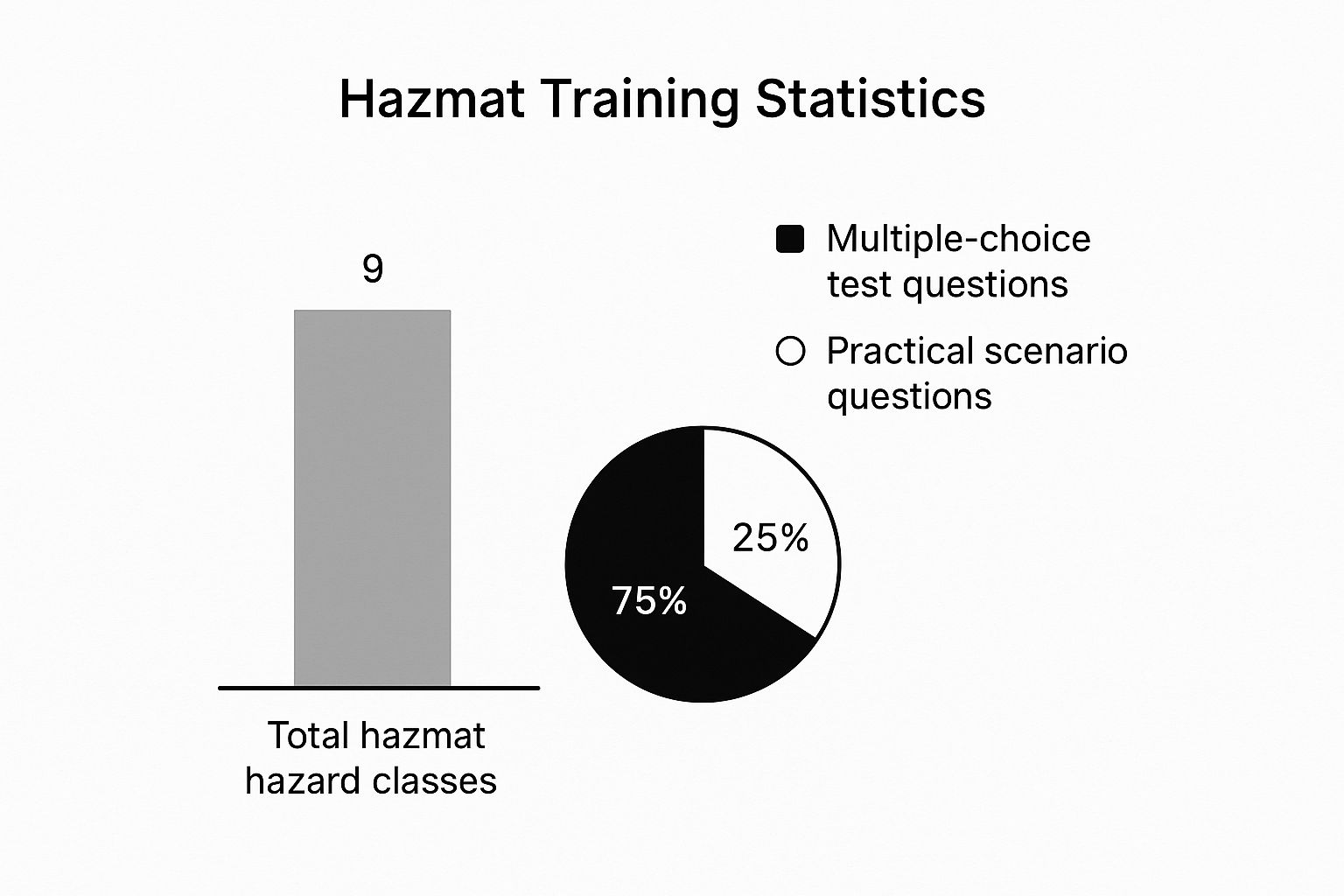
As you can see, it's overwhelmingly multiple-choice. That means being able to recognize key terms, rules, and scenarios at a glance is your ticket to passing.
Tying It All Together
It's also important to see how these core areas connect with each other. They aren't isolated topics. For instance, the information listed on your shipping papers directly determines the placards you need to display on your truck. In the same way, a material's hazard class dictates the specific loading and segregation rules you must follow.
When you prepare for your hazmat practice test, focus on seeing these connections. This kind of systematic thinking will help you on other parts of your CDL journey, too. The same logical approach you use for hazmat is what helps you succeed on the general knowledge test. By really digging into these fundamentals, you’ll be ready for whatever the exam throws at you.
Get the Most Out of Your Hazmat Practice Tests

Simply taking a hazmat practice test over and over isn't a real study strategy—it's just a guessing game. If you want to turn these practice exams into a genuinely powerful tool for passing, you've got to be methodical. It all starts with treating your very first attempt like a diagnostic, not a final grade.
Go ahead and take that first test completely cold. No studying beforehand. This gives you a brutally honest look at what you already know and, more importantly, what you don't. The results will instantly shine a spotlight on your problem areas, whether that's placarding rules, emergency response, or what needs to be on the shipping papers.
Create a Targeted Study Plan from Your Mistakes
Once you have that initial score, the real work begins. Don't just glance at the percentage and move on. You need to dig into every single question you got wrong.
Look for patterns. Did you consistently miss questions about Class 4 flammable solids? Maybe the rules for separating corrosive materials from everything else are what tripped you up.
The goal here is to pinpoint your weaknesses so you can build a focused study plan. Instead of trying to memorize the entire CDL manual from cover to cover, you can zero in on the specific sections that gave you trouble. It's about studying smarter, not harder.
If emergency procedures were a problem, dedicate an entire study session just to that. This surgical approach is way more effective than trying to swallow the whole elephant at once.
Recreate Real-World Test Conditions
Knowing the material is only half the battle. You also have to perform under the pressure of the real exam, which means a ticking clock and a quiet, formal setting. The best way to prepare for that is to simulate it.
Here’s how you can make your practice feel like the real deal:
- Set a Timer: Find out the actual time limit for the hazmat exam in your state and use it for every practice run. This gets you comfortable with the pacing and prevents you from running out of time on test day.
- Kill the Distractions: Put your phone on silent and in another room. Turn off the TV. Find a quiet spot where you won't be interrupted. You need to mimic the focus of a real testing center.
- No Cheating: It's tempting to quickly look up an answer, but don't. The whole point is to see what you actually know right now.
This kind of practice does more than just test your memory; it trains you to stay calm and focused when it counts. That mental toughness can be the deciding factor. It’s the same philosophy behind any quality CDL training program, where building both knowledge and practical confidence is the key to success.
Here’s a pro-tip most people skip: spend time reviewing the questions you got right. Make sure you understand why the correct answer was correct. This cements the knowledge in your mind and helps you recognize the logic when you see similar questions on the official exam.
By repeating this cycle—test, analyze, study, repeat—each hazmat practice test becomes a stepping stone. You'll stop guessing and start knowing, building the kind of solid confidence you need to walk into that testing center and ace your exam.
Let's Break Down Some Sample Hazmat Test Questions

Knowing the rules is one thing. Applying them when the clock is ticking on an exam is a completely different ballgame. The best way I’ve found to get ready for the real deal is to grind through a solid hazmat practice test.
Let’s walk through a few questions together. We'll look at why the right answer is right and, just as importantly, how to sniff out the wrong answers designed to trip you up. This isn't just about memorizing facts; it's about training your brain to think like a professional who understands the why behind the rules.
Sample Question 1: Shipping Papers
Question: Your shipping papers must be kept in a pouch on the driver's door or:
A) In the glove compartment.
B) On the driver's seat when you are out of the vehicle.
C) In the sleeper berth.
D) In a locked safe box under the passenger seat.
The answer here is B. This is a classic question that hits on a core safety principle. In an emergency, first responders need those papers immediately. The rules are black and white: when you're at the wheel, they must be within reach. When you're out of the truck, they have to be on the driver's seat or in that door pouch. No exceptions.
Think about it from a firefighter’s perspective. Wasting time hunting through a glove compartment (A), a sleeper berth (C), or a locked box (D) could be catastrophic. The exam will always favor the option that provides the fastest access for emergency personnel.
Sample Question 2: Placarding
Question: You are transporting 1,500 pounds of Class 8 Corrosive Materials. What placard is required?
A) A "DANGEROUS" placard.
B) No placard is required.
C) A "CORROSIVE" placard.
D) A "POISON" placard.
The correct choice is C. Corrosives fall under Table 1 materials, and the rule for Table 1 is simple: any amount requires the specific placard. So, because you're hauling corrosives, you have to display the "CORROSIVE" sign.
The "DANGEROUS" placard (A) is a very common trap. You only use that when you have a mixed load of two or more types of Table 2 materials that add up to more than 1,001 pounds. And saying no placard is needed (B) is wrong because the 1,001-pound threshold only applies to Table 2, not Table 1.
I can't stress this enough: you must know the difference between Table 1 and Table 2 placarding rules. It's one of the most common stumbling blocks on the exam. If you get that down cold, you're already ahead of the game.
Sample Question 3: Loading and Segregation
Question: Which of these materials must NOT be loaded onto the same vehicle with Class 1 Explosives?
A) Class 4 Flammable Solids
B) Class 8 Corrosives
C) Division 5.1 Oxidizers
D) All of the above.
The only safe answer is D. The segregation table isn't just a list of suggestions; it's a critical tool to prevent disaster. Explosives are the most heavily restricted class for a reason. You absolutely cannot load them with flammables, corrosives, or oxidizers. Each one of those combinations creates a unique and incredibly dangerous situation.
The kind of detailed, systematic thinking you use for these questions is the same mindset you need for other parts of your CDL. It’s not that different from the methodical checks you run on your truck's braking system. Honing this sharp eye for detail will help you across the board, including when you're studying for something like the air brakes test. Every hazmat practice test you take just makes you a smarter, safer driver all around.
Smart Study Strategies Beyond Practice Tests
While a solid hazmat practice test is the foundation of your prep, you can't stop there. True mastery comes from mixing it up with other proven study methods. Just hammering away at practice tests can lead to a false sense of security where you've only memorized the answers, not the actual rules behind them. A smarter, more rounded plan ensures that critical safety information is second nature when you're under pressure.
One of the best ways to make information stick is through active recall. This is a simple but powerful shift from just reading the CDL manual to actively pulling the information out of your brain. It’s what separates knowing from just recognizing.
Make the Knowledge Your Own
Flashcards are a classic for a reason. Creating your own for each of the nine hazard classes, their placards, and critical segregation rules is a fantastic active recall exercise. The simple act of writing this stuff down helps burn it into your memory.
Another great technique is to try and teach what you've just learned. After you've studied something complex, like shipping paper requirements, explain it out loud. It doesn't matter if it's to your spouse, your dog, or just the empty room.
This forces you to organize the information in a way that makes sense. If you get stuck or can't explain a part clearly, that’s a red flag telling you exactly what you need to go back and review.
Don't be afraid to get creative with mnemonics, either. These little memory tricks are lifesavers for remembering lists, like the required order of information on shipping papers. A silly phrase you make up yourself is often far more memorable than a dry list from the manual.
How to Tackle the CDL Manual
Let's be honest, the official CDL manual can be dense. It's the source of truth for the exam, but reading it cover-to-cover is a recipe for burnout. The key is to be strategic. Use your practice test results to pinpoint your weak areas and dive into the manual with a specific goal.
- One topic at a time. Dedicate a whole study session just to placarding rules. Then, another one just for emergency response procedures. This focused approach is much more effective.
- Mark it up. Don't be shy about highlighting key definitions and taking notes in the margins. When you rewrite a concept in your own words, you're forced to process it on a deeper level.
- Think in real-world terms. As you read about segregation rules, picture yourself actually at the loading dock, making the decision about where to place a certain material. Connect the text to the job.
This kind of disciplined studying isn't just for your hazmat endorsement. The same habits will make you a pro at other essential skills, like learning the routine for a perfect pre-trip inspection. By combining these smart study habits with consistent practice testing, you’re not just preparing to pass an exam—you're preparing to be a safe, competent professional on the road.
Common Questions People Ask About the Hazmat Test
Even with a solid study plan, you're bound to have a few questions buzzing in your head before test day. That's completely normal. Getting some straight answers can quiet those nerves and help you walk in feeling confident. Let’s tackle some of the most common things drivers wonder about when they're getting ready for the hazmat endorsement exam.
How Many Questions Are on the Hazmat Test?
You can expect to see 30 multiple-choice questions on the CDL hazmat test. To get a passing grade, you’ll need to get at least 24 of them right, which works out to an 80% score.
Now, that's the standard just about everywhere, but it's always smart to double-check the specifics with your local DMV when you book your appointment. State rules can sometimes have minor differences.
Is the Hazmat Endorsement Test Hard to Pass?
I'll be straight with you—it's tough. But it's absolutely doable. The challenge isn't about trick questions; it's about the sheer volume of detailed safety information you have to know cold. We're talking about precise placard rules, complex material segregation charts, and exact shipping paper requirements. There's not a lot of room for guessing.
That said, with a good study routine—I mean really digging into your CDL manual and using a quality hazmat practice test—most drivers get through it just fine. The real trick is to spend enough time to understand the regulations, not just try to memorize a bunch of facts.
What Happens If I Fail the Hazmat Test?
Failing the test isn't the end of your career before it starts. If you don't pass the first time, take a deep breath. Most states will let you take it again, though you might have to wait a day or so before your next shot. Just be prepared to pay the test fee for each attempt.
Think of a failed attempt as a free, personalized study guide. It shows you exactly where your weak spots are. Don't get down about it—use that knowledge to zero in on the topics that gave you trouble and get back to the practice tests.
There's a reason this whole process is so rigorous. The federal government sets strict standards for anyone handling hazardous materials, and for good reason. Hazmat practice tests are a big part of making sure you're up to speed with all the safety regulations.
The U.S. Department of Transportation requires all hazmat employees to pass training that covers safety, security, and job-specific tasks. You're required to get this training done within 90 days of starting a hazmat job, and you'll need a refresher course at least every three years to keep your certification current.
At Patriot CDL, we provide the hands-on training and expert guidance you need to pass your endorsement tests and launch a successful trucking career. Learn more about our CDL programs.