So, you want to know exactly how many questions are on the CDL test? Let's get right to it.
The main event, the cornerstone of your CDL journey, is the General Knowledge test. This exam consists of 50 multiple-choice questions. To get a passing grade, you need to answer at least 40 of them correctly, which comes out to a solid 80%. This is the first big hurdle every single aspiring commercial driver has to clear.
The Big Picture: How Many Questions Are on the CDL Test?
While knowing the 50-question count for the General Knowledge test is a great start, it's really just the beginning of the story. Think of it as the foundation of a house—absolutely essential, but you still need the walls and the roof to complete the structure.
The type of truck you want to drive and the kind of cargo you plan to haul will determine which additional tests, or "endorsements," you'll need to take. Each one has its own set of questions focused on that specific area of expertise.
For a quick reference, here's the breakdown of the main test everyone takes.
CDL General Knowledge Test at a Glance
This table gives you the key numbers for the foundational CDL General Knowledge test.
| Metric | Number |
|---|---|
| Total Questions | 50 |
| Questions to Pass | 40 |
| Passing Score | 80% |
These numbers are your primary target as you start studying.
Beyond the Foundation: Endorsement Tests
After you nail the General Knowledge exam, you’ll move on to specialized tests. For instance, if you're aiming for a Class A license to drive a tractor-trailer, you'll have to pass the Combination Vehicles test. If you're hauling liquids, you'll need a Tanker endorsement.
Here are some of the most common add-on tests:
- Air Brakes: A must-have for almost any driver operating a large commercial vehicle.
- Combination Vehicles: Required for all Class A license holders.
- HazMat: For those who will be transporting hazardous materials.
- Tanker: Necessary for hauling bulk liquids.
This modular approach ensures that drivers are qualified for the specific equipment they'll be operating. Getting a handle on how the general knowledge test fits into this larger system is the key to mapping out your study plan and getting on the road faster.
How Many Questions Are on the Different CDL Endorsement Tests?
Once you’ve got the General Knowledge test in your rearview mirror, you might need to tackle a few more exams. These are for endorsements—specialized add-ons to your CDL that open up doors to drive specific types of vehicles or haul certain kinds of cargo.
Think of it this way: passing the General Knowledge test is like getting your basic driver's license. Earning endorsements is like getting certified to drive a race car or a fire truck. Each one proves you have the unique knowledge for a particular job in the trucking world.
Every endorsement has its own written test, and the number of questions you’ll face depends on the specialty. The more complex or hazardous the job, the more you'll need to know, and the test will reflect that.
A Look at the Endorsement Tests
The length of each endorsement exam is a pretty good indicator of its complexity and the safety knowledge required. Hauling hazardous materials, for example, comes with a lot more rules and risks than hauling general freight, so that test is naturally longer.
Here’s a quick rundown of the most common endorsements and what to expect on test day:
- Hazardous Materials (H): This is often the most demanding endorsement test, with around 30 questions. It's heavy on placarding, handling, and emergency response for obvious reasons.
- School Bus (S): Expect about 25 questions centered entirely on student safety, proper loading and unloading procedures, and managing the unique environment of a school bus.
- Tanker (N): This test typically has 20 questions that focus on the "slosh" effect of liquid cargo, the high center of gravity, and other challenges specific to tankers.
- Doubles/Triples (T): You’ll likely see 20 questions covering how to safely couple and uncouple multiple trailers, along with the physics of maneuvering such a large combination vehicle.
- Passenger (P): This exam also has about 20 questions, dealing with everything from pre-trip inspections on a bus to managing passengers and ensuring their safety.
Just like the General Knowledge test, every endorsement exam requires an 80% score to pass. The math is simple, but the pressure is real.
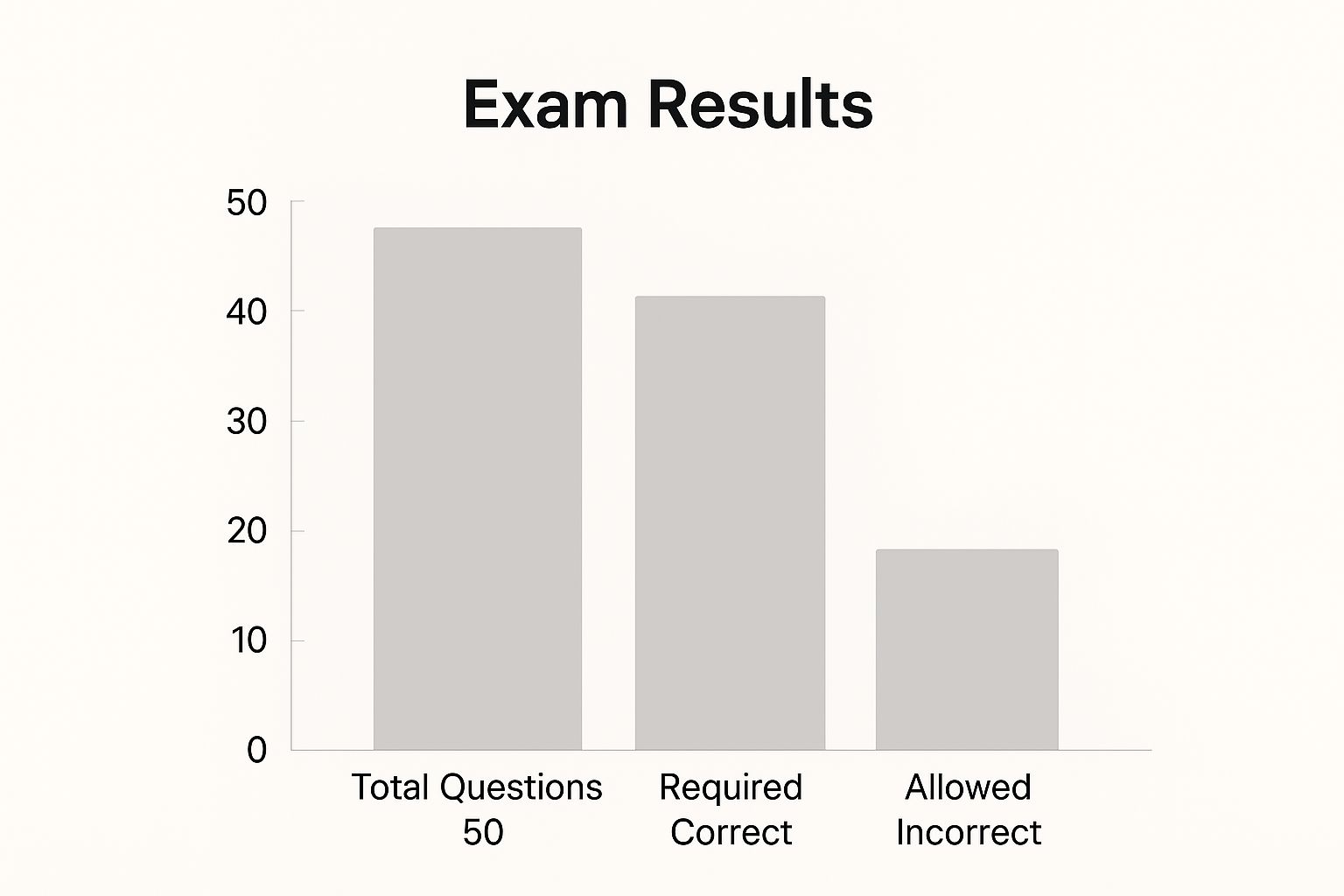
While this graphic shows a 50-question test, the principle is the same across the board. If your test has 20 questions, you need 16 correct answers to pass. There's not a lot of room for error.
CDL Endorsement Test Question Counts
To give you a clearer picture, here’s a table summarizing the typical test lengths and passing requirements for the most common CDL endorsements.
| Endorsement Type | Typical Number of Questions | Passing Score (%) |
|---|---|---|
| Hazardous Materials (H) | 30 | 80% |
| School Bus (S) | 25 | 80% |
| Tanker (N) | 20 | 80% |
| Doubles/Triples (T) | 20 | 80% |
| Passenger (P) | 20 | 80% |
Remember, these numbers can vary slightly by state, but they give you a solid baseline for what to expect as you prepare.
Why Endorsements Matter for Your Career
Picking the right endorsements is all about mapping your CDL to your career ambitions. If you only ever plan to drive a truck with an automatic transmission, for example, you may not worry about certain restrictions.
But if you want to maximize your job prospects, skills like operating a manual transmission are invaluable. If you find yourself with an E restriction, we have a specialized course that can help with the E restriction removal process.
Mastering endorsements isn't just about passing another test; it's about becoming a more versatile and valuable professional driver. Each endorsement you earn unlocks new job opportunities and higher earning potential.
Understanding Combination Vehicles and Air Brakes Tests
Beyond hauling specific types of cargo, two of the biggest knowledge tests you'll face are for Combination Vehicles and Air Brakes. These aren't just extra boxes to check; they are absolutely critical for safely handling the most common heavy-duty trucks on the road.
If you’ve got your sights set on driving a tractor-trailer, you're aiming for a Class A CDL. That means the Combination Vehicles test is a mandatory step. This exam is all about the unique challenges of handling a vehicle that bends in the middle. It's designed to make sure you know how to prevent rollovers, control the "crack-the-whip" effect, and properly couple and uncouple your rig.
Breaking Down the Combination Vehicles Test
So, what does this key CDL test look like? The Combination Vehicles exam is a pretty quick one, typically with 20 questions. To get a passing grade, you need to answer at least 16 of them correctly—that's the standard 80% passing score. The questions will dig into the specific mechanics and safety procedures for articulated vehicles.
To really nail this section, you have to get comfortable with how these big rigs move and behave. A great way to prepare is by running through practice questions. This Combination Vehicles Test 1 is a solid resource to see where you stand before the real deal.
What to Expect on the Air Brakes Test
The Air Brakes test is another must-pass for most commercial drivers, since just about every Class A and Class B truck uses an air brake system. This exam is a little longer, usually around 25 questions. You'll need to get at least 20 right to pass.
The Air Brakes test goes way beyond just knowing how to hit the pedal. It's about understanding the entire system inside and out—from the air compressor to the slack adjusters. The goal is to prove you can spot a problem before it turns into a disaster on the highway.
This test confirms you can run a proper pre-trip air brake inspection and truly grasp the nuances of stopping a massive vehicle that relies on compressed air. Getting both the Combination Vehicles and Air Brakes tests under your belt is a massive step toward becoming a safe, skilled, and professional driver.
Who Makes the Rules for the CDL Test?
Ever wonder why the CDL test feels so consistent, whether you're taking it in California or Florida? That’s no accident. There's a national framework in place to make sure every single commercial driver is held to the same high standard of safety and knowledge.
Think of it like this: a federal agency creates the master blueprint for the CDL test. Then, each state's DMV uses that blueprint to build its own testing program. This is why the core material is the same no matter where you get your license.
The FMCSA Sets the Standard
The agency behind all this is the Federal Motor Carrier Safety Administration (FMCSA). Their job is to set the national standards for commercial driving, ensuring the skills you’re tested on are the ones that actually keep our roads safe.
Because of the FMCSA's oversight, all entry-level drivers must get their training from a school listed on the official Training Provider Registry. It’s also why the general knowledge test is 50 questions everywhere you go. Each state administers its own version, but they all have to follow these federal guidelines.
Understanding this gives you the bigger picture. The test you’re studying for isn't just some random DMV quiz; it's part of a nationwide system that the entire trucking industry respects. Knowing that you're working toward a universally recognized standard should give you a real confidence boost.
Passing your CDL exam means you've met a benchmark for safety and professionalism that is recognized in every state. It's your entry ticket into a nationwide community of qualified drivers.
Meeting both federal and state criteria is your first big step. Before you head to the DMV, it's a good idea to review a full breakdown of the official CDL requirements to make sure you have all your bases covered.
How Each Test Section Prepares You for the Real World
The CDL exam is more than just a test you need to pass—it’s the first step in building the mindset of a professional driver. Think of each question as a mini-simulation, a direct link to a challenge you’ll absolutely face out on the road. It’s designed to turn book smarts into practical, life-saving habits.

Nowhere is this more clear than in the General Knowledge section. Those questions about vehicle inspections aren’t there just to make you memorize parts. They're drilling into you the routine that will become second nature. Knowing the ins and outs of a proper pre-trip inspection means you'll be the one to spot a frayed brake line or a low tire before it becomes a disaster on the interstate. We have a complete guide that breaks down exactly what to look for in our article on the pre-trip inspection.
From Theory to Practice
The whole point of the CDL test is to see if you grasp the critical safety rules and driving skills needed to operate a massive vehicle. The general knowledge exam is the big one you have to pass to get your Commercial Learner's Permit (CLP), which is your ticket to getting behind the wheel and starting your hands-on training for the full CDL.
This practical, real-world focus carries through to every single endorsement test. Each one is geared toward specific situations you’ll encounter on the job.
- Tanker Endorsement: When you're tested on "liquid surge," you're learning how to handle the incredible force of thousands of gallons of liquid sloshing around behind you. Understanding this is what keeps you from rolling over on a sharp turn.
- HazMat Endorsement: Questions about placarding, shipping papers, and emergency procedures aren't just trivia. They prepare you to know exactly what to do if a hazardous leak happens, protecting yourself and everyone else on the road.
- Combination Vehicles: Learning about the "crack-the-whip" effect isn't just a technical term. It teaches you how your trailer will behave, so you instinctively know to take turns wider and avoid clipping curbs or cars in tight spots.
Every question is a simulated experience, a mental rep that strengthens your decision-making abilities for when you're actually behind the wheel. The test isn't just asking what you know; it's confirming how you'll act.
When you start to see the test this way, your study time becomes much more valuable. You're not just memorizing answers to pass an exam; you're building the situational awareness and muscle memory that define a safe, professional, and successful driver. Every correct answer is another brick in the foundation of a long and rewarding career.
Answering Your Top CDL Knowledge Test Questions
Even after you know what’s on the test, a few practical questions always pop up. Let's walk through some of the most common ones I hear from new drivers, so you can head to the DMV feeling ready for anything.
How Much Time Do I Get for the General Knowledge Test?
You’ll typically have one hour (60 minutes) to complete the 50-question General Knowledge exam. That works out to about 72 seconds per question, which is more than enough time if you're prepared.
Here's a pro tip: Don't get bogged down. Run through the test and answer all the questions you're certain about first. Flag the ones that give you pause and circle back to them at the end. This way, you bank all the easy points and don't risk running out of time on a single tough question.
What Happens If I Fail One of the Tests?
Failing a test is a bummer, but it’s definitely not the end of the world. The good news is that you only have to retake the specific test you failed—any other sections you’ve already passed are locked in.
Most states will make you wait a short period, often just one business day, before you can give it another shot. It’s always smart to double-check your local DMV's specific rules, as some might have different waiting periods or limits on how many times you can retake it.
Think of a failed attempt as a diagnostic tool. It shows you exactly where you need to focus your study time. Hit the books on those weak spots, and you’ll be in a much better position for your next try.
Are the CDL Test Questions the Same Everywhere?
Nope. While the Federal Motor Carrier Safety Administration (FMCSA) sets the rules and outlines what every commercial driver needs to know, each state creates its own unique bank of test questions.
The core information you need to learn is the same whether you're in California or Maine. Your state's official CDL driver's manual is always going to be your best friend and the ultimate source for getting ready for how many questions are on the CDL test you'll be taking.
Ready to stop studying and start driving? At Patriot CDL, we provide the hands-on training and expert guidance you need to pass your CDL exams and launch a successful trucking career. Get started today by visiting us at our website.