If you want to ace the written part of your Commercial Driver's License exam, a knowledge cdl practice test is your single best weapon. It's the closest you can get to the real thing, letting you master the material and pinpoint your weak spots long before you set foot in the DMV.
Laying the Groundwork for CDL Test Success
Starting a career as a commercial driver is a huge step, but the journey kicks off in the classroom, not behind the wheel. Your first real challenge is the General Knowledge exam. This isn't just another test; it's the foundation for your entire CDL, and passing it means you're starting to think like a pro who puts safety first.
This initial exam covers a ton of ground, touching on everything a commercial driver needs to know. It's the gatekeeper that stands between you and your Commercial Learner's Permit (CLP), which you need for hands-on training and any specialized endorsements.
What the General Knowledge Test Covers
The exam is built to make sure you have a solid handle on the core principles of operating a large vehicle safely and legally. Think of it as the official rulebook for the road. While the exact questions can differ a bit from state to state, they all revolve around the same key areas.
You can bank on seeing questions about:
- Vehicle Inspection: This is all about the pre-trip, on-the-road, and post-trip inspections. You'll need to know how to spot potential issues with brakes, tires, lights, and coupling systems before they turn into major problems.
- Basic Vehicle Control: These questions cover the nuts and bolts of handling a big rig—things like shifting gears correctly, managing the space around you, and taking turns and curves without incident.
- Safe Driving Protocols: This is a big one. It's about defensive driving, seeing hazards before they happen, and adjusting to bad weather like rain or fog. It also includes how you communicate with other drivers on the road.
- Cargo Management: Expect to be tested on how to load, secure, and inspect your cargo properly. Shifting loads and improper weight distribution are no joke.
- Rules and Regulations: This part tests your knowledge on critical rules like Hours of Service (HOS), commercial vehicle speed limits, and the strict policies on alcohol and drugs.
A lot of people underestimate just how much the General Knowledge test covers. It's more than just common sense driving; you have to know the technical details, especially when it comes to vehicle systems and federal regulations.
The Power of a Diagnostic Practice Test
Instead of just cracking open the CDL manual and reading from page one, there’s a much smarter way to start. Take a diagnostic knowledge cdl practice test right out of the gate. This first run-through isn't about getting a perfect score—it’s about creating a map for your study plan.
It will show you exactly where you're already solid and, more importantly, where you're struggling.
Maybe you find out you’re a natural with road rules but the section on air brake systems feels like a foreign language. That's fantastic information to have. It lets you build a study plan that focuses your energy where it's needed most. Taking a moment to understand the full scope of CDL requirements also helps drive home why this foundational knowledge is so crucial.
This targeted approach means you stop studying blind and start studying smart. You'll save a ton of time and build a much deeper understanding of the material, setting yourself up for a pass on the general knowledge test and every endorsement exam that comes after it.
Turning Practice Tests into Real-World Knowledge
Anyone can take a knowledge cdl practice test over and over again, but that's just memorization. If you want to walk into the DMV confident you're going to pass, you need to turn those practice sessions into genuine learning opportunities. The goal isn't just to recognize the right answers—it's to truly understand the material.
This means you have to shift your mindset. Move away from casual, open-book run-throughs and start treating your practice like a dress rehearsal for the real thing. You're building the mental muscle for both speed and accuracy under pressure, which is exactly what you'll face when it counts. It’s a deliberate process, not a chore.
This simple three-stage approach—Diagnose, Personalize, and Build—is the roadmap from just practicing to actually mastering the content.
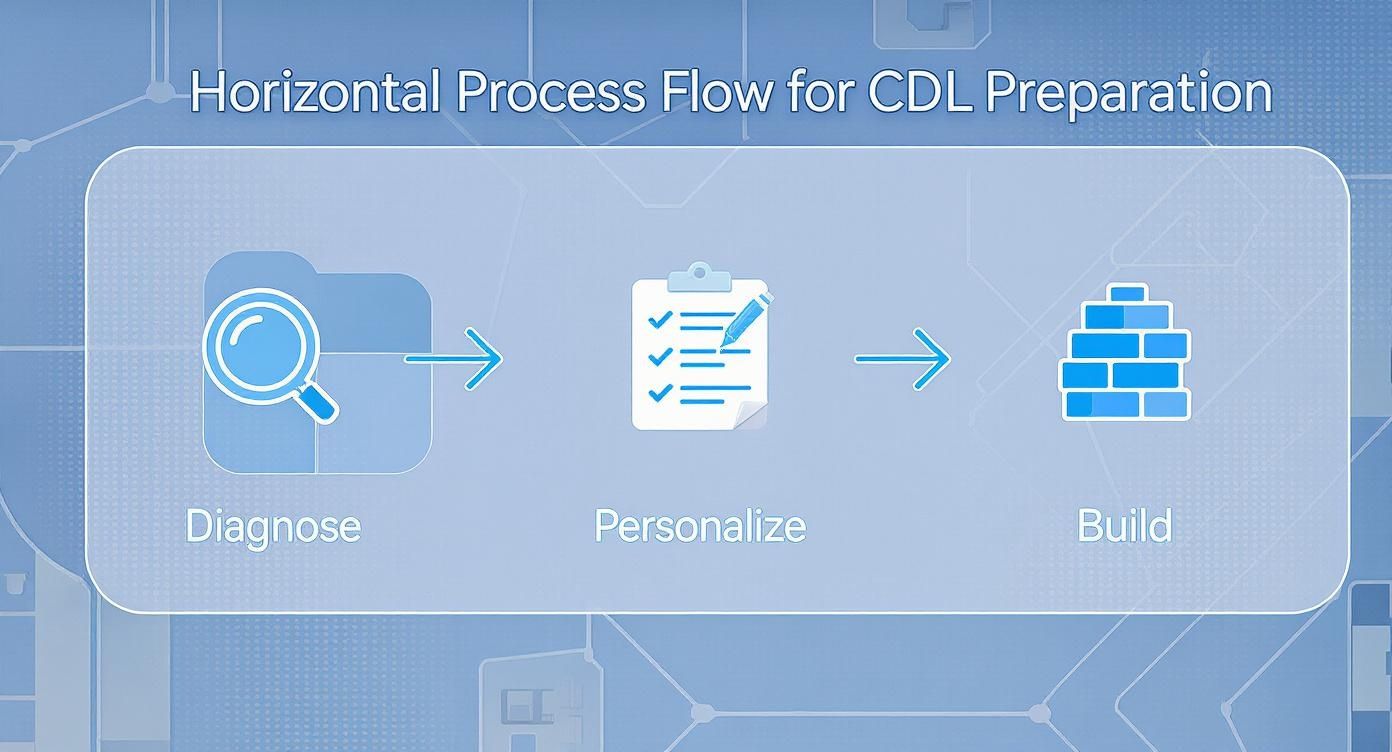
As you can see, good preparation isn't random. It's a structured journey that takes you from finding your weak spots to building the kind of solid knowledge that sticks with you.
From Casual Study to Timed Simulation
When you first start out, keep it low-stress. Treat your initial practice tests like an open-book quiz. The goal here is simple engagement with the material, so don't even think about the clock. Your only job is to understand the why behind every single question.
Once you start feeling more comfortable with the content, it's time to introduce the timer. This is a crucial step. The real CDL knowledge test is timed, and learning to manage that pressure is a skill in itself. It’s what keeps you from rushing and making simple, avoidable mistakes on test day.
The moment you switch from untimed to timed practice is when you're truly getting ready for the exam. You're training your brain to pull up the right information quickly and accurately, which is half the battle.
Pinpoint Your Weak Spots by Analyzing Your Mistakes
The most important part of any practice test isn't your score; it's the questions you got wrong. Every single incorrect answer is a flare lighting up a gap in your knowledge. Don't just look at the right answer and move on. You need to dig in and figure out why you made that mistake.
Start looking for patterns in your errors. It’s usually one of two things:
- Topic-Specific Weaknesses: Are you constantly getting tripped up by questions on air brake systems? Or maybe it's the combination vehicles section? This tells you exactly which chapters in the CDL manual need more of your attention.
- Question Format Confusion: Do you do well on direct definition questions but struggle with ones that lay out a specific driving scenario? That’s a sign you need to practice applying your knowledge to real-world situations, not just reciting facts.
By sorting your mistakes into these categories, you can build a personalized study plan. This targeted approach is way more effective than just re-reading the entire manual from start to finish. You’re putting your effort where it will make the biggest difference.
Build Mastery with Focused Repetition
After you've identified your trouble areas, it's time to zero in on them. Instead of taking full-length exams, find practice tests that are dedicated to the sections where you're struggling. If air brakes are giving you a headache, take a dozen air brake-only tests until you’re hitting high scores consistently.
The data backs this up. CDL prep resources show that this kind of focused, persistent practice dramatically boosts your chances of passing. Many drivers report it takes multiple tries to clear that critical 80% passing threshold on the general knowledge test. One driver we know went from a 70% to an 86% on his HazMat practice tests after about 15 to 20 focused attempts over four days—and then he went in and passed the real thing.
This proves that smart repetition isn't about mind-numbing memorization. It's about building the deep understanding and confidence you need to succeed. If you want to review the core material, our guide on the general knowledge test breaks down exactly what you'll face. This strategy turns practice from a grind into a system for building real expertise, making sure you walk into that exam ready for anything.
Mastering Key Sections and CDL Endorsements
Passing the General Knowledge exam is your entry ticket, but the endorsements you earn are what truly shape your career and earning potential. Think of the general test as the foundation. The endorsements are the specialized skills that open doors to hauling more complex, and often more valuable, cargo.
This is where a targeted knowledge cdl practice test for each specific endorsement becomes your best friend. These specialized tests dive deep into technical details that the general exam only skims. Getting these letters on your license isn't just a formality; it's proof that you have the expert knowledge to handle challenging situations safely and professionally.
Deconstructing the Air Brakes Section
For many new drivers, the Air Brakes section is the first real mountain to climb after the general test. It’s notoriously technical for a reason—it requires you to understand the entire system, from the air compressor all the way to the brake chambers. Straight memorization won’t get you far here. You need to grasp the mechanics.
Practice questions for this section are often pulled from real-world situations. For instance, a question might ask: "During a static leakage test, what is the maximum acceptable air pressure loss for a single vehicle in one minute?" The answer is 3 PSI. But just knowing the number isn't enough. You have to understand why that’s the standard and what it means for safety if a truck is losing more air than that.
Mastering air brakes is less about memorizing numbers and more about visualizing the system. Once you understand how each component works together, the test questions become simple logic puzzles instead of a list of random facts to cram.
To feel truly confident, you should be able to walk through the entire pre-trip air brake inspection in your head. This means checking compressor governor cut-in and cut-out pressures, testing the low-pressure warning signal, and performing both static and applied leakage tests. Our detailed Air Brakes Test is a perfect tool for this, letting you drill these concepts until they become second nature.
Tackling Combination Vehicles and Key Endorsements
Beyond air brakes, several other sections demand their own dedicated study plan. Each one comes with unique challenges, and a generic practice test just won’t cover the details you need.
Let's break down what to expect in the core CDL knowledge tests. The requirements are strict, and each section tests a distinct skill set.
Overview of Core CDL Knowledge Test Sections
| Test Section | Typical Number of Questions | Required Passing Score (%) | Key Topics Covered |
|---|---|---|---|
| General Knowledge | 50 | 80% | Vehicle control, shifting, seeing hazards, emergency procedures, inspections |
| Air Brakes | 25-30 | 80% | Air brake system components, pre-trip inspections, dual air systems |
| Combination Vehicles | 20-25 | 80% | Coupling/uncoupling, "crack-the-whip" effect, rollover prevention, turning |
| Hazardous Materials (H) | 30 | 80% | Placarding rules, loading/unloading, shipping papers, emergency response |
| Tanker (N) | 20 | 80% | Liquid surge management, outage/ullage, special vehicle handling |
| Doubles/Triples (T) | 20 | 80% | Assembling rigs, rearward amplification, inspecting converter dollies |
As you can see, the 80% passing score is the industry standard across the board, leaving very little room for error. You have to know your stuff, plain and simple.
Using Endorsement-Specific Practice Tests
The single most effective way to prepare for these specialized exams is to use a knowledge cdl practice test designed specifically for that endorsement. This is how you ensure you're learning the exact information needed to pass.
When you take a HazMat practice test, for example, you're not just memorizing rules from a book. You're being put into scenarios that force you to think like a driver responsible for dangerous goods—making decisions about placarding, documentation, and emergency response.
Likewise, a tanker practice test will drill you on the dynamics of liquid movement until managing surge becomes an instinct. This focused repetition is what builds the expertise that separates a qualified driver from a truly professional one.
How to Handle State Specific CDL Regulations
It’s a classic mistake to think every state’s CDL test is the same. While the Federal Motor Carrier Safety Administration (FMCSA) sets the foundation, each state puts its own spin on the rules. Relying only on a generic knowledge cdl practice test can leave you blindsided by local regulations you never even knew existed.
Think of it this way: your state's official CDL manual, the one from your local DMV, is your ultimate playbook. It's the only guide that's 100% tailored to the exact test you’re about to take. Practice tests are fantastic tools, but they’re there to sharpen your understanding of what you learn from that official manual, not replace it.
Why Your State Manual Is Non-Negotiable
A generic practice test might cover the federal rule, but what if your state has a stricter law? You can bet that local variation will be on the test. The DMV examiner won't care what a general study guide said; their questions come directly from their state-issued book.
The single biggest mistake you can make is assuming all CDL information is universal. Your state's manual is the final authority on every question you'll face. Cross-reference every concept from your practice tests with the official manual to avoid any surprises.
This isn’t just about passing a test. It's about learning the specific laws you’ll be expected to follow every single day on the job in your state.
Common Areas Where State Laws Differ
Federal regulations cover the big stuff, but states have plenty of room to add their own rules. As you study, keep a sharp eye on these areas, because this is where you'll find most of the differences.
- Speed Limits: Many states have split speed limits, meaning trucks have a lower legal speed than passenger cars. You need to know that number.
- Intrastate Commerce Rules: Planning on driving only within your state? The age and medical requirements can be different from the federal standards for interstate drivers.
- Unique Cargo Regulations: A state with a huge logging industry will have specific rules for securing timber that you won't find in a state known for agriculture.
- Mountain Driving Rules: If you're in a state with serious mountain passes, expect specific laws on chain usage, mandatory brake checks, and how to use runaway truck ramps.
For example, the knowledge required for driving in California is worlds away from what you'd need to know to haul freight in Ohio. Each state presents its own unique challenges. A generic practice test simply can't cover all those local details, so it's on you to dig into your manual and find them.
Treat your state’s CDL manual as your primary textbook. Use practice tests to quiz yourself and lock in that knowledge. This two-part strategy ensures you've covered all your bases—both federal and local—so you can walk into the DMV with confidence.
Your Game Plan for Test Day Success

You’ve put in the hours. You’ve taken countless knowledge cdl practice tests. Now, all that’s left is the real thing. This is where all your hard work pays off, and success isn't about last-minute cramming—it's about getting your mind and body ready to perform at their peak.
A solid game plan for the final 48 hours can be the difference between a pass and a fail. The focus shifts now. It's less about learning new material and all about reinforcing what you already know and walking into that testing center with confidence.
The Final 48-Hour Countdown
The night before your test is absolutely not the time to pull an all-nighter. Let’s be real: at this point, you either know the material or you don’t. Forcing it now will just lead to burnout and anxiety, which are your worst enemies on test day.
Your final day of prep should be all about light review and relaxation. Maybe run through one last full-length practice test just to keep the concepts fresh in your mind, but don't get hung up on the score. The goal here is just to stay sharp.
After that? Put the books away. Seriously. Go do something that helps you unwind, eat a good meal, and get a full night of sleep. A well-rested brain performs so much better on cognitive tasks, and your CDL knowledge test is a perfect example of that.
Navigating the Testing Center
Walking into the testing center can be intimidating, but knowing exactly what to expect helps cut down on those test-day jitters. These places are structured and have strict rules, so being prepared for the check-in process lets you stay calm and focused on the task at hand.
Make sure you have everything ready to go:
- Valid Identification: This usually means your current driver's license, but they often ask for a second form of ID like a Social Security card. It’s always smart to check your specific state's requirements beforehand.
- Medical Certificate: Have your valid DOT Medical Examiner's Certificate ready to present.
- Proof of Residency: You'll need documents proving you live in the state where you're testing.
Once you’re checked in, you’ll be shown to a computer station. The test interface is usually pretty simple, but take a minute to get your bearings before you start. Figure out how to select answers, move between questions, and—most importantly—how to use the "flag" or "review" feature.
The ability to flag a tough question and come back to it is a game-changer. Don't waste precious time and energy getting stuck. Flag it, knock out the questions you know for sure, and then circle back with a clear head.
Proven Test-Taking Tactics
As soon as that timer starts, your strategy is just as important as your knowledge. The goal is to move through the test efficiently and accurately, turning all that practice into a passing score.
A huge part of your prep has been about understanding vehicle systems, especially the pre-trip inspection, and you'll see that knowledge pop up in a lot of questions. Combine what you know with a few smart tactics.
- Process of Elimination: Even if you aren't 100% sure, you can almost always spot two answers that are clearly wrong. Getting rid of those instantly bumps your odds of a correct guess from 25% to 50%.
- Read Every Question Carefully: The DMV loves to play with wording. Make absolutely sure you understand what the question is asking before you click. Keep an eye out for tricky words like "not" or "except."
- Manage Your Time: Don't rush, but keep an eye on the clock. If you’ve been using timed practice tests, you should already have a good feel for your pace. Answer the easy ones first to build momentum and confidence.
You’ve done the work. By mixing deep knowledge with a smart test-day strategy, you can walk in calm, focused, and ready to prove it.
Answering Your Top Questions About the CDL Knowledge Test
Even the most prepared students have questions pop up while studying for their CDL knowledge exam. It’s completely normal. From how long to study to what to do if you come up short, getting good answers is key to building real confidence.
Let’s walk through some of the questions I hear most often from aspiring drivers.
How Many Hours Should I Really Study?
This is the big one, and the honest answer is: it depends. There’s no magic number. A good starting point for most people is somewhere in the 20 to 30-hour range. That’s enough time to really dig into your state's CDL manual and take a good number of practice tests without just skimming the surface.
But here’s a better way to think about it: forget the clock and focus on your scores. When you can consistently hit 90% or higher on a variety of full-length practice exams, that’s when you know you're ready. Hitting that mark, especially under timed conditions, is a much better sign of readiness than just putting in the hours.
Are Online CDL Practice Tests Actually Accurate?
Many of them are, but you have to be smart about which ones you use. The best ones pull their questions straight from the official state CDL handbooks. They're designed to be more than just a quiz; they teach you. A high-quality practice test will give you a detailed explanation for every single answer, right or wrong, so you learn the "why" behind the rules.
When you're looking for a good knowledge cdl practice test, make sure it has these features:
- Covers Everything: It needs to have questions for the General Knowledge test plus all the major endorsements like Air Brakes, Combination Vehicles, HazMat, and others.
- Feels Like the Real Deal: Look for platforms that mimic the multiple-choice format and timing of the actual test. Getting used to that pressure is a huge advantage.
- State-Specific Questions: While the core rules are federal, states have their own quirks. Practice tests that let you select your state are incredibly valuable for drilling on local regulations.
No matter how great a practice test is, your official state CDL manual is the ultimate source of truth. Always have it on hand to double-check information and study the specific laws that a generic test might not cover.
What’s the Hardest Part of the Test?
If you ask ten veteran drivers this question, you’ll likely get the same two answers from nine of them: Air Brakes and Combination Vehicles. These sections trip people up because they aren't about simple memorization. They require you to understand the mechanics of how these complex systems work.
The Air Brakes section, for example, gets deep into how the entire system operates—from the compressor all the way to the brake chambers—and includes the detailed pre-trip inspection steps. The Combination Vehicles test is just as tough, covering tricky concepts like offtracking and the "crack-the-whip" effect, which are absolutely critical for preventing rollovers. The only way to master these sections is to drill them with targeted practice tests until the concepts click.
What Happens If I Fail?
First thing's first—don't panic. It happens more often than you think, and it's definitely not the end of your driving career. Most states let you retake the test, though you'll likely have a short waiting period and have to pay the fee again.
The most important thing to do is use the failure as a learning opportunity. As soon as you leave, write down every topic you can remember struggling with. Was it identifying placards? Calculating stopping distances? That list is pure gold.
Now you have a targeted study plan. Go back to the manual and focus only on those weak areas. Then, find practice tests that let you drill down on just those topics. Keep at it until you’re consistently scoring way above the 80% passing grade. When you go back for your second attempt, you won’t just be more prepared—you’ll be more confident.
Ready to stop worrying and start preparing? The expert instructors at Patriot CDL guide you through every step of the process, from mastering the knowledge test to acing your skills exam. Build your confidence and launch your new career by visiting us at https://patriotcdl.com.