Thinking about a career in trucking? It can seem like a complex maze of rules and regulations, but the path is actually quite straightforward, thanks to federally required standards.
The short answer is this: every new driver must complete Entry-Level Driver Training (ELDT) from a registered school before they can even sit for their Commercial Driver's License (CDL) test. Let's break down exactly what that journey looks like, from day one to the day you get your license.
Your Roadmap to Becoming a Licensed Truck Driver
Kicking off a career as a professional truck driver is a fantastic move, especially with how much demand there is for skilled operators right now. The road to getting behind the wheel is more structured than it used to be, which is a good thing—it guarantees every new driver starts with a solid foundation in safety and operational know-how. This approach doesn't just produce better drivers; it also makes the whole process easier to navigate for newcomers.
And that demand is no joke. The U.S. Bureau of Labor Statistics (BLS) projects that jobs for heavy and tractor-trailer drivers will grow by 5% between 2023 and 2033. That works out to roughly 240,300 job openings for truckers every single year for the next decade.
The Core Steps to Your CDL
Before we get into the nitty-gritty, it helps to look at the entire process from a bird's-eye view. You can think of it as three main stages, with each one building on the one before it. This step-by-step progression makes sure you hit every requirement without getting overwhelmed.
This is a great visual of the three key steps you’ll follow to meet all the truck driver education requirements.
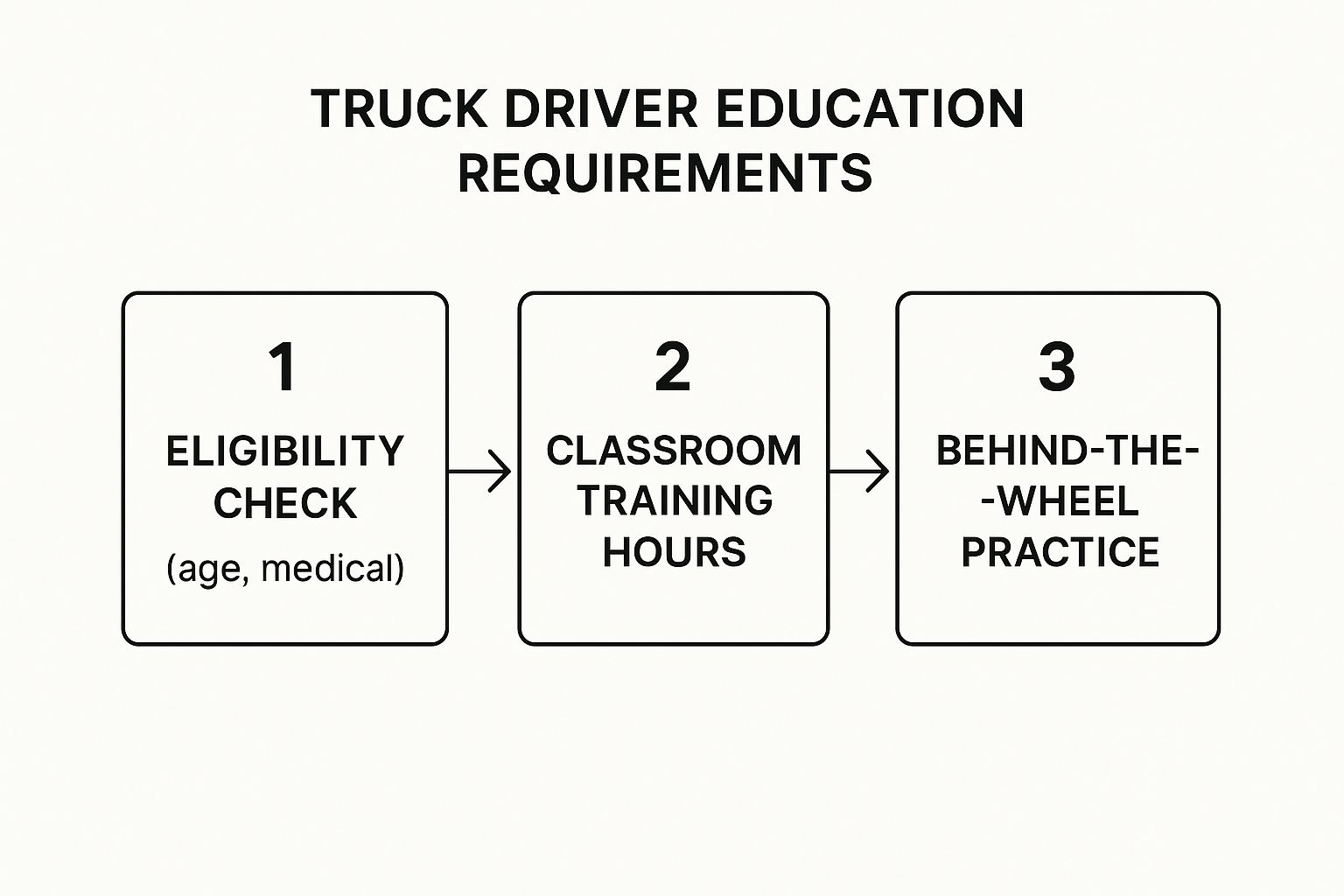
As you can see, the journey starts with meeting the basic eligibility rules, then moves into critical classroom learning, and finally culminates in practical, hands-on experience behind the wheel.
Now, while this framework is the national standard, some of the specific details can change depending on where you live. For example, the exact steps to get a CDL in Alabama might have slight differences from another state, even though both will be built on the same federal ELDT rules. Knowing both the national and local requirements is key to a smooth process.
The table below breaks down these core stages into a clear, step-by-step guide. It outlines the sequence every aspiring driver will follow to meet all the necessary educational and licensing requirements.
Key Steps to Becoming a Licensed Truck Driver
| Step | Requirement | Key Objective |
|---|---|---|
| 1. Meet Basic Eligibility | Age, clean driving record, medical fitness (DOT physical) | Establish a baseline of fitness and responsibility to safely operate a commercial vehicle. |
| 2. Obtain a CLP | Pass written knowledge tests at the DMV | Gain a Commercial Learner's Permit to legally practice driving with a licensed instructor. |
| 3. Complete ELDT Theory | Pass the classroom/theory portion from a registered provider | Learn the rules of the road, safety protocols, and operational knowledge before getting behind the wheel. |
| 4. Complete ELDT BTW Training | Finish required behind-the-wheel (BTW) driving hours with an instructor | Develop essential hands-on driving skills and maneuvers in a real-world environment. |
| 5. Pass the CDL Skills Test | Successfully perform vehicle inspection, basic controls, and a road test | Demonstrate complete competency to an examiner and officially earn your Commercial Driver's License. |
This table shows the logical progression, from getting your initial permit to finally acing that skills test.
The real takeaway is simple: your education is the bedrock of your career. This isn't just about cramming to pass a test. It's about becoming a safe, competent professional who is an asset to any company and a responsible presence on our nation's highways. The investment you make in quality training now pays off for your entire career.
The Federal ELDT Mandate: What You Need to Know
If you're looking to get into trucking today, you'll hear a lot about the Entry-Level Driver Training (ELDT) mandate. This isn't just another government regulation to check off a list. It's a foundational safety standard from the Federal Motor Carrier Safety Administration (FMCSA), put in place to make sure every single new driver hits the road with the same high-quality, core set of skills.
Think of it as the national standard for truck driver training. Before ELDT, training standards could vary wildly from state to state or even school to school. Now, there's a consistent curriculum that ensures whether you train in California or Maine, you’re learning the same essential knowledge and proving the same on-road skills. It creates a level playing field and, more importantly, safer highways for all of us.

The whole process is broken down into two main parts that build on each other: learning the rules of the road in a classroom and then proving you can apply them from behind the wheel.
The Two Pillars of ELDT
The logic behind the ELDT mandate is simple: you have to know what to do and why you're doing it before you can actually do it safely. The training is split into two distinct, sequential phases.
- Theory (Classroom) Instruction: This is where you build your foundation. Before you even think about turning the key, you'll dive deep into everything from basic vehicle controls and managing your hours of service to mastering defensive driving techniques and handling hazardous materials.
- Behind-the-Wheel (BTW) Training: Once you've got the theory down, it's time to put it into practice. This hands-on portion takes place in two settings: a controlled range where you can practice maneuvers without traffic, and then out on public roads with your instructor.
You absolutely must complete and pass the theory curriculum before you're allowed to start the behind-the-wheel training. It's a step-by-step process designed for success.
The biggest shift with ELDT is that training is now proficiency-based. It’s not about just sitting in a truck for a certain number of hours. You have to actually prove to your instructor that you’ve mastered each required skill. Only then can they sign off on your training and clear you for the CDL test.
What You Will Learn and Master
The ELDT curriculum isn't vague; it’s a detailed roadmap for new drivers. To even get started, you first have to get your Commercial Learner’s Permit (CLP) by passing the written knowledge exams and meeting all the medical and residency requirements. From there, your ELDT program kicks in.
The theory portion covers the critical knowledge you'll use every day. After that, the behind-the-wheel training is where you'll be required to physically master specific maneuvers. We're talking about everything from performing a perfect pre-trip inspection to executing tricky backing maneuvers and navigating tight city corners.
Our comprehensive guide on CDL requirements walks you through all the specifics you can expect during this phase. Ultimately, the ELDT mandate makes sure every new driver has proven their competence in a structured, professional environment long before they take the wheel on their own.
How State-Specific Rules Shape Your CDL Journey
Think of getting your CDL as a two-part process. First, you have the federal government setting the big-picture rules. These are the nationwide standards everyone has to follow, no matter where you live. This is where the Entry-Level Driver Training (ELDT) mandate comes in—it’s the universal foundation for all new drivers.
But your actual license? That comes from your home state. This is the second part of the process, and it’s where things can get a little different.
Let's use an analogy. The federal ELDT rules are like the master blueprint for building a safe, solid house. It dictates the core structure and safety features that every single house must have. State rules, on the other hand, are the local building codes. They take that master blueprint and add their own specific requirements—maybe they require a certain type of foundation for their soil or have unique window standards. You have to follow both to get the keys to your new home, or in this case, your CDL.
So while your core truck driver education requirements are the same everywhere, the paperwork, fees, and procedures can vary quite a bit from one DMV to the next.
Universal Prerequisites in Every State
Before you start worrying about local quirks, let's cover the basics that apply to everyone, everywhere. These are the non-negotiables that every aspiring trucker in the U.S. has to meet.
You absolutely must:
- Be at least 21 years old if you want to drive across state lines (that’s called interstate commerce). Some states will issue a CDL for in-state-only driving to folks between 18 and 20.
- Pass a Department of Transportation (DOT) physical exam. This is to make sure you’re medically fit for the job.
- Already have a valid, standard driver's license from the state where you live.
- Provide proof that you are a U.S. citizen or a lawful permanent resident.
Think of these as the entry ticket. Once you’ve got these covered, you can move on to your state’s specific to-do list. The federal training guidelines are a huge part of this, so it’s worth taking a closer look at the ELDT program to see how it gets you ready for these universal standards.
How State Requirements Can Vary
This is where you need to put on your detective hat and check with your local DMV. States have their own way of doing things when it comes to applications, tests, and fees. This is exactly why a driver in Texas might have a totally different experience than a driver just across the border in Oklahoma.
The core skills and knowledge being tested are standardized by federal law, but the logistical details of getting your license are managed at the state level. Always check with your local DMV for the most accurate, up-to-date information.
To give you a better idea of what I mean, let's look at some common areas where states differ. The table below shows how the same requirement can be handled in a few different ways, which really highlights why doing your local homework is so important.
State Requirement Variation Examples
| Requirement | State A Example | State B Example | State C Example |
|---|---|---|---|
| Application Fees | Might bundle the permit and license fees together for around $97. | Could charge separate fees for the application, permit, and skills test, totaling over $100. | Often has individual fees for knowledge tests, endorsements, and the final license, easily adding up to $75 or more. |
| Required Documents | May ask for two proofs of residency, your Social Security card, and one proof of identity. | Often has its own specific medical form (like the MER MCSA-5875), and may require a thumbprint and full legal name verification. | Could demand a certified birth certificate or passport, along with two proofs of address. |
| Skills Test | The road test might include specific maneuvers on urban streets and highways that are common in that region. | The pre-trip inspection part of the test might have a very strict, state-mandated checklist you have to follow to the letter. | Scheduling your skills test could mean booking weeks ahead of time at a third-party testing site approved by the state. |
As you can see, while the destination is the same—a shiny new CDL—the road to get there can have a few different turns depending on your state. Your local DMV’s website is your best friend in this process.
Choosing the Right Truck Driving School
Now that ELDT training is the law of the land, picking the right school isn't just a suggestion—it's the single most important decision you'll make on your journey to getting a CDL. This choice is the bedrock of your entire career. It will define your skill level, how quickly you land a good job, and where you go from there.
Before you even look at a school's website or talk to a recruiter, there’s one step you absolutely cannot skip. You must check if the school is listed on the Federal Motor Carrier Safety Administration's (FMCSA) Training Provider Registry (TPR).
If a school isn't on that list, any training you complete with them is legally worthless. It won't qualify you to even sit for the CDL exam. Think of the TPR as your ultimate safety check.
What Separates the Good from the Great
Once you've confirmed a school is on the TPR, it's time to dig deeper. This is where you separate the schools that just check a box from the ones that genuinely prepare you for life on the road.
First up, ask about their student-to-instructor ratio, especially for the behind-the-wheel portion. A low ratio is a game-changer. A 3:1 or even a 1:1 ratio means you get dedicated, one-on-one time with an instructor, which is crucial for nailing those tough maneuvers. More time behind the wheel for you, less time watching someone else.
Next, take a hard look at their equipment. Ask about the age and condition of their trucks. You want to learn on modern, well-maintained rigs that are similar to what you’ll be driving when you get hired. There’s nothing worse than training on an old clunker only to feel lost in a brand-new truck on your first day.
The End Goal: A Great Job
A school’s real job isn't just to get you a license; it’s to help you launch a career. That's where job placement support and industry connections become incredibly important.
Look for schools that shout about their high job placement rates and can prove it. The best ones have solid relationships with major trucking companies. These partnerships often open doors to pre-hire letters and tuition reimbursement deals, where a carrier helps pay for your schooling once you’re on their team.
A top-tier school doesn't just teach you to pass a test; it actively helps you secure your first job. Don't be shy—ask them the tough questions: "What percentage of your graduates from the last six months found employment within 30 days of getting their CDL?"
Finally, don't forget to look into financial aid. Good schools know that training is a major investment. They should be able to walk you through payment plans, grants, or loan options to make it affordable. A great place to start your journey is by understanding the process of getting your CLP, which is the first credential you'll need before training begins.
Understanding CDL Classes and Endorsements
https://www.youtube.com/embed/MQUl0Meo3sE
A Commercial Driver's License (CDL) isn't a one-size-fits-all deal. It's better to think of it less like a single driver's license and more like a set of keys, where each key lets you drive a different type of commercial vehicle. The specific license you earn dictates exactly what you can get behind the wheel of.
Getting a handle on these differences is a huge part of meeting your truck driver education requirements. Your first move is to figure out which class of license matches the kind of trucking job you're aiming for. There are three main classes, each tied to the weight and type of vehicle you'll be operating.
The Three Main CDL Classes
Your entire career path starts with picking the right license class. Each one unlocks different doors, whether you're interested in local delivery gigs or cross-country hauling.
Class A CDL: This is the big one—the master key of the trucking world. It allows you to operate any combination of vehicles with a gross combination weight rating (GCWR) of 26,001 pounds or more, as long as the trailer you're towing weighs more than 10,000 pounds. With a Class A, you can drive the iconic tractor-trailers that are the backbone of the shipping industry.
Class B CDL: This license is for driving a single large vehicle with a gross vehicle weight rating (GVWR) of 26,001 pounds or more. You can also tow a smaller trailer, but it can't weigh more than 10,000 pounds. Think straight trucks, large dump trucks, or city buses.
Class C CDL: This class covers vehicles that don't quite fit the Class A or B criteria but are built for specific jobs. This is what you'll need if you plan to transport 16 or more passengers (including yourself) or carry federally regulated hazardous materials.
Your choice of CDL class really sets the stage for your career. A Class B is great for a lot of local and regional work, but the Class A license gives you the most options and opens up the widest range of jobs in the industry.
Specializing Your Skills with Endorsements
Once you have your foundational CDL, you can add endorsements. These are like extra certifications that prove you have the specialized knowledge to handle specific types of cargo or vehicles. Think of them as adding powerful tools to your professional toolkit, making you a much more valuable and versatile driver.
To get an endorsement, you’ll have to pass an additional written knowledge test for each one you want. Some of the most common ones you'll see are:
- (H) Hazmat: A must-have for transporting hazardous materials.
- (N) Tanker: For hauling liquids or gasses in tanker trucks.
- (T) Doubles/Triples: Gives you the green light to pull two or three trailers at once.
- (P) Passenger: Required for driving any vehicle, like a shuttle or tour bus, designed to carry 16 or more people.
- (S) School Bus: A highly specific endorsement needed to operate a school bus.
Picking the right endorsements is a smart, strategic move. It can directly lead to better job opportunities and a bigger paycheck.
How Proper Training Shapes Your Career and Paycheck
Getting the right truck driver education isn't just about checking a box to get your license. Think of it as the single most important investment you can make in your future on the road—one that pays off in both career stability and cold, hard cash.
When you walk out of a certified Entry-Level Driver Training (ELDT) program, you're not just another applicant. You're sending a clear signal to every trucking company out there that you're a serious, well-prepared professional ready to do the job right.
Top-tier carriers actively recruit graduates from solid training schools because it takes the guesswork out of hiring. They know you’ve been drilled on safety protocols, which is everything in this industry. For you, that trust translates directly into better starting pay, juicy sign-on bonuses, and a shot at the good routes right out of the gate.
Building a Career That Lasts
The skills you pick up in training aren’t just for your first year on the job; they’re the bedrock of your entire career. The trucking world is always changing, with new tech hitting the road every year. A solid education means you'll have no trouble adapting to things like advanced driver-assist systems or even sliding behind the wheel of a new electric rig.
Investing in quality training is the first and most critical step toward building a stable, profitable, and long-lasting career on the road. It proves you're committed to being a safe and skilled professional.
Your training also gives you a huge leg up in a competitive job market. The Bureau of Labor Statistics recently reported the median annual wage for heavy and tractor-trailer truck drivers was around $57,440. But here's the kicker: many students who complete a formal ELDT program have job offers lined up before they even graduate. That’s how much employers value a properly trained driver.
This foundation is more important than ever. With the number of electric trucks expected to hit about 54,000 globally by 2025, having that core knowledge will keep you ahead of the curve.
Plus, all this classroom and behind-the-wheel time is designed to help you ace your exams. To get a better idea of what you'll be up against, check out our guide on the CDL general knowledge test and see how your training directly sets you up for success.
Your Top Questions Answered
Getting started in the trucking industry naturally comes with a lot of questions. Let's tackle some of the most common ones we hear from people thinking about getting their CDL.
How Long Does Truck Driving School Actually Take?
Believe it or not, most full-time CDL programs are designed to get you road-ready in just three to seven weeks. The modern training approach, thanks to the ELDT mandate, is all about proving your skills—not just sitting in a classroom for a set number of hours.
If you have a full-time job or other commitments, many schools offer part-time and evening classes. These obviously take a bit longer, but they provide the flexibility to get your license on your schedule.
The name of the game is proficiency. Schools want you to master every skill, from pre-trip inspections to complex backing maneuvers. Once you can demonstrate you've got it down, you're ready to test.
Can I Just Study on My Own and Skip School?
That's a definite no. Since the federal Entry-Level Driver Training (ELDT) rules went into effect in February 2022, formal training is no longer optional.
Every single new applicant for a Class A or Class B CDL must complete training from a school officially listed on the FMCSA's Training Provider Registry. This requirement ensures that every driver hitting the road for the first time shares a common foundation of safety and operational knowledge. Learning from a buddy or family member, unfortunately, won't cut it anymore.
What's the Typical Price Tag for CDL Training?
You can expect the cost of a solid truck driving program to be somewhere between $3,000 and $10,000. While that might sound like a lot, that investment usually covers the entire process from start to finish.
Your tuition fee almost always includes:
- Classroom instruction covering all the theory you need.
- Behind-the-wheel training on both a closed course and public roads.
- The use of the school's truck for your final CDL skills exam.
Here's the best part: many trucking companies are so eager for new drivers that they offer tuition reimbursement. These programs can drastically lower your upfront cost—sometimes even covering the entire bill—making your CDL an investment that pays for itself.
Ready to start a career with freedom and excellent pay? Patriot CDL offers accelerated training programs to get you on the road fast. Learn more at the Patriot CDL website.