Think about a career path that offers solid pay, incredible stability, and is always in demand—all without needing a four-year college degree. That's the reality of professional truck driving, and quality truck driver training is your most direct route to get there. This guide will walk you through the whole process, from figuring out which license you need to landing your first job behind the wheel.
Your Fast Lane to a High-Demand Career
Starting a career in truck driving means becoming part of the nation's economic backbone. Professional drivers are the lifeblood that keeps store shelves stocked, hospitals supplied, and our entire country moving forward. This isn't just another job; it’s an essential role in a massive, critical industry.
In 2022 alone, the U.S. trucking industry moved a staggering 72.6% of the nation's freight by weight. We're talking about everything from the food on your table to life-saving medical equipment. The demand isn't slowing down, either. The Bureau of Labor Statistics (BLS) expects to see about 240,300 openings for heavy and tractor-trailer drivers each year from 2023 to 2033.
Why Truck Driver Training Is Your Starting Line
While the need for drivers is obvious, you can't just jump into the driver's seat of a big rig. It takes a unique skill set, a solid grasp of safety rules, and, of course, a Commercial Driver's License (CDL). This is where formal truck driver training becomes non-negotiable.
Think of it like this: knowing how to drive your car doesn't mean you're ready to pilot a 40-ton machine. A structured training program gives you the bedrock for a long, safe, and successful career.
Here’s what you gain:
- Mastering the Core Skills: You'll learn the A-to-Z of trucking, from pre-trip inspections and logbook management to complex maneuvers like backing, turning, and navigating tight city streets.
- Building Real-World Confidence: Let's be honest, handling an 80,000-pound vehicle is intimidating at first. Good instructors guide you through every step, building your confidence in a controlled setting long before you hit the open highway.
- Acing the CDL Exam: Reputable programs are built around one primary goal: to make sure you pass every part of the CDL test—the written exam, the vehicle inspection, and the on-road skills test.
- Prioritizing Safety and Compliance: You’ll get a deep understanding of federal and state regulations, hours-of-service rules, and the kind of defensive driving techniques that keep everyone safe.
Simply put, truck driver training is your roadmap. It provides the structured learning, hands-on practice, and expert guidance you need to go from an aspiring driver to a qualified professional ready to meet the industry's incredible demand.
The ongoing driver shortage has created a golden opportunity for new drivers. With the right training, you can go from the classroom to a well-paying, high-demand career in just a matter of weeks. This guide is your first step on that journey.
Getting to Know Your CDL: Classes and Endorsements
The Commercial Driver's License, or CDL, isn't just a piece of plastic—it's the key that unlocks your entire career in trucking. Think of it like a tiered system. Just as a regular driver's license has different levels for cars and motorcycles, a CDL has different classes that let you operate bigger, heavier rigs and qualify for more specialized, higher-paying jobs.
Making the right choice from the get-go is a big deal. The class you pick determines the kind of training you'll need and the career doors that will open for you once you have that license in hand.
For example, a Class A CDL is the gold standard, putting you in the driver's seat of the big tractor-trailers you see cruising down the interstate. Other classes might be a better fit if you're aiming to drive something like a dump truck or a city bus.
The Three Main CDL Classes
So, what’s the difference? It all comes down to a number called the Gross Vehicle Weight Rating (GVWR). This is simply the total maximum weight a truck can be, including the vehicle itself, its fuel, any passengers, and all the cargo it's carrying.
- Class A CDL: This is the heavyweight champion. It allows you to operate any combination of vehicles with a total weight of 26,001 pounds or more, as long as the trailer you’re pulling weighs over 10,000 pounds. If you're dreaming of a career in long-haul or regional trucking, this is the license you'll need.
- Class B CDL: This license is for driving a single large vehicle that weighs 26,001 pounds or more. You can also tow a small trailer, but it can't be heavier than 10,000 pounds. This is the ticket for jobs involving straight trucks, dump trucks, and large buses.
- Class C CDL: This class is a bit different. It’s for vehicles that don't meet the heavy weight requirements of A or B but are designed to carry 16 or more passengers (including you, the driver) or transport specific hazardous materials that require a placard.
To make this crystal clear, here’s a quick breakdown of what you can drive—and the jobs you can get—with each class of license.
CDL Classes at a Glance
| CDL Class | Vehicle Type You Can Drive | Typical Job Examples |
|---|---|---|
| Class A | Tractor-trailers (semis), truck and trailer combinations, flatbeds, tanker trucks | Long-haul freight driver, regional delivery, tanker hauler |
| Class B | Straight trucks, box trucks, dump trucks, large passenger buses, cement mixers | Local delivery driver, construction, city bus operator |
| Class C | Small HazMat vehicles, passenger vans, shuttle buses | Airport shuttle driver, non-emergency transport, small bus driver |
As you can see, the Class A license gives you the most flexibility, which is why it’s the most sought-after by both drivers and employers.
Level Up Your License with Endorsements
Once you've chosen your CDL class, you can add endorsements to it. These are special qualifications that show you have the extra knowledge and skill to handle specific types of vehicles or cargo. Getting them involves passing some extra written tests, but the payoff is huge.
Think of endorsements as certifications for your CDL. They prove to employers you can handle higher-risk or more complex loads, which almost always translates to better job opportunities and a bigger paycheck.
For instance, you can't just hop into a tanker and start hauling gasoline without the right endorsement. The same goes for hazardous materials. Each one requires specialized knowledge.
Here are some of the most common endorsements you can add:
- T (Double/Triple Trailers): Lets you pull two or three trailers at once.
- N (Tank Vehicle): A must-have for hauling liquids or gasses in a tank truck.
- H (Hazardous Materials – Hazmat): Required to transport materials classified as hazardous.
- X (Combination Tank/Hazmat): A combo endorsement that covers both N and H.
- S (School Bus): The endorsement needed to operate a school bus.
- P (Passenger): Required for operating a vehicle that carries a certain number of passengers.
Deciding which class and endorsements to aim for during your truck driver training is the first step in building a successful career. For a deeper dive, you can learn more about specific CDL requirements for your state.
How to Choose the Right Training Program
Not all truck driving schools are created equal. This is a big decision—one that affects your timeline, your wallet, and how fast you get on the road earning a living. The trick is finding a program that truly clicks with your personal goals, how you learn best, and what your daily schedule can handle.
Some programs are built for speed, getting you from zero to licensed in record time. Others take a more measured approach. Understanding the difference between these two paths is the first step to making a smart investment in your future.
Accelerated vs. Part-Time Programs
The first major fork in the road is often deciding between a fast-paced, immersive program or a more flexible one.
An accelerated program is exactly what it sounds like: a full-time, intensive course designed to make you a job-ready, licensed driver in just a few weeks. It’s a total immersion, a boot camp for your new career where your only focus is mastering the skills to ace your CDL exam.
On the other hand, a part-time or community college program stretches the same curriculum over several months. This setup is perfect for folks who need to keep their day job or juggle other life commitments while they train. It offers flexibility, but the trade-off is a longer wait before you can start earning a professional driver's paycheck.
Here’s a simple way to look at it:
- Accelerated Programs: Perfect if you can go all-in on full-time study and want to start your new career ASAP. They're intense, but incredibly efficient.
- Part-Time Programs: A better fit if you need to keep your current job while you learn. You just have to be patient, as it takes longer to finish.
For most people eager to start, the speed of an accelerated program is a massive plus. We’re not talking about years of school here. A quality Class A Commercial Driver’s License (CDL) program can be completed in just 6 to 7 weeks of dedicated, full-time training. That's an incredibly quick entry into a field that's always looking for good drivers.
This speed is a huge deal in an industry that has struggled with driver shortages for decades. That’s why accelerated training has become such a game-changer. Expert instructors can take you from the basics to advanced road maneuvers in a matter of weeks. You can check out a variety of accelerated CDL program options to see just how fast you could be on your way.
What to Look for in a Quality School
Once you've decided on a timeline, you need to dig into what makes a truck driving school genuinely good. Asking the right questions now can save you a world of headaches later. A great program isn't just about memorizing facts to pass a test; it's about building the real-world skills and confidence you need for a safe, successful career.
The best training programs are all about hands-on, behind-the-wheel experience. Classroom theory is important, but true confidence is built on the road, not in a textbook.
Keep an eye out for schools that prioritize practical, real-world application and give you the support you need to really nail it. This flowchart gives you a quick visual on which license you'll need for different types of trucks.
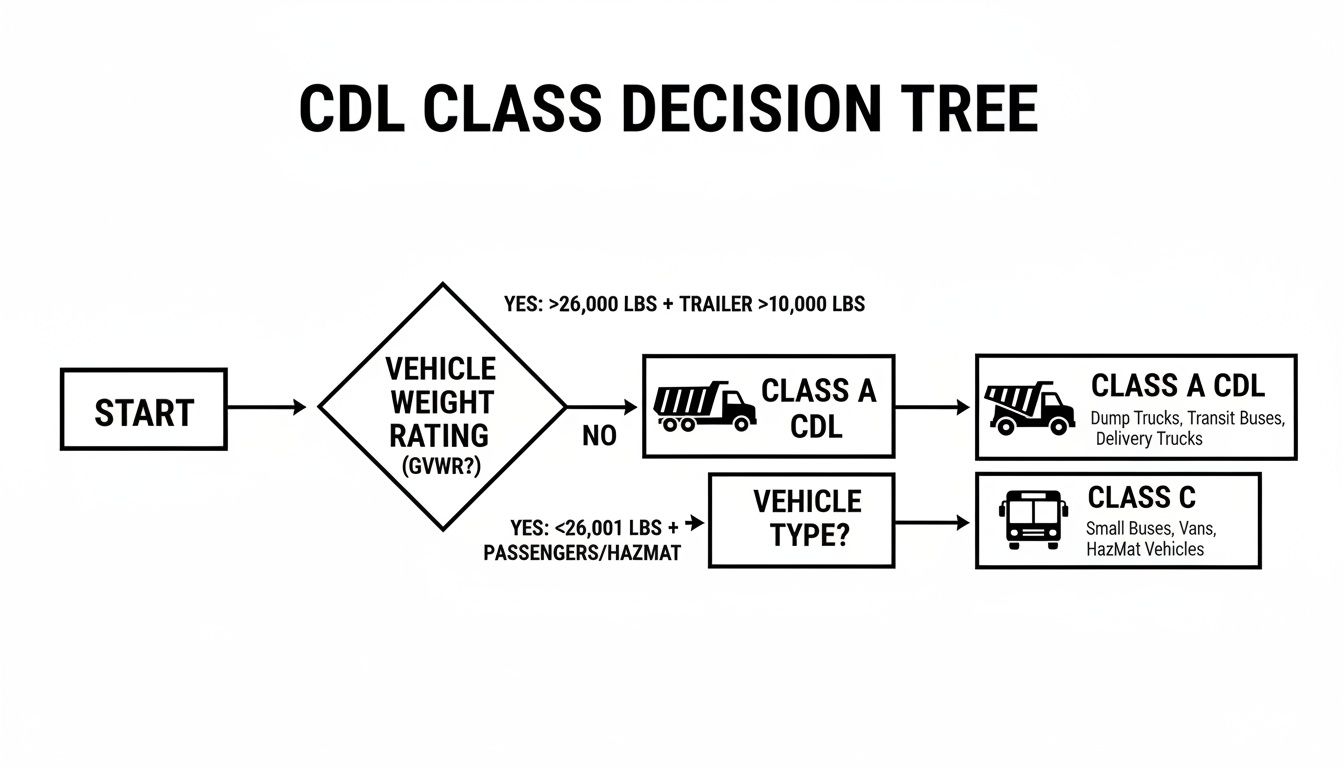
As you can see, the vehicle's weight and what you're hauling are the key factors that determine whether you need a Class A, B, or C license.
Key Questions to Ask Any Training School
Don't just sign up for the first school you find. Show up with a list of questions. A school that’s proud of its program will have no problem giving you straight answers. You're investing your time and money, so you have every right to be thorough.
Here are the must-ask questions:
- What is your student-to-instructor ratio? You want a low number here. It means more personal attention and more one-on-one coaching time when you’re actually driving.
- What kind of equipment will I be training on? Make sure you’ll be learning on modern, well-maintained trucks that are similar to what companies are using today.
- How much behind-the-wheel time is included? This is non-negotiable. You need a program that guarantees significant time driving on real roads—not just doing laps in a parking lot.
- Do you offer job placement assistance? The best schools have connections. They have strong relationships with trucking companies and can often line you up with recruiters before you even have your license in hand.
- What is the total cost of the program, including all fees? Get everything in writing. Ask for a clear breakdown of tuition, books, exam fees, and any other hidden costs so you know exactly what you're paying for.
By doing your homework and getting answers to these questions, you can choose a training program with confidence, knowing it's the right one to launch your career.
What to Expect During Your CDL Training
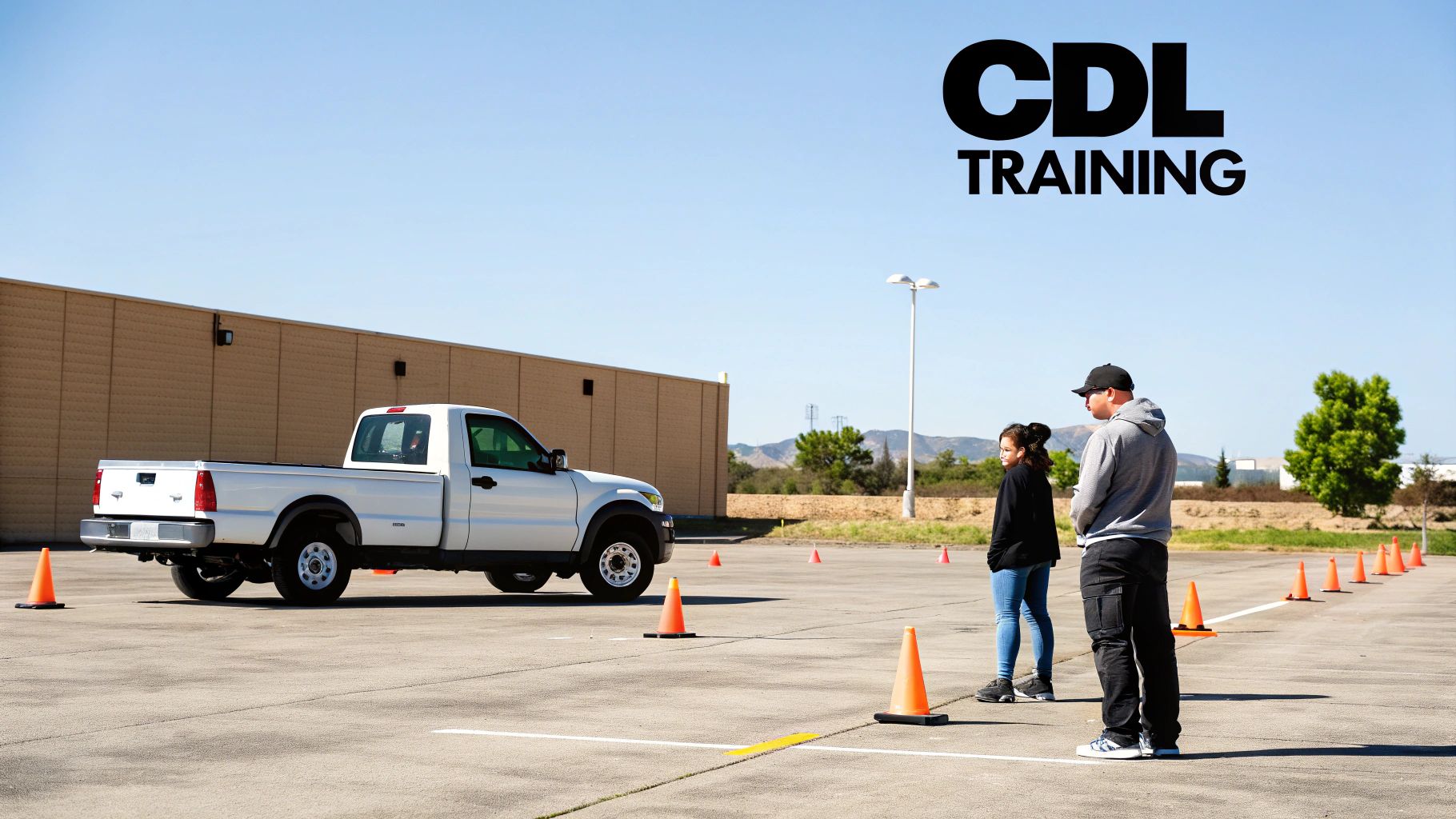
Walking into a truck driving school for the first time is a mix of excitement and maybe a little bit of nerves. Don't worry, that's normal. Your truck driver training isn't just a class; it's a carefully designed journey meant to take you from a complete beginner to a confident professional who’s ready to hit the road.
The whole process is broken down into two main parts that build on each other: classroom theory and hands-on, behind-the-wheel practice.
You can't learn to drive an 80,000-pound rig just by reading a book, but you also can't just jump into the driver's seat without understanding the rules of the road. The classroom gives you the essential foundation you need before you ever turn the key.
This step-by-step approach ensures you build real skill and confidence. Every lesson, whether in the classroom or out on the practice pad, sets you up for the next challenge.
Building Your Foundation in the Classroom
The first part of your training takes place in a classroom. This is where you'll get into the nitty-gritty of the rules, regulations, and systems that are the backbone of the trucking industry. This isn’t about cramming for a test; it’s about understanding the why behind everything you do as a driver.
Your instructors will walk you through critical topics like federal hours-of-service rules (which dictate how long you can legally drive), how to keep an accurate logbook, and the specific laws that can change from state to state.
A huge piece of your classroom time will focus on mastering the pre-trip inspection. This is a detailed, top-to-bottom check of every critical part of your truck and trailer that you must do before every trip. It's one of the most important safety habits you will ever learn.
Getting this process down cold is non-negotiable for passing your exam and, more importantly, for staying safe. For a deep dive into what's involved, you can explore our guide on the pre-trip inspection. This isn't just exam prep; it's a daily ritual that protects you, your cargo, and everyone else on the road.
Getting Behind the Wheel in the Yard
Once you’ve got a handle on the theory, it’s time to put it into action. Your training moves from the classroom out to a controlled training yard or driving range. Here, you get your first real feel for handling a big rig without the pressure of other cars and trucks around you.
This is where your confidence really starts to grow. With an instructor right by your side, you’ll start learning the fundamentals of controlling that massive vehicle.
You'll spend a lot of time practicing key maneuvers over and over again, including:
- Straight-Line Backing: Learning to keep that long trailer perfectly straight while reversing.
- Offset Backing: Moving the whole rig backward into a lane that’s slightly to the left or right.
- Alley Docking: This is a tough but essential skill—backing the trailer perfectly into a tight space, just like a real loading dock.
- Parallel Parking: Yes, you have to learn to parallel park the beast!
These drills are all about teaching you how to manage the trailer’s pivot point and really get a feel for the truck's true size. It takes practice and patience, but this is where you build the muscle memory you'll rely on for your entire career.
Taking Your Skills to the Real World
After you’ve mastered the basics in the yard, the final phase of your training is getting out on public roads. This is where it all comes together. You'll navigate real-world traffic, intersections, and highways with your instructor providing guidance from the passenger seat.
This progression—from the yard to the street—is by design. It makes sure you have the core skills locked down before you have to deal with the unpredictability of other drivers. You’ll start on quieter local roads, work your way up to busier streets, and eventually merge onto multi-lane highways.
During this on-road time, you’ll get comfortable with shifting gears on hills, making wide turns without clipping curbs, and safely navigating around other vehicles. Every mile you drive is a practical lesson in defensive driving and situational awareness, setting you up perfectly for your final CDL road test and the great career that comes after.
Preparing for Your CDL Permit and Road Test
Getting that Commercial Driver’s License is the final hurdle in your training. This is where the rubber literally meets the road, and all the hours you’ve spent in the classroom and behind the wheel finally pay off.
Don't think of it as one big, scary test. It's really a three-part challenge, with each section designed to confirm you have the skills and knowledge to be a safe, competent professional out on the highway. A good school makes sure you’ve drilled every single part of this process, so nothing on exam day comes as a surprise.
Mastering the Written Permit Exam
First things first: you can't even get to the driving portion without passing the written exam for your Commercial Learner's Permit (CLP). This is a multiple-choice test that digs into all the crucial information you covered in the classroom.
This isn't a step you can breeze through. The test is designed to make sure you have a rock-solid foundation before you ever start maneuvering a big rig.
You can expect questions covering a few core areas:
- General Knowledge: This is the big one. It covers everything from basic vehicle control and spotting hazards to communicating effectively on the road.
- Air Brakes: You’ll need to prove you have a deep understanding of how air brake systems function, how to inspect them properly, and how to use them safely.
- Combination Vehicles: If you’re going for a Class A license, this section tests you on the unique challenges of coupling, uncoupling, and safely operating a tractor-trailer.
Passing the written exam is all about consistent studying and taking plenty of practice tests. Forget about cramming the night before. Use practice exams to pinpoint what you don't know, then hit the official state CDL manual until the material feels like second nature.
For a more focused look at this part of the test, check out our in-depth guide covering the https://patriotcdl.com/general-knowledge-test/.
Acing the Vehicle Inspection Test
The first practical part of your exam is the pre-trip vehicle inspection. An examiner will be right there with you, clipboard in hand, as you walk around the truck. Your job is to point out each critical component and explain exactly what you're looking for—things like cracks, leaks, or unsafe wear and tear.
This is a direct performance of the pre-trip routine you should have practiced dozens of times during your training. Examiners are looking for a systematic, thorough approach that proves you know how to ensure a vehicle is safe before it ever pulls out onto the street. Confidence and a well-practiced, logical flow are what will get you a passing grade here.
The Basic Controls and Road Test
Finally, it's time to show what you can do behind the wheel. This part is actually broken down into two stages: the basic controls (or "yard skills") test, followed by the on-road driving test.
The basic controls test is where you'll perform key maneuvers in a closed-off lot. Think straight-line backing, offset backing, and alley docking. The examiner wants to see precision and control. Can you judge your distances and handle the trailer without hitting any cones or crossing boundary lines?
Once you clear the yard skills, you'll head out for the on-road test. The examiner will ride shotgun, giving you directions and evaluating how you handle real traffic. They're watching everything: how you make turns, change lanes, manage your speed, and follow traffic laws. The best advice? Stay calm, drive defensively, and make your intentions clear to everyone around you.
Launching Your Career After Graduation
Getting that CDL in your hand after completing truck driver training feels amazing. It’s a major milestone, but it’s really just the starting line. The real prize is what comes next: a stable career in a field that’s desperate for skilled professionals like you.
The demand for qualified drivers isn't just a talking point—it's a global reality. This massive driver shortage gives new graduates a powerful advantage right out of the gate. Companies aren't just willing to hire new talent; they're actively searching for it to keep their trucks rolling and the economy moving.
This isn't a temporary blip, either. A 2023 report from the International Road Transport Union (IRU) found that over 3 million truck driver jobs were sitting empty worldwide. If things don't change, that number could skyrocket to over 7 million by 2028. That kind of demand translates to job security that’s hard to find anywhere else.
Your First Steps on the Career Ladder
With your new CDL, you’ll find plenty of doors open for entry-level positions. Most new drivers kick off their careers as company drivers, which is a fantastic way to sharpen your skills and get real-world experience without the risks of owning your own rig.
Here are a few of the most common starting points:
- Over-the-Road (OTR) Driver: This is the classic long-haul lifestyle. You'll be crossing state lines, seeing the country, and hauling freight for weeks at a time. It’s perfect for those who want to maximize their income and don’t mind being away from home.
- Regional Driver: If you want to stay a bit closer to home, a regional route is a great fit. You’ll operate within a specific cluster of states, which usually means getting home more often than an OTR driver.
- Local Driver: For those who want to sleep in their own bed every night, local driving is the way to go. These jobs typically involve daily routes with more frequent stops, all within your home city or area.
The great thing is, you get to decide what works for you. Whether you're chasing the adventure of the open road or the stability of a daily schedule, there’s a driving job that fits your life. The experience you get in those first few years will be the bedrock of your entire career.
Mapping Out Your Long-Term Career Path
Your first job is just that—a start. The trucking industry has clear routes for career growth and specialization. After gaining some experience, many drivers move from company positions into more independent roles, giving them greater control over their income and schedule.
For instance, after a few years on the road, you might decide to become an owner-operator. This is where you buy your own truck and essentially run your own small business, contracting with companies to haul their freight. It's a bigger responsibility, for sure, but the trade-off is higher earning potential and the freedom of being your own boss. You might even consider our E-Restriction Removal Course (https://patriotcdl.com/e-restriction-removal-course/) to make sure every possible job opportunity is open to you.
As you start applying for that first driving job, remember to put your best foot forward. Knowing how to write a resume that gets you hired is crucial for highlighting your new CDL and all the skills you've just learned.
No matter which road you choose, the future looks bright. With solid training under your belt, you’re set up for a rewarding career that can last a lifetime.
Answering Your Top Questions About Trucking School
If you're thinking about a career in trucking, you've probably got a lot of questions. That’s completely normal. Let's break down some of the most common things people want to know before they jump into training, so you can make a decision with total confidence.
How Long Does Truck Driver Training Actually Take?
The timeline really comes down to the type of program you pick. If you're ready to dive in and get on the road fast, an accelerated, full-time program at a dedicated CDL school is your best bet. You could be done and ready to test in just three to seven weeks.
On the other hand, if you need to keep your current job while you train, part-time programs or courses at community colleges offer more flexibility. These routes will naturally take longer, sometimes several months. It all depends on your personal situation and how quickly you want to be earning a paycheck from behind the wheel.
Do I Need Any Driving Experience to Get Started?
Nope, not at all. A good CDL school is designed for complete beginners. They assume you know nothing about driving a big rig and will teach you everything from the ground up. You'll start with the absolute basics and work your way up to the complex maneuvers you'll need to pass your test and handle the job safely.
All you really need to bring to the table is a standard driver's license and a decent driving record. The school handles the rest.
The main thing to remember is this: you don’t need a trucking background to succeed. All you need is a desire to learn and a serious commitment to safety.
What’s the Price Tag for Truck Driver Training?
The cost can vary quite a bit, typically running from a few thousand to several thousand dollars. What you pay depends on factors like the school’s location, the quality of their trucks and facilities, and the specific CDL class you're training for.
While it's a real investment, think of it as a direct on-ramp to a stable, good-paying career. Most schools offer financing options to help, and many trucking companies even have tuition reimbursement programs to attract new drivers.
Will a CDL School Help Me Land a Job?
Absolutely. Any reputable school will have solid job placement support. They've built relationships with carriers over the years and know exactly who is hiring. Good schools host recruiters on-site, keep updated job boards, and will even help you polish your application.
For a lot of people, this is a big career change. To make sure you're putting your best foot forward, it helps to see how others have framed their new skills. Check out some career change resume examples to get some ideas.
With the driver shortage being what it is, graduates from respected schools are in high demand. Companies are eager to hire well-trained, entry-level drivers right out of school, making your transition from the classroom to the cab a whole lot easier.
Ready to grab the wheel of your new career? At Patriot CDL, our accelerated, hands-on training programs get you licensed and ready for the road in just a few weeks. Find out how we can get your journey started at https://patriotcdl.com.