So, you’re thinking about getting your Commercial Driver's License. What exactly is the CDL test? Think of it less as a single test and more as the final hurdle—a comprehensive exam that proves you have the skills and knowledge to safely handle a large commercial vehicle.
This isn't just about passing a driving test; it's about earning a professional certification. It’s the key that unlocks a career in the trucking industry and ensures everyone sharing the road is safe.
Your Starting Point for a Commercial Driving Career
The CDL test is your gateway into the world of professional driving. It acts as a crucial barrier to entry, making sure that every driver operating a big rig, bus, or tanker meets a consistent, high standard of competence. Believe it or not, this system is a relatively modern invention.
Before the Commercial Motor Vehicle Safety Act of 1986, the rules were all over the place. Licensing standards varied wildly from state to state. To address growing safety concerns on our highways, the federal government stepped in and created a uniform standard for testing and licensing commercial drivers across the entire country. By 1992, every state was on board.
What Does the Test Actually Involve?
The CDL test isn't something you can knock out in an afternoon. It’s a multi-stage process designed to check every aspect of your readiness, and it's split into two main phases: a series of written knowledge exams and a hands-on skills test.
You have to conquer the written portion first. Passing these exams earns you a Commercial Learner’s Permit (CLP), which is essentially your ticket to start practicing behind the wheel of a commercial vehicle, as long as a licensed CDL holder is with you.
Once you’ve held your CLP for a minimum period—typically at least 14 days—you can move on to the final challenge.
The hands-on skills test is where the rubber meets the road, literally. It consists of three parts: a thorough pre-trip vehicle inspection, a basic vehicle control test on a closed course, and an on-road driving test in live traffic.
To give you a clearer picture, here’s a quick breakdown of the entire process:
Overview of the CDL Testing Process
This table summarizes the key stages you'll navigate to earn your CDL.
| Test Component | Purpose | Format |
|---|---|---|
| Written Knowledge Exams | To test your understanding of traffic laws, vehicle systems, and safety procedures. | Multiple-choice questions taken on a computer at the DMV. |
| Pre-Trip Vehicle Inspection | To ensure you can identify and explain key vehicle components and confirm they are safe to operate. | A hands-on inspection where you point to parts and explain their function to an examiner. |
| Basic Control Skills Test | To evaluate your ability to maneuver the vehicle precisely in tight spaces (e.g., backing, turning). | A series of maneuvers performed on a closed course, away from public traffic. |
| On-Road Driving Test | To assess your ability to safely operate the vehicle in real-world traffic conditions. | Driving on public roads with an examiner who scores your performance. |
Passing each of these components shows that you have both the book smarts and the practical skills to handle a commercial vehicle safely and confidently. Understanding how each step builds on the last is critical, which is why a structured training program is the best way to prepare for success.
Checking Your Eligibility for a CDL
Before you can even start thinking about the written test or getting behind the wheel for the skills exam, you have to clear a few essential hurdles first. Think of this stage as the pre-flight check for your trucking career. Skipping any of these steps can ground your ambitions before they even get off the ground. The first major milestone is qualifying for your Commercial Learner's Permit (CLP).
The federal government lays down the baseline rules that every state has to follow. This ensures there's a consistent standard for safety and professionalism across the country. These foundational requirements are non-negotiable and form the very bedrock of your application.
At a minimum, you'll need to meet the age and residency requirements. To get a CDL for driving within your home state (intrastate commerce), you have to be at least 18 years old. If you're planning to drive across state lines (interstate commerce), the minimum age jumps to 21. You'll also need to show valid proof of U.S. citizenship or lawful permanent residency.
The Critical Medical Examination
Beyond your age and where you live, every single aspiring commercial driver has to prove they are medically fit to handle a large vehicle. This is done by passing a Department of Transportation (DOT) physical, and it can't be done by just any doctor. The exam must be performed by a certified medical examiner who is listed on the National Registry.
This is much more than just a routine check-up. The examiner is specifically looking at key health indicators to make sure you don't have a condition that could make driving unsafe.
- Vision and Hearing: Your eyesight and hearing must meet minimum standards, whether you use glasses or hearing aids.
- Blood Pressure: It needs to be within a safe range, as high blood pressure is a serious risk factor on the road.
- Overall Physical Health: The exam screens for specific conditions that could cause a sudden loss of control, like epilepsy, insulin-dependent diabetes, or certain heart ailments.
Once you pass, you’ll be issued a Medical Examiner's Certificate. You are required to have this certificate with you anytime you're operating a commercial vehicle. It’s a crucial piece of the puzzle for your CLP application.
Passing the DOT physical is how you prove you have the physical fitness needed for the demanding job of a commercial driver. It’s a key safety measure designed to protect you, your cargo, and everyone else on the road.
State-Specific Rules and Documentation
While the federal government sets the big-picture rules, each state adds its own specific procedures and documentation requirements. This is where you need to do a little local homework. It is absolutely vital to check with your state's Department of Motor Vehicles (DMV) to get the exact list of what you need to bring.
In most cases, you can expect to provide the following:
- Your current, valid non-CDL driver’s license.
- Proof of U.S. citizenship or lawful permanent residency (like a passport or birth certificate).
- Your Social Security card.
- Proof of residency in your state (utility bills or a lease agreement usually work).
- Your DOT Medical Examiner's Certificate.
Getting all these documents gathered up ahead of time will make your trip to the DMV go so much more smoothly. For a more detailed look at what to expect, check out our guide on CDL requirements. This initial phase is all about doing your due diligence. Getting your paperwork in perfect order builds a strong foundation for the rest of your CDL journey.
Tackling the CDL Written Knowledge Exams
Before you can even think about getting behind the wheel of a big rig, you've got to hit the books. The first real challenge on your path to a CDL is a series of written knowledge exams. This is your chance to prove you understand the theory and rules of the road before you put them into practice. You can’t get your Commercial Learner's Permit (CLP) without passing these tests.
These aren't your average driving tests. They're designed to dig deep into your understanding of everything from specific traffic laws for commercial vehicles to the complex mechanics that keep these massive machines running safely. Every single driver has to start with the same foundational exam, no matter what they plan on driving down the line.
The General Knowledge Test: Your Foundation
The cornerstone of the entire written portion is the General Knowledge test. This is the big one. It's a comprehensive exam that covers the universal principles every commercial driver must master to operate a commercial motor vehicle safely and legally.
You can expect questions on a wide range of topics, including:
- Basic Vehicle Control: How to manage your speed, properly steer, and brake a vehicle that’s much larger and heavier than a car.
- Vehicle Inspections: The critical steps for pre-trip, en-route, and post-trip inspections. You need to know what to look for to keep your vehicle safe.
- Emergency Procedures: The correct response to an accident, a fire, or any other emergency you might face.
- Hazard Awareness: How to spot and react to potential dangers, from distracted drivers to black ice on the road.
Getting this material down cold is absolutely essential. We have a more detailed guide on how to ace the General Knowledge test that you'll want to check out.
Choosing Your Endorsements
Once you've conquered the General Knowledge test, it's time to specialize. This is where endorsements come in. Think of them like certifications that give you the legal green light to operate specific types of vehicles or haul specialized cargo.
The endorsements you pursue are tailored to the career you want. You might add endorsements for air brakes, combination vehicles, tankers, hazardous materials (HazMat), or transporting passengers. To add an endorsement, you'll need to pass another written exam, and most states require a score of 80% or higher to pass.
The endorsements you earn directly open—or close—doors to certain jobs. A driver with HazMat and Tanker endorsements is qualified to haul liquid chemicals, while someone with a Passenger endorsement can drive a coach bus.
How to Prepare for Success
Your single most important resource for these exams is your state's official CDL manual. Seriously, this book has everything you need to know. It contains all the material for both the General Knowledge test and every endorsement exam you might take.
But just reading it isn't enough. The key is to study actively. Take practice tests until you're consistently scoring well, make flashcards for tough concepts, and really focus on understanding why a rule exists, not just what the rule is. This deeper knowledge won't just help you pass the test; it will make you a safer, more confident driver out on the open road.
Mastering the Hands-On CDL Skills Test
So, you've passed the written exams and proven you know the rules of the road. Now comes the part that gets most people’s palms sweating: the hands-on skills test. This is where the rubber literally meets the road. An examiner will be watching your every move to make sure you can handle a commercial vehicle safely and confidently.
Don't let it intimidate you. The skills test isn't one massive, high-pressure exam. Think of it as three separate challenges, each one focused on a different, critical driving skill. You'll tackle them one by one, from knowing your rig inside and out to navigating it through real-world traffic.
The Pre-Trip Vehicle Inspection
Before you even turn the key, your test begins. The very first section is the Pre-Trip Vehicle Inspection, and it's your chance to show the examiner you know your truck like the back of your hand. You’ll walk them around the vehicle, pointing out key parts and explaining exactly what you're checking for.
This isn't just a memory game. They want to see that you truly understand why you're checking things. You'll need to confidently identify and explain the condition of components like:
- Fluid levels (oil, coolant, power steering)
- The entire brake system, from air lines to chambers
- Tires, wheels, and suspension parts
- Coupling systems for tractor-trailers
- All required emergency equipment
A solid pre-trip isn't just about passing the test; it's a fundamental part of being a safe, professional driver. To get a better handle on what this involves, you can dig deeper with our complete guide to the pre-trip inspection.
The infographic below shows where the skills test fits into your overall journey to getting your CDL.
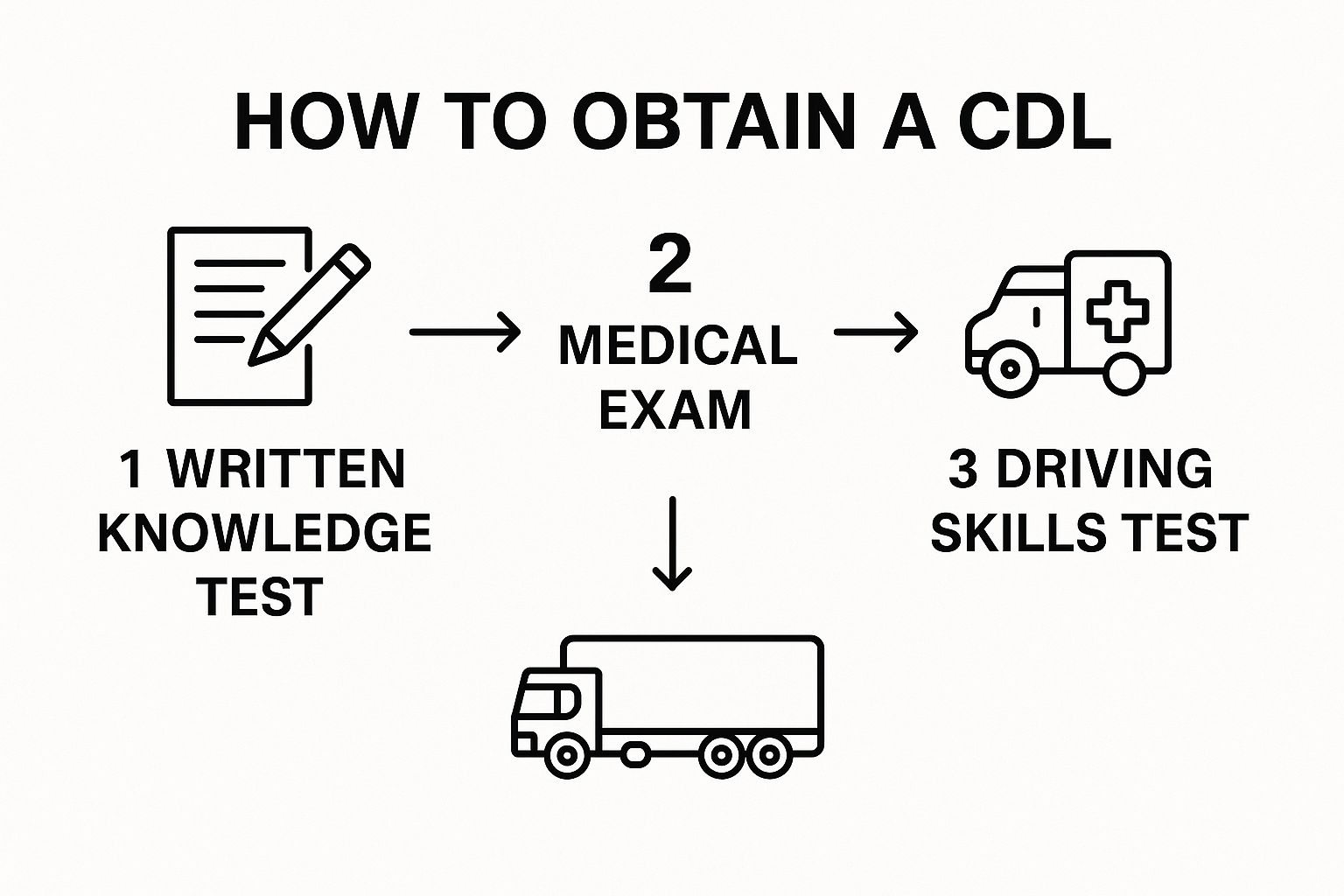
As you can see, the skills test is the final hurdle after you've cleared the written exams and sorted out your medical card.
Basic Control Skills Test
Once the examiner is satisfied with your pre-trip, you'll move on to the Basic Control Skills Test. This part happens away from traffic, usually in a big, coned-off lot or on a special course. The whole point is to see if you can handle your rig with precision in tight spaces.
This is where you prove you can finesse that truck. The maneuvers you'll perform are designed to mimic real-life situations, like backing into a tight dock or weaving through a crowded truck yard.
You'll be asked to perform several specific maneuvers, which typically include:
- Straight-Line Backing: Can you back your rig in a perfectly straight line for about 100 feet? It's harder than it sounds.
- Offset Backing: This tests your ability to back into a lane that's just to the right or left of you.
- Parallel Parking: Yes, even in a big rig. You'll need to park the vehicle in a space parallel to a curb or cones.
The examiner will score you on your accuracy, your control over the vehicle, and how many times you have to pull forward to correct your angle.
The On-Road Driving Test
This is the grand finale—the On-Road Driving Test. You’ll take everything you've learned and put it into practice in actual traffic. With the examiner in the passenger seat giving directions, you’ll navigate public roads and show you can operate safely alongside other vehicles.
They'll be watching everything. You'll be scored on how you handle intersections, change lanes, manage your speed, and keep a safe following distance. They want to see that you're not just driving, but that you're constantly aware of your surroundings, anticipating hazards, and operating that big machine with the confidence of a professional.
Nail this final part, and you're on your way to earning that CDL.
Understanding CDL Classes and Endorsements
Getting a Commercial Driver's License isn't a one-size-fits-all deal. Think of it less like a single key and more like a set of keys, each one unlocking a different type of commercial vehicle. Your license is broken down into specific classes and endorsements that dictate exactly what you're legally allowed to drive.
This is a crucial concept to grasp right from the start. The class you aim for will determine the kind of truck you test in and, ultimately, the career path you can follow. The system is built around three main classes, and the dividing line between them is almost always the vehicle's weight and what it was built to do.
The Three Main CDL Classes
Deciding on the right CDL class is the first major step in your trucking journey. It's a choice that shapes your future job prospects.
At the top of the ladder is the Class A license. This is the big one, the license that lets you get behind the wheel of combination vehicles like the classic tractor-trailers you see on the highway. If you're dreaming of a long-haul career, this is typically the license you need. It covers any combination of vehicles with a hefty combined weight rating of 26,001 pounds or more.
Next up is the Class B license. This license is for driving a single, heavy vehicle that isn't towing a massive trailer. We're talking about straight trucks, dump trucks, cement mixers, and most city buses.
Finally, there’s the Class C license. This one is for smaller commercial vehicles that don’t fit into the other categories but still require special training. Think of vehicles designed to transport 16 or more passengers (like airport shuttles) or smaller trucks that carry certain types of placarded hazardous materials.
Comparison of CDL Classes A, B, and C
To make it even clearer, let's break down the key differences between the classes. This table gives you a side-by-side look at what each license allows you to operate.
| CDL Class | Permitted Vehicle Types | Typical Gross Vehicle Weight Rating (GVWR) |
|---|---|---|
| Class A | Tractor-trailers, truck and trailer combinations, tanker vehicles, flatbeds. | 26,001 lbs. or more (combined weight). |
| Class B | Straight trucks, large buses (city, tour, school), box trucks, dump trucks. | A single vehicle with a GVWR of 26,001 lbs. or more. |
| Class C | Passenger vans, small HazMat vehicles, small buses. | Any single vehicle that does not meet Class A or B criteria but requires an endorsement. |
Seeing it laid out like this really helps visualize where you might fit in the industry. Your choice of class sets the foundation for your entire driving career.
Adding Power with Endorsements
Once you've chosen your license class, you can specialize even further with endorsements. These are essentially special qualifications you can add to your CDL, each one opening up new doors and job opportunities. Getting an endorsement involves passing an additional knowledge test and, in some cases, another skills test.
Endorsements are your ticket to more specialized—and often higher-paying—work. They show employers you have the verified skills to handle specific types of cargo or equipment.
Some of the most common endorsements you'll see are:
- (N) Tank Vehicle: A must-have for hauling liquids or gases in a tanker truck.
- (H) Hazardous Materials (HazMat): Required if you want to transport materials that the government classifies as hazardous.
- (S) School Bus: If you plan on driving a school bus, you’ll need this to transport students safely.
- (P) Passenger: This is for operating any commercial vehicle, like a charter bus, designed to carry a certain number of passengers.
On the flip side, some drivers end up with restrictions on their license. A common one is the "E" restriction, which means you can only drive commercial vehicles with automatic transmissions. If you find yourself in that boat, you can enroll in an E restriction removal course to learn how to operate a manual and greatly expand your job options. Knowing these details helps you navigate the entire CDL testing process with confidence.
Got Questions About the CDL Test? We've Got Answers.
When you’re looking at getting your CDL, the test itself is just one piece of the puzzle. A ton of practical questions pop up along the way, and you’re not alone in asking them. Let's tackle some of the most common things aspiring drivers want to know.
Think of this as the straightforward, no-fluff guide to the logistics—from how much it'll cost you to what happens if you stumble on test day.
How Much Is This Going to Cost Me?
Let's get right to it: the cost. It's usually the first thing people ask, and unfortunately, there isn't one simple answer. Each state sets its own fees, so what you pay in Texas will be different from what you pay in Ohio.
That said, you can generally expect to open your wallet for a few key things:
- The Commercial Learner's Permit (CLP): This is your first step, and it comes with an application fee.
- Written Knowledge Tests: Some states charge for each test you take, while others might offer a package deal.
- The Skills Test: This is almost always the biggest single expense, often running anywhere from $100 to over $300.
- License Issuance Fee: After you've passed everything, there's one last fee to get the actual CDL card in your hand.
When you add it all up, you're looking at several hundred dollars just for the state-required testing and licensing. Keep in mind, this number doesn't factor in your DOT physical or the cost of a good training program.
Do I Really Have to Go to a Truck Driving School?
This is a big one. While you technically might not need to attend a traditional, months-long school, the game changed in February 2022 with the Entry-Level Driver Training (ELDT) mandate.
The new ELDT rules are simple: if you're getting a Class A or Class B CDL for the first time, you must complete a specific curriculum from a training provider listed on the federal registry. You can't even book your skills test until you do.
So, while you might not be in a "school" in the classic sense, you absolutely have to complete a certified training program. And honestly? A quality school does so much more than tick a government box. It gives you the structured, hands-on practice you need to not just pass the test, but to be a safe, confident driver from day one.
What Happens If I Fail a Part of the Test?
First off, don't panic. Failing a section of the CDL test is surprisingly common and it is definitely not the end of your career before it starts. Every state has a system for re-testing.
If you fail one of the written exams, you can typically reschedule it pretty quickly, sometimes even the next day. You'll likely have to pay the testing fee again, though.
For the hands-on skills test—whether it’s the pre-trip inspection, backing maneuvers, or the road test—the process is similar. Most states make you wait a short period, usually from one to seven days, before you can give it another shot. Just be aware that some states limit how many times you can fail before you have to start the entire application process from scratch.
How Long Is a CDL Good For?
Once you earn that CDL, it's not yours for life. Just like a regular driver's license, it has an expiration date. How often you need to renew depends on your state, but most require it every four to eight years, often lining up with your birthday.
Renewing usually involves paying a fee and showing a current medical certificate. If you have endorsements like HazMat, get ready for an extra step—you’ll likely have to pass a written test again and go through another federal background check. It's on you to keep track of that expiration date to stay legal and on the road.
Ready to stop wondering and start driving? At Patriot CDL, we provide the hands-on training and expert guidance you need to pass your CDL test with confidence. Learn more about our programs and get on the road to your new career.