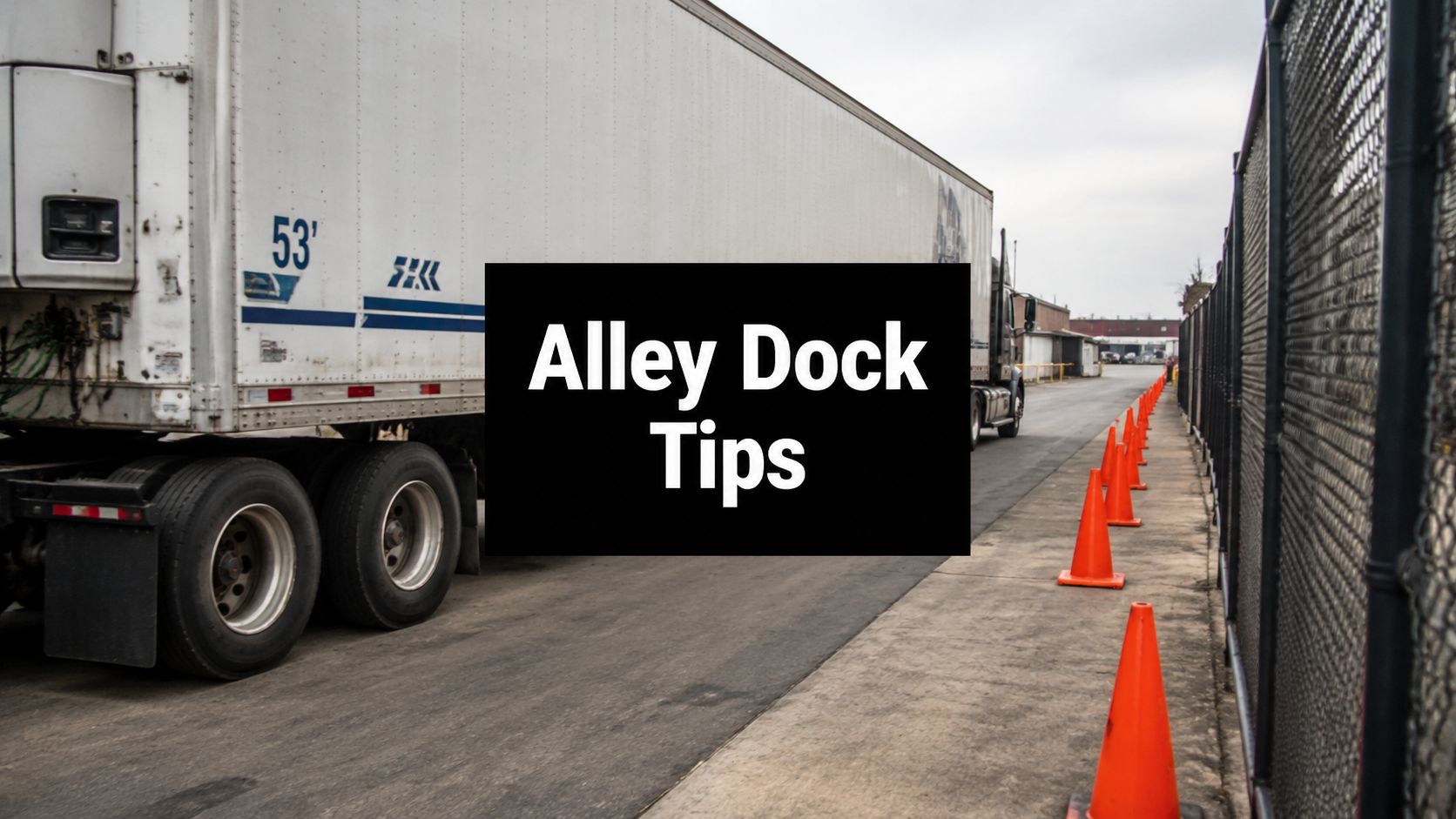
The cones blur into an intimidating wall of orange. The instructor is silent, watching. This is it, the alley dock. For many CDL students, this single maneuver is the most stressful part of the skills test. It feels like a complex, unforgiving puzzle.
It doesn't have to stay that way. Good drivers don't solve the alley dock with luck, and they don't rely on random steering. They build a repeatable routine with reference points, calm setup, mirror discipline, and patient corrections. Once that routine clicks, the maneuver starts to make sense.
That matters because the alley dock is really a geometry problem. Your tractor moves one way, your trailer reacts another way, and every foot of setup changes what happens next. If you can see that picture clearly before you move, you'll back with more control and less panic.
These alley dock tips focus on the part many students miss. Not just how to spin the wheel, but how to think through the maneuver before the truck even starts rolling backward. That's where confidence comes from. Not bravado. A system.
1. Perfect Your Reference Points and Sight Lines
A student who watches every cone, both mirrors, the trailer, and the hood at the same time usually falls behind the truck. Alley docking gets easier when your eyes have a job order. You pick a few reliable references, check them in the same sequence, and let those references tell you what the trailer is doing.
That is how experienced drivers reduce stress. They do not try to read the whole scene at once. They build a visual system.
Build a personal map of your truck
Your truck already gives you markers. The mirror edge, hood line, trailer corner, tandems, and cone lane can all serve as reference points. Each one answers a different question. Is the trailer entering the hole cleanly? Is the angle increasing too fast? Are you drifting away from the target line?
A common technique shared by experienced drivers is using a fixed visual target near the inside cone to judge tandem alignment as the trailer starts to rotate. The exact target matters less than consistency. If you use the same marker every time, your brain starts connecting that sight picture to the correction that follows.
That part trips up many students. They assume reference points are something they copy from another driver. They are really something you calibrate. One school truck may line the passenger mirror up neatly with the cone lane. Another may make the trailer rivet line easier to read. The goal is not a universal marker. The goal is a repeatable one.
Practical rule: Give each reference a simple name and keep the names the same every time. “Mirror edge.” “Trailer corner.” “Tandems at cone.” Clear labels make faster decisions under pressure.
A good way to build that map is to pause before backing and study the picture. Note where the alley entrance sits in the driver-side mirror. Note where the trailer tandems appear in relation to the nearest cone. Then confirm those same views on the next attempt. You are training pattern recognition, the same skill that helps with other backing maneuvers such as CDL parallel parking practice.
Check them before every attempt
Reference points shift when the seat position changes, the mirrors move, or you switch trucks. A marker that worked yesterday may be off today by a few inches, and a few inches is enough to create a late correction. Recheck your sight lines early, before you start the maneuver.
Many alley dock problems begin as visual problems. If your eyes are checking the wrong marker, your hands usually steer at the wrong time. Clean sight lines give you earlier information, and earlier information gives you calmer, smaller corrections.
2. Master the Initial Approach Angle and Positioning
You pull past the alley, stop, and everything feels off. The hole looks tighter than it did from the driver seat, the trailer seems too close to one side, and now every wheel turn feels urgent. That problem usually started before the truck ever began backing.
For a 90 degree alley dock, the standard driver-friendly setup is backing with the driver's side facing the destination, because that side gives you the clearest view during the maneuver and is commonly used in CDL skills practice (driver-side alley dock demonstration).

Setup decides how hard the back will be
Alley docking works like geometry on wheels. Your starting position sets the shape of the path the trailer can take. If that shape is poor, the trailer has to make a sharper move later, and sharp moves create rushed corrections.
A clean setup starts with the tractor and trailer in a square, readable relationship. Many instructors teach students to begin with the cab positioned so the trailer can make a predictable first swing toward the opening. The exact look can vary by truck and training lot, but the goal stays the same. Give yourself an angle that lets you see the trailer enter the alley early, not after it is already drifting off line.
Spacing matters just as much. If you crowd the alley entrance, the trailer will not have room to arc into the space. If you set up too far away, you may force yourself into a late chase. Drivers often learn this best by treating the setup like a puzzle. You are placing the truck in a spot where the trailer can turn once, settle, and continue back with small inputs. A broader guide to that setup logic appears in this walkthrough on how to back a semi trailer step by step.
Match the setup to the equipment
One reason students get confused is that two trucks can need two different starting spots. Tandem position changes how the trailer reacts. With tandems farther forward, the trailer can pivot differently than one with tandems farther back. Drivers have noted that many tutorials ignore tandem position, even though sliding tandems are common on modern Class A equipment.
That means your approach should be deliberate, not copied blindly. Before you start, ask a simple question: how much room will this trailer need to swing? That one question slows your thinking in a good way. It gets you out of guesswork and into planning.
Walk it before you back it
Get out and look at the alley before the maneuver. Walk the entry line. Check your usable space. Look at the ground slope, cone placement, and any obstacle that could steal room from the trailer's path.
This short walk helps your brain build the picture before the truck starts moving. Skilled drivers do this because backing is easier when the path already exists in your head. Then the steering wheel becomes a tool for following that plan, not for inventing one under pressure.
3. Execute Controlled Backing with Minimal Steering Corrections
You start backing. The trailer begins to drift. Your hands want to keep turning the wheel until something looks better.
That urge causes a lot of trouble.
Controlled backing works more like solving a geometry problem than wrestling a machine. You make one input, give the trailer time to respond, then read the new picture in your mirrors. If you steer again before the trailer shows you the result of the first move, you are guessing instead of driving.

Slow truck, clear feedback
Back at a crawl. Instructors consistently see that smooth, deliberate pedal control leads to better judgment than jerky throttle inputs. Fast backing hides small errors until they become large ones. Slow backing lets you catch them while they are still easy to fix.
The key is feedback. Your trailer cannot answer instantly. It needs a little travel distance before the angle changes enough to show up clearly in the mirrors. That is why students who rush often feel lost. They are reacting to a picture that has not fully developed yet.
A calm backing speed gives your brain time to process what both mirrors are showing.
Backing should feel controlled and almost quiet. If the maneuver starts to feel rushed, slow the truck and simplify your next decision.
Use one correction for one purpose
Each steering input should have a job. Maybe you need to bring the trailer back toward center. Maybe you need to hold an angle that is already working. Maybe you need to stop the trailer from bending any farther. Name the job before you move the wheel.
That habit keeps you from stacking corrections.
Students often turn left, then quickly right, then left again, all before the truck moves enough to reveal the effect of the first turn. The result is the same as changing your answer three times before reading the question carefully. The trailer path gets harder to predict, not easier.
If you want to sharpen that kind of reverse control across different setups, study the mirror timing and patience used in semi-trailer backing practice.
Follow a simple correction cycle
Use the same sequence every time the picture starts to feel fuzzy:
- Pause and read: Stop the truck and check both mirrors.
- Choose one fix: Decide what single change the trailer needs.
- Turn lightly: Use a small steering input, not a full crank.
- Wait for feedback: Let the truck roll enough to show the result.
- Reset early: Pull forward if the angle is breaking down.
That cycle builds consistency because it reduces panic. You always know what comes next.
A practical example helps. If the trailer starts drifting left, do not chase it with a big wheel movement. Make one measured correction, let the unit move, and watch whether the trailer slows that drift, holds the new line, or keeps moving left. Then decide again. Good backing is often a series of small decisions made at the right time.
A second visual can help you study the rhythm of the maneuver:
4. Use Professional Spotter Communication and Ground Awareness
On the CDL test, you may not have a spotter directing every move. In real work, though, good spotter habits can save you from expensive mistakes and dangerous blind-side surprises. Even in training, thinking like a driver who works with ground help will make you safer and more methodical.
A spotter is useful only if both people understand the same signals. If the spotter points vaguely and the driver guesses, the help becomes a hazard.
Agree on signals before the truck moves
Keep it basic. Stop means stop. Left means left. Right means right. If the spotter disappears from view, the truck stops until contact is restored. That standard has prevented many bad outcomes in busy yards and tight docks.
Use a short pre-brief. Confirm where the spotter will stand, which side you'll favor, and what the emergency stop signal looks like. Then repeat the stop signal out loud before backing.
Ground rule: If you lose sight of your spotter, stop the truck first. Find the person second.
A real dock example makes the point. A trailer may look centered in both mirrors, but a spotter on the ground might catch a low curb, pallet stack, or hanging pipe that never showed clearly from the cab. Mirrors are strong tools, not perfect tools.
Ground awareness starts before reverse
Professional drivers don't rely on a spotter to discover hazards they could have found on foot. They walk the lane first. They look for broken pavement, wet spots, poles, wheel chocks, and swing clearance near the tractor.
This same discipline helps on the skills pad. Even if the “hazards” are just cones and painted lines, get in the habit of scanning the whole space before backing. That habit carries straight into real freight work, where one missed object can turn a routine dock into a long day.
5. Manage Mirror Adjustment and Positioning for Optimal Visibility
If your mirrors are set for highway driving and never touched before backing, you're making alley docking harder than it needs to be. On the road, you care about traffic flow and lane awareness. In reverse, you care about trailer corners, ground edges, and drift.
The mirror picture should tell you two things at all times. Where the trailer is going, and what it's getting close to.

Set mirrors for backing, not cruising
Before a backing session, check that each side mirror shows the trailer edge and enough ground behind it to judge drift. Your convex mirrors should widen the picture, not replace the flat mirrors. Dirty glass, loose housings, and bad angles create delayed decisions.
A simple yard example. If your passenger mirror shows mostly sky and trailer side, you may miss how close the trailer tires are getting to the cone line. Tilt it down enough to read ground relationship. That one adjustment can make your corrections earlier and smaller.
Learn what the mirror image means
A lot of students look in the mirror but don't interpret what they see. If the trailer seems to “jump” across the mirror, the problem may be speed, not angle. If one side opens up while the other side closes fast, the trailer is rotating and needs patient control.
Use consistent mirror checks. Left mirror, right mirror, quick front awareness, then back to the active side. If you need a primer on dialing in your visual field, study how to adjust wing mirrors on a truck and apply that same precision before every backing session.
Here's a useful habit:
- Clean first: Dust and rain streaks erase detail near the cone line.
- Check security: Vibrations can shift mirror position over time.
- Reconfirm after seat changes: A new seating position changes your sight line.
- Read both sides: Don't become loyal to one mirror and ignore the other.
Mirrors don't dock the truck for you. But they do give you the truth, if you set them up well and read them consistently.
6. Develop Spatial Awareness and Mental Visualization Skills
A common alley dock problem starts before the truck even rolls backward. The driver looks at the opening, grabs the wheel, and reacts to whatever the trailer does next. That feels busy, but it is still guesswork.
Strong backing starts with a picture in your mind. You should know where the trailer tail needs to go, where the pivot will begin, and what each small steering input is supposed to change. Alley docking works like solving a geometry problem in slow motion. If you can picture the shape of the move before you start, your hands stay calmer and your corrections stay smaller.
Rehearse the path before the truck moves
Stop for a moment before you back. Look at the dock or cone box, then trace the trailer path in your head from start to finish. Ask yourself three direct questions. Where should the trailer tandems travel. When should the trailer begin to bend. At what point should the tractor start following it in.
That pause builds control. Backing has a delay built into it. You turn the wheel now, but the full result shows up a moment later. Drivers who expect that delay do not chase the trailer as much.
A simple training trick helps here. Use a toy tractor trailer, a sketch on paper, or two pens on a desk to act out the pivot. Many drivers say this makes the maneuver easier to understand because you can study the angle from above, which you never get to see from the seat. You are teaching your brain what the truck will do before you ask your hands to do it.
Name the next movement out loud
Students often improve when they say the next step before they make it.
“If I hold this angle, the trailer tail should move toward the target.”
“If the trailer starts closing too fast, I need less steering, not a panic turn.”
That habit sounds simple, but it trains prediction. Prediction is what separates controlled backing from constant recovery.
You can build the same skill away from the range. Studying winding road ahead training concepts helps you read how a long vehicle tracks through space, which supports better judgment during backing too.
Build a mental map, not just a steering habit
Steering habits alone break down when the setup changes a little. A mental map travels with you. It helps you adapt if the alley is tighter, the pavement slopes, or the trailer starts from a slightly different angle.
Focus on these mental checkpoints:
- Target line: Know where the trailer tandems and tail need to finish.
- Pivot point: Watch for the moment the trailer begins rotating into the space.
- Chase point: Recognize when the tractor should start following the trailer instead of forcing more angle.
- Stop point: Pause before the picture gets worse. A short stop often prevents a big correction.
That is how experienced drivers make alley docking feel manageable. They are not just turning a wheel. They are reading space, predicting motion, and checking their plan against what the trailer is doing.
7. Practice Progressive Difficulty and Build Competence Systematically
A student sets up one alley dock well, then makes the next rep much tighter, adds speed, gets behind the trailer, and starts guessing. That pattern is common. The problem is not effort. The problem is practice design.
Alley docking improves fastest when you train it like a puzzle with levels. First learn the picture. Then learn the timing. Then add pressure after the basic picture stays consistent. Skilled drivers do not build this maneuver by forcing dramatic recoveries over and over. They build it by repeating simple versions until the trailer path starts to make sense.
Make practice easier before you make it harder
Driver discussions and instructor experience point to the same pattern. Many missed alley docks start early, when the driver creates too much angle and then rushes to fix it with extra steering. Cleaner attempts usually begin with a calmer setup and a smaller, more manageable trailer swing.
That is why practice should start with control, not stress.
Use a progression like this:
- Start with space: Give yourself a wide alley and clear cone lines so you can study how the trailer enters without panic.
- Change one variable at a time: Tighten the alley, shorten the setup, or add a pull-up decision later. Do not change all three at once.
- Repeat the same setup on purpose: If one approach works, run it again. Repetition helps your eyes connect a starting position to the trailer path that follows.
- Add pressure last: Shadows, uneven pavement, nearby trucks, and time pressure belong later in practice, after your basic sequence is reliable.
This works like learning to hit a mark in basketball. You do not start with a defender in your face. You first learn what a good shot feels like.
Build confidence from clean, repeatable reps
Students often treat a pull-up like failure. It is not. A pull-up is a reset that protects the setup before the trailer picture gets worse. During practice, that matters because it teaches judgment, not pride.
Keep score in a simple way. Write down which setups produced a clean entry, how much angle you carried, and where the picture started to break down. Over time, patterns show up. You begin to see which starting positions give you room and which ones force late corrections.
If you want extra repetition on the visual side, driver simulator training for backing decision practice can help you rehearse sequence and sight picture before you repeat it in the truck. Simulator work does not replace range time, but it can strengthen the mental side of alley docking.
Small, correct reps build a driver who knows what to expect. That confidence is what makes the maneuver feel slower, clearer, and more controllable under test pressure.
7-Point Alley Dock Tips Comparison
| Technique | 🔄 Implementation complexity | 💡 Resources & tips | ⚡ Speed / efficiency | 📊 Expected outcomes | ⭐ Key advantages |
|---|---|---|---|---|---|
| Perfect Your Reference Points and Sight Lines | Low–Medium, initial practice to identify personal points | Minimal equipment (tape/marks); practice in daylight; verify regularly | Moderate, reduces hesitancy once learned | Fewer backing errors, consistent positioning, increased confidence | Builds muscle memory; transferable across trucks |
| Master the Initial Approach Angle and Positioning | Medium, requires geometric understanding and space | Space to set up; walk alley beforehand; use full turning radius | High, fewer corrections during backing | Higher first-pass success; fewer pull-ups and collisions | Sets up entire maneuver for success |
| Execute Controlled Backing with Minimal Steering Corrections | Medium, disciplined technique and mirror monitoring | Spotter recommended; practice slow backing (2–3 mph); brake modulation | Low raw speed but high overall efficiency (fewer retries) | Significant reduction in collisions; smoother docks | Directly reduces risk and equipment wear |
| Use Professional Spotter Communication and Ground Awareness | Low–Medium, coordination and standardized signals needed | Trained spotter, radios/hand signals, pre-brief; noise mitigation | High when available, faster, more confident backing | 40–60% reduction in accidents; better hazard detection | Eliminates blind spots; shared safety responsibility |
| Manage Mirror Adjustment and Positioning for Optimal Visibility | Low, routine pre-dock adjustments; practice interpreting views | Adjustable/convex mirrors, cameras; keep mirrors clean and secure | High, improves reaction and reduces need for spotters | Major drop in blind-spot incidents; more accurate alignment | Single most impactful preventative improvement |
| Develop Spatial Awareness and Mental Visualization Skills | High, cognitive skill that develops over time | Time, deliberate practice, walking alleys, sketches or simulators | Improves decision speed and reduces trial-and-error over time | Fewer corrections; adaptable to unusual dock geometries | Enables mastery and transfer to other complex tasks |
| Practice Progressive Difficulty and Build Competence Systematically | Medium–High, needs structured curriculum and oversight | Training facilities, cones, instructors, staged scenarios | Time-intensive initially but yields long-term efficiency | Durable skills, lower failure rates, reduced bad habits | Produces reliable competence and confidence |
Your Next Stop: CDL Success
The alley dock isn't one trick. It's a chain of habits working together. Good reference points keep your eyes calm. Good setup keeps the trailer honest. Good mirror use keeps small problems small. Good visualization helps you predict what the truck will do before it does it.
That's why the best alley dock tips aren't just about steering input. They're about preparation and pattern recognition. The driver who understands the geometry usually looks smoother because the truck isn't surprising them every few seconds. They've already built the picture in their head.
If you're frustrated with this maneuver, don't read that frustration as lack of ability. Read it as a sign that your system needs tightening. Maybe your references change from rep to rep. Maybe your setup distance changes with tandem position and nobody explained why. Maybe you're backing too fast to read the mirrors well. Those are solvable problems.
Treat each attempt like a study session, not a verdict on your future. Stop earlier. Pull up sooner. Name the reference points out loud. Predict the first trailer move before reverse. Check what happened against what you expected. That process turns random practice into useful practice.
Confidence in alley docking comes from seeing the same cause-and-effect pattern enough times that it stops feeling mysterious. Once that happens, the cones look less like a trap and more like a lane you know how to enter.
The bigger payoff is that these habits don't stay on the test pad. They carry into real work. A driver who uses ground awareness, controlled backing speed, clear visual targets, and patient corrections is safer in customer yards, warehouse lots, and crowded terminals. Passing the CDL exam matters. Building professional backing habits matters even more.
Keep practicing with intention. Ask your instructor to explain why a setup worked, not just whether it worked. That's how you turn an alley dock from the most stressful part of training into one of the most teachable skills in trucking.
Patriot CDL helps future drivers build real backing skill, not just test-day survival. If you want hands-on CDL training with instructors who break tough maneuvers into clear, repeatable steps, explore Patriot CDL and take the next step toward your Class A or Class B license.